What's a Passing Score on the Arizona Real Estate Salesperson (AZ-RES)? (And How to Get There)
In short
Seventy-five percent, on each paper separately. On the General exam that's 60 of 80 scored questions; on the Arizona State exam it's 45 of 60. Pretest questions don't count either way. That leaves you 20 misses on General and 15 on State — a budget you have to spend deliberately.
The passing score
The Arizona Department of Real Estate sets the bar at 75%, and Pearson VUE reports your result as a straight percent score from 0 to 100. There's no scaled score to decode, and the same 75% applies to every version of the exam.
Since January 2026 the Arizona Real Estate Salesperson exam has been two separately booked papers, and each is scored on its own. Each paper stands alone: fail one and you rebook only that one, with the pass on the other still standing — though both have to be in hand within the year before you file your license application.
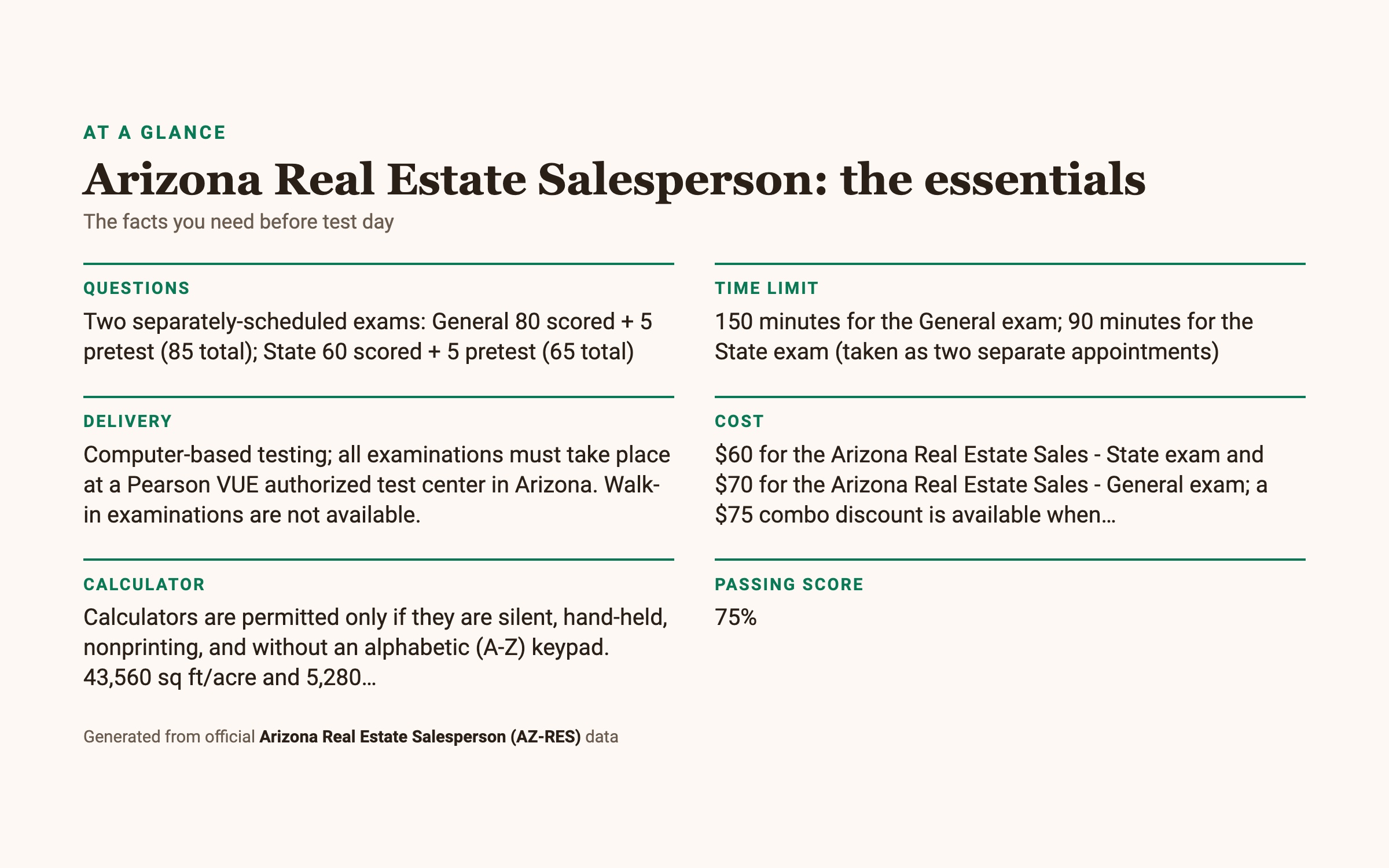
Both papers also carry 5 unscored pretest questions, which Pearson uses to trial items for future exams. They aren't identified, so you can't tell them from the real thing. Nothing is deducted for a wrong answer, so leave nothing blank.
75% is Arizona's number, set by ADRE. Passing scores are set by each state's licensing agency, so if you're also testing elsewhere, check that agency's requirement; this one doesn't carry over. California sets its salesperson pass mark at 70%.
What that means for how you study
Twenty allowed misses on the General paper sounds generous until you price your weak areas against it.
Real Estate Math Calculations is 7 of the 80 scored questions. Write off math and you've spent more than a third of your error budget before you read a question. Financing and Settlement is another 7.
The big blocks work the other way. Real Estate Contracts and Agency is 16 of 80 — one question in five. Get that area to 90% and you've bought room to be mediocre somewhere small.
| General exam area | Questions | Share of your 20 misses if you score 0 |
|---|---|---|
| Real Estate Contracts and Agency | 16 | 80% |
| Real Property Characteristics, Legal Descriptions, and Property Use | 11 | 55% |
| Property Value and Appraisal | 11 | 55% |
| Real Estate Practice | 10 | 50% |
| Forms of Ownership, Transfer, and Recording of Title | 9 | 45% |
| Property Disclosures and Environmental Issues | 9 | 45% |
| Financing and Settlement | 7 | 35% |
| Real Estate Math Calculations | 7 | 35% |
The State paper is flatter, so the same trick doesn't work there. Contracts leads at 8 of 60. Four areas take 6 questions each: Arizona Agency, Reasonable Skill and Care, and two separately weighted licensee-conduct areas. Five more take 5 apiece, and foreclosures, short sales and deeds in lieu take 3 between them. Every area is small, which makes broad coverage of ARS Title 32 and the Commissioner's Rules the reliable route to 45.
Take a full set of practice questions, score it by area, and convert each area's percentage into a predicted number of misses. Multiply your error rate by the real question count, add them up, and compare the total with 20; the biggest predicted-miss area is your next study hour.
Your score report shows you the same per-area percentages afterwards. Don't try to recombine them into an overall mark: the areas hold different numbers of questions, and Pearson's candidate handbook says summing or averaging them doesn't work. They tell you what to study next, nothing more. The weighting is worth doing beforehand, on practice, where the question counts are in front of you.
Aim for 85% in practice, not 75%. Ten points of margin is what absorbs a bad section — the paper where the questions you drilled turn up in a shape you didn't drill — without letting it become a retake.
Common questions
What is the passing score for the AZ-RES exam? 75% of the scored questions — and you need it twice. General and State are separate bookings carrying separate marks, so a strong result on one does nothing for the other.
How many questions do I need to get right? 60 of 80 on the General exam, 45 of 60 on the State exam.
Do the pretest questions count? No. Each paper has 5 unscored pretest items mixed in with the scored ones. They aren't marked, so answer everything.
What happens if I fail one paper? You keep the pass on the other, and rebook only the paper you failed. Wait 24 hours, book it again, and pay the same fee. Both passes need to be in hand within the year before you apply for the license.
Can I see what I got wrong? Not after the first failure. From the second onward you can book a single 30-minute review that walks you through every question you answered incorrectly — within 14 days of that attempt, and before you sit the paper again.
Is 75% the passing score everywhere? No. Each state's licensing agency sets its own. 75% is Arizona's; California requires 70% for its salesperson exam.
Only Ever's practice questions and study guides for this exam are free, including the AI-generated sets other providers paywall. Try the free practice questions and score yourself by area, so you know where your 20 misses are going.