Property Ownership on the Arizona Real Estate Salesperson (AZ-RES): What's Tested and How to Study It
In short
Property Ownership is worth roughly 25 questions across Arizona's two salesperson papers — about one in six of everything you'll be asked, and it all rests on one body of knowledge. It covers what you can own, how it gets described on paper, and what limits sit on it: estates and tenancies, legal descriptions, liens and easements, and Arizona's water rights.
Estates, descriptions, and encumbrances
Everything here starts with one split: real property versus personal property. Real property is the land, everything permanently attached to it, and the bundle of legal rights that comes with it. Personal property is everything movable. A dishwasher in a box is personal property; plumbed into the kitchen it has become a fixture, and it conveys with the house unless the contract says otherwise.
The exam tests that boundary through fact patterns. A tenant's display shelving bolted to a shop wall is a trade fixture and stays the tenant's. Crops still in the ground are emblements. Questions give you a scenario and ask what conveys.

Estates and tenancies
Ownership itself comes in layers. Fee simple absolute is the largest bundle of rights you can hold. A life estate lasts only as long as someone's life. Leasehold estates give possession without ownership: estate for years, periodic estate, estate at will, estate at sufferance. Learn how each one terminates, since that's the distinction questions turn on.
Then there's how many people own it, which is where Arizona diverges from most states. Arizona is a community property state, so property acquired during a marriage is generally owned equally by both spouses regardless of whose name is on the deed. Joint tenancy carries the right of survivorship; tenancy in common doesn't. Community property with right of survivorship combines the two, and you should expect it on the exam.
Common-interest ownership adds another layer — condominiums, planned communities, cooperatives — where you own your unit, share the common areas, and an HOA holds real power over what you can do with it.
Legal descriptions
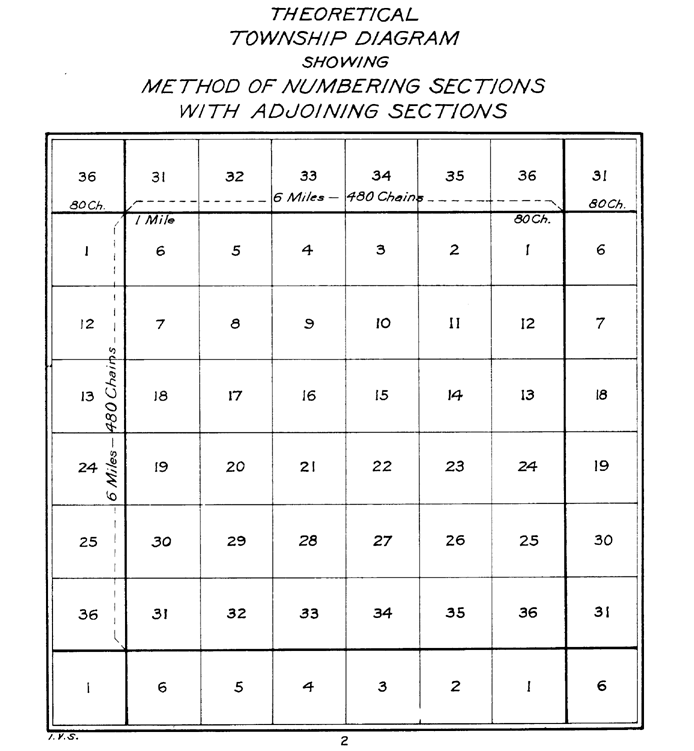
Legal descriptions are how land gets identified in a way a court will accept. Three systems do the job a street address can't. Metes and bounds walks the boundary by direction and distance from a point of beginning and must close back on itself. The rectangular survey system divides land by township and range into 36-section townships, each section a square mile of 640 acres. Lot and block points to a recorded plat — how most Arizona homes are described.
Memorize the measurement facts now, because the test center doesn't provide them.
| Conversion | Value |
|---|---|
| Square feet per acre | 43,560 |
| Feet per mile | 5,280 |
| Acres in a section | 640 |
| Acres in a quarter-section | 160 |
| Acres in a quarter of a quarter | 40 |
Encumbrances, rights, and Arizona water
Encumbrances are claims that ride along with the property without being ownership. Liens are the money kind. The types you'll see are mortgage liens, tax liens, mechanic's liens, and judgment liens, and they sit in a priority order that decides who gets paid in a foreclosure. Property tax liens generally come first, ahead of everything else including a first mortgage.
Easements are the use kind. An easement appurtenant runs with the land and benefits an adjoining parcel, while an easement in gross belongs to a person or company — a utility line is the standard example. An encroachment is a third thing entirely: a structure crossing a boundary line, which a survey will reveal.
Ownership doesn't stop at the surface. You hold surface, subsurface, and air rights, and they can be sold separately — a seller can convey the land while keeping the minerals underneath.
Arizona water law diverges sharply from the rest of the country. Arizona follows prior appropriation for surface water, where the earliest continuous beneficial user holds the senior right, and layers the 1980 Groundwater Management Act on top for groundwater inside Active Management Areas. Developers of subdivided land in an AMA must demonstrate an assured 100-year water supply. The Central Arizona Groundwater Replenishment District exists so those developments can meet that requirement by replenishing groundwater elsewhere.
How it shows up on the exam
Only Ever's curriculum gives Property Ownership 6 study hours across 8 topics. That's how long the material takes to learn properly. It is not a measure of how much the exam asks about it.
Pearson VUE's published outlines show the real shape:
| Where it's tested | Questions |
|---|---|
| General: Real Property Characteristics, Legal Descriptions, and Property Use | 11 of 80 |
| General: Forms of Ownership, Transfer, and Recording of Title | 9 of 80 |
| State: Ownership and Encumbrances | 5 of 60 |
Concentrate on four things. Make the real-versus-personal-property boundary automatic; it shows up as fact patterns, so drill it until you don't have to think. Know the tenancy types and which carry survivorship. Be ready to say what each legal description system is for. Then treat Arizona's community property rules and water law as their own block — those are the questions an out-of-state study guide will not prepare you for.
Cognitive level matters here too. Pearson classifies General-exam items as knowledge, application, or analysis, and the Real Property Characteristics block splits 6 knowledge, 3 application, 2 analysis. Five of its eleven questions go past straight recall, so memorizing definitions alone leaves points on the table.
Common questions
How much of the exam is property ownership? About 25 questions across both papers — roughly one in six of everything you'll be asked, spread over three separate outline areas.
Is Arizona a community property state? Yes. Property acquired during a marriage is generally owned equally by both spouses, whatever the deed says. Arizona also recognizes community property with right of survivorship.
What's the difference between an easement appurtenant and an easement in gross? An appurtenant easement benefits a neighboring parcel and transfers with the land automatically, so a new owner inherits it without signing anything. An easement in gross belongs to a person or company instead, and it does not pass to whoever buys the land next.
Do I need to memorize the measurement conversions? Yes. 43,560 square feet per acre and 5,280 feet per mile are not provided at the test center.
What is the CAGRD? The Central Arizona Groundwater Replenishment District. It lets developments inside Active Management Areas meet Arizona's assured 100-year water supply requirement by replenishing groundwater elsewhere.
Only Ever's guides and practice questions for this exam are free, including the AI-generated question sets other providers charge for. Try the free practice questions and start with the Arizona water and community-property items, which is where a national study guide will leave you short.