California Life & Health Insurance License (CA-LH) Format & Logistics: What to Expect on Test Day
In short
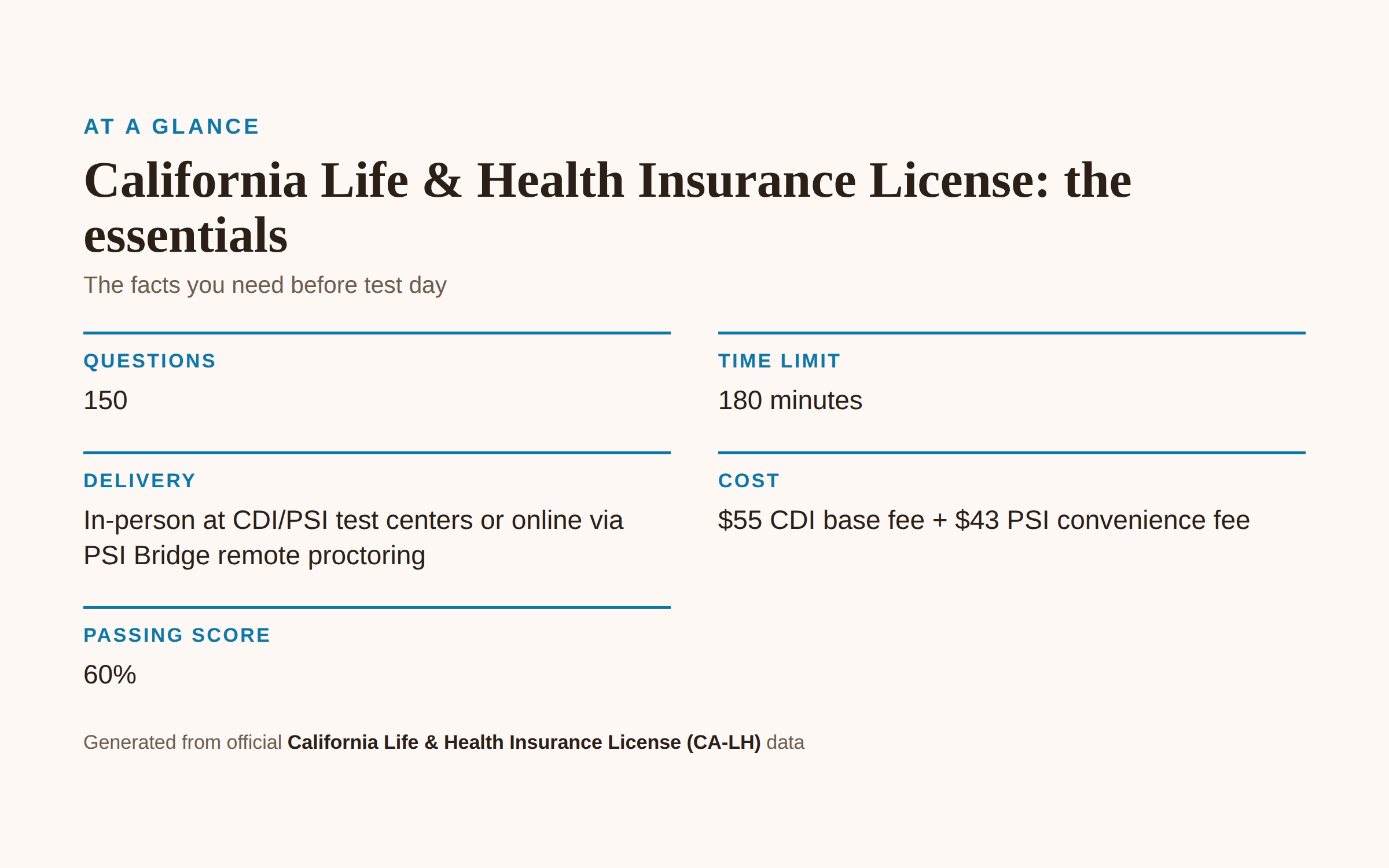
The CA-LH exam is 150 multiple-choice questions with 180 minutes on the clock — about 72 seconds per question. You can sit it in person at a CDI or PSI test center, or from home through PSI Bridge remote proctoring. California's pass mark is 60%, which works out to 90 correct answers. Budget $98 in fees.
The format at a glance
Every item on the California Life & Health Insurance License exam is multiple choice. No other question type appears on the paper — 150 questions, one format, first screen to last.
The clock gives you 180 minutes. Divide that evenly across 150 questions and each one gets 72 seconds. That is the raw average, and it leaves you nothing in hand.
So work to a flat minute a question. All 150 answered inside 150 minutes, and 30 minutes of margin left at the end. The rhythm:
Read the stem and decide what it is asking →
rule out the options you can dismiss quickly →
pick between what is left and move on →
hold the 30 banked minutes as margin.
Your checkpoint is question 90 at the 90-minute mark. Short of it, that half-hour is already going toward finishing the paper, so tighten up on the early questions before it is gone.
The content splits two ways, and knowing which half you are in changes how you study it. The general knowledge portion is nationally uniform, built on model law from the National Association of Insurance Commissioners. The NAIC writes legislation that many states adopt, so those questions look the same wherever you sit them. General Insurance Regulation is the opposite case: written around California's own insurance code, and the single largest block on the exam at 25%.
A quarter of 150 questions is about 38 items. Here is how the whole paper divides up:
| Section | Share | Questions (of 150) |
|---|---|---|
| General Insurance Regulation | 25.0% | ~38 |
| Policy Riders, Provisions, Options, and Exclusions | 12.5% | ~19 |
| Other Health Insurance Concepts | 12.5% | ~19 |
| Types of Policies | 8.3% | ~12 |
| Completing the Application, Underwriting, and Delivering the Policy | 8.3% | ~12 |
| Retirement and Other Insurance Concepts | 8.3% | ~12 |
| Types of Accident & Health Policies | 8.3% | ~12 |
| Health Policy Provisions, Clauses, and Riders | 8.3% | ~12 |
| Social Insurance | 4.2% | ~6 |
| Field Underwriting Procedures | 4.2% | ~6 |
Those counts are each rounded off a section weight, which is why the column lands a little short of 150. Treat them as shares of the paper.
One thing we cannot tell you is the calculator policy — that field is blank in our exam data for CA-LH. The official CDI exam info page is the authority on what you may carry in, and it is worth a look before you book.
What test day looks like
You can take this exam in-person at CDI or PSI test centers, or online from home via PSI Bridge remote proctoring. Same 150 questions either way.
The fees come in two pieces: a 43 PSI convenience fee, $98 in total. That covers the exam itself. The California Department of Insurance runs it, and you have to clear it before the state will license you as a life and health producer.
If you sit the exam through PSI, it reaches you as a computer-based test, so get familiar with that interface beforehand. Reading a question on a screen and clicking an answer is a different motion from working down a printed page. Work through a few timed sets on screen and the interface stops costing you attention.
The pass mark in California is 60%. On 150 questions that is 90 correct, so you can miss 60 and still pass. Those 60 misses are one budget stretched across the whole paper. Get nothing right in the 38-question General Insurance Regulation block and you have spent 38 of them before anything else is counted.
One caution if California is not your only state. The passing score is set by each state's insurance department, and you must verify the exact figure with the one you are licensing under. Many of them require 70%, and on a 150-question paper that is 105 correct — fifteen more than California asks of you.
The heaviest sections are the ones worth a timed run before you book. Standard policy provisions sits inside Policy Riders, Provisions, Options, and Exclusions, at 12.5% one of the two largest blocks after General Insurance Regulation. Annuities sits in Types of Policies, at 8.3%. Score a full practice set section by section and you can see where your 60 misses are currently going.
Common questions
How many questions does the CA-LH exam have? 150, every one of them multiple choice. The paper mixes general insurance concepts with California's own regulations.
How much time do you get? 180 minutes. Across 150 questions, that is 72 seconds each on the raw average.
What is the passing score? California asks for 60% — 90 of the 150 questions. Other states set their own figure and many of them sit at 70%, so verify yours with the Department of Insurance you are licensing under.
What does the exam cost? 55 CDI base fee and a $43 PSI convenience fee.
Where can you take it? At a CDI or PSI test center, or from home under PSI Bridge remote proctoring.
How long should you study? Plan against roughly 60 hours. A quarter of the exam is General Insurance Regulation, so California-specific law deserves a large slice of that time.
Sixty hours goes down easier in fifteen-minute pieces. That is how Only Ever cuts the official syllabus up: 15-minute topics, weighted to match what the state tests, so the General Insurance Regulation block gets the share its 25% earns. Only Ever's practice questions and study guides for this exam are free, AI-generated sets included. Try the free practice questions and score yourself by section before you pay the $98.