A 9-Week California Life & Health Insurance License (CA-LH) Study Plan That Fits a Real Schedule
In short
Budget about 60 hours. This plan spends them over nine weeks: 7.5 hours a week for the first six, then five a week for the last three. Those last three go entirely to General Insurance Regulation, which carries 25% of the syllabus on its own. The exam is 150 multiple-choice questions in 180 minutes.
How long the prep takes
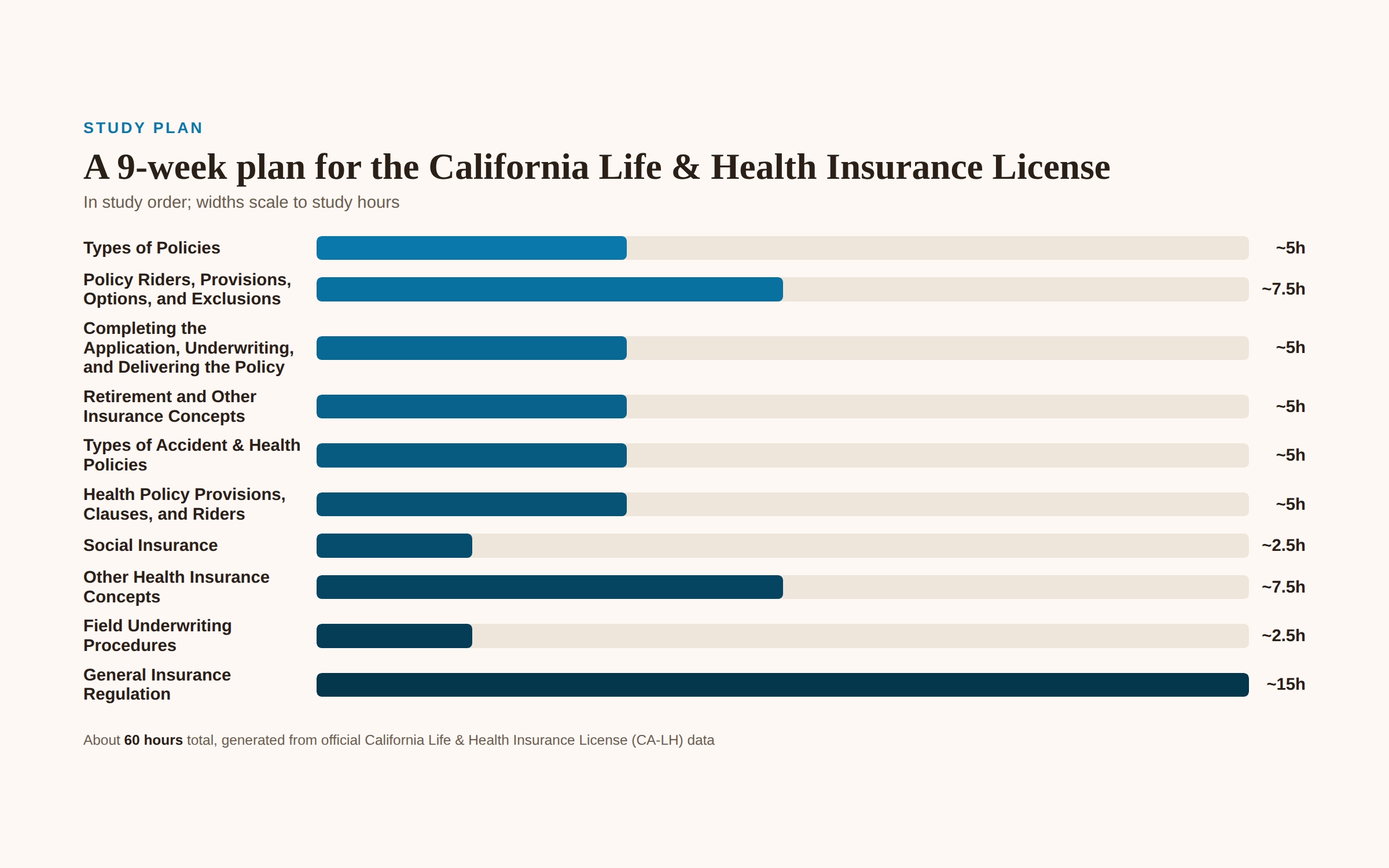
Sixty hours is the working estimate for the California Life & Health Insurance License (CA-LH) syllabus, and it is the number this plan spends. Here is where it goes.
| Domain | Share of the syllabus | Hours | Topics |
|---|---|---|---|
| Types of Policies | 8.3% | 5 | 5 |
| Policy Riders, Provisions, Options, and Exclusions | 12.5% | 7.5 | 5 |
| Completing the Application, Underwriting, and Delivering the Policy | 8.3% | 5 | 4 |
| Retirement and Other Insurance Concepts | 8.3% | 5 | 5 |
| Types of Accident & Health Policies | 8.3% | 5 | 5 |
| Health Policy Provisions, Clauses, and Riders | 8.3% | 5 | 3 |
| Social Insurance | 4.2% | 2.5 | 2 |
| Other Health Insurance Concepts | 12.5% | 7.5 | 4 |
| Field Underwriting Procedures | 4.2% | 2.5 | 1 |
| General Insurance Regulation | 25.0% | 15 | 11 |
That is 60 hours across 45 topics. (The shares are rounded to one decimal, so the column adds to 99.9 rather than a clean 100.)
Sixty hours over a hundred points of syllabus is 0.6 hours — 36 minutes — for every percentage point. Every domain is funded at close to that rate, once you allow for the rounding in the weights. General Insurance Regulation's 25% buys it 15 hours. Social Insurance, at 4.2%, gets 2.5 hours where the rate would say 2.52. The hours here follow syllabus weight. The last section covers how to adjust for your own weak areas.
California's pass mark is 60%, so you need 90 of the 150 questions right and you can afford to miss 60. The clock gives you 180 minutes for the paper, which works out at 1.2 minutes — 72 seconds — a question if you spend it evenly. That pass mark is California's own. Every state sets its own requirement, and several sit at 70%. If you are licensing elsewhere, confirm the number with that state's Department of Insurance before you plan anything.
Week by week
The six-then-three split follows the material. The general knowledge content on this exam is nationally uniform, built on the model laws the NAIC writes and many states adopt. General Insurance Regulation is the section heavily customized to California's own laws. The two behave differently under revision: the uniform concepts build on each other and reward early study, while the California code is recall that fades, so it sits closest to your exam date.
| Week | Hours | Running total | What you cover |
|---|---|---|---|
| 1 | 7.5 | 7.5 | Types of Policies (5h), then the opening 2.5h of Policy Riders, Provisions, Options, and Exclusions |
| 2 | 7.5 | 15 | Finish Policy Riders (5h); open Completing the Application, Underwriting, and Delivering the Policy (2.5h) |
| 3 | 7.5 | 22.5 | Finish the application block (2.5h); Retirement and Other Insurance Concepts (5h) |
| 4 | 7.5 | 30 | Types of Accident & Health Policies (5h); open Health Policy Provisions, Clauses, and Riders (2.5h) |
| 5 | 7.5 | 37.5 | Finish health provisions (2.5h); Social Insurance (2.5h); open Other Health Insurance Concepts (2.5h) |
| 6 | 7.5 | 45 | Finish Other Health Insurance Concepts (5h); Field Underwriting Procedures (2.5h) |
| 7 | 5 | 50 | General Insurance Regulation: The Insurance Regulatory System; Producer Licensing and Responsibilities; Marketing, Sales Practices, and Unfair Trade; Privacy, Fraud, and Federal Compliance; Federal Health Law and Guaranty Associations |
| 8 | 5 | 55 | General Insurance Regulation: California Insurance Code & Department of Insurance; California Producer Licensing, Appointment & Continuing Education; California Marketing, Replacement & Suitability Rules |
| 9 | 5 | 60 | General Insurance Regulation: California Unfair Trade Practices & Claims Settlement; California Life & Health Insurance Guaranty Association; California Health Insurance Mandates & Continuation of Coverage |
Weeks 1 to 3, the life side
Week 1 is product anatomy. You are separating term cover from permanent. Then permanent splits again, into traditional whole life and the interest-sensitive and adjustable contracts the syllabus groups beside it, universal and variable life among them. Annuities sit in the same block. They carry two sets of rules, because the accumulation period and the payout period work differently and you need both. Close the week when you can say what separates traditional whole life from a flexible policy like universal life. Then describe an annuity's two phases without looking.
Weeks 2 and 3 move from what a policy is to what its paperwork says. Policy Riders, Provisions, Options, and Exclusions is worth 12.5% of the syllabus, so it gets 7.5 hours where half the domains on the list get five. It covers standard provisions alongside nonforfeiture options, dividends and loans, and the riders that sit on top. The incontestability clause and the free look period are provisions. Waiver of premium and accidental death benefit are riders. The nonforfeiture options are a third list again, and keeping the three apart is much of the work here. Week 2 then opens the application block, where contract law lives — a warranty and a representation are different kinds of promise, and you should be able to say how. Week 3 finishes that block and spends five hours on Retirement and Other Insurance Concepts: buy-sell funding, qualified and nonqualified plans, and the tax treatment of premiums and proceeds.
Weeks 4 to 6, the health side
Plan architecture comes next, in week 4: individual disability income next to group cover, and the managed-care shapes — HMO, PPO, and the high-deductible plans that pair with a health savings account. Week 5 handles the provisions layer, taking the mandatory uniform provisions first, the optional ones second, then rights of renewability. It also folds in Social Insurance, which is small at 4.2% and almost entirely recall. Medicare has four parts, A through D, and you are expected to match each one to what it covers. Medicaid eligibility runs on income; Medicare's runs on age or disability. The last 2.5 hours of week 5 open Other Health Insurance Concepts, and week 6 finishes it.
The densest of the health weeks is the sixth. Other Health Insurance Concepts is 12.5% of the syllabus across four topics: disability definitions and classifications, where you have to keep total, partial, residual and recurrent apart; ownership, beneficiaries and premium modes; coordination of benefits and occupational coverage; and managed care, subrogation and tax treatment. Field Underwriting Procedures closes the week with a single topic and 2.5 hours — what a producer does with an incomplete application, and the rules on collecting the initial premium. Close the health weeks when you can name three mandatory uniform provisions from memory, separate residual disability from partial, and say what coordination of benefits is there to do.
Weeks 7 to 9, the regulation block
Fifteen hours and 11 topics, the largest domain on both counts. Week 7 stays on the general layer: the regulatory system, producer licensing, marketing and unfair trade practices, privacy and fraud, and federal health law. Weeks 8 and 9 are California's own, and the table above lists what falls in each. This is statute, so it is recall work, and repetition is what moves it.
Finish week 9 able to define twisting and churning the way the California Insurance Code defines them. State the continuing education and renewal requirements for a California producer. Then say what the Guaranty Association covers and which products it excludes.
The loop inside each week is the same one every time:
Read the topics in that week's block →
work the practice questions attached to them →
write down every question you missed and every one you guessed right →
spend the tail of the week's hours on that list alone.
Track the guesses as carefully as the misses, because a lucky answer in week 2 is still an unlearned topic in week 9.
If you have less time (or more)
Nine weeks is one way to spend the 60 hours, and compressing the plan means dividing the same total across fewer weeks. Split those 60 hours evenly, and the arithmetic is:
| Weeks available | Hours per week, split evenly |
|---|---|
| 4 | 15 |
| 6 | 10 |
| 9 | 6.7 |
| 12 | 5 |
The nine-week row is the even-split version. This plan front-loads: 7.5 hours for six weeks, then five for three, which keeps the regulation block last and fresh.
Four weeks at 15 hours is a little over two hours a day, every day, which is a real commitment on top of a job. Twelve weeks at five hours sits more easily around full-time work. Nine is the default here because it holds the heaviest week to 7.5 hours and still leaves regulation until the end.
What does not compress is General Insurance Regulation. It is a quarter of the syllabus and 11 of the 45 topics. If you have to cut, take it out of the weeks covering the uniform material. Those 15 hours stay whole.
Going the other way, extra time is worth most on whatever your practice questions keep catching. Score by domain, find the two lowest, and give them the extra hours.
Two scheduling items go on the calendar. Decide early whether you are testing in person at a CDI or PSI test center or from home through PSI Bridge remote proctoring. And if you are testing through PSI, spend part of week 9 with the computer-based testing interface itself, so the format is familiar before the 180 minutes start.
Common questions
How many questions does the California Life & Health Insurance exam have? 150, all multiple choice, covering the general insurance concepts and the California-specific regulation together in one paper.
How much time do I get? 180 minutes for all 150 questions — 72 seconds each at an even pace.
What is the passing score for the CA-LH exam? 60% in California. Required passing scores are set state by state, and several states sit at 70% instead, so verify the figure with the Department of Insurance for whichever state you are licensing in.
What does the exam cost? Generally 55 to the CDI as the base fee, and $43 more for the PSI convenience fee. Check the current figures on the Official CDI Exam Info & Syllabus page before you book.
Where can I take it? In person at a CDI or PSI test center, or from home online through PSI Bridge remote proctoring.
How many hours should I plan for the California Life and Health exam? Around 60 in total. General Insurance Regulation alone is 25% of the exam, so plan for California's own laws to take a serious share of that.
Only Ever's practice questions and study guides for the CA-LH exam are free, including the AI-generated sets other providers keep behind a paywall. Try the free practice questions and score yourself domain by domain, so you know which of these nine weeks needs to be two.