California Property & Casualty (CA-PC) Format & Logistics: What to Expect on Test Day
In short
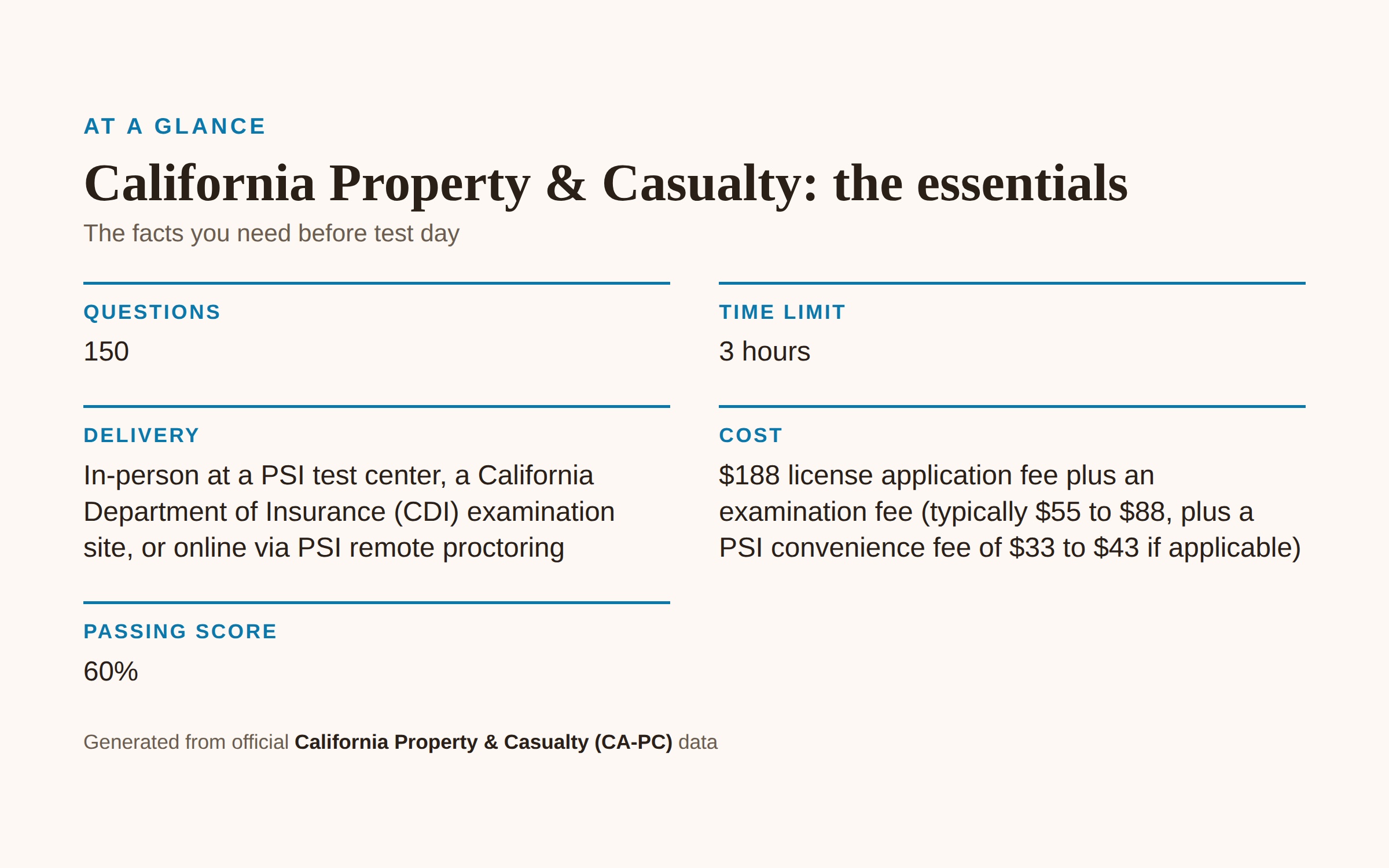
The CA-PC exam is 150 multiple-choice questions with 3 hours on the clock. You can sit it in person at a PSI test center, at one of the California Department of Insurance's own examination sites, or from home under PSI remote proctoring. The pass mark is 60%, which is 90 correct answers. Fees start at $243 with the license application included.
The format at a glance
Every item on this paper is multiple choice, and there are 150 of them. No written answers, and no second question type waiting halfway through.
The clock gives you 3 hours. Divided across 150 questions, that is 72 seconds each — the average you are pacing against all day.
The harder feature of this exam is its two layers. The question bank starts from a nationally uniform core built on model law from the National Association of Insurance Commissioners (NAIC). California's own insurance code and regulations are layered on top of that core.
Most of the regulatory material, national and Californian both, is gathered into one section. Part VII: General Insurance Regulation (Nationally-Uniform Framework) is the heaviest section on the exam at 27.3%, or roughly 41 of the 150 questions.
| Section | Weight | Questions (of 150) | Study hours |
|---|---|---|---|
| Part VII: General Insurance Regulation (Nationally-Uniform Framework) | 27.3% | ~41 | 16 |
| Part A: Property Insurance - Types of Policies | 13.6% | ~20 | 8 |
| Part A: Property Insurance - Terms and Related Concepts | 13.6% | ~20 | 8 |
| Part A: Property Insurance - Policy Provisions and Contract Law | 13.6% | ~20 | 8 |
| Part B: Casualty Insurance - Types of Policies, Bonds, and Related Terms | 13.6% | ~20 | 8 |
| Part B: Casualty Insurance - Terms and Related Concepts | 9.1% | ~14 | 6 |
| Part B: Casualty Insurance - Policy Provisions | 9.1% | ~14 | 6 |
Each figure in the question column is a weight rounded to a whole number, which is why the column adds to 149 instead of 150. Treat them as shares of the paper.
Six of Part VII's fourteen objectives are named for California, and that is the state layer. Three are bodies of law: the Insurance Code and the Department of Insurance itself, California automobile insurance laws, and California property insurance laws with the residual markets. Three are conduct and administration: producer licensing and continuing education, unfair trade practices and claims settlement, and the guaranty association alongside workers' compensation. Those six are on the paper because you are testing in California, and nothing in the national core covers them.
The study-hours column totals 60, which is the full prep estimate for this exam, and 16 of those hours sit on Part VII. That is 26.7% of the plan against the 27.3% of the paper Part VII carries. The plan is already proportioned to the exam, so the split is one less thing to work out.
One field we cannot fill in for you is the calculator policy, which is blank in our exam data for CA-PC. The CDI License Examination Objectives page is the authority on what may come into the room with you. Check it while you are booking.
What test day looks like
There are three ways to take the California Property & Casualty exam. A PSI test center. An examination site run by the California Department of Insurance. Or your own desk, through PSI remote proctoring.
The money arrives in three pieces. The license application is 55 to 33 to 243 at the low end and $319 at the high end, before a single study resource.
Sixty percent passes, so 90 of the 150 have to be right. That leaves 60 you can afford to lose across three hours. Hold it as a running budget.
Pace the paper in three equal blocks:
Look at the clock at question 50, where you want to be near the one-hour mark →
look again at question 100, near two hours →
the last 50 questions then have a clear hour, plus whatever you saved earlier.
California's 60% does not travel. Every state's insurance department sets its own requirement for property and casualty licensure, and many sit higher, at 70%. If you are licensing anywhere else as well, get that figure from the agency itself.
Part A is where the syllabus is most explicit about the work. Homeowners policies and commercial package and property both live in Part A's types-of-policies section, 13.6% of the exam. That is the HO-2 through HO-8 forms, DP-1 through DP-3, and the Commercial Package Policy, and you are asked to tell them apart by which perils each form covers.
Insurance risk and insurable interest opens the terms section, another 13.6%. The syllabus points you at flashcards for this one: pure risk against speculative risk, indemnity, subrogation, proximate cause, and the three hazards — moral, morale, physical.
Common questions
How many questions are on the California P&C exam? 150, all multiple choice, splitting national property and casualty material with California's own regulations.
How long do you get? 3 hours for the whole paper, which averages 72 seconds a question.
What is the passing score? 60% in California, so 90 of the 150. Other states set their own figure and many require 70%, so confirm it with the department of insurance you are licensing under.
Where can you take it? Three places: a PSI test center, a California Department of Insurance examination site, or your own home under PSI remote proctoring.
What does it cost? The license application is 55 to 33 to $43 applies in some cases.
How long should you study? Around 60 hours, with the largest share going to Part VII.
Those 60 hours cover 50 topics across the seven sections, and 14 of the 50 sit inside Part VII alone. Each of those 50 is a 15-minute topic in Only Ever, short enough to finish one on a break. The practice questions and study guides here are free, generated question sets included — the part other providers put behind a paywall. Try the free practice questions, take the Part VII topics first, and you will know where you stand before the $188 leaves your account.