What's a Passing Score on the California Property & Casualty (CA-PC)? (And How to Get There)
In short
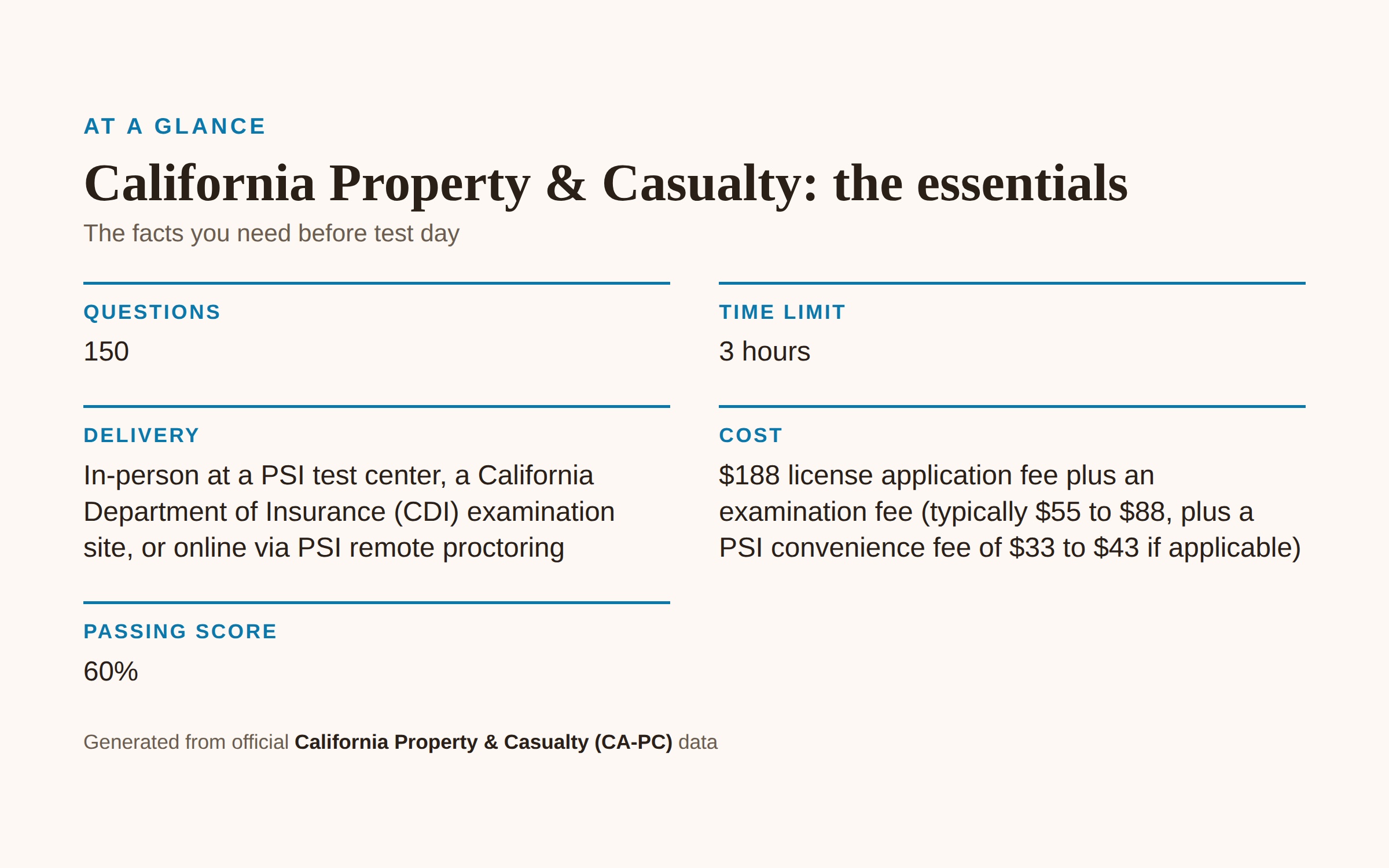
Sixty percent. The exam runs 150 multiple-choice questions in 3 hours, so the bar works out to 90 right and 60 misses to spend. That is a state licensure standard, and it is California's alone. Other states set their own and many ask for 70%, so if you are licensing elsewhere, get the figure from that state's department of insurance.
The passing score
Sixty percent of 150 questions is 90 correct answers, which leaves 60 you can get wrong. It is a state licensure exam, and the passing score is set strictly at 60%.
The CA-PC exam page covers both halves of what you will be tested on — the nationally uniform material drawn from NAIC model law, and California's own insurance laws and regulations layered over it.
That 60% belongs to California and carries nowhere else. Passing standards differ from one state to the next, 70% being a common requirement elsewhere, so anyone licensing outside California should verify the number with that state's department of insurance or certification agency.
Three hours across 150 questions works out to 72 seconds each. Read the stem, answer, move on — there is not much room left for a second pass over 150 items.
What that means for how you study
One section is slightly more than twice the weight of any other, and it decides where the hours go. General Insurance Regulation is 27.3% of the paper, roughly 41 of the 150 questions, against 13.6% for the largest of the rest.
The shares and hours below are Only Ever's mapping of the syllabus; California's own License Examination Objectives are the official word on what is examinable.
| Exam section | Share | ≈ Questions of 150 | Hours budgeted |
|---|---|---|---|
| Part VII: General Insurance Regulation (Nationally-Uniform Framework) | 27.3% | 41 | 16 |
| Part A: Property Insurance - Types of Policies | 13.6% | 20 | 8 |
| Part A: Property Insurance - Terms and Related Concepts | 13.6% | 20 | 8 |
| Part A: Property Insurance - Policy Provisions and Contract Law | 13.6% | 20 | 8 |
| Part B: Casualty Insurance - Types of Policies, Bonds, and Related Terms | 13.6% | 20 | 8 |
| Part B: Casualty Insurance - Terms and Related Concepts | 9.1% | 14 | 6 |
| Part B: Casualty Insurance - Policy Provisions | 9.1% | 14 | 6 |
The shares are percentages, so the question counts round — expect one either side of each figure.
Skip the regulation section and you have spent 41 of your 60 allowed misses before you sit down. The 19 that remain have to cover the other 109 questions, which is 83% on all of them.
Run the same numbers forward and the section pays you back. Score 90% on those 41 regulation questions and you bank 37 marks, so you need 53 more from the remaining 109 — under half of them.
Part VII is 14 topics and 16 of the 60 budgeted hours. It pairs each national rule with its California counterpart: the NAIC framework, producer licensing and the federal privacy rules, then the California Insurance Code, the state's automobile and property insurance laws, and California's own unfair-trade-practice and claims-settlement rules. The study guidance for all of it is memorization.
The property and casualty sections come with instructions of their own. Homeowners forms HO-2 through HO-8 sit against dwelling forms DP-1, DP-2 and DP-3, and the property policy types reward knowing which perils fall into the basic, broad and special tiers. On the casualty side the syllabus singles out one concept to master: occurrence versus claims-made coverage triggers, and how a retroactive date applies. That section is 3 topics, 6 hours and about 14 questions.
Sixty hours is what the plan budgets across its 50 topics. Over 9 weeks that comes to 6 hours 40 minutes a week — two weekday evenings and a Saturday morning.
Measure the weak sections instead of guessing at them. Only Ever's practice questions and study guides for this exam are free, including the AI-generated sets.
Take a full set of free practice questions →
group every wrong answer by the section it came from →
multiply each section's error rate by its real question count →
add the predicted misses up and compare the total against 60.
Whichever section contributes the most predicted misses is where your next study hour goes. Aim for 75% in practice; fifteen points of margin absorbs one bad section on the day.
Common questions
What's the passing score on the CA-PC exam? 60%, which on a 150-question paper means 90 correct answers.
How many questions are on the California P&C exam? 150, all multiple choice. They span the national property and casualty material and California's own insurance regulation.
How long do I get? 3 hours. Evenly spread, that is 72 seconds a question.
Is 60% the passing score everywhere? No. Each state's licensing agency sets its own standard and 70% is common, so confirm the number with the department of insurance where you are licensing.
How long should I study for it? About 60 hours. Put 16 of them into General Insurance Regulation, which is over 27% of the paper on its own, and spread the remaining 44 across the six property and casualty sections.
Where do I take it? Three ways: a PSI test center, one of the CDI's own examination sites, or remote proctoring through PSI.
What does it cost? Two charges, and a third where it applies. The license application is 55 to 33 to 243 at the low end and $319 at the top.
Try the free practice questions, sort your wrong answers by section, and use the result to decide where the last week goes. A 60% pass mark leaves room to finish with some of the 50 topics half-learned, as long as the 41-question regulation section is not one of them.