A 9-Week California Property & Casualty (CA-PC) Study Plan That Fits a Real Schedule
In short
Sixty hours over nine weeks. Six of those weeks take one syllabus domain each, six to eight hours a week, and the last three go to General Insurance Regulation, which is 27.3% of the exam on its own. The paper is 150 multiple-choice questions in three hours, and 60% passes.
How long the prep takes
Sixty hours is the working estimate for the California Property & Casualty (CA-PC) syllabus. It covers seven domains and 50 topics, and this is where the hours go.
| Domain | Share of the syllabus | Hours | Topics | Questions, roughly |
|---|---|---|---|---|
| Part A: Property Insurance - Types of Policies | 13.6% | 8 | 7 | 20 |
| Part A: Property Insurance - Terms and Related Concepts | 13.6% | 8 | 8 | 20 |
| Part A: Property Insurance - Policy Provisions and Contract Law | 13.6% | 8 | 7 | 20 |
| Part B: Casualty Insurance - Types of Policies, Bonds, and Related Terms | 13.6% | 8 | 7 | 20 |
| Part B: Casualty Insurance - Terms and Related Concepts | 9.1% | 6 | 3 | 14 |
| Part B: Casualty Insurance - Policy Provisions | 9.1% | 6 | 4 | 14 |
| Part VII: General Insurance Regulation (Nationally-Uniform Framework) | 27.3% | 16 | 14 | 41 |
The last column is each share applied to a 150-question paper, so treat it as a planning figure: 13.6% works out at about 20 questions, 9.1% at about 14, and regulation's 27.3% at about 41. (The weights are rounded to one decimal and total 99.9, which is also why the question column adds to 149.)
Collapse those seven rows into the three parts they belong to and the exam gets easier to hold in your head. Property takes 24 hours and about 60 questions. Casualty is 20 hours for about 48. Regulation is 16 hours for about 41, all of it inside one domain. That part alone is about 41 questions, against a total allowance of 60 misses.
That allowance comes from the pass mark. 60% of 150 is 90 correct answers, so you can miss 60 and still walk out licensed. Three hours across 150 questions leaves 1.2 minutes for each one at an even pace.
Two rows in the table are worth more attention than their size suggests. Casualty Terms and Related Concepts carries only 3 topics and gets 6 hours, which is two hours per topic and the heaviest ratio on the syllabus. Negligence, damages, and the difference between an occurrence trigger and a claims-made trigger take that long because each one has to be applied to a situation before it counts as learned. The 8 topics in Property Terms get an hour each, because most of that domain is definitions you can drill.
That 60% is California's own. Passing standards for property and casualty licensure are set state by state and many other states require 70%, so if you are testing elsewhere, confirm the number with that state's department of insurance before you plan around it.
Week by week
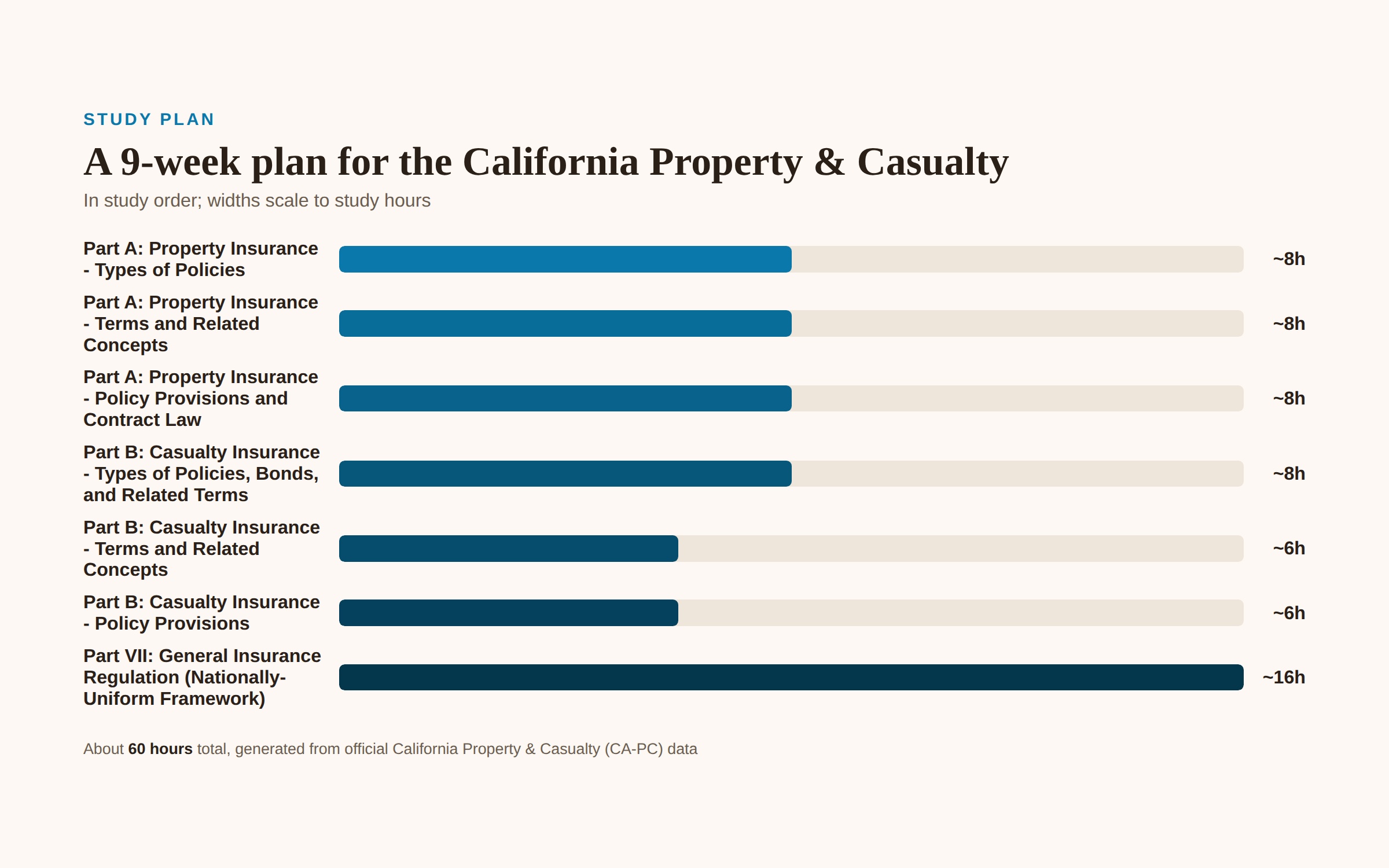
The plan gives each of the first six domains its own week, then splits regulation's 16 hours across the final three. Weeks run 8, 8, 8, 8, 6, 6, 5.5, 5.5 and 5 hours. That averages 6.7 a week, and it front-loads the longer weeks while your study habit is new.
| Week | Hours | Running total | What you cover |
|---|---|---|---|
| 1 | 8 | 8 | Part A: Property Insurance - Types of Policies |
| 2 | 8 | 16 | Part A: Property Insurance - Terms and Related Concepts |
| 3 | 8 | 24 | Part A: Property Insurance - Policy Provisions and Contract Law |
| 4 | 8 | 32 | Part B: Casualty Insurance - Types of Policies, Bonds, and Related Terms |
| 5 | 6 | 38 | Part B: Casualty Insurance - Terms and Related Concepts |
| 6 | 6 | 44 | Part B: Casualty Insurance - Policy Provisions |
| 7 | 5.5 | 49.5 | Part VII, the nationally uniform layer — 8 topics, from the regulatory system and the NAIC's role through to guaranty associations and the workers compensation framework |
| 8 | 5.5 | 55 | Part VII, California — the Insurance Code and the Department of Insurance, producer licensing and continuing education, automobile insurance laws |
| 9 | 5 | 60 | Part VII, California — property insurance laws and residual markets, unfair trade practices and claims settlement, the P&C Guaranty Association and workers compensation |
Weeks 1 to 3, the property side
The Homeowners forms run HO-2 through HO-8 and the Dwelling policies run DP-1 through DP-3, and week 1 is mostly about telling them apart. You need to know which perils fall under the basic, broad and special coverage tiers, so start with the Homeowners forms. Then work through the Commercial Package Policy and its components, and the Business Owners Policy with builders risk and cyber. Inland marine, the National Flood Insurance Program and the other property policies close out the domain's seven topics. Finish the week able to state the coverage difference between an HO-3 and an HO-5 without looking it up, and to name the components of a CPP.
Week 2 is vocabulary, and it pays interest everywhere else. Eight topics in eight hours covers risk and insurable interest, hazards and perils, loss valuation, proximate cause and deductibles, limits of liability and coinsurance, the cancellation and vacancy provisions, liability and negligence, and binders and endorsements. Two clusters of that list repay flashcards. The first is the hazard trio, where moral describes a character flaw, morale describes carelessness, and physical describes a tangible feature of the property or operation. The second is loss valuation, where actual cash value and replacement cost settle the same loss at different figures. Coinsurance is the one to practice with a calculator in hand.
Week 3 turns to the contract itself. Memorize what sits in each of the four parts of a policy: the Declarations, the Insuring Agreement, the Conditions and the Exclusions. That structure opens the provisions domain, and it comes back in week 6. The rest of the week covers who counts as an insured, mortgagee rights, proof of loss and notice of claim, and appraisal and subrogation. Then come the elements that form a valid contract, warranties and concealment, and a federal layer on top: FCRA, Gramm-Leach-Bliley and TRIA. Ask yourself what appears on the declarations page and nowhere else. A clean answer means the week landed.
Weeks 4 to 6, where the syllabus starts repeating
Casualty products fill week 4, the second and last of the product weeks. Commercial General Liability and the Business Auto form open the week. Around them sit workers compensation and employers liability, the liability section of a Business Owners Policy, and professional, umbrella and excess cover. Crime and equipment breakdown close the domain out. Bonds sit oddly beside all that liability material and are easy to leave until last, which is a mistake worth avoiding: fidelity bonds and surety bonds are structured differently, and a surety bond has three distinct parties to it.
Three topics, six hours. Week 5 has the thinnest topic list on the syllabus and the most time per topic, and the ratio is deliberate. Negligence, legal liability and damages is a framework you have to apply to a fact pattern, and you learn it by working examples. Coverage triggers are the concept to master in this domain. An occurrence policy responds to when the injury happened and a claims-made policy responds to when the claim was made, and how retroactive dates apply sits in the same topic.
Week 6 is lighter than its six hours suggest. Every one of the four topics in Casualty Policy Provisions has a near twin in the property provisions you studied in week 3: the same four-part policy structure, the same definition-of-the-insured and duties-after-a-loss material, the same proof of loss and notice of claim and appraisal, the same subrogation and other-insurance clauses. Most of the week is therefore revision. The new material is narrow — what changes once the loss is an injury to somebody else, and how the provisions handle it.
The same effect reaches back one week. Week 5's negligence topic revisits the liability concepts from week 2, and its binders and endorsements topic revisits week 2's binders and endorsements. Study the casualty weeks by asking what has changed, and they move faster than their hour counts suggest.
Weeks 7 to 9, the regulation block
Sixteen hours and 14 topics, all inside one domain worth 27.3% of the exam. Regulation gets 16 of your 60 study hours, which is 26.7% of your time for 27.3% of the paper. It sits at the end because it leans on material you cover in weeks 3 and 4, so studying it earlier would mean learning the same ground twice.
Week 7 takes the eight nationally uniform topics, built on the NAIC model laws that many states adopt. Five and a half hours across eight topics is quick, and it can be, because several of them cover ground you have already crossed from another angle. Privacy and federal compliance revisits the FCRA and Gramm-Leach-Bliley material from week 3. The workers compensation framework revisits week 4.
Weeks 8 and 9 are California's own law and there is no shortcut in them. Week 8 takes the Insurance Code and the Department of Insurance, producer licensing with appointment and continuing education, and automobile insurance laws. Week 9 takes property insurance laws and residual markets, unfair trade practices and claims settlement, and the P&C Guaranty Association alongside workers compensation. Six topics, 10.5 hours. Finish week 9 able to say what rebating, misrepresentation and defamation mean under California's unfair trade practices rules, and to state the continuing education and renewal requirements for a California producer.
Inside every week, the loop is the same:
Read that week's topics →
work the practice questions attached to them →
write down every question you missed and every one you guessed correctly →
spend the last quarter of the week's hours on that list alone.
Log the lucky guesses as carefully as the misses. A guessed answer in week 2 is still an unlearned topic in week 9.
If you have less time (or more)
Nine weeks is one way to spend 60 hours. Compress it and the arithmetic is simple: six weeks means 10 hours a week, twelve weeks means 5. Four weeks would mean 15 a week, a little over two hours every day on top of a job, which is where the plan stops fitting a real schedule.
When the total comes down, the question is which hours you protect. Three blocks earn theirs outright.
Regulation keeps all 16. It is the largest domain on the syllabus by weight, by topic count and by hours, and no other row can absorb a cut that size.
Property Terms and Related Concepts keeps all 8. It is the vocabulary the other six domains are written in, and trimming it makes them harder.
The other block worth defending is week 4. Its domain is worth about 20 questions, and the products inside it — CGL, business auto, workers compensation, the bonds — are recall items.
That leaves weeks 5 and 6, 12 hours between them, as the place with real slack — not because the material matters less, but because you have already met most of it in weeks 2 and 3. Cut there first, and cut by revising faster while keeping every topic on the list.
With extra time, let your practice scores choose where it goes. Take a set of practice questions, which are free, score it domain by domain, and multiply each domain's error rate by its question count from the table above. The domain with the highest predicted misses gets the next hour, and it is often a domain that felt fine.
Decide early where you are sitting the exam, too. There are three options — a PSI test center, a California Department of Insurance examination site, or online through PSI remote proctoring — and it is worth settling before you are deep in week 8.
Common questions
How many questions are on the California P&C exam? 150, all multiple choice, mixing the national property and casualty material with California's own insurance regulation in a single paper.
What is the passing score? 60% in California, which is 90 of the 150 questions. Passing standards vary widely between states and many others sit at 70%, so verify the figure with the department of insurance or certification agency for whichever state you are licensing in.
How long do I get? Three hours for the whole paper.
How many hours should I study for it? Around 60. General Insurance Regulation is more than 27% of the paper by itself, so expect a large share of those hours to go on California's statutes, on producer licensing, and on the NAIC model framework.
Where can I sit the exam? Three ways. Two are in person: a PSI test center, or a California Department of Insurance examination site. The third is online, with PSI remote proctoring.
What does it cost? Two charges, and sometimes three. The license application is 55 and 33 to $43 on top. Confirm the current figures when you book.
Only Ever's practice questions and study guides for the CA-PC exam are free, including the AI-generated sets other providers keep behind a paywall. Try the free practice questions and score yourself domain by domain before week 1, so the plan above starts already tuned to you.