How to Pass the California Life & Health Insurance License (CA-LH) (2026): A Realistic Plan
In short
Pass marks first: 60% of 150 multiple-choice questions inside 180 minutes, so 90 correct answers with 60 misses to spend. One section, General Insurance Regulation, is a quarter of the exam. The exam data puts the study load at 60 hours, split by weight across nine weeks, with timed practice sharing the last one.
What the California Life & Health Insurance License (CA-LH) exam tests
The CA-LH is administered by the California Department of Insurance. It is one sitting: 150 multiple-choice questions, 180 minutes on the clock. The fee is 55 CDI base fee plus a $43 PSI convenience fee. You can sit it at a CDI or PSI test center, or from home through PSI Bridge remote proctoring.
The content comes from two places. Most of the outline is nationally uniform, built on the model laws of the National Association of Insurance Commissioners, so it travels to any state. General Insurance Regulation is where both meet. 5 of its 11 topics carry that national framework; the other 6 carry California's own rules, from the Insurance Code and the CDI through to the California Life & Health Insurance Guaranty Association (CLHIGA) and the state's health insurance mandates.
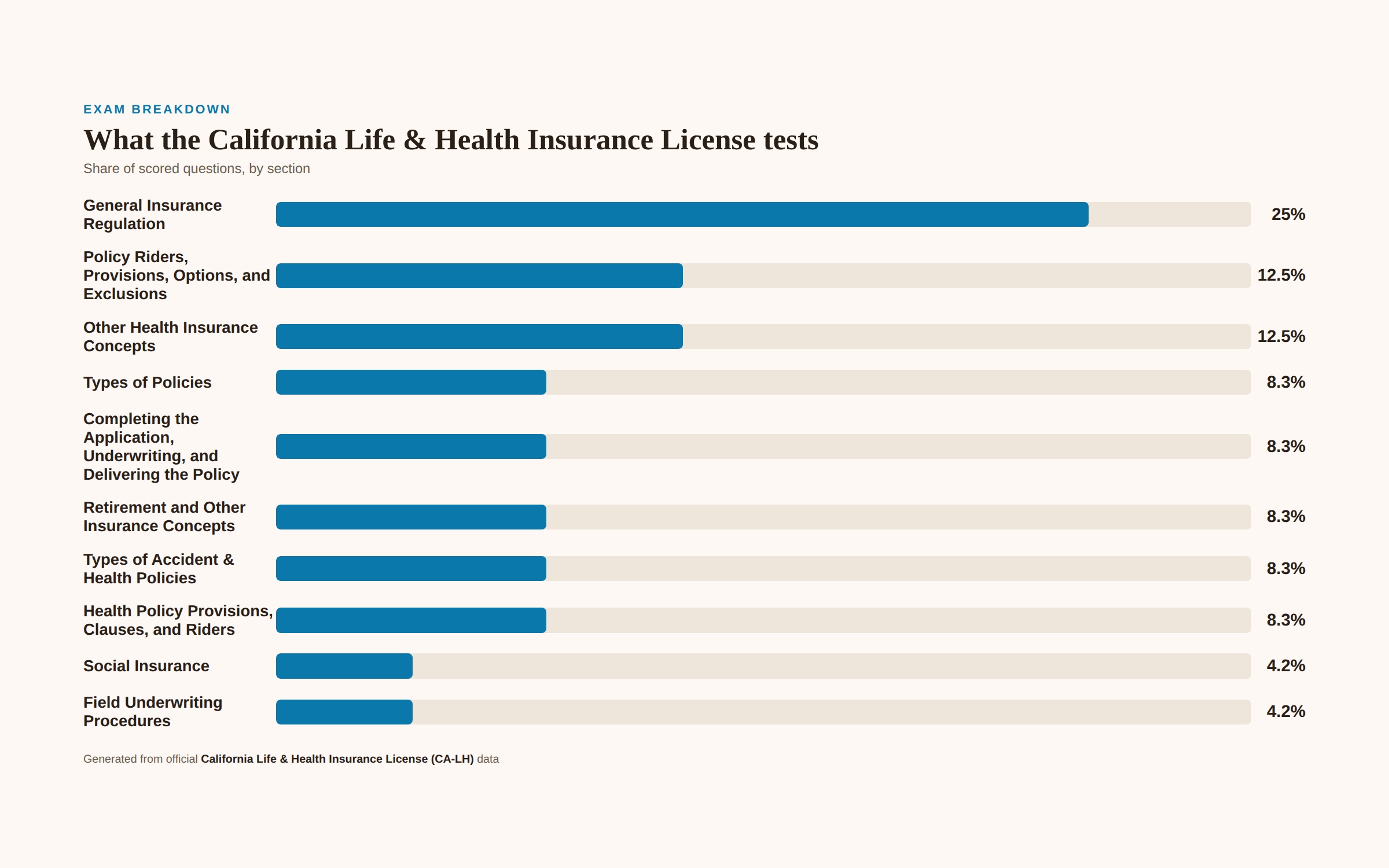
10 sections, weighted from 4.2% up to 25%:
| Section | Weight | Topics | Estimated study hours |
|---|---|---|---|
| General Insurance Regulation | 25% | 11 | 15 |
| Policy Riders, Provisions, Options, and Exclusions | 12.5% | 5 | 7.5 |
| Other Health Insurance Concepts | 12.5% | 4 | 7.5 |
| Types of Policies | 8.3% | 5 | 5 |
| Completing the Application, Underwriting, and Delivering the Policy | 8.3% | 4 | 5 |
| Retirement and Other Insurance Concepts | 8.3% | 5 | 5 |
| Types of Accident & Health Policies | 8.3% | 5 | 5 |
| Health Policy Provisions, Clauses, and Riders | 8.3% | 3 | 5 |
| Social Insurance | 4.2% | 2 | 2.5 |
| Field Underwriting Procedures | 4.2% | 1 | 2.5 |
Those hour estimates track the weights. 25% draws 15 hours of the 60, each 12.5% section draws 7.5, and the two 4.2% sections draw 2.5 apiece.
A quarter of 150 questions is 37 or 38 of them, and that is General Insurance Regulation on its own. It also holds 11 of the 45 topics in the outline, more than twice as many as any other section. Field Underwriting Procedures is the smallest: one topic, 4.2%.
The plan, section by section
Allocate the 60 hours in proportion to the weights. Across nine weeks that averages 6.7 hours a week, and the last week doubles as timed practice.
- Weeks 1–2 — General Insurance Regulation, 15 hours for 25%: the national framework first, then California's version of it, ending on what CLHIGA covers when an insurer becomes insolvent →
- Week 3 — Policy Riders, Provisions, Options, and Exclusions, 7.5 hours for 12.5%: the free look period, the incontestability clause and the two-year period it usually runs for, standard policy provisions, nonforfeiture options, dividends and policy loans →
- Week 4 — Other Health Insurance Concepts, 7.5 hours for 12.5%: total, partial, residual and recurrent disability, coordination of benefits, Workers Compensation, subrogation →
- Week 5 — Types of Policies, 5 hours for 8.3%: traditional whole life, the interest, market-sensitive and adjustable products, term life, annuities →
- Week 6 — Types of Accident & Health Policies, 5 hours for 8.3%, with Field Underwriting Procedures, 2.5 hours: disability income, medical expense, high-deductible health plans with HSAs and HRAs, Medicare supplements, long-term care →
- Week 7 — Health Policy Provisions, Clauses, and Riders, 5 hours for 8.3%, with Social Insurance, 2.5 hours: mandatory and optional provisions, rights of renewability, Medicare Parts A, B, C and D, Medicaid eligibility →
- Week 8 — Completing the Application, Underwriting, and Delivering the Policy, 5 hours for 8.3%: warranties and representations, HIPAA, the Fair Credit Reporting Act, contract law →
- Week 9 — Retirement and Other Insurance Concepts, 5 hours for 8.3%, then full 150-question timed runs.
That order follows the weights. If a diagnostic run disagrees, and annuities are costing you more than the regulation material, move the weak section forward and keep its hour count attached to it.
Where candidates lose points
The weights are uneven, so an even split of study time carries a cost. Divide 60 hours ten ways and General Insurance Regulation gets 6. Weighted by the exam's own percentages it gets 15, which matches a quarter of the exam and 11 of the 45 topics. The gap is nine hours.
The second trap sits inside that same section. Its 11 topics come in two layers over the same ground, the national rule and California's rule for it, and four of the five national topics have a California counterpart named in the outline: the regulatory system and the California Insurance Code; producer licensing and California's licensing, appointment and continuing-education rules; marketing and unfair trade and California's replacement, suitability and claims-settlement rules; federal health law and guaranty associations and CLHIGA itself. Study each pair back to back. California's health insurance mandates and continuation of coverage is the one that stands alone.
The 60% bar is California's own. Every state's Department of Insurance sets the score it requires and 70% is a common one, so if you are licensing elsewhere, get the figure from that department before you judge a practice score.
Small sections are cheaper than they look. Social Insurance and Field Underwriting Procedures are 4.2% each, which is 6.3 questions apiece on a 150-question paper, or about 13 between them. Their estimates total 5 hours, across three topics. Dropping both to protect the big sections trades 13 questions for 5 hours of study.
Then there is the clock. Every question is multiple choice, and 150 of them inside 180 minutes comes to 72 seconds each. That is the pace a full practice run has to hold. The exam's notes also say to be familiar with the computer-based testing interface if you are taking it through PSI, so a home sitting under PSI Bridge is worth a rehearsal of its own. Score each run by section and note where the time went, because a slow section and a wrong section need different work.
Common questions
How many questions are on the California Life & Health Insurance exam? 150, all multiple choice, covering the national material and California's own regulation in one sitting.
How much time do I get? 180 minutes, which is 72 seconds a question.
What is the passing score? 60% in California, or 90 of the 150 questions. Other states set their own bar and 70% is common, so check with the Department of Insurance where you plan to license.
What does the exam cost? 55 CDI base fee and a $43 PSI convenience fee.
Where can I take it? At a CDI or PSI test center, or at home under PSI Bridge remote proctoring.
How long should I study? 60 hours, going by the exam data's per-section estimates. 15 of them belong to General Insurance Regulation.
One readiness check you can run out loud tonight: say what CLHIGA covers when an insurer becomes insolvent, then define twisting and churning the way the California Insurance Code does, and whichever answer comes out vague is where the next study hour goes.
Only Ever's practice questions and study guides for the CA-LH are free, AI-generated sets included. Try the free practice questions and score yourself section by section, so those 60 hours land where the weight is.