How to Pass the California Property & Casualty (CA-PC) (2026): A Realistic Plan
In short
You need 90 of 150 multiple-choice questions right — 60% — and you get 3 hours to do it. General Insurance Regulation alone is 27.3% of the paper, roughly 41 questions. Our section-by-section estimates add up to 60 hours of study, and the weights decide where those hours go.
What the California Property & Casualty (CA-PC) tests
The CA-PC is one sitting: 150 multiple-choice questions, 3 hours on the clock. The bar is 60% of them. Sit it at a PSI test center, at a California Department of Insurance examination site, or from home under PSI remote proctoring.
Two bodies of material feed the paper. One is a nationally uniform core built on the model law of the National Association of Insurance Commissioners; layered over it are California's own statutes, from the Insurance Code through to the state's residual property markets. The outline for all of it is published by the CDI as its License Examination Objectives.
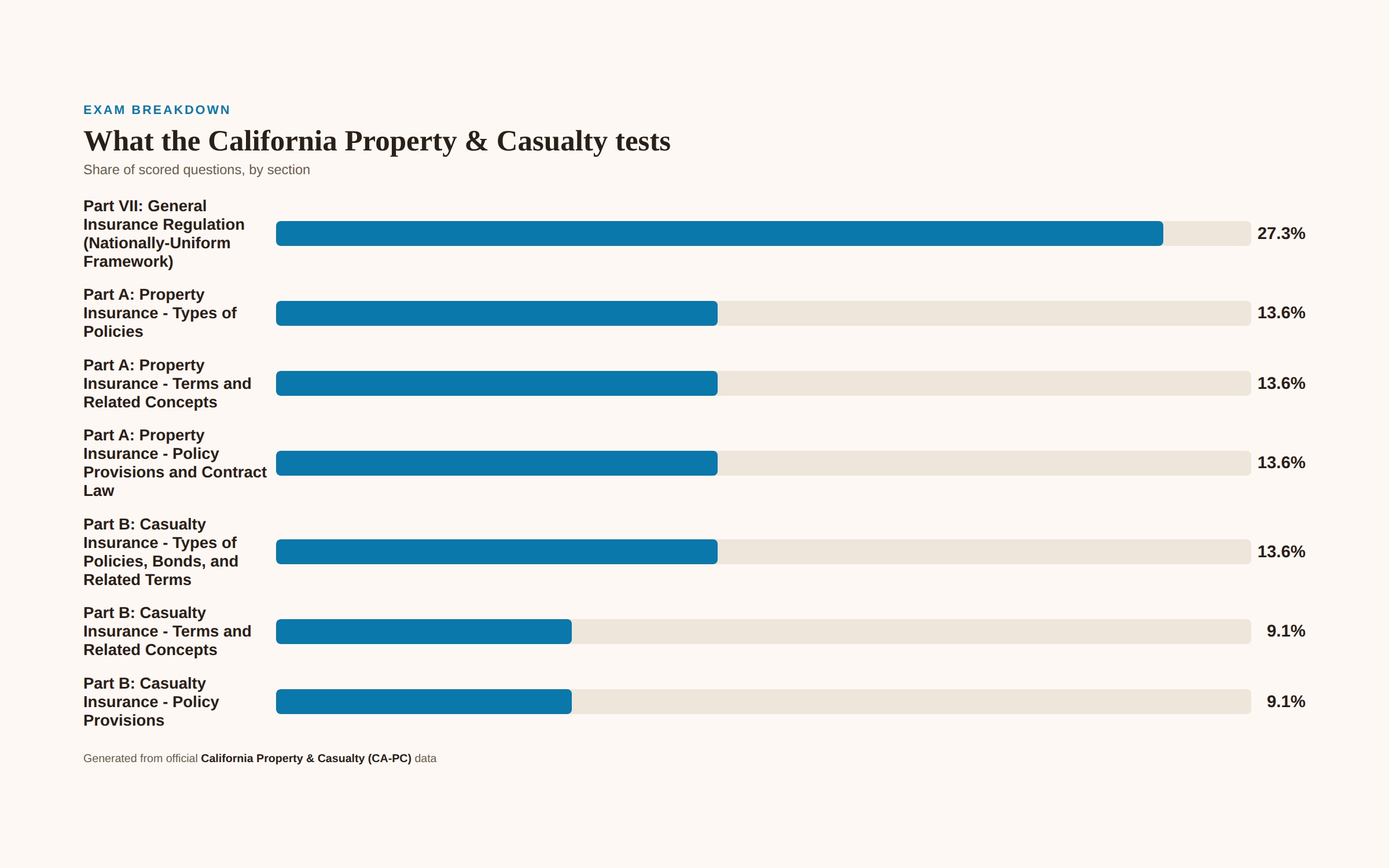
Seven sections, 50 topics, weighted from 9.1% up to 27.3%:
| Section | Weight | Topics | Study hours |
|---|---|---|---|
| Part VII: General Insurance Regulation (Nationally-Uniform Framework) | 27.3% | 14 | 16 |
| Part A: Property Insurance - Types of Policies | 13.6% | 7 | 8 |
| Part A: Property Insurance - Terms and Related Concepts | 13.6% | 8 | 8 |
| Part A: Property Insurance - Policy Provisions and Contract Law | 13.6% | 7 | 8 |
| Part B: Casualty Insurance - Types of Policies, Bonds, and Related Terms | 13.6% | 7 | 8 |
| Part B: Casualty Insurance - Terms and Related Concepts | 9.1% | 3 | 6 |
| Part B: Casualty Insurance - Policy Provisions | 9.1% | 4 | 6 |
Group those seven and the exam gets easier to hold. Property's three sections come to 40.8%, about 61 questions; casualty's three come to 31.8%, about 48. Regulation carries 27.3% on its own, and holds 14 of the 50 topics against 8 in the next-largest section.
Those 60 hours track the weights: 16 for regulation, 8 for each 13.6% section, and 6 apiece for the two 9.1% casualty sections. The two casualty sections are the only ones whose share of the hours runs ahead of their share of the paper, so borrow from them first if you fall behind.
The plan, section by section
Nine weeks. The 60 hours land in weeks 1–8, about 7.5 hours a week, and week 9 is timed practice on the full paper.
Weeks 1–2 — General Insurance Regulation, 16 hours for 27.3%: the regulatory system and the NAIC's role, producer licensing and fiduciary duties, unfair trade and unfair claims settlement practices, privacy and federal compliance. Then the California layer: the Insurance Code and the Department of Insurance, California licensing, appointment and continuing education, the state's auto and property laws, the residual markets, and the California P&C Guaranty Association →
Week 3 — Property Insurance, Types of Policies, 8 hours for 13.6%: what separates HO-2 through HO-8, then DP-1, DP-2 and DP-3, then the Commercial Package Policy and commercial property forms, the BOP, builders risk and cyber, inland marine, and the National Flood Insurance Program →
Week 4 — Property Insurance, Terms and Related Concepts, 8 hours for 13.6%: risk and insurable interest, the three hazards, loss valuation, proximate cause, deductibles and indemnity, limits and coinsurance, cancellation and vacancy, negligence, and blanket vs. specific coverage →
Week 5 — Property Insurance, Policy Provisions and Contract Law, 8 hours for 13.6%: declarations, insuring agreement, conditions and exclusions — the DICE spine of any policy — then who counts as the insured, mortgagee rights, proof of loss and notice of claim, appraisal and subrogation, the elements that make a contract valid, warranties and concealment, FCRA, Gramm-Leach-Bliley and TRIA →
Week 6 — Casualty Insurance, Types of Policies, Bonds, and Related Terms, 8 hours for 13.6%: Commercial General Liability, personal and commercial auto, workers compensation, the BOP's liability section, professional, umbrella and excess liability, crime and fidelity bonds vs. surety bonds, and equipment breakdown →
Week 7 — Casualty Insurance, Terms and Related Concepts, 6 hours for 9.1%: negligence and legal liability, compensatory vs. punitive damages, binders and endorsements, and how an occurrence trigger behaves alongside a claims-made one, retroactive dates included →
Week 8 — Casualty Insurance, Policy Provisions, 6 hours for 9.1%: the same DICE spine on the liability side, duties after a loss, proof of loss, notice of claim and appraisal, subrogation, the other-insurance provision and loss settlement →
Week 9 — full 150-question runs against the clock, scored section by section.
Run a free diagnostic before week 1, then keep each section's hours with it when you reorder the weeks. If casualty terms are costing you more than the regulation material, move week 7 forward with its 6 hours intact.
Where candidates lose points
Look at the calendar first. Divide 60 hours seven ways and every section gets about 8.6 hours. Our estimate for regulation is 16, so an even split leaves it roughly 7.4 hours short — on the section carrying 41 questions and 14 topics, and by nearly half of what it needs.
That section's 14 topics divide by scope. Eight carry the national framework. Six name California: the Insurance Code and the Department of Insurance, producer licensing with appointment and continuing education, automobile insurance laws, property insurance laws and residual markets, unfair trade practices and claims settlement, and the P&C Guaranty Association with workers compensation. Work the California six alongside the national eight, a few topics at a sitting, so both passes over the section happen together.
Part A's Terms section is where the calculations live. Loss valuation and coinsurance sit inside 13.6% of the paper — about 20 questions, spread over 8 topics. Actual cash value vs. replacement cost is a calculation, and so is a coinsurance requirement. Drill both with numbers on paper.
The two provisions sections read like a repeat and are not one. Part A's Policy Provisions and Contract Law shares its spine with Part B's Policy Provisions. Both open on declarations, insuring agreement, conditions and exclusions. Both cover duties after a loss, proof of loss, appraisal and subrogation. Together they are 22.7% of the exam, about 34 questions. Weeks 5 and 8 sit three weeks apart, so when the second one comes round, file the liability differences against the framework you already have.
Casualty's Terms and Related Concepts is the smallest section by topic count: three topics carrying 9.1% of the paper, about 14 questions. That works out at roughly 3% of the exam per topic, more than any other section. The three are negligence, legal liability and damages; binders, endorsements and limits of liability; and the difference between occurrence and claims-made triggers, retroactive dates included.
The 60% bar belongs to California. Passing standards vary widely between states, and 70% is a common requirement elsewhere, so if you plan to license in another state, confirm the figure with that state's department of insurance before you read anything into a practice score.
And watch the pace. 150 questions in 180 minutes is 72 seconds each, which is the speed a full timed run has to hold in week 9.
Common questions
How many questions are on the California P&C exam? 150, all multiple choice, drawn from national property and casualty material and California's own insurance regulation.
What is the passing score? 60%, which is 90 of the 150 questions. That figure is California's. Other states set their own and many require 70%, so check with the department of insurance where you intend to license.
How long do I get? 3 hours for the whole paper — 72 seconds a question if you spread it evenly.
How long should I study? We plan for around 60 hours of focused work. General Insurance Regulation accounts for more than 27% of the test on its own, so give its state codes, licensing rules and NAIC material the largest share.
Where can I take it? At a PSI test center, at a CDI examination site, or online through PSI remote proctoring.
What does it cost? The license application fee is 55 and 33 to $43 where it applies.
Two questions off our readiness list for this exam will tell you where week 1 starts: name the three parties to a surety bond, and say what California treats as rebating, as misrepresentation, and as defamation. Whichever one you answer slowly is the section to schedule first.
Only Ever's practice questions and study guides for the CA-PC are free, AI-generated sets included. Try the free practice questions and score yourself section by section, so those 60 hours go where the 41 questions are.