How to Pass the FINRA Securities Industry Essentials (SIE) (2026): A Realistic Plan
In short
Passing the FINRA Securities Industry Essentials (SIE) comes down to one domain: Products and Their Risks is 44% of the exam — nearly half. You need a score of 70 across 85 questions in 1 hour and 45 minutes. Most candidates prepare for around 85 hours. Master the products and you're most of the way there.
What the SIE tests
The SIE is the entry-level securities exam, and unlike the Series 7 it needs no firm sponsorship — anyone 18 or older can sit it. It checks foundational knowledge before you specialize: the products, the markets, the rules, and the activities that are off-limits. The exam is 85 multiple-choice questions. Of those, 75 are scored and 10 are unidentified pretest items scattered through the test. You get 1 hour and 45 minutes, and the pass mark is 70, set by FINRA — the same for everyone. It costs $100. You can't bring your own calculator, but an on-screen one is provided.
The four sections are weighted very unevenly, and this is the most important fact for planning your time:
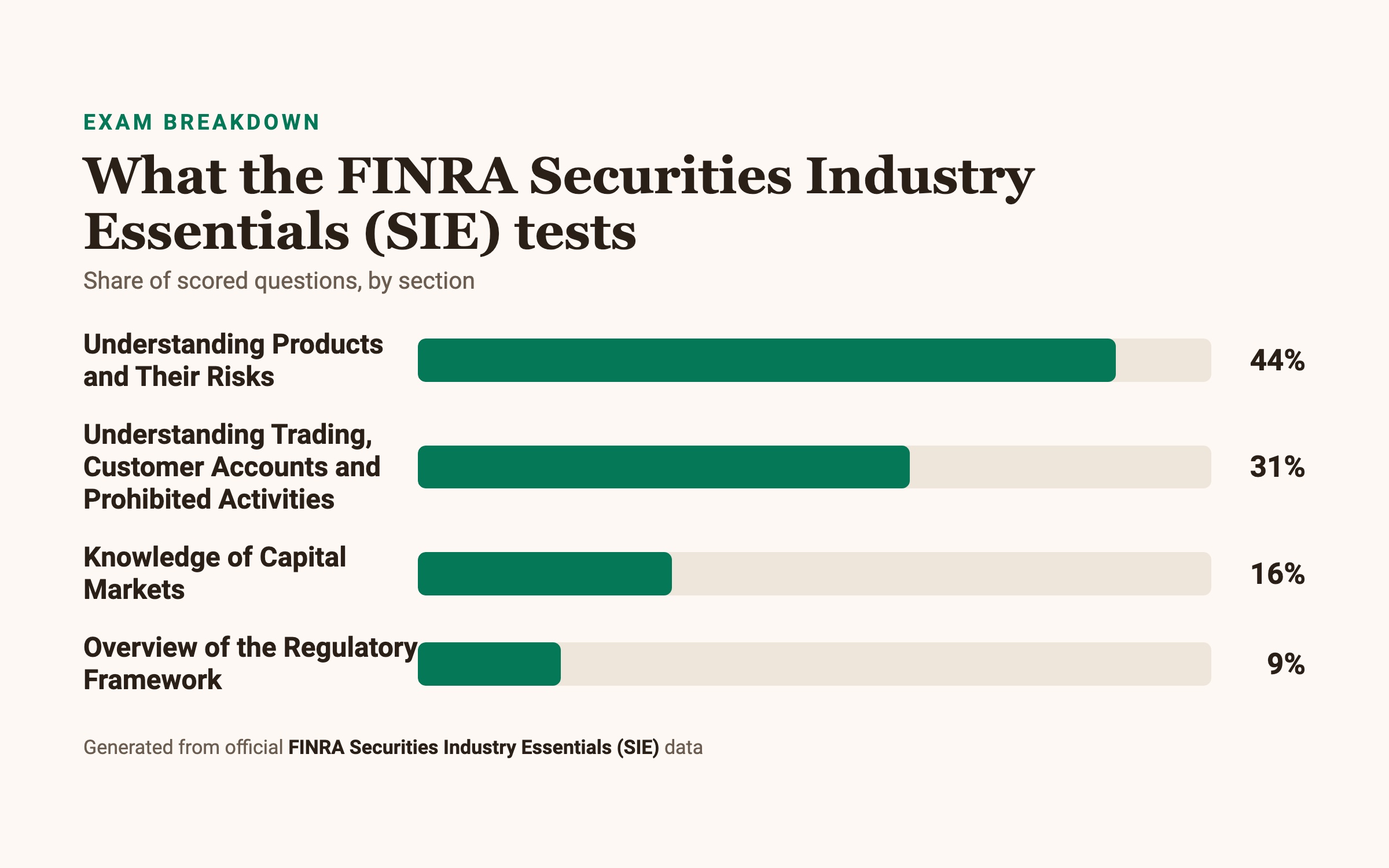
Products and Their Risks is 44% of the exam. The Trading, Customer Accounts, and Prohibited Activities domain adds another 31%. Capital Markets is 16%, and the Regulatory Framework overview is 9%. One domain carries the bulk of your result, so it should earn most of your hours.
The plan, section by section
Eighty-five hours, weighted to match, is a realistic plan:
Put the bulk into Products and Their Risks, ~35 hours — stocks, bonds, options, packaged products, and the risk that comes with each → then Trading, Customer Accounts, and Prohibited Activities, ~25 hours — how orders work and what counts as a violation → then Capital Markets, ~15 hours — the market participants and market structure → finish with the Regulatory Framework, ~10 hours — the SEC and SROs and the other regulators and agencies.
Products is where the SIE is won, so build it deliberately: learn each product, then the specific risks attached to it, because the exam almost always asks the two together. Short daily sessions work better than long weekend blocks here — there's a lot of terminology, and spacing it out is what makes it stick. There's no penalty for guessing, so on the day you answer every question. Start with a free SIE diagnostic to find your weakest domain before you commit the hours.
Where people lose marks
- Giving each domain equal hours is the classic SIE mistake. Products is 44% and the regulatory overview is 9%, so your calendar should look nothing like an even split.
- The exam pairs each product with the risk it carries, so study the two together — a question about a bond is usually a question about interest-rate or credit risk.
- Insider trading, market manipulation, and other prohibited activities look similar under pressure. Know the definitions cleanly and these become reliable points.
- There's no guessing penalty, so an unanswered question is simply a lost point. Answer all 85, even the ones you're unsure of.
Common questions
How many questions are on the SIE? 85 in total — 75 scored and 10 unscored pretest items mixed throughout.
How long do I get? 1 hour and 45 minutes.
What score do I need to pass? 70. It's a fixed cutoff set by FINRA, the same for every candidate.
Is there a penalty for guessing? No. Answer every question — a blank scores the same as a wrong answer, so there's no reason to leave one.
Can I bring a calculator? No personal calculators. If you test online you get an on-screen calculator; at a test center a standard calculator is provided.
How long should I study? Around 85 hours for most candidates, depending on your finance background.
Put your hours where the marks are — Products and Their Risks — learn each product alongside its risk, and answer every question on the day. The full question bank and study guide are free, where most providers charge for them. Try the free SIE practice questions.