How to Pass the OMSB Nursing Licensing (2026): A Realistic Plan
In short
The OMSB nursing exam is 100 multiple-choice questions in a single 2-hour-30-minute session at Pearson VUE. Results come back as Pass or Fail — OMSB doesn't publish a numeric cut score. Adult Health is the biggest domain at 30%, so weight the bulk of your roughly 150 study hours toward it, then the other high-yield areas.
What the OMSB exam tests
The Oman Medical Specialty Board (OMSB) licenses nurses through the Omani Examination for Nurses (OEN), a computer-based test delivered at Pearson VUE centers. OMSB moved to Pearson VUE in 2023, so older guides that still say Prometric are out of date. The paper is 100 multiple-choice questions, each with four options and one best answer, sat in a single 2-hour-30-minute session.
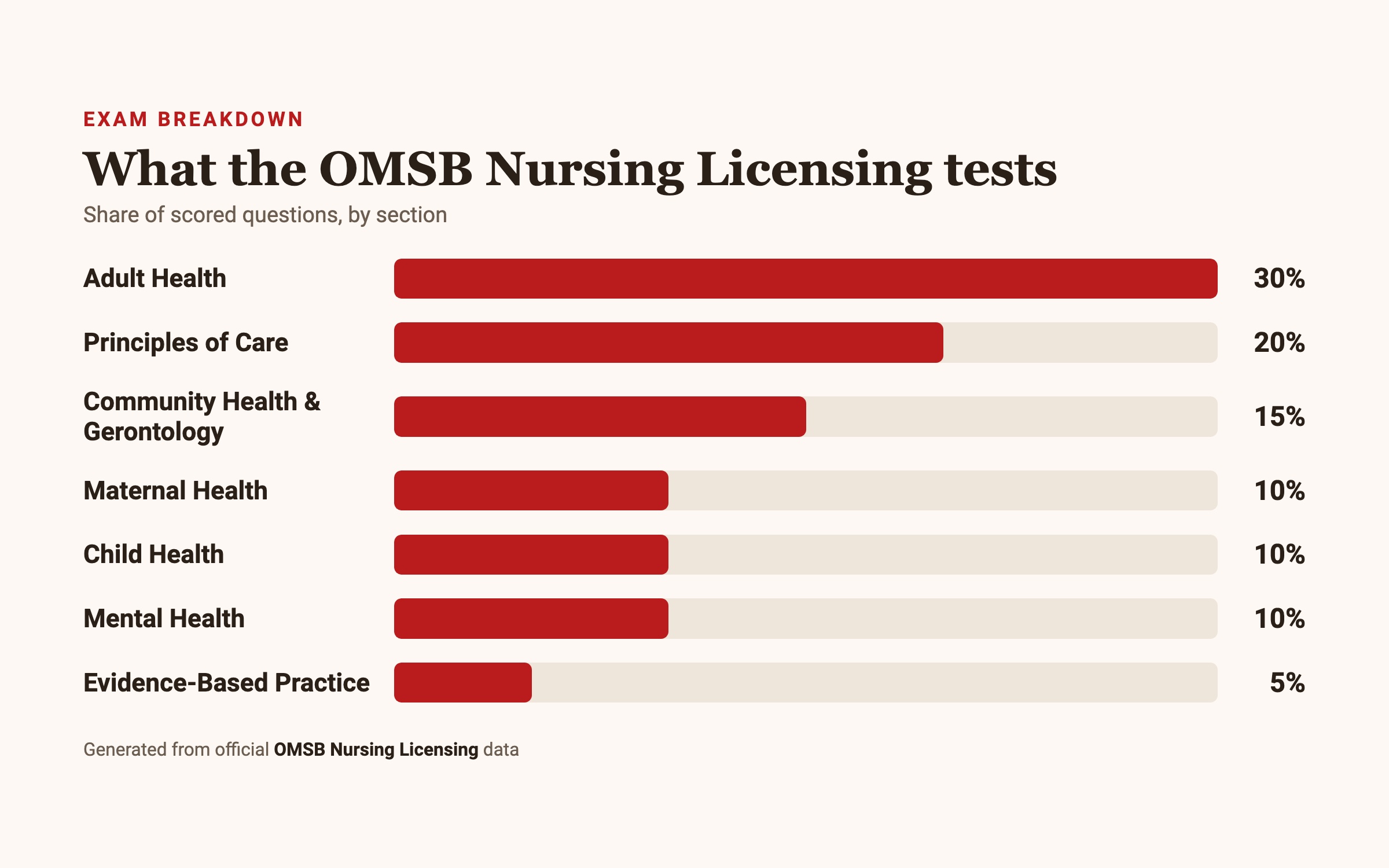
The blueprint spans seven domains, weighted roughly like this (each can vary by about 5%):
- Adult Health — 30%
- Principles of Care (standards of care, legal and ethical practice, leadership and management) — 20%
- Community Health & Gerontology — 15%
- Maternal Health — 10%
- Child Health — 10%
- Mental Health — 10%
- Evidence-Based Practice (research and epidemiology) — 5%
On scoring, OMSB keeps things simple: results are emailed as Pass or Fail within 24 hours, with no numeric score released. A 60% pass mark is widely repeated online, but OMSB doesn't publish one, so treat 60% as a working target it never confirms and aim clear of a borderline result.
The plan, section by section
Spread about 150 hours — close to five months of steady study — across the seven domains by weight:
Start with Adult Health (30%, ~45 hours) →
then Principles of Care (20%, ~30 hours) →
then Community Health & Gerontology (15%, ~22 hours) →
then Maternal, Child, and Mental Health (10% each, ~15 hours apiece) →
finish with Evidence-Based Practice (5%, ~8 hours).
Adult Health (30%)
The largest single domain — medical and surgical nursing and critical care for adult patients. Drill prioritization and escalation scenarios until your reasoning is quick and consistent; this is where most of the marks live.
Principles of Care (20%)
Standards of care, legal and ethical practice, and leadership and management. Learn the Omani scope-of-practice and professional-conduct rules alongside delegation and patient-safety principles — the local content is the part imported study material tends to miss.
Community Health & Gerontology (15%)
Public and community health, health promotion, and the care of older adults. It's a larger slice than most candidates expect, so give it real time.
Maternal, Child & Mental Health (10% each)
Antenatal-to-newborn care; pediatric assessment, milestones, and weight-based dosing; and psychiatric assessment with therapeutic communication and safety. Combined, these three are 30% of the paper, so steady coverage across all three pays off.
Evidence-Based Practice (5%)
Research literacy and epidemiology basics — reading evidence and applying it to a clinical decision. Small, but quick to secure.
Where people lose marks
The OMSB's specific pitfalls:
- Candidates prepare for the wrong exam shape. OMSB is 100 questions in one 2.5-hour sitting, not the 200-question, two-block format some Gulf guides describe. Practise at that length so your pacing is right.
- Preparation targets the wrong test center. OMSB moved to Pearson VUE in 2023, and booking and on-the-day logistics differ from the old Prometric process; outdated guides can send you to the wrong system.
- The seven-domain spread gets ignored. Principles of Care (20%) and Community Health & Gerontology (15%) together outweigh Maternal, Child, and Mental Health combined, yet they're the ones people under-study.
- Candidates chase an official 60%. There isn't one published — you only get Pass or Fail back, so build in a comfortable margin.
Common questions
How many questions are on the OMSB nursing exam? 100 multiple-choice questions, each with four options and a single best answer, sat in one 2-hour-30-minute session.
What is the passing score? OMSB reports results as Pass or Fail (emailed within 24 hours) and does not publish a numeric cut score. Some prep sites cite 60%, but that figure is unofficial.
How much does it cost? The examination fee is 200 USD. Verify current fees and any DataFlow verification costs on the official OMSB and Pearson VUE portals.
Where is the exam held? At Pearson VUE test centers worldwide — OMSB switched from Prometric to Pearson VUE in 2023.
How long should I study? Around 150 structured hours, weighted toward Adult Health and the other larger domains such as Principles of Care and Community Health.
A single Pass/Fail result with no published cut score means you want honest evidence you're clearing the bar before you book. Only Ever maps the OMSB blueprint to short study topics and the practice questions are free. Try the free OMSB practice questions and let your accuracy tell you when you're ready.