How to Pass the Saudi Nursing Licensure (2026): A Realistic Plan
In short
To pass the SNLE you need a scaled score of 500 on a 200-to-800 scale, across 200 multiple-choice questions taken in two 120-minute blocks. Adult Nursing and Maternal-Child Nursing together make up 70% of the paper, so most of your roughly 150 study hours belong there. Build the plan around the blueprint weights, not around what you already enjoy revising.
What the SNLE tests
The SNLE is set by the Saudi Commission for Health Specialties (SCFHS) and delivered as a computer-based test at Prometric centers. You get 200 multiple-choice questions, each with four options. Up to 10% are unscored pilot items the SCFHS is trialing for future papers. You won't know which, so treat every question as if it counts.
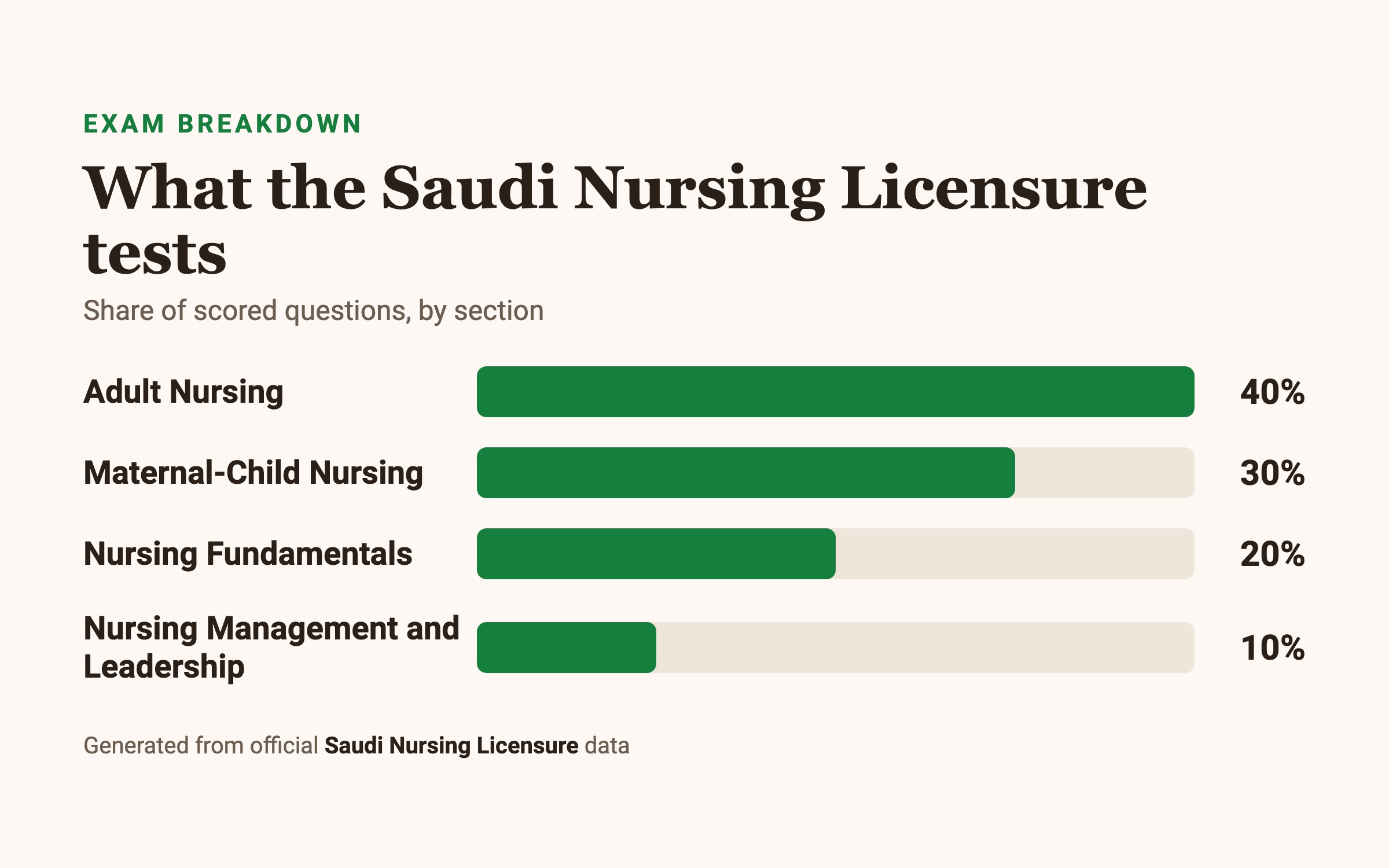
The blueprint splits into four domains, and the weighting is the single most useful thing to internalize before you open a textbook:
- Adult Nursing — 40% (about 80 of your 200 questions)
- Maternal-Child Nursing — 30% (about 60 questions)
- Nursing Fundamentals — 20% (about 40 questions)
- Nursing Management and Leadership — 10% (about 20 questions)
Scoring is where the SNLE differs from a simple pass mark. Your result is reported on a 200-to-800 scaled score, and 500 is the line. That scale is set by the SCFHS and is identical for every candidate. There's no curve to game, and a raw count of "I got 62% right" doesn't translate directly — the SCFHS controls the raw-to-scaled conversion. Results aren't instant either; they're released within two to six weeks once the testing window closes and the psychometric analysis is done.
The plan, section by section
Work the domains in order of weight, spending your hours where the marks are. A sensible sequence across roughly 150 hours and five months:
Start with Adult Nursing (40%, ~60 hours) →
move to Maternal-Child Nursing (30%, ~45 hours) →
then Nursing Fundamentals (20%, ~30 hours) →
finish with Management and Leadership (10%, ~15 hours).
Adult Nursing (40%)
Mostly medical and surgical nursing with critical care on top. Drill prioritization: which patient you see first, which finding you escalate, what you do before calling the doctor. These scenario items are where the 40% is won or lost. The domain also folds in community and mental health nursing, which candidates routinely skip.
Maternal-Child Nursing (30%)
Broad by design: prenatal care through to neonatal stabilization and pediatric milestones. Practice weight-based dosage calculations until they're automatic — a pediatric dose question you can't finish in a minute is a mark you've handed back.
Nursing Fundamentals (20%)
Your foundation: physical assessment, pharmacology, and the basic sciences behind clinical reasoning. It's only 20%, but it's high-yield revision because it underpins the other three domains.
Management and Leadership (10%)
Delegation, patient safety, evidence-based practice, and nursing informatics. Learn the delegation rules cold; they're quick marks that many candidates leave on the table because they run out of study time.
Where people lose marks
The traps on the SNLE are specific, and most are avoidable:
- Candidates misread the scaled score. You need 500 on the 800-point scale, so don't waste exam-day energy tallying how many you think you got right — the raw count doesn't map linearly to the scale.
- Time runs out in block one. Each 120-minute block holds 100 questions, about 72 seconds each, and you can't borrow minutes across the scheduled 30-minute break. If a question stalls you, flag it and keep moving.
- Fundamentals gets over-revised because it feels safe. It's 20% of the paper, while Adult and Maternal-Child are 70% combined. That's where the hours should go.
- The leadership domain gets ignored entirely. It's small, but delegation and patient-safety items are among the most predictable questions on the exam.
Common questions
How many questions are on the SNLE? 200 multiple-choice questions, four options each. Up to 10% may be unscored pilot items that don't count toward your result.
How long is the exam? 240 minutes total, split into two 120-minute blocks of 100 questions, with a scheduled 30-minute break in between.
What score do I need to pass? 500 on a 200-to-800 scaled score. The SCFHS sets it, and it's the same for every candidate.
How much does it cost? Verify the current fee with the SCFHS. The SNLE exam (Prometric) fee is commonly cited around SAR 1,000 (about USD 289); the SAR 600 figure you'll often see quoted may refer to DataFlow verification rather than the exam itself.
Where do I sit it? It's a computer-based exam at authorized Prometric test centers, in Saudi Arabia and internationally.
How long should I study? Around 150 structured hours, weighted heavily toward Adult Nursing and Maternal-Child Nursing since they're 70% of the content.
The fastest way to find your weak domains is to answer real questions under time pressure, then study what you got wrong. Only Ever maps the full SNLE blueprint to short, focused study topics, and the practice questions are free — no paywall on the part that moves your score. Try the free SNLE practice questions and let your results decide where the next study block goes.