Imagine a specialized piece of machinery sitting in a client’s garage. Every year, it reliably prints out $100,000 in crisp bills to pay their mortgage, buy their groceries, and fund their children's education. If that machine began to sputter and break down, your client would spare no expense to insure it. As an insurance producer, your primary job is to help clients realize they are that machine. Their ability to wake up, go to work, and earn a paycheck is their most valuable asset. If an illness or injury destroys that earning capacity, the financial foundation collapses. This is the domain of disability income insurance.
Fundamentally, disability income insurance replaces a portion of an insured's earned income upon the inability to work due to sickness or injury. It is not designed to make a client wealthy; it is designed to keep them solvent. You will notice immediately that insurance companies typically limit disability income benefits to between 50% and 70% of an individual's gross earned income.
Why not 100%? The insurance industry relies on fundamental human psychology. Limiting disability income benefits to a percentage of gross income discourages malingering. Malingering is the act of faking or prolonging a disability to continue collecting insurance benefits. If an individual could make exactly the same amount of money staying home watching television as they could working a grueling 40-hour week, the mathematical incentive to return to work vanishes. The 50% to 70% limit ensures the insured has enough money to survive, but maintains a financial incentive to recover and return to the workforce.
To master disability insurance, you must understand how these policies manipulate time. When a client falls ill or gets injured, a sequence of specific time periods dictates exactly when the policy responds, how long it waits, and when it stops paying.
1. The Probationary Period: Defending the Risk Pool
The moment a disability policy is issued, the clock starts on the probationary period. A probationary period is a set amount of time after a policy goes into effect during which no benefits are paid for illness-related disabilities.
The probationary period in a disability policy begins on the date the policy is issued and typically lasts 15 to 30 days. Why does this exist? It is designed to protect the insurer from adverse selection by individuals with pre-existing conditions. Insurers want to prevent a scenario where a client feels a lump, buys a policy on Monday, gets diagnosed with cancer on Wednesday, and files a claim on Friday.
Adverse selection occurs when individuals with a higher probability of illness disproportionately purchase insurance, threatening to collapse the risk pool if not mitigated by safeguards like probationary periods.
Crucially, probationary periods in disability income policies generally do not apply to disabilities caused by accidents. An accident is an unforeseen, abrupt event—you cannot plan to fall off a ladder just because your policy was issued yesterday. Therefore, accident coverage begins immediately.
2. The Elimination Period: The Time-Based Deductible
Once the probationary period is clear, we must look at the elimination period. The elimination period is the continuous amount of time that must pass after a disabling illness or injury begins before benefit payments start.
Key Concept: You can think of the elimination period in a disability policy as functioning like a time-based deductible. Instead of paying the first $1,000 of a claim out-of-pocket like you would in auto insurance, the client pays for the first 30, 60, or 90 days of their disability out of their own savings.
The elimination period in a disability policy begins on the exact date the insured becomes disabled. During the elimination period of a disability income policy, the insured receives absolutely no benefit payments.
This period allows the client and the insurer to strike a bargain regarding premiums:
A shorter elimination period increases the likelihood of the insurer paying a claim (since even minor injuries will breach the waiting period). Consequently, a shorter elimination period results in a higher policy premium.
Conversely, choosing a longer elimination period transfers more short-term risk to the insured, which significantly reduces the premium cost of a disability income policy.
3. The Benefit Period: The Payout Horizon
Once the insured survives the elimination period, the checks begin to flow. How long do they last? That is dictated by the benefit period, which is the maximum length of time that disability income payments will continue after the elimination period is satisfied.
Just like the elimination period, the benefit period directly correlates with cost. Choosing a longer benefit period increases the premium cost of a disability income policy because it exposes the insurer to years, or even decades, of potential payouts.
Short-Term vs. Long-Term Disability
Disability income insurance is broadly categorized into two timelines: short-term and long-term. Knowing the standard parameters for both is essential for your exam and your field practice.
Generally provides benefit periods ranging from two years up to the insured's age 65.
As a producer, you will source disability insurance from two distinct avenues: individual policies tailored to a specific professional, and group policies purchased by an employer. The mechanics, underwriting, and taxation of these two domains differ dramatically.
Individual Disability Income Insurance
Individual disability income insurance is purchased directly by a person from an insurance company. You sit across the kitchen table from a client, assess their needs, and write a policy specifically on their life.
Because it is highly customized, individual disability income policies typically specify a flat monthly benefit amount (e.g., $4,000 per month). To prevent the malingering we discussed earlier, individual disability income benefit amounts are determined based on the insured's income at the time of application.
Another massive advantage for your clients is the scope of coverage: individual disability income policies can cover both occupational and non-occupational disabilities. Whether the client hurts their back at the office or on the ski slopes, the individual policy protects them.
Group Disability Income Insurance
In the corporate world, you will deal with group disability income insurance, which is a single master policy issued to an employer to cover a group of eligible employees.
Because the insurer can spread risk across an entire workforce, group disability income insurance generally requires no medical underwriting for the basic benefit amount. This pooling of risk means that group disability income policies are usually less expensive per person than comparable individual disability income policies.
Unlike the flat monthly amount found in individual policies, group disability income policies typically state benefits as a percentage of the worker's current income (for example, 60% of base salary).
However, group coverage has distinct limitations you must explain to clients:
Portability: Group disability insurance is generally not portable. An employee's group disability insurance coverage typically terminates upon leaving the employer.
Scope of Coverage: Group disability income policies typically cover only non-occupational disabilities. Why? Because occupational disabilities are generally excluded from group disability income policies due to existing Workers' Compensation coverage, which handles on-the-job injuries.
Coordination of Benefits: Group disability income benefits are often reduced by the amount of any Social Security disability benefits the employee receives, ensuring the total payout does not accidentally incentivize malingering.
Occupational hazards, such as those found in the construction trades, are typically excluded from group disability income policies because they are covered by mandatory Workers' Compensation insurance.
To advise a client properly, you must understand how the IRS treats both the money going into the policy (premiums) and the money coming out (benefits).
For individual policies:
Premiums for individual disability income insurance are paid with after-tax dollars.
Because the client already paid tax on the money used to buy the policy, benefits received from an individually owned disability income policy are not subject to income tax.
For group policies, the tax rule is dictated by who pays the premium:
Employers can deduct the premium payments for a group disability income policy as a regular business expense.
However, when an employer pays the premium for a group disability income policy, the benefits received by a disabled employee are subject to income tax.
Conversely, when an employee pays the premium for a group disability income policy with after-tax dollars (often through a payroll deduction), the benefits are received tax-free.
Disability income insurance does not just protect families; it protects businesses. Imagine two software developers who own a highly successful tech firm 50/50. If one partner suffers a catastrophic brain injury and can never write code again, the business faces an existential crisis. The healthy partner is now doing 100% of the work but still owes 50% of the profits to the disabled partner (or their family).
This is where a business disability buyout policy steps in. A business disability buyout policy provides the necessary funds to purchase a disabled owner's share of a business. This is not an informal handshake; a disability buyout policy is used to fund a formal legal buy-sell agreement between business partners.
Mechanics and Timelines
Because the goal is to buy out a partner and sever the business relationship cleanly, business disability buyout policies typically pay benefits as a large lump sum rather than ongoing monthly income.
The timeline for a buyout is intentionally slow. Business disability buyout policies typically feature an elimination period of one to two years. Think about the logic here: if a partner suffers a severe stroke, you do not want to trigger a permanent, multimillion-dollar buyout of their shares in month three, only for them to make a miraculous recovery in month eight. A prolonged elimination period in a disability buyout policy ensures the disabled partner's condition is permanent before a permanent business transfer occurs.
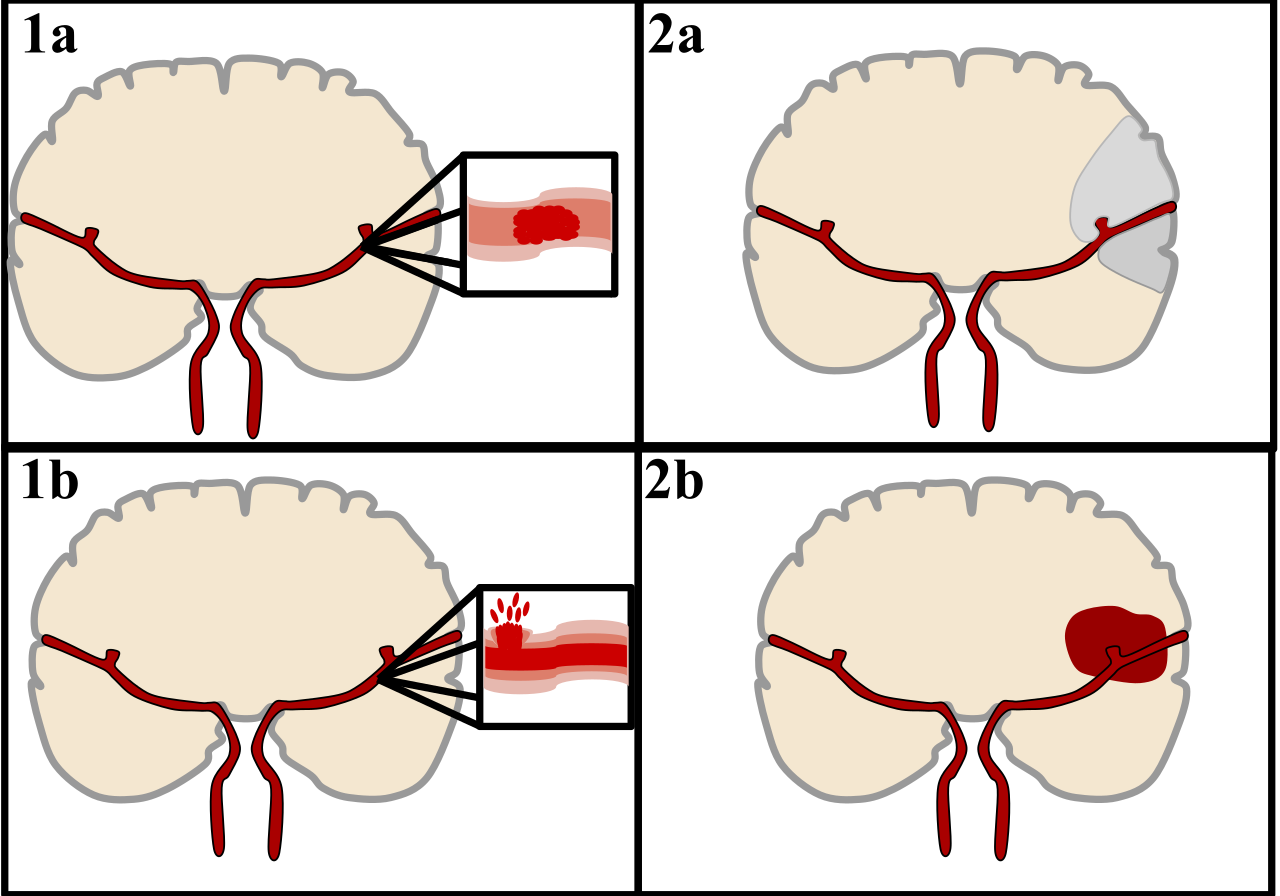
A severe ischemic or hemorrhagic stroke can cause debilitating impairments. The extended elimination period in a buyout policy accounts for the possibility of recovery, ensuring the disability is truly permanent before transferring ownership.
However, because those premiums were paid with after-tax money, benefits paid out from a business disability buyout policy are received completely tax-free. This ensures that the healthy partner receives the exact, un-diluted lump sum required to execute the buy-sell agreement.
Mastering these concepts transforms you from a salesperson into a professional risk manager. You are not just quoting premiums; you are structuring the exact timelines, tax strategies, and legal frameworks that keep families in their homes and businesses alive when the human engine breaks down.