Identification and Police Interviews
A witness picks a stranger out of a lineup with total confidence — and turns out to be wrong. This is not a hypothetical for dramatic effect; it is the single most consistent cause of wrongful conviction in the common law world, and it is precisely why the law surrounding identification and police interviews is built like a pressure vessel: dense with procedural safeguards designed to contain a very human failure mode. A witness's certainty and a witness's accuracy are almost entirely unrelated variables, and every rule you are about to learn exists because courts, eventually, worked that out the hard way.
PACE Code D governs the identification of suspects by witnesses and the taking of fingerprints, footwear impressions, and photographs by police in England and Wales. It sits within the Police and Criminal Evidence Act 1984 framework alongside the interview codes, but its logic is distinct: where the interview codes police what a suspect says, Code D polices what a witness sees and how reliably that seeing gets converted into evidence.

The threshold question is when a formal identification procedure must happen at all. Code D requires one whenever a witness has identified or purported to identify a suspect and the suspect disputes being the person the witness saw, or, more broadly, whenever there is a reasonable chance of a witness being able to identify a suspect whose identity is disputed. Note the word "disputed" doing the heavy lifting in both formulations — identification procedures resolve a contested fact, not confirm an admitted one. That is why an identification procedure is not required where it would serve no useful purpose, for example because the suspect admits being at the scene and disputes only what happened there. If the defendant says "yes, that was me, but I acted in self-defence," parading him in front of a witness proves nothing anyone disputes.
Key distinction: Code D identification procedures exist to test disputed identity, not to corroborate an account the suspect already accepts.
Code D does not give police a free choice among identification methods. It builds a hierarchy, and an identification officer — someone with no involvement in the investigation — must arrange and supervise whichever procedure is used, precisely so the person running the process has no stake in its outcome.
Video identification sits at the top of that hierarchy: Code D requires the identification officer to offer it first, unless it is not practicable. A video identification must show the suspect together with at least eight other people who resemble the suspect in age, general appearance, and position in life — nine images total, engineered so the witness's job is genuinely difficult rather than a coin-flip dressed up as a test.
If video identification cannot be arranged, the fallback options descend in a specific order:
| Procedure | What happens | When used |
|---|---|---|
| Video identification | Witness views suspect's image among at least 8 others | First choice, unless impracticable |
| Identification parade | Suspect stands in a line with at least 8 similar-looking people | Where video is not practicable |
| Group identification | Witness observes the suspect within an informal group (e.g., a shopping centre or train station) | Where parade/video are not practicable |
| Confrontation | Witness is asked directly whether the person in front of them is who they saw | Last resort — all other methods impracticable |
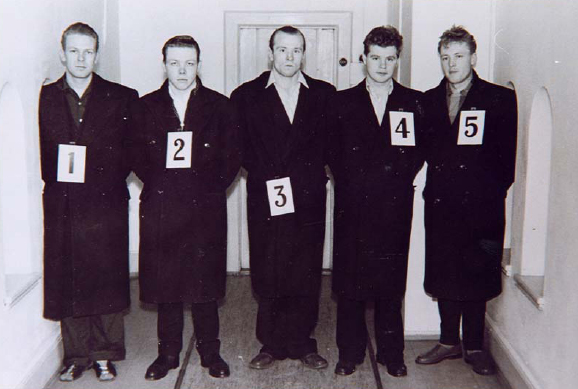
An identification parade under Code D requires the suspect to stand in a line with at least eight other people who resemble the suspect — the live, in-person cousin of video identification, now rarely the first port of call because video procedures are faster to arrange and easier to standardise. Group identification trades the artificial line-up for a naturalistic setting: the witness watches the suspect move within a genuine crowd, which can be useful where a suspect refuses to cooperate with more formal procedures but still carries obvious risks of a less controlled comparison group.
Confrontation is the procedure of last resort under Code D, used only when video identification, an identification parade, and group identification are all impracticable. In a confrontation, the witness is simply asked to confirm whether the person confronting them is the person they saw on the earlier occasion — no comparison, no line, no distractor faces. Because confrontation strips away every safeguard the other procedures build in, it is deliberately positioned as the method of last resort, not a convenient shortcut.
Several rules exist purely to stop contamination of the witness's memory before or during the procedure. An identifying witness must not be shown photographs or given any other description of the suspect immediately before attending an identification procedure — the entire evidential value of the exercise depends on the witness's memory being untouched by prompts supplied by the investigation. For the same reason, a first description of the suspect given by a witness must be recorded in the witness's own words before that witness takes part in any identification procedure, creating a fixed, pre-procedure benchmark against which the eventual identification (and any inconsistencies) can be measured. And where two or more witnesses are attending identification procedures in the same case, they must not communicate with each other about the case before or during those procedures — one witness's account cannot be allowed to leak into another's memory.
A solicitor is entitled to be present when police carry out a Code D identification procedure with a suspect, and a written record must be made of the procedure, including any objections raised by the suspect or their solicitor. That record matters later: breach of PACE Code D during an identification procedure may lead a court to exclude the resulting identification evidence under section 78 of PACE 1984, which allows a court to exclude prosecution evidence if admitting it would have such an adverse effect on the fairness of proceedings that it ought not to be admitted. Section 78 is not automatic — a breach does not guarantee exclusion — but it is the lever a defence solicitor pulls when Code D has been ignored.
Suspects are not always cooperative, and Code D anticipates that too. A suspect who unreasonably refuses to cooperate with a video identification may have that refusal recorded, with a group identification or covert procedure arranged instead. A covert identification procedure may be used where the suspect's whereabouts are unknown or the suspect deliberately makes themselves unavailable for a formal procedure — the investigation is not permitted to grind to a halt simply because a suspect declines to play along.
Even a procedurally flawless identification procedure produces evidence that juries are historically prone to overweight, which is why the trial safeguards matter as much as the police-station ones. The Turnbull guidelines, from R v Turnbull, require a judge to give the jury a special warning about the danger of convicting on disputed eyewitness identification evidence. Specifically, a Turnbull warning must direct the jury to scrutinise the circumstances in which the identifying witness made their observation of the offender — not simply how confident the witness sounds in the witness box, but how good their actual opportunity to observe really was.
To make that scrutiny concrete, practitioners use the mnemonic ADVOKATE, which assesses the quality of identification evidence by reference to:
Amount of time observed · Distance · Visibility · Obstruction · Known or seen before · Any reason to remember · Time lapse · Errors or discrepancies
Run a witness's account through ADVOKATE and you get a quick diagnostic of whether their identification is likely to be reliable, or whether it collapses under the first honest question about lighting, distance, or how long they actually looked.
Where the quality of identification evidence is poor and there is no other evidence to support it, the trial judge should withdraw the case from the jury and direct an acquittal — a Turnbull-driven safeguard against convictions resting on identification evidence too weak to sustain them. But weak identification evidence is not automatically fatal to the prosecution: supporting evidence capable of correcting weak identification evidence may include a defendant's proven lies, forensic evidence, or admissions. A shaky ADVOKATE score plus a defendant caught lying about his alibi is a very different case from a shaky ADVOKATE score standing alone.
Turn now from what witnesses see to what suspects say — or refuse to say. The standard police caution states that a suspect does not have to say anything, but that it may harm their defence if they do not mention when questioned something they later rely on in court, and warns that anything they do say may be given in evidence. That caution is the doorway into the law of adverse inferences under the Criminal Justice and Public Order Act 1994 (CJPOA 1994), which quietly rewired the "right to silence" from an absolute shield into something more conditional.
| Section | Trigger | What it allows |
|---|---|---|
| s.34 | Suspect fails to mention a fact when questioned that they later rely on in their defence | Adverse inference, but only if the fact was one the suspect could reasonably have been expected to mention at the time |
| s.36 | Suspect fails to account for an object, substance, or mark found on them | Adverse inference from the failure to explain |
| s.37 | Suspect fails to account for their presence at a particular place | Adverse inference from the failure to explain |
| s.38 | — | A defendant cannot be convicted wholly or mainly on the basis of an adverse inference alone |
Section 34 is the workhorse provision and the one most heavily litigated: it lets a court draw an adverse inference where a suspect fails to mention a fact when questioned that they later rely on in their defence, but that inference can only be drawn if the fact relied on at trial is one the suspect could reasonably have been expected to mention when questioned. If disclosure to the defence was minimal and the fact genuinely could not have been anticipated, no inference follows. Sections 36 and 37 target narrower, more concrete failures — an unexplained bloodstain, an unexplained presence at the scene — and a special warning must be given to the suspect before an inference can be drawn under either section, explaining in ordinary language what inference may be drawn from silence. Critically, section 38 caps the damage all of this can do: a defendant cannot be convicted wholly or mainly on the basis of an adverse inference drawn from their silence, so silence can sharpen a prosecution case, but it can never be the prosecution case.
One procedural safeguard cuts across all of this: no adverse inference can be drawn from a suspect's silence during interview if the suspect had not had the opportunity to consult a solicitor before being questioned. Deny access to legal advice, and the entire adverse-inference machinery is disabled for that interview.
This is where doctrine becomes advocacy. A solicitor may advise a client to answer no comment throughout a police interview to avoid providing evidence that could support the prosecution case — the client volunteers nothing that can be picked apart, quoted back, or shown to be inconsistent later. Alternatively, a solicitor may advise a client to provide a prepared written statement to the police instead of answering interview questions orally. Providing a prepared written statement can protect a client from an adverse inference under section 34 while still avoiding the risks of oral questioning — the client's account of the key facts goes on record (satisfying the "mentioned when questioned" requirement) without exposing them to live cross-examination by an investigating officer.
Neither strategy is risk-free, and neither is right by default. A solicitor should weigh the strength of the evidence disclosed, the client's ability to cope with questioning, and the risk of adverse inferences when advising on how to answer police questions. A client who answers no comment despite having a genuine explanation may still face an adverse inference if they later rely on that explanation at trial — silence bought at interview can be repaid with interest at trial, once the "reasonably have been expected to mention" test bites. And genuine reliance on legal advice to remain silent is relevant to whether an adverse inference should be drawn, but it does not automatically prevent an inference being drawn — "my solicitor told me to say nothing" is a factor for the jury to weigh, not a legal immunity.
Practical takeaway: the choice between no comment and a prepared statement is not about hiding information — it is about controlling the form in which information reaches the police, while still satisfying section 34's "mentioned when questioned" trigger.
A parallel safeguard operates for suspects who cannot be assumed to understand or exercise their rights unaided. An appropriate adult must be present when police interview a suspect who is a juvenile, or a suspect who is mentally disordered or otherwise mentally vulnerable. Age itself can be uncertain in the moment, so Code C resolves the ambiguity firmly: anyone who appears to be under 18 must be treated as a juvenile, in the absence of clear evidence that they are older.
Who can fill the role depends on the suspect. A parent, guardian, or social worker may act as the appropriate adult for a juvenile suspect, while a relative, guardian, carer, or someone experienced in dealing with mentally vulnerable people may act as the appropriate adult for a mentally vulnerable suspect. One combination is expressly ruled out: a solicitor attending the police station in their professional capacity cannot also act as the appropriate adult for the same suspect. The two roles pull in overlapping but distinct directions — legal advice versus general welfare safeguarding — and combining them in one person would blur a line Code C wants kept sharp.
That distinction matters because the appropriate adult's job is not passive. The role of the appropriate adult is to safeguard the rights, entitlements, and welfare of the detained person, not simply to observe the interview, and a detained person must be told that the appropriate adult's role is to advise them, observe whether the interview is conducted fairly, and facilitate communication. This is an active, protective function — closer to an advocate for fairness than a silent chaperone. Precisely because the role is active, an appropriate adult may be excluded from an interview if their conduct prevents the proper questioning of the suspect — the safeguard is not a licence to derail the investigation.
The appropriate-adult requirement is not confined to interviews. An identification procedure involving a juvenile or mentally vulnerable suspect requires an appropriate adult to be present in addition to any solicitor the suspect wants, and the identification officer must consider a vulnerable suspect's ability to understand and to give informed consent to an identification procedure. The same concern that drives the interview safeguard — a suspect who may not fully grasp what is happening or what their rights are — carries straight across into the identification context.
Notice the shared design principle running through everything above: identification procedures, adverse-inference rules, and appropriate-adult safeguards are all responses to the same underlying risk — that a criminal justice system built on human testimony and human questioning will, left unchecked, produce confident-but-wrong outcomes. Code D disciplines what witnesses see and how; the CJPOA 1994 disciplines what silence can and cannot prove; the appropriate-adult regime disciplines who gets to be questioned without extra protection. For SQE1, the examinable skill is rarely reciting a rule in isolation — it is spotting which safeguard a given fact pattern engages, and advising a client on the strategic trade-offs (no comment versus a prepared statement, cooperating with an identification procedure versus not) that those safeguards create.