When a buyer acquires title to a parcel of real estate, they do not necessarily obtain absolute freedom to alter, build upon, or use that land however they see fit. Often, previous owners or original developers have permanently embedded invisible boundaries into the very fabric of the ownership. Private land use controls are limitations on property use established by private individuals or entities rather than the government.
As a real estate professional, you will navigate a constant push-and-pull between public zoning laws (what the city allows) and private restrictions (what the deed or neighborhood allows). This creates our first foundational rule: If a conflict exists between a public land use control and a private land use control, the more restrictive rule dictates the permitted land use. For example, if local city zoning permits multi-family dwellings, but a private neighborhood restriction limits the lot strictly to a single-family home, the private restriction wins because it is the more restrictive of the two.
An aerial view showing distinct boundaries between residential, commercial, and industrial zones. When public zoning laws and private deed restrictions conflict in such areas, the more restrictive rule dictates the permitted land use.
A common form of private land use control is a deed restriction. In essence, a deed restriction is a private limitation placed in a deed that dictates permitted or prohibited uses of a specific real estate parcel.
Because property rights represent a "bundle of sticks", a property owner can create a deed restriction before conveying the property to a new owner, effectively holding back a "stick" regarding how the land can be used. When designed correctly, these limitations are not temporary agreements between two buddies; they attach to the dirt itself. A deed restriction that runs with the land binds all subsequent owners of the property to the terms of the restriction.
However, restrictions come with different degrees of severity. You must be able to clearly distinguish between a covenant and a condition.
Covenants vs. Conditions
Feature
Restrictive Covenant
Deed Condition
Definition
A restrictive covenant is a promise contained in a deed or contract to do or not do a certain act regarding the property.
A condition in a deed establishes a defeasible fee estate. (Ownership is conditional on an event).
Violating a deed condition can result in the loss of property title through reversion to the original grantor.
Impact on Title
Violating a restrictive covenant does not result in the loss of property title.
Title can be entirely stripped from the current owner and handed back to the grantor (or their heirs).
To enforce a promise upon people who buy the house three generations from now, a restrictive covenant must run with the land to be enforceable against future buyers. If it does not run with the land, it is merely a personal agreement that dies when the property is sold.
As you expand from a single parcel of land to an entire housing tract, subdivision covenants, conditions, and restrictions are a common form of private land use control. In the industry, subdivision covenants, conditions, and restrictions are commonly abbreviated as CC&Rs.
An aerial view of a tract housing subdivision. Developers utilize Covenants, Conditions, and Restrictions (CC&Rs) in these large-scale developments to enforce architectural harmony and protect the property values of all lots.
Why do these exist? Developers establish CC&Rs to maintain specific architectural and use standards in a new subdivision. They want to ensure that before the last lot is sold, the first buyer hasn't turned their front yard into a junkyard, which would destroy the value of the remaining lots. To achieve this harmony, CC&Rs frequently regulate architectural styles within a subdivision, frequently regulate exterior paint colors within a subdivision, and frequently regulate fence heights within a subdivision.
The Constructive Notice Principle:
How does a buyer know they aren't allowed to paint their house neon purple? CC&Rs are typically recorded in the public land records of the county where the subdivision is located. Under the law, recording CC&Rs in public land records provides constructive notice of the restrictions to all future property purchasers. This means the buyer cannot claim ignorance. Legally, recording the document in the county courthouse is equivalent to posting a giant billboard that everyone is presumed to have read.
Enforcement and the Doctrine of Laches
Who enforces these rules? Typically, homeowners associations manage and enforce CC&Rs within a specific community. However, it is not solely the association's responsibility. Because every home's value relies on the mutual promises made in the subdivision, any property owner within a subdivision governed by CC&Rs has the legal standing to enforce the restrictions against a non-compliant neighbor.
If a neighbor begins building an unapproved 12-foot fence, enforcement of CC&Rs is typically achieved by obtaining a court injunction to halt the prohibited activity.
But what if the association sees the 12-foot fence, ignores it for five years, and then decides to sue? They will likely lose due to a concept called Laches.
The legal doctrine of laches can prevent the enforcement of a private deed restriction.
The doctrine of laches states that a legal right may be lost if an unreasonable delay occurs in asserting that right.
Think of laches as "use it or lose it." A homeowners association may lose the right to enforce a specific CC&R if the association consistently fails to enforce the rule over a long period. You cannot sleep on your rights and expect the court to enforce them later.
When buyers move into a condominium, they trade some individual autonomy for shared conveniences. This requires highly structured internal governance split into two distinct tiers: Bylaws and Rules.
1. Condominium Bylaws (The "Operating System")
Condominium bylaws are the governing documents dictating the operational procedures of a condominium association. Think of bylaws as the structural constitution of the building.
Condominium bylaws establish the procedures for electing a board of directors.
Condominium bylaws establish the procedures for holding association meetings.
Condominium bylaws mandate the procedures for collecting maintenance fees from property owners.
2. Rules and Regulations (The "Daily Living Standards")
While bylaws dictate how the government runs, condominium rules and regulations establish specific daily living guidelines for community residents.
Condominium rules and regulations often govern acceptable noise levels within the community.
Condominium rules and regulations often dictate parking protocols.
Condominium rules and regulations establish rules for the use of shared amenities (e.g., "The pool closes at 10 PM," or "No glass containers in the gym").
To keep the lights on in the hallways and the pool clean, the association requires money. Homeowners association assessments are mandatory fees paid by property owners to fund the maintenance of common areas. If a client asks, "Do I really have to pay this?" the answer is a resounding yes. Failure to pay homeowners association assessments allows the association to place a lien on the delinquent owner's property, which can eventually lead to foreclosure.
Not all private land use controls last forever. Some are legally void from the moment they are written, while others expire or are terminated over time.
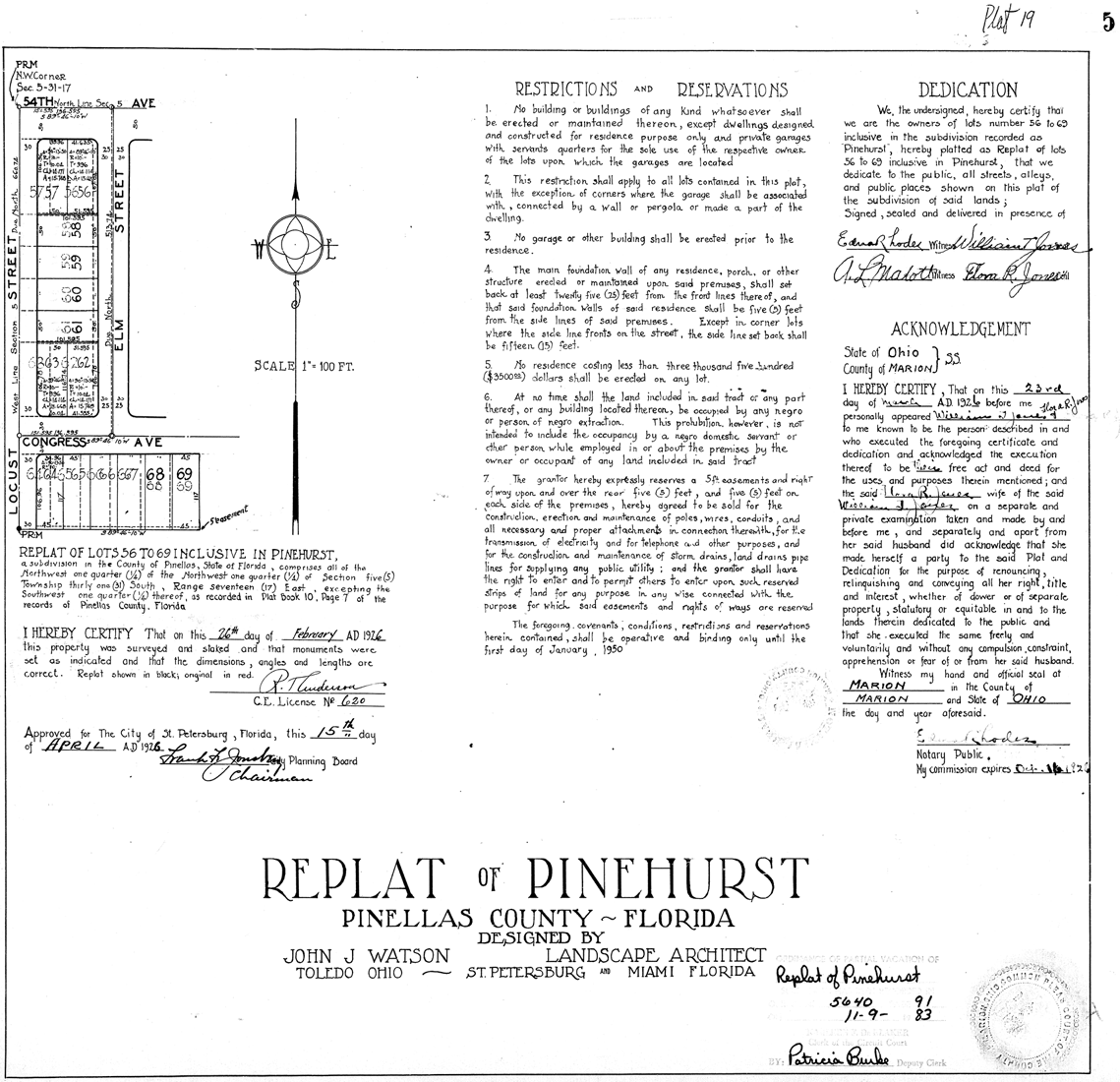
A 1926 subdivision plat containing a racially restrictive covenant. Under the Fair Housing Act, discriminatory restrictions are legally void and unenforceable, though their presence does not invalidate the underlying property deed.
If a title search pulls up an old deed from 1940 that states the property "shall only be sold to persons of the Caucasian race," what happens to the transaction today?
Discriminatory deed restrictions based on protected classes are legally void.
Discriminatory deed restrictions based on protected classes are completely unenforceable.
Crucially, the presence of a legally void discriminatory deed restriction does not invalidate the underlying deed conveying the property.
The property transfer is perfectly valid; the court simply uses an invisible red pen to cross out the illegal, discriminatory sentence.
Lawful Termination of Restrictions
Even valid private land use restrictions do not always last into eternity. There are three primary ways a private land use restriction can be legally terminated:
Mutual Agreement:Private land use restrictions can be terminated by a formal written agreement among all affected property owners. If every single neighbor in the subdivision signs a document agreeing to abandon the restriction on fence heights, the restriction dies.
Time Limit:Private land use restrictions terminate automatically if the original deed includes a specific expiration date for the restrictions. (e.g., "These conditions shall be in effect for a period of 50 years from the date of recording.")
Changed Circumstances:A court can terminate a private land use restriction if neighborhood conditions have changed so drastically that the restriction no longer serves its original purpose. For example, if a 1920 deed restricted a parcel to residential use, but today that parcel is surrounded by a massive industrial park and a six-lane highway, a judge may rule that enforcing the quiet residential restriction is no longer logical or possible.