Equity, Capitalization Rate, and LTV Calculations
Not sure you’re ready?
Take the ~3-minute readiness diagnostic and see where you stand.
Real estate is not merely the transfer of physical land and improvements; it is the transfer of financial geometry. When a client purchases a property, they are not just buying a shelter or a storefront—they are acquiring a position in a mathematical relationship between market value, borrowed capital, and cash flow. To navigate this landscape as a real estate professional, you must master the fundamental computations that define property valuation and mortgage risk. These formulas are not arbitrary hurdles created for a licensing exam; they are the exact mechanisms through which lenders evaluate risk, investors measure yield, and homeowners build wealth.
When we speak of home equity, we are defining the specific financial interest a property owner has in a real estate parcel. It is the portion of the property's value that belongs unequivocally to the owner, unencumbered by debt.
Equity is a dynamic figure, constantly in flux based on two variables: market forces and loan amortization.
The Equity Formula: Home Equity = Current Market Value − Outstanding Mortgage Loan Balance
Because equity is a residual value, a property owner's equity increases under two conditions:
- Appreciation: Equity increases when the market value of the property increases.
- Amortization: Equity increases when the principal balance of the mortgage loan decreases through regular payments.
Conversely, at the exact moment of closing, before any market appreciation or loan paydown has occurred, a buyer's initial equity in a property at the time of purchase equals the total amount of the down payment. If your client purchases a $500,000 home and puts down $100,000, their initial equity is exactly $100,000.
If equity represents the owner's interest, the Loan-to-Value (LTV) ratio represents the lender's exposure. The LTV ratio measures the size of a mortgage loan relative to the value of the property securing the loan.
Mortgage lenders use the Loan-to-Value ratio to assess the financial risk of a loan application. The logic is straightforward: a higher Loan-to-Value ratio indicates a higher level of risk for the mortgage lender. If a borrower defaults, the lender must sell the property to recover the loan balance. A high LTV means a very thin margin of error if property values decline.
Because lenders are intrinsically risk-averse, the calculation contains a built-in conservative safeguard regarding the property's "value."
The LTV Formula: LTV Ratio = Loan Amount ÷ The Lower of the Appraised Value or the Purchase Price
If your client agrees to buy a home for $400,000, but the appraiser values it at $380,000, the lender will calculate the LTV based on the $380,000 figure. The lender will not lend on an inflated purchase price.
The 100 Percent Rule
Property value is effectively split into two slices: the money the buyer brings and the money the lender brings. Therefore, the buyer's down payment percentage plus the Loan-to-Value percentage must equal exactly 100 percent of the property's value.
By definition, an 80 percent Loan-to-Value ratio corresponds to a 20 percent down payment on the property.
LTV Limits and Insurance Constraints
Because higher LTVs carry higher risk, lenders and government-backed programs impose strict thresholds. When the borrower puts down very little capital, the lender typically requires mortgage insurance to offset their exposure.
| Loan Type | Maximum Permitted LTV | Key Rule / Consequence |
|---|---|---|
| Conventional | Varies (often up to 97%) | Conventional loans with a Loan-to-Value ratio above 80 percent typically require the borrower to pay Private Mortgage Insurance (PMI). |
| FHA | 96.5% | FHA loans permit a maximum Loan-to-Value ratio of 96.5 percent for qualified borrowers (requiring a minimum 3.5% down payment). |
| VA | 100% | VA loans permit a maximum Loan-to-Value ratio of 100 percent for qualified veterans, requiring zero down payment. |
| USDA | 100% | USDA rural development loans permit a maximum Loan-to-Value ratio of 100 percent for eligible properties in designated rural areas. |
Transitioning from residential homeownership to commercial investing requires a shift in valuation mechanics. When evaluating an income-producing property, investors do not just look at comparable sales; they look at the yield the property generates.
The capitalization rate (or "cap rate") measures the annual rate of return on an income-producing property. Crucially, to standardize properties across different investors, the capitalization rate assumes the property is purchased entirely with cash. By eliminating the variable of how a specific buyer chooses to finance the deal, the cap rate isolates the pure financial performance of the building itself.
Net Operating Income (NOI)
Before you can calculate a cap rate, you must isolate the correct income figure: the Net Operating Income (NOI).
Net Operating Income is calculated by subtracting total operating expenses from the effective gross income of the property. (Effective gross income is the total potential rent, minus vacancies and credit losses, plus any secondary income like parking fees).
Because the cap rate assumes an all-cash purchase and focuses strictly on the building's operations, two major line items are strictly forbidden from the NOI calculation:
- Debt service payments are explicitly excluded from the calculation of Net Operating Income. (A mortgage is an obligation of the investor, not an operating expense of the property).
- Depreciation expenses are explicitly excluded from the calculation of Net Operating Income. (Depreciation is a paper tax deduction, not an actual out-of-pocket operating expense).
The IRV Formula
The relationship between Income, Rate, and Value forms the cornerstone of investment real estate finance mathematics. We call this the IRV formula.
If you know any two of these variables, you can calculate the third.
The IRV Triad:
- Income: The IRV formula states that Net Operating Income equals the Capitalization Rate multiplied by the Property Value. (I=R×V)
- Value: The IRV formula states that Property Value equals the Net Operating Income divided by the Capitalization Rate. (V=I÷R)
- Rate: The IRV formula states that the Capitalization Rate equals the Net Operating Income divided by the Property Value. Or, at the time of acquisition, the capitalization rate is calculated by dividing the Net Operating Income by the purchase price of the property. (R=I÷V)
The Inverse Relationship of Rate and Value
One of the most profound concepts in real estate finance is how cap rates move in response to price.
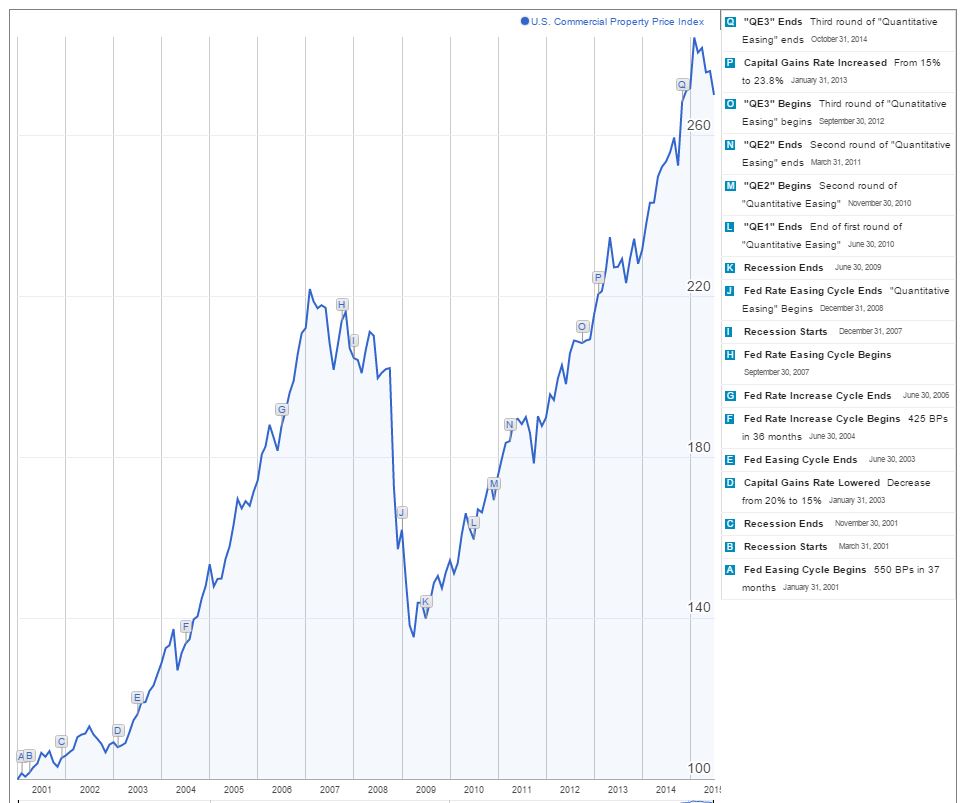
Because of the underlying mathematics of V=I÷R, capitalization rate and property value have an inverse relationship when the Net Operating Income remains constant.
Imagine a building generating exactly $100,000 in NOI year after year.
- If investors demand a 10% return (cap rate), the building is worth $1,000,000. ($100,000 ÷ 0.10)
- If investors demand a 5% return (cap rate), the building is worth $2,000,000. ($100,000 ÷ 0.05)
Therefore, an increase in the capitalization rate results in a lower property value estimate when the Net Operating Income is constant.
Cap Rates as a Measure of Risk
Why would the cap rate go up or down? Risk. The cap rate is the market's assessment of how safe the income stream is.
- A higher capitalization rate generally indicates a higher level of risk for the real estate investor. (For example, an aging apartment building in an area with declining employment might trade at an 8% or 10% cap rate. Investors demand a high yield to compensate for the danger).
- Conversely, a lower capitalization rate generally indicates a lower level of risk for the real estate investor. (A brand-new building leased to a reliable corporate tenant for twenty years might trade at a 4% cap rate. The income is incredibly safe, so investors are willing to pay a premium price, which drives the cap rate down).
While the cap rate evaluates the property in a vacuum (assuming an all-cash purchase), real-world investors usually use leverage (mortgages) and they need metrics to evaluate their specific out-of-pocket performance.
The General Rate of Return
At its broadest level, the general rate of return is calculated by dividing the annual profit by the total investment amount. This simple metric can be applied to almost any asset class, from stocks to a business venture.
Cash-on-Cash Return
For real estate investors seeking to measure the exact efficiency of their leveraged capital, the preferred metric is the cash-on-cash return.
Unlike the cap rate, which uses NOI (ignoring the mortgage), cash-on-cash return evaluates what is left over after the mortgage is paid.
Cash-on-Cash Return Formula: Cash-on-Cash Return = Annual Pre-Tax Cash Flow ÷ Total Cash Invested
Annual pre-tax cash flow is what remains after you take the NOI and subtract the annual debt service.
Total cash invested is the actual liquidity the investor surrendered to acquire the asset. This total cash invested includes the down payment and any closing costs paid out of pocket by the buyer.
For instance, if an investor puts down $50,000 and pays $5,000 in closing costs, their total cash invested is $55,000. If the property generates $5,500 in cash flow over the year after paying the mortgage, their cash-on-cash return is 10% ($5,500 ÷ $55,000).
By mastering these calculations—Equity, LTV, the IRV formula, and Cash-on-Cash returns—you transcend being a mere tour guide of properties. You become a true advisor, capable of mathematically proving a property's worth, diagnosing a lender's risk limits, and architecting an investor's wealth.