Continuing Education and State Registration
A license to practice in any high-stakes profession—whether it is structural engineering, medicine, or the securities industry—is not a permanent certification of competence; it is merely a baseline entry ticket. The financial markets are dynamic ecosystems where regulatory frameworks, product complexities, and fraudulent schemes mutate continuously. To ensure that market participants do not operate on outdated assumptions, the regulatory architecture relies on two distinct mechanisms: mandatory, ongoing knowledge maintenance, and strict geographic jurisdictional boundaries. Just as a physician must keep abreast of novel therapeutics and respect state medical board licensing limits, a registered representative is bound by rigorous Continuing Education mandates and the localized authority of state securities laws.
To maintain the integrity of the market, FINRA demands that financial professionals continuously update their knowledge. However, the knowledge required to operate safely falls into two categories: the universal rules of the regulatory road, and the specific mechanics of the products your firm actually sells.
Therefore, FINRA's Continuing Education program consists of two mandatory components known as the Regulatory Element and the Firm Element.
The Regulatory Element: The Universal Rules
The Regulatory Element of FINRA's Continuing Education program focuses on general compliance, regulatory changes, ethics, and sales practice standards. Because these are macro-level industry standards, the Regulatory Element is administered directly by FINRA, entirely independent of your employer.
FINRA understands that a derivatives trader faces different ethical dilemmas than an investment company products representative. Consequently, FINRA tailors the content of the Regulatory Element to the specific securities registration category held by the registered individual.

You must complete the Regulatory Element annually. Registered persons must complete the Regulatory Element of FINRA's Continuing Education program annually by December 31.
The Penalty Box: CE Inactive Status
What happens if you ignore the December 31 deadline? The regulatory guillotine drops swiftly. A registered person who fails to complete the Regulatory Element by the annual deadline will have their registration status changed to Continuing Education Inactive by FINRA.
CE Inactive Status Consequences An individual with a Continuing Education Inactive status is prohibited from performing any activities that require a securities registration. You cannot solicit clients, execute trades, or offer advice. Furthermore, you are prohibited from receiving compensation for activities that require an active securities registration.
There is one critical, logical exception: registered persons with a Continuing Education Inactive status are permitted to receive trailing commissions for business completed before the inactive status took effect. The logic here is straightforward—you were properly licensed when you earned the business, so you are entitled to the residual payout.
If you remain in this penalty box too long, the door locks behind you. A registered person whose status remains Continuing Education Inactive for a continuous two-year period will have their registration administratively terminated by FINRA. To re-enter the industry, you must pass your qualification exams again.
The Firm Element: Your Specific Mechanics
If the Regulatory Element is the universal driver's manual, the Firm Element is the specific instruction book for the car you are currently driving. The Firm Element of FINRA's Continuing Education program is designed and administered by each individual member firm.
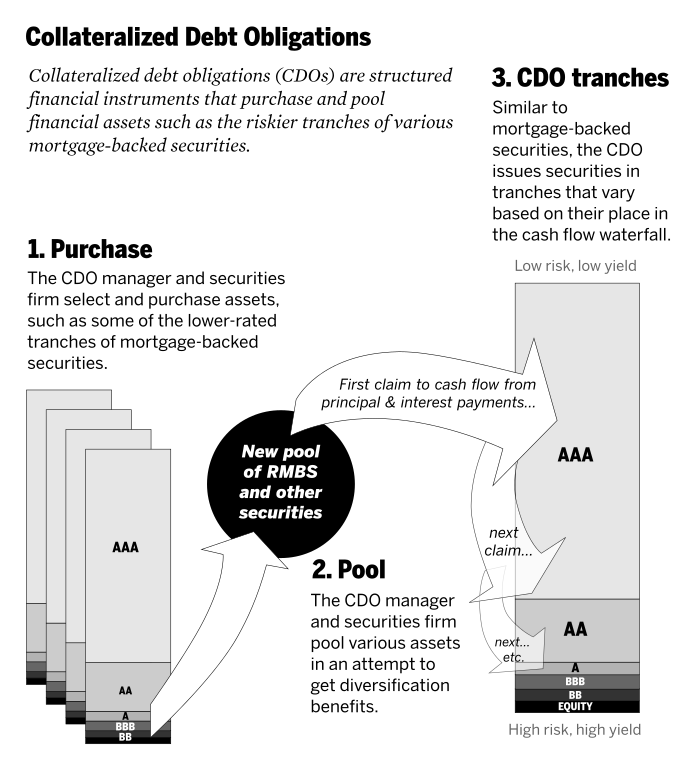
The Firm Element focuses on the specific products, services, risks, and regulatory priorities of the individual member firm. A broker-dealer that exclusively trades municipal bonds will have a vastly different Firm Element curriculum than a firm underwriting complex collateralized debt obligations.
To determine what training is necessary, a broker-dealer must conduct an annual needs analysis to develop its written Firm Element training plan. Once the plan is set:
- All registered securities professionals must complete Firm Element continuing education training on an annual basis.
- Unlike the rigid December 31 FINRA deadline, an individual member firm establishes its own internal deadline for its registered persons to complete the annual Firm Element training.
- Failing to complete the Firm Element training can result in disciplinary action against a registered representative by the employing broker-dealer.
Because broker-dealers already face heavy regulatory training burdens, FINRA allows for operational efficiency. A broker-dealer may use required Anti-Money Laundering (AML) training and Annual Compliance Meetings toward satisfying the Firm Element continuing education requirement for its registered persons.
| Feature | Regulatory Element | Firm Element |
|---|---|---|
| Administered By | FINRA | The employing Broker-Dealer |
| Focus | Ethics, general compliance, regulations | Firm-specific products, services, risks |
| Deadline | December 31 annually | Established internally by the firm |
| Penalty for Failure | CE Inactive Status (FINRA-enforced) | Internal disciplinary action by firm |
The Maintaining Qualifications Program (MQP)
Life is unpredictable. Professionals step away from the industry to raise children, care for sick family members, or pursue other ventures. Historically, leaving the industry for more than two years meant your licenses expired. Today, the Maintaining Qualifications Program (MQP) allows eligible individuals to maintain their securities qualifications for up to five years after terminating their registration by completing annual continuing education. It effectively serves as a five-year pause button for your hard-earned credentials.
Federal laws like the Securities Exchange Act of 1934 regulate the broad, national mechanics of the market. However, the United States relies on a dual-regulatory system. Every state strictly governs the buying and selling of securities within its own borders.
State securities laws are commonly referred to as Blue Sky Laws. The term originated in the early 20th century when a judge declared that certain speculative stock schemes had "no more basis than so many feet of blue sky." Today, Blue Sky Laws are designed to protect investors against fraudulent sales practices and speculative schemes within a specific state jurisdiction.
The Architecture of State Law
Because fifty entirely different sets of laws would paralyze commerce, the Uniform Securities Act serves as a model law that guides individual states in drafting their specific Blue Sky Laws. It creates a baseline template that states can adopt and modify.
To enforce these laws, each state has its own securities regulatory agency overseen by a state securities administrator. These administrators are powerful figures within their borders. On a broader scale, the North American Securities Administrators Association (NASAA) represents state and provincial securities regulators, establishing unified policies and protecting investors at the local level.
Personnel Registration: The Rep and the Firm
The most immediate way Blue Sky Laws impact your day-to-day career is through geographic restrictions. You cannot simply sit in an office in Florida and cold-call prospects in California without the proper state registrations in place.
- Broker-Dealer Registration: Under Blue Sky Laws, a broker-dealer must be registered in a specific state before conducting securities business with residents of that state.
- Representative Registration: A registered representative must hold a valid state-level securities registration in the specific state where a customer resides before soliciting or executing trades for that customer. Passing the Series 63 Uniform Securities Agent State Law Examination is the standard requirement for the state registration of a registered representative.
The "Moving Customer" Scenario This rule applies even to existing clients. If a customer moves to a new state, the registered representative cannot execute trades for that customer until the representative becomes registered in the new state. If your best client retires and moves to Arizona, your priority must be filing your paperwork to register in Arizona before managing their portfolio in their new home.
Registering the Securities: Exemptions and Preemption
Just as the people selling the investments must be registered locally, the investments themselves face state scrutiny. Blue Sky Laws require non-exempt new securities offerings to be registered within a state before being sold to residents of that state.
However, requiring every major corporation to register its stock in all 50 states would be an administrative nightmare. Therefore, certain securities and transactions are exempt from state registration requirements under Blue Sky Laws.
When state laws and federal laws clash or overlap, federal law prevails. Federal securities laws preempt state Blue Sky Laws in areas of overlapping regulation.
The most critical example of this preemption is the National Securities Markets Improvement Act (NSMIA). NSMIA established that securities listed on a national stock exchange (like the NYSE or Nasdaq) are exempt from state-level registration. These are known as "federal covered securities." Because they already meet the rigorous listing standards of national exchanges and the SEC, individual states are prohibited from forcing these companies to register at the state level.

The Ultimate Trump Card: Anti-Fraud Jurisdiction Do not mistake federal preemption for state irrelevance. While NSMIA prevents a state from requiring a nationally listed stock to register, it does not strip the state of its police powers. State securities administrators retain anti-fraud jurisdiction over all securities transactions occurring within their borders regardless of federal preemption.
If a broker in your state is using deceptive practices to sell a federally covered security, the state administrator retains absolute authority to investigate, issue subpoenas, and bring the hammer down on the fraudulent activity. The registration may be preempted by federal law, but the mandate to punish fraud is absolute at the state line.