Algebraic Expressions and Equations
Not sure you’re ready?
Take the ~3-minute readiness diagnostic and see where you stand.
Human language relies on phrases and sentences to communicate meaning. Mathematics operates on the exact same architecture, utilizing a highly precise symbolic language to describe the physical and conceptual relationships of the universe. In this mathematical language, an algebraic expression acts as a mathematical phrase containing numbers, variables, and operations, while an equation forms a complete, declarative mathematical sentence. Understanding how to build, manipulate, and interpret these structures is not merely an exercise in moving symbols around a page; it is the fundamental mechanism we use to model reality, solve unknown quantities, and communicate logical absolute truths.
For elementary educators, mastering this translation between the physical world and algebraic notation is essential. When you teach algebra, you are teaching students how to encode reality into a system where it can be analyzed and solved.
Before we can manipulate algebraic statements, we must understand the individual gears and levers that make them work.
Variables and Constants At the heart of algebra is the variable, a symbol used to represent an unknown or changeable quantity in mathematics. Letters such as x, y, and z are commonly used as variables in algebra to stand in for these fluctuating amounts. In contrast, a constant is a fixed numerical value that does not change. The number 7 will always represent exactly seven units, regardless of the context.
When we multiply a variable by a known number, that numerical factor is called a coefficient. In the notation 4x, the number 4 is the coefficient. It tells us that we have four of whatever quantity x represents.
The Building Blocks: Terms
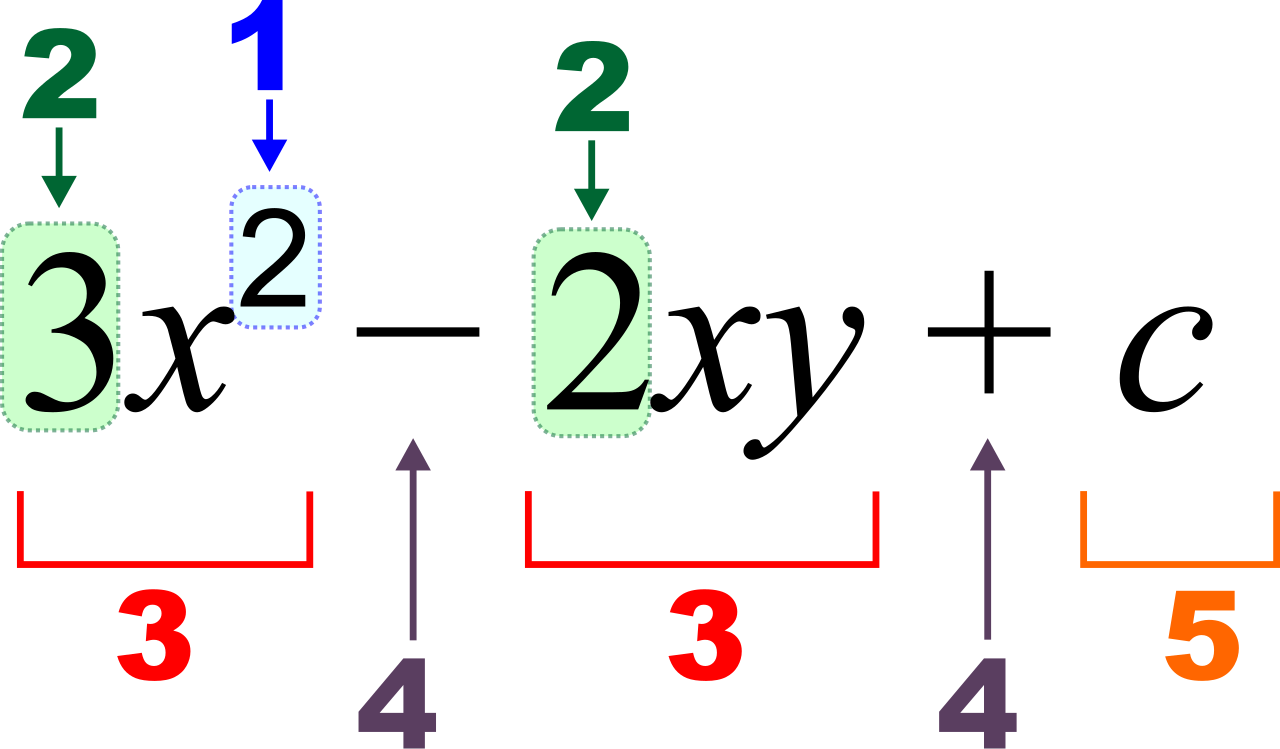
Algebraic structures are built out of individual units called terms. A term is a single number, a single variable, or numbers and variables multiplied together. For instance, 5, y, and 3x2 are all individual terms.
How do we tell where one term ends and another begins? Terms in an algebraic expression are separated by addition or subtraction signs. If you look at the structure 3x+4y−7, you are looking at exactly three terms: 3x, 4y, and −7. Multiplication and division bind numbers and variables tightly together into a single term; addition and subtraction act as the boundaries between them.
Expressions vs. Equations
The most critical distinction in early algebra is differentiating between an expression and an equation. They require completely different treatments and serve entirely entirely different purposes.
- An algebraic expression is a descriptive phrase. Because it is only a phrase, an algebraic expression does not contain an equal sign. It describes a quantity, such as 2x+5, but it makes no claim about what that quantity equals. We can simplify expressions, but we cannot "solve" them for a final numerical answer unless we are given a specific value for the variable.
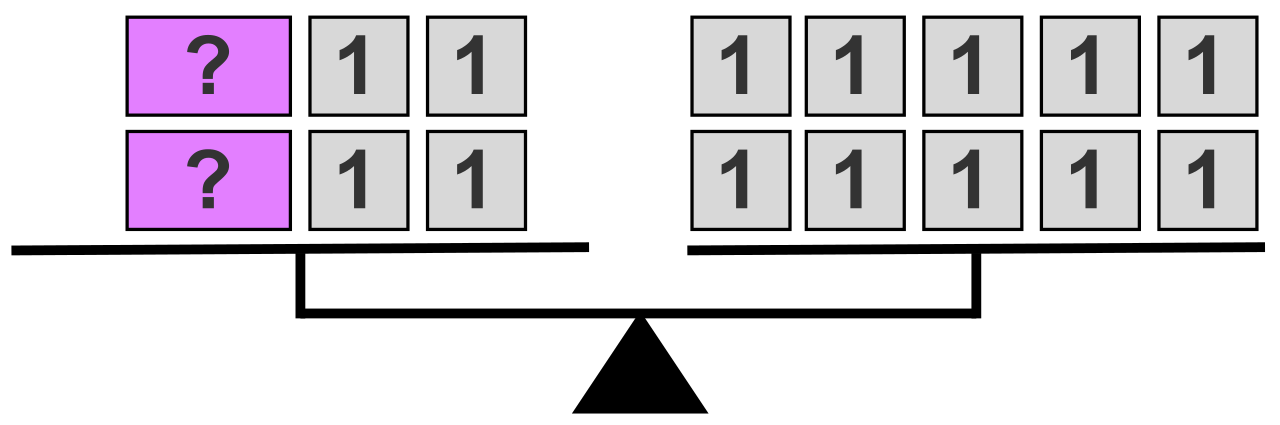
- An equation is a mathematical statement asserting that two mathematical expressions have equal value. To make this assertion, an equation must contain an equal sign. The structure 2x+5=15 is an equation. It definitively claims that the expression on the left balances perfectly with the expression on the right.
In algebra, we frequently encounter expressions that are unnecessarily complex. Just as you would reduce a fraction to its simplest form to make it easier to understand, we simplify algebraic expressions by combining their compatible parts.
Combining Like Terms
To simplify an expression, we look for like terms—terms that contain the exact same variables raised to the exact same powers. For example, 4x and 7x are like terms. The terms 5y and 2y2 are not like terms because, although they share the variable y, they are raised to different powers.
The Rule of Combining Only like terms can be combined using the mathematical operations of addition or subtraction.
If you have 4x (four unknown quantities) and you add 7x (seven of that exact same unknown quantity), you now possess 11x. You have merely updated the coefficient. Furthermore, constants are considered like terms and can be combined together. If an expression contains a +3 and a −8, they combine effortlessly into −5.
Combining like terms simplifies an expression and generates an equivalent algebraic expression. Equivalent expressions are expressions that produce the same numerical value for any value of the substituted variables. The expression 3x+2x+4 and the simplified expression 5x+4 are entirely equivalent. No matter what number you substitute for x, both structures will always yield the exact same result.
The Distributive Property
Sometimes, terms are locked inside parentheses, preventing us from simplifying an expression. To release them, we use the distributive property, a foundational rule that allows multiplying a single term by two or more terms enclosed inside a set of parentheses.
Imagine a rectangular field. The width of the field is a. The length of the field is split into two sections, b and c. The total area of the field is width times total length: a(b+c). Alternatively, you could calculate the area of the two smaller sections independently—ab and ac—and add them together. Both methods must yield the same total area.
Therefore:
- The algebraic formula for the distributive property over addition is a(b+c)=ab+ac.
- The algebraic formula for the distributive property over subtraction is a(b−c)=ab−ac.
If you encounter the expression 3(2x−4), you apply the 3 to every term inside the parentheses via multiplication, yielding 6x−12. You have now generated a simpler, equivalent linear algebraic expression ready for further manipulation.
When we finally discover the actual numerical value of a variable, or when we want to test a hypothesis, we evaluate the expression.
Evaluating an algebraic expression requires replacing each variable with a specific numerical value. It transforms our generalized algebraic blueprint into a concrete arithmetic calculation.
Suppose we have the expression 2x2−3x+5 and we are told that x=4. We substitute 4 wherever an x appears: 2(4)2−3(4)+5
Crucially, once the substitution is complete, the rules of arithmetic take over. The mathematical order of operations must be applied to evaluate an expression after substituting numerical values for variables. Following the order of operations (PEMDAS):
- Exponents first: (4)2=16. The expression becomes 2(16)−3(4)+5.
- Multiplication next: 2(16)=32 and 3(4)=12. The expression becomes 32−12+5.
- Addition and Subtraction last (left to right): 32−12=20, and 20+5=25.
The evaluated result is 25.
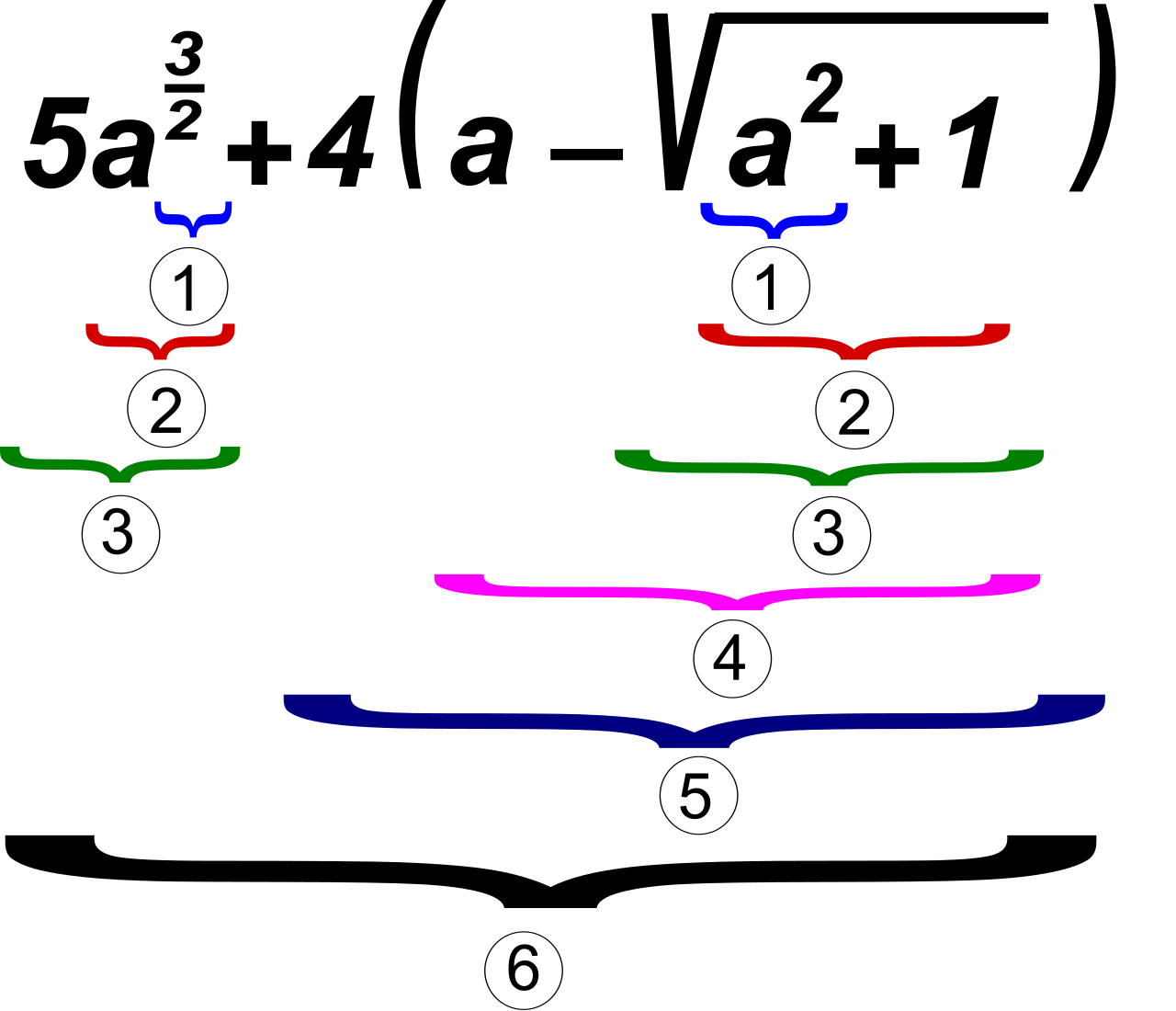
Algebra's immense utility comes from its ability to model real-world scenarios. To utilize it, educators and students must learn how to fluently translate English vocabulary into mathematical operators. Translating between verbal statements and algebraic expressions or equations is akin to mastering the vocabulary of a foreign language.
Here is the essential lexicon used to decode verbal math problems:
Addition and Subtraction
- The verbal phrase "sum of" translates to the mathematical operation of addition. ("The sum of x and 4" →x+4)
- The verbal phrase "more than" translates to the mathematical operation of addition. ("Five more than y" →y+5)
- The verbal phrase "difference of" translates to the mathematical operation of subtraction. ("The difference of 10 and x" →10−x)
- The verbal phrase "less than" translates to the mathematical operation of subtraction.
A Critical Pitfall: "Less Than" Translating a verbal phrase containing "less than" requires reversing the order of the terms in the algebraic subtraction expression. This is the most common error in early algebra. If a problem states "seven less than x," you are starting with x and removing seven. The correct translation is x−7, not 7−x.
Multiplication and Division
- The verbal phrase "product of" translates to the mathematical operation of multiplication. ("The product of 3 and y" →3y)
- The verbal phrase "times" translates to the mathematical operation of multiplication. ("Four times z" →4z)
- The verbal phrase "quotient of" translates to the mathematical operation of division. ("The quotient of x and 2" →2x)
- The word "twice" in a verbal mathematical statement translates to multiplying a quantity by the number two. ("Twice the sum of x and 1" →2(x+1))
- The word "half" in a verbal mathematical statement translates to multiplying a quantity by one-half or dividing a quantity by two. ("Half of x" →21x or 2x)
Establishing Equality
How do we know when to construct an expression versus an equation? We look for the verbs that assert a definitive outcome or state of being.
- The word "is" in a verbal mathematical statement translates to an equal sign in an algebraic equation. ("Five more than x is twelve" →x+5=12)
- The word "yields" in a verbal mathematical statement translates to an equal sign in an algebraic equation. ("The product of x and 3 yields 15" →3x=15)

Putting Translation into Practice
Let us synthesize these translation rules by parsing a complex verbal statement: "Twice the difference of a number and four yields half of that number."
- Identify the variable: "a number" and "that number" can be represented by x.
- Translate "difference of a number and four": (x−4). We use parentheses because the next operation applies to the entire difference.
- Translate "Twice": Multiply the difference by two: 2(x−4).
- Translate "yields": Add the equal sign: =.
- Translate "half of that number": 21x.
The final, fully translated algebraic equation is: 2(x−4)=21x
Through identifying constants, wielding coefficients, combining like terms, and accurately translating human vocabulary into symbolic operators, we equip students with the tools to map the universe mathematically. This capacity to turn the verbal into the algebraic—and manipulate those structures to unearth new truths—is the beating heart of mathematical fluency.