The US Constitution and Bill of Rights
Not sure you’re ready?
Take the ~3-minute readiness diagnostic and see where you stand.
Constructing a nation requires more than shared ideals; it requires the precise application of political physics. A government must possess enough concentrated force to maintain order and direct commerce, yet incorporate enough structural friction to prevent that force from crushing individual liberty. The trajectory of the United States from its first, fragile governing framework to its enduring constitutional order represents a masterclass in political engineering—a shift from a decentralized, voluntary alliance to a sovereign, federated republic. Understanding this transition is not merely a historical exercise for social studies educators; it provides the essential mechanics for explaining to students how modern political power is contained, negotiated, and wielded in their everyday lives.
To understand the United States Constitution, you must first understand the system that spectacularly failed before it. The Articles of Confederation were ratified in 1781 as the first framework of government for the United States. Drafted during the Revolutionary War, the architects of the Articles were terrified of tyrannical central authority—so they purposefully built an engine that lacked a drive shaft.
The Articles of Confederation established a weak central government that lacked the authority to enforce laws across the states. It was less a nation and more a "firm league of friendship" between independent countries. The structural deficiencies were fatal:
- No Revenue: A government without money is a government in name only. Under the Articles of Confederation, the national government had no power to levy taxes directly on citizens. It could only ask states for funds. Consequently, the inability of the national government to collect taxes led to severe national debt and economic instability following the Revolutionary War.
- No Economic Control: Under the Articles of Confederation, the national government could not regulate interstate or foreign commerce. States printed their own worthless currencies and slapped tariffs on each other's goods, strangling economic growth.
- No Enforcement or Dispute Resolution: Congress could pass resolutions, but Congress under the Articles of Confederation lacked a permanent executive branch to enforce legislation. Furthermore, it lacked a national court system to resolve disputes between states.
- Legislative Gridlock: To do anything meaningful, the hurdle was impossibly high. The Articles of Confederation required the approval of nine out of thirteen states to pass new national laws. Worse, the Articles of Confederation required a unanimous vote of all thirteen states to amend the document.
The Breaking Point: Shays' Rebellion
By 1786, the theoretical flaws of the Articles had become a bloody reality. Shays' Rebellion was a 1786 armed uprising in Massachusetts led by farmers facing debt and property foreclosure. When these desperate farmers marched on courthouses to stop their farms from being seized, the national government was powerless to intervene. It had no army and no money to raise one.
When teaching this to high schoolers, frame it as a catastrophic systems failure: Shays' Rebellion demonstrated the inability of the central government under the Articles of Confederation to maintain public order. The nation was teetering on the brink of anarchy. The political elite realized the first framework was unsalvageable.
In response to the looming crisis, delegates gathered in the summer heat. The Constitutional Convention took place in Philadelphia from May to September 1787. Interestingly, the Constitutional Convention was initially convened to revise the Articles of Confederation before delegates decided to create an entirely new framework.
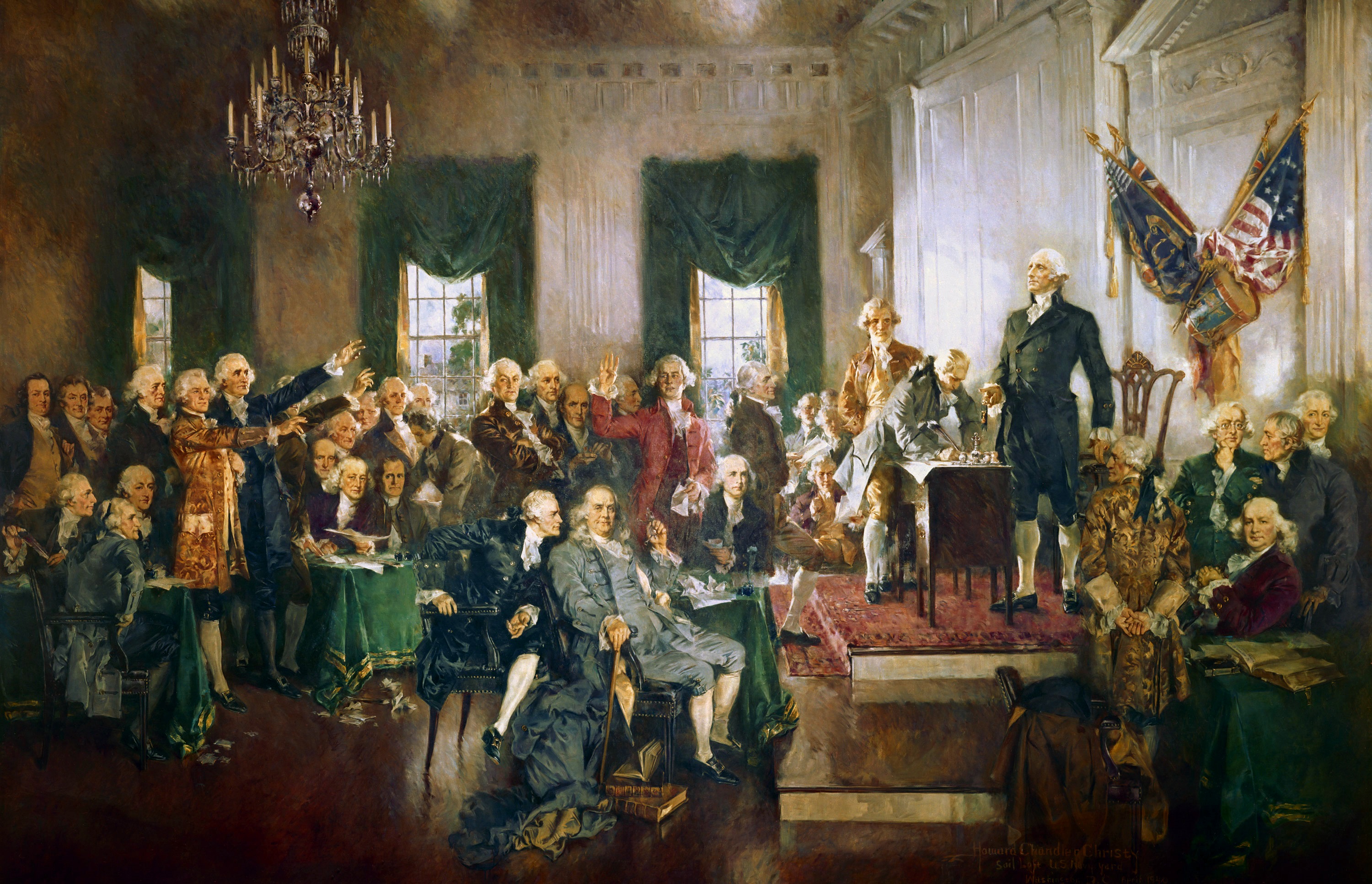
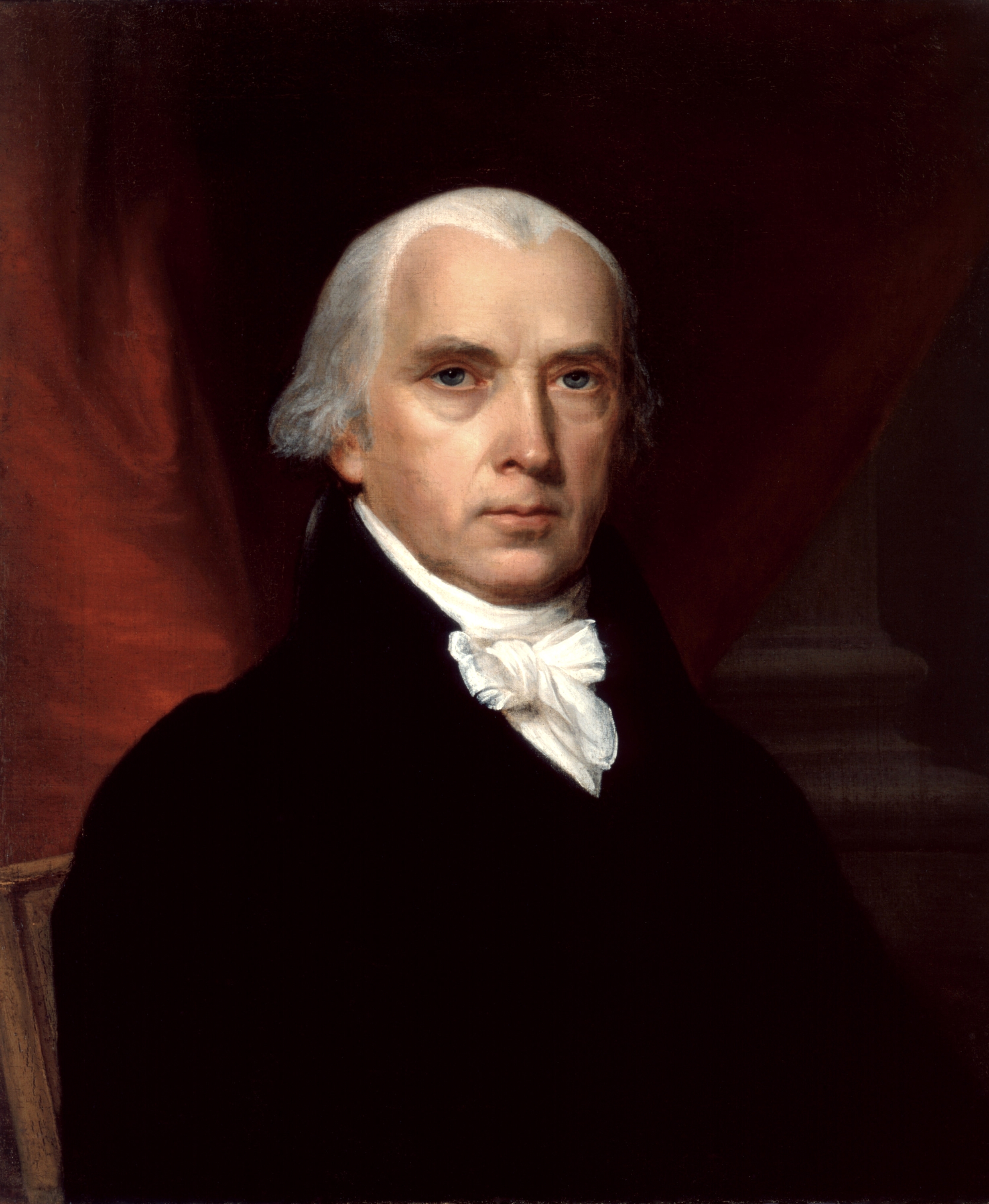
At the center of this engineering effort was a brilliant, obsessive scholar of political history. James Madison is known as the Father of the Constitution for his pivotal role in drafting the document. Madison recognized that fixing the government required solving a deeply mathematical problem: How do you allocate representation among states of vastly different sizes and economic models?
The Clash of State Interests
Two competing blueprints were thrown onto the table, setting up the most critical conflict of the Convention:
| Proposal | Legislative Structure | Core Argument & Beneficiary |
|---|---|---|
| The Virginia Plan | The Virginia Plan proposed a bicameral national legislature with representation based on state population. | The Virginia Plan favored larger, more populous states by giving those states more power in the national legislature. |
| The New Jersey Plan | The New Jersey Plan proposed a unicameral national legislature with equal representation for every state. | The New Jersey Plan favored smaller states by preventing larger states from dominating the national legislature. |
The delegates were deadlocked. The solution was an elegant hybrid that shapes American politics to this day. The Great Compromise created a bicameral legislature consisting of a Senate and a House of Representatives.
- To satisfy the small states: In the Senate created by the Great Compromise, each state is granted two representatives regardless of the state's population.
- To satisfy the large states: In the House of Representatives created by the Great Compromise, representation is apportioned based on state population.
The Dark Arithmetic of Slavery
The most morally devastating compromises of the Convention revolved around the institution of slavery. Southern states wanted enslaved people counted for representation (to gain power) but not for taxation; Northern states argued the opposite.
The resulting math was brutal. The Three-Fifths Compromise determined that three-fifths of an enslaved population would count toward a state's total population for representation and taxation. As a prospective social studies teacher, you must emphasize the direct political effect of this: The Three-Fifths Compromise artificially increased the political power of Southern slaveholding states in the House of Representatives, giving them a disproportionate grip on the federal government for the next seventy years.
Furthermore, to keep Southern states at the table, the delegates agreed to the Commerce and Slave Trade Compromise, [which] prohibited Congress from banning the transatlantic slave trade before the year 1808.
Finally, the delegates had to decide how to elect the chief executive. Distrusting both the uneducated masses and the potential corruption of the legislature, the Electoral College was established as a compromise between electing the president by a direct popular vote and electing the president by a vote of Congress.
The resulting document was a marvel of defensive engineering. The US Constitution establishes three branches of government: the legislative, executive, and judicial branches.
Key Concept: The Constitution doesn't just grant power; it deliberately fragments it.
- Separation of powers divides governmental authority among three distinct branches to prevent any single branch from becoming too powerful.
- Checks and balances constitute a system wherein each branch of government possesses the ability to limit the powers of the other branches.
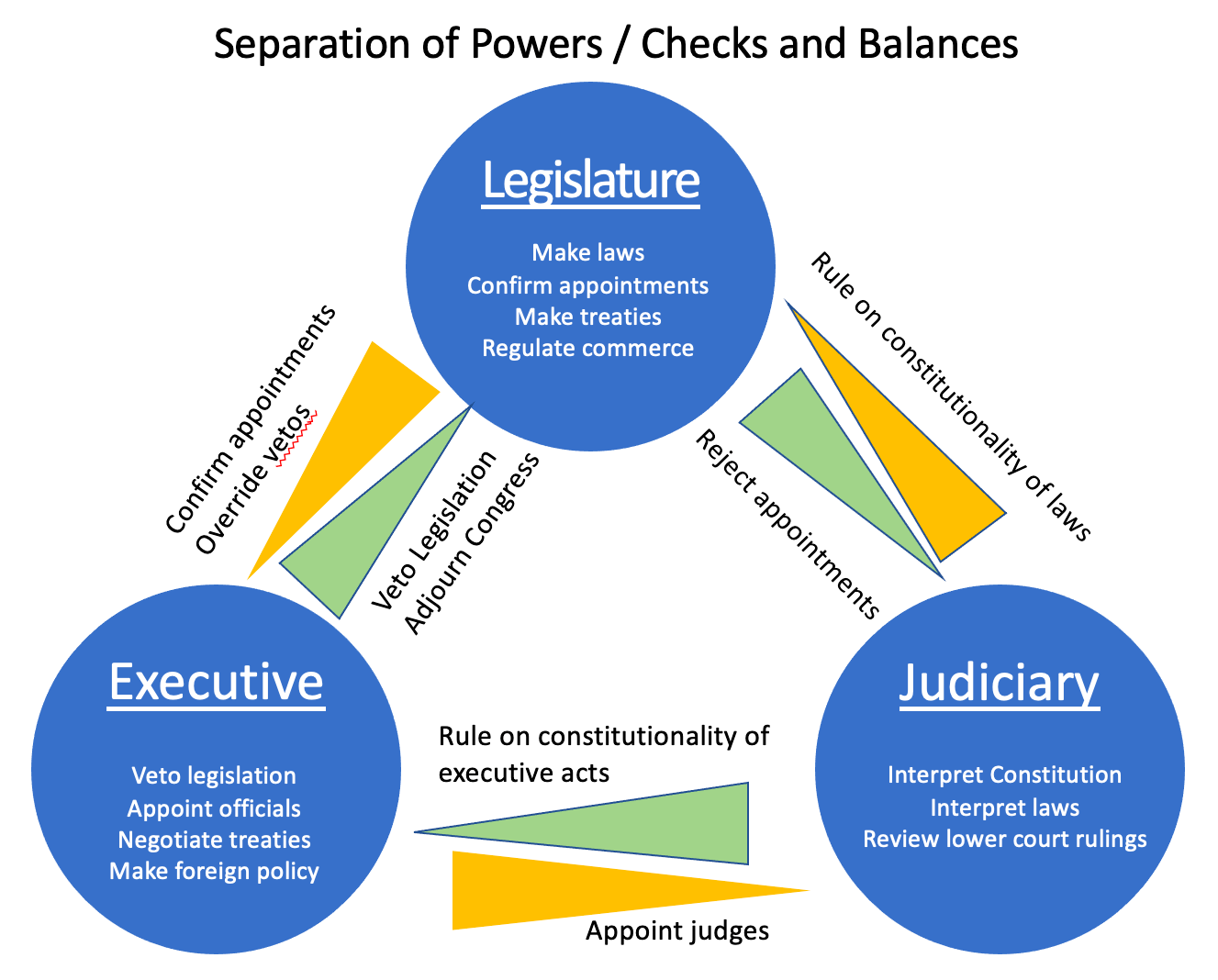
When your students ask why the government seems slow or argumentative, tell them it is working exactly as designed. The framers introduced intentional friction so that no sudden wave of populism or tyrannical executive could easily seize total control.
This structure is laid out directly in the text:
- Article I of the US Constitution outlines the powers and structure of the legislative branch.
- Article II of the US Constitution outlines the powers and structure of the executive branch.
- Article III of the US Constitution outlines the powers and structure of the judicial branch.
Beyond separating power horizontally, the Constitution separates it vertically. Federalism is the division of political power between a central national government and individual state governments. Yet, the framers had learned the lesson of the Articles of Confederation. To ensure the nation functioned as a single sovereign entity, the Supremacy Clause in Article VI establishes that the US Constitution and federal laws take precedence over state laws.
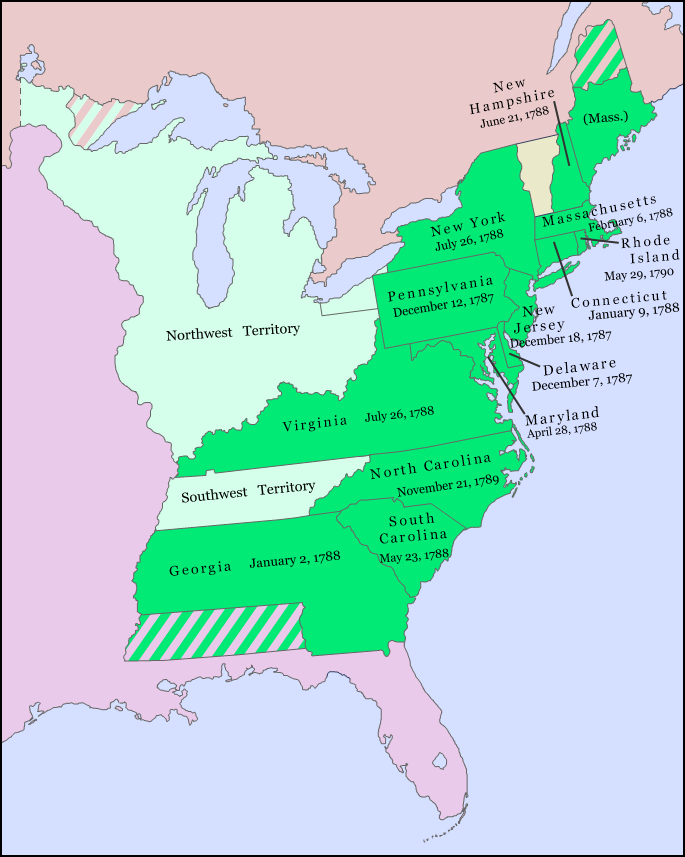
Drafting the Constitution was only half the battle. Now, it had to be legally enacted. Ratification of the US Constitution required the formal approval of nine out of thirteen states. This sparked the greatest public debate in American history, dividing the country into two fierce intellectual camps.
The Federalists
Federalists were supporters of the newly drafted US Constitution who advocated for a strong central government. Their argument was entirely pragmatic: Federalists believed a strong national government was necessary to maintain order, manage the national economy, and protect the country against foreign threats.
To win over a skeptical public, Alexander Hamilton, James Madison, and John Jay wrote a collection of 85 essays known as The Federalist Papers. As educators, you can frame these essays as the ultimate op-ed campaign. The Federalist Papers were published to persuade the public and state conventions to ratify the US Constitution.
Two of these essays remain the bedrock of American political theory:
- Federalist No. 10, written by James Madison, argued that a large republic would prevent any single political faction from dominating the government. Madison brilliantly flipped the script: instead of fearing that a large country would be impossible to govern, he argued that a large country would possess so many competing interests that no single group could form a tyrannical majority.
- Federalist No. 51, written by James Madison, explained how separation of powers and checks and balances would prevent government tyranny. As Madison famously wrote, "Ambition must be made to counteract ambition."
The Anti-Federalists
On the other side were the skeptics. Anti-Federalists opposed the ratification of the US Constitution because Anti-Federalists feared a strong central government would threaten individual liberties. Having just fought a revolution against a distant, powerful King in London, they had no desire to install a distant, powerful President in a new national capital.
Anti-Federalists favored preserving political power within the individual state governments rather than centralizing power. They believed state governments were closer to the people and more responsive. Prominent Anti-Federalists included Patrick Henry, George Mason, and Richard Henry Lee.
Their most potent weapon in the debate was pointing out what the Constitution lacked. Anti-Federalists heavily criticized the original US Constitution for lacking a specific enumeration of individual rights. They demanded a guarantee in writing that the new government wouldn't crush their freedoms.
Federalists initially argued that a bill of rights was unnecessary because the US Constitution only granted limited, specific powers to the national government. Hamilton argued in Federalist No. 84 that listing rights was actually dangerous—if you list them, might a future tyrant assume that any unlisted right is not protected?
However, political reality forced their hand. To secure ratification from hesitant states, Federalists promised to add a series of amendments protecting individual liberties to the US Constitution.
This promise resulted in the most famous tenet of American constitutional law. The Bill of Rights consists of the first ten amendments to the United States Constitution. Fulfilling the Federalists' bargain, the Bill of Rights was ratified and added to the United States Constitution in 1791.
When teaching the Bill of Rights, avoid rote memorization. Frame them as direct reactions to the abuses suffered under British rule—they are the literal "never again" clauses of the American Revolution:
- The First Amendment protects the freedoms of religion, speech, the press, assembly, and petition. This is the intellectual lifeblood of the republic.
- The Second Amendment protects the right of the people to keep and bear arms. Born from the reliance on state militias during the Revolution.
- The Third Amendment restricts the quartering of soldiers in private homes without the property owner's consent. A direct reaction to the British Quartering Acts.
- The Fourth Amendment protects citizens from unreasonable searches and seizures by the government. Tell your students: this is why a police officer cannot simply kick down your door or search your phone without a warrant.
- The Fifth Amendment provides protections against self-incrimination, double jeopardy, and the deprivation of property without due process of law. The right to remain silent, and the promise of legal fairness.
- The Sixth Amendment guarantees the right to a speedy and public trial by an impartial jury in criminal cases. Secret tribunals are banished.
- The Seventh Amendment guarantees the right to a jury trial in federal civil cases.
- The Eighth Amendment prohibits the federal government from imposing excessive bail, excessive fines, and cruel and unusual punishments. The state cannot torture its citizens.
Finally, to address the philosophical concerns of the Federalists (who worried about listing rights) and the Anti-Federalists (who demanded state sovereignty), Madison drafted two vital bookends:
- The Ninth Amendment states that the enumeration of certain rights in the US Constitution does not deny other rights retained by the people. (You have rights beyond what is written here).
- The Tenth Amendment reserves all powers not delegated to the federal government to the states or to the people. This is the bedrock of states' rights, explaining why, today, high school graduation requirements or local speed limits vary wildly from state to state.
By mastering the mechanical failures of the Articles, the complex political physics of the Constitutional Convention, and the philosophical compromises of Ratification, you are not merely preparing to pass the Praxis. You are equipping yourself to explain to the next generation exactly how their world is wired.