Identifying Arithmetic Counterexamples
Not sure you’re ready?
Take the ~3-minute readiness diagnostic and see where you stand.
In mathematics, a universal claim is an absolute promise. To state that "all numbers behave a certain way" or "every mathematical operation yields a specific result" is to forge an ironclad contract covering infinitely many possibilities. If that contract is violated even a single time, the entire mathematical statement shatters. You do not need to check an infinite number of cases to disprove a universal law; you only need to find the one anomaly that refuses to conform.
In the pursuit of mathematical truth, we must distinguish between what happens sometimes and what happens always.
A mathematical counterexample is a specific case demonstrating that a general statement is false.
When a student or a mathematician encounters a proposed rule, the instinct shouldn't just be to confirm it, but to rigorously attempt to break it. Finding a single counterexample is sufficient to prove that a universal mathematical statement is false. It does not matter if a rule works for a billion numbers; an arithmetic statement is considered mathematically false if there is even one valid counterexample. A counterexample proves definitively that a proposed mathematical rule does not apply universally.
The Illusion of Confirmation
It is a common trap to test a few friendly numbers, see that a rule holds, and declare it true. For instance, consider the statement: "If a number is multiplied by 2, the result is an even number." You might test 3, 4, and 5. The results are 6, 8, and 10—all even.
However, the existence of multiple examples supporting a mathematical statement does not prove the absence of a counterexample. If we test a fraction, say 1.5, we get 1.5×2=3. Three is not an even number. The rule is broken. The confirming examples were an illusion of universality.
Breaking Conditional Statements
Many mathematical claims take the form of conditional statements: "If [Hypothesis], then [Conclusion]."
To successfully construct a counterexample to a conditional statement, you must do two things simultaneously:
- Satisfy the statement's given hypothesis. You must enter the domain the rule claims to govern.
- Make the statement's conclusion false. You must show that the promised outcome fails to materialize.
If a claim states, "If an animal is a bird, then it can fly," finding a flying bat does not help you (it fails the hypothesis). Finding a walking dog does not help you (it also fails the hypothesis). You must find an ostrich: a bird (satisfies the hypothesis) that cannot fly (makes the conclusion false).

When evaluating arithmetic claims on the Praxis Core Mathematics exam, random guessing is inefficient. A student evaluating an arithmetic claim must test various categories of numbers to systematically search for a counterexample.
We look for the "boundary cases"—the numbers that behave strangely compared to everyday counting numbers. The standard categories of numbers to test for counterexamples include:
- Zero (0)
- One (1)
- Positive Integers (2,3,4…)
- Negative Integers (−1,−2,−3…)
- Proper Fractions (Numbers strictly between 0 and 1, or −1 and 0)

Let us systematically apply this toolkit to dismantle several classic false statements.
1. The Peculiar Power of Zero
Zero is the great destroyer of arithmetic assumptions. It absorbs multiplication, collapses addition to a standstill, and outright breaks division.
The False Claim: "Division by any real number yields a real number." The Counterexample: The number zero serves as a counterexample to the false statement claiming division by any real number yields a real number. If we take 5 and divide it by 0, the result is not a real number; it is mathematically undefined. The hypothesis (a real number) is met by 0, but the conclusion (yields a real number) fails.
2. The Identity Crisis of One
Because 1 is the multiplicative identity, it often ruins claims that assume multiplication always scales a value upward or downward.
The False Claim: "Multiplying a real number by a positive integer strictly increases the value of the original number." The Counterexample: The number one serves as a counterexample to the false statement claiming multiplying a real number by a positive integer strictly increases the value of the original number. Let our real number be 8 and our positive integer be 1. 8×1=8. The value remained identical; it did not strictly increase.
3. The Reversal of Proper Fractions
When we deal with positive integers, squaring a number makes it explode in size. Multiplying them makes them grow. But step into the fractional world between 0 and 1, and the universe turns upside down.
The False Claim: "Squaring a number always produces a larger number." The Counterexample: Proper fractions between zero and one serve as counterexamples to the claim that squaring a number always produces a larger number. Take the proper fraction 21. When we square it: (21)2=41. The result, 0.25, is smaller than the original 0.50.
The False Claim: "Multiplying two positive numbers always produces a product larger than both factors." The Counterexample: Proper fractions between zero and one serve as counterexamples to the claim that multiplying two positive numbers always produces a product larger than both factors. If we multiply 21×31, we obtain 61. The product (61) is vastly smaller than both of the starting factors.
4. The Hidden Nature of Negative Integers
Negative integers behave contrary to our baseline intuition about magnitude and roots. They are prime hunting grounds for counterexamples, especially when variables are squared or cubed.
The False Claim: *"The square root of a squared number is exactly equal to the original number, or x2=x."∗∗∗TheCounterexample:∗∗Negativeintegersserveascounterexamplestothefalseclaimthatthesquarerootofasquarednumberisexactlyequaltotheoriginalnumber.Letx = -4.First,wesquareit:(-4)^2 = 16. Next, we take the [principal square root](https://en.wikipedia.org/wiki/Square_root) of \16,whichis4.Ourfinalresultis4,whichdoesnotequalouroriginalnumber,-4.(Thetruemathematicalruleis\sqrt{x^2} = |x|$).
The False Claim: "The sum of two numbers is always greater than either individual number." The Counterexample: Negative integers serve as counterexamples to the false claim that the sum of two numbers is always greater than either individual number. Consider $-5 and \-10. Their sum is \-15.Because-15 is further to the left on the [number line](https://en.wikipedia.org/wiki/Number_line), it is *less* than both \-5 and \-10$.
The False Claim: "The cube of any non-zero integer is a positive integer." The Counterexample: Negative integers serve as counterexamples to the false statement claiming the cube of any non-zero integer is a positive integer. If we take $-2andcubeit:(-2) \times (-2) \times (-2) = -8$. The result is explicitly negative.
5. The Lonely Even Prime
Sometimes, a counterexample doesn't require testing an infinite category, but rather knowing a single definitional anomaly.
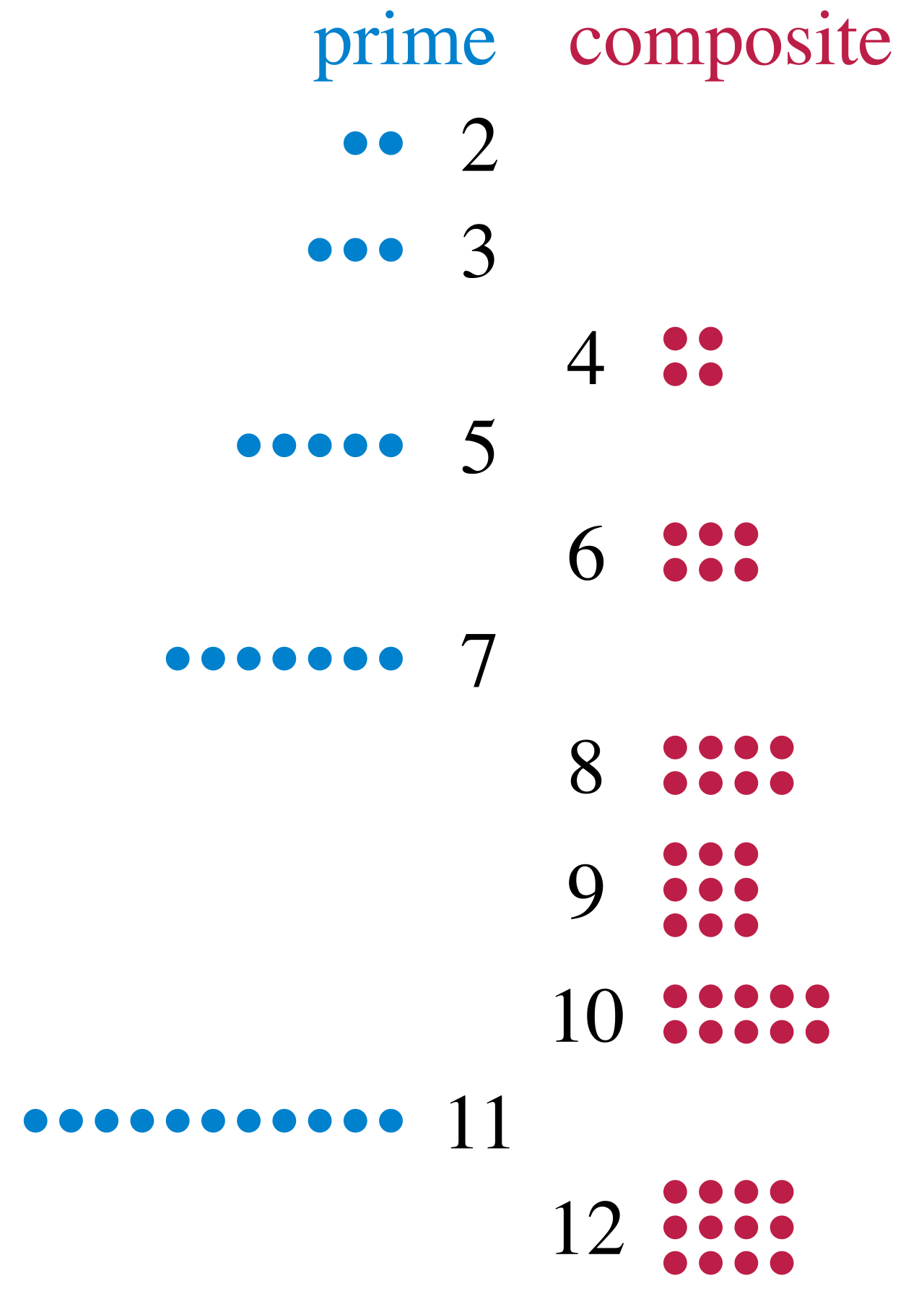
The False Claim: "All prime numbers are odd numbers." The Counterexample: The number two serves as a counterexample to the false mathematical statement claiming all prime numbers are odd numbers. A prime number is defined as a whole number greater than $1whoseonly[divisors](https://en.wikipedia.org/wiki/Divisor)are1 and itself. Two divides perfectly by only \1 and \2$, satisfying the hypothesis. However, two is an even number, making the conclusion false.
When faced with evaluating mathematical statements on the Praxis Core, use this table as your systematic mental checklist. If a statement feels "too broad," run it through these boundary cases immediately.
| Number Category | Best Used to Disprove Claims About... | Classic Counterexample Action |
|---|---|---|
| Zero ($0$) | Division, positive/negative outcomes | x÷0 is undefined, not a real number. |
| One (1) | Multiplication increasing values | x×1=x (value does not strictly increase). |
| Proper Fractions (0<x<1) | Multiplication/squaring increasing values | (21)2=41 (squaring makes it smaller). |
| Negative Integers (−x) | Addition increasing values, roots, cubes | (−3)2=3=−3; (−2)3=−8. |
| The Number $2$ | Properties of prime numbers | The only prime number that is even, disproving "all primes are odd." |
Remember, true mathematical comprehension is not just about knowing when a rule works. It is about understanding the exact, precise boundaries where the rule finally falls apart. Find the crack, insert the counterexample, and the entire false premise will shatter.