Properties of Angles and Intersecting Lines
Not sure you’re ready?
Take the ~3-minute readiness diagnostic and see where you stand.
Imagine a structural engineer drafting the blueprints for a steel suspension bridge. The beams and cables slicing across each other are not placed randomly; they are governed by a rigid, inescapable mathematical symmetry. The moment two lines cross in space, they birth a system of relationships that dictates the physical world. In geometry, an angle is formed by two rays sharing a common endpoint. That exact, microscopic anchor—called the vertex—is the pivot around which our entire understanding of spatial relationships revolves. To master the geometry of the Praxis Core exam, we must understand how these vertices behave when lines collide, run side-by-side, or slice through one another.

The most fundamental interaction in two-dimensional space occurs when lines cross. By definition, intersecting lines are lines that cross each other at exactly one point. When this happens, space is suddenly divided into four distinct regions around the vertex, giving rise to two highly specific relationships between the newly formed angles.

Adjacent vs. Vertical Angles
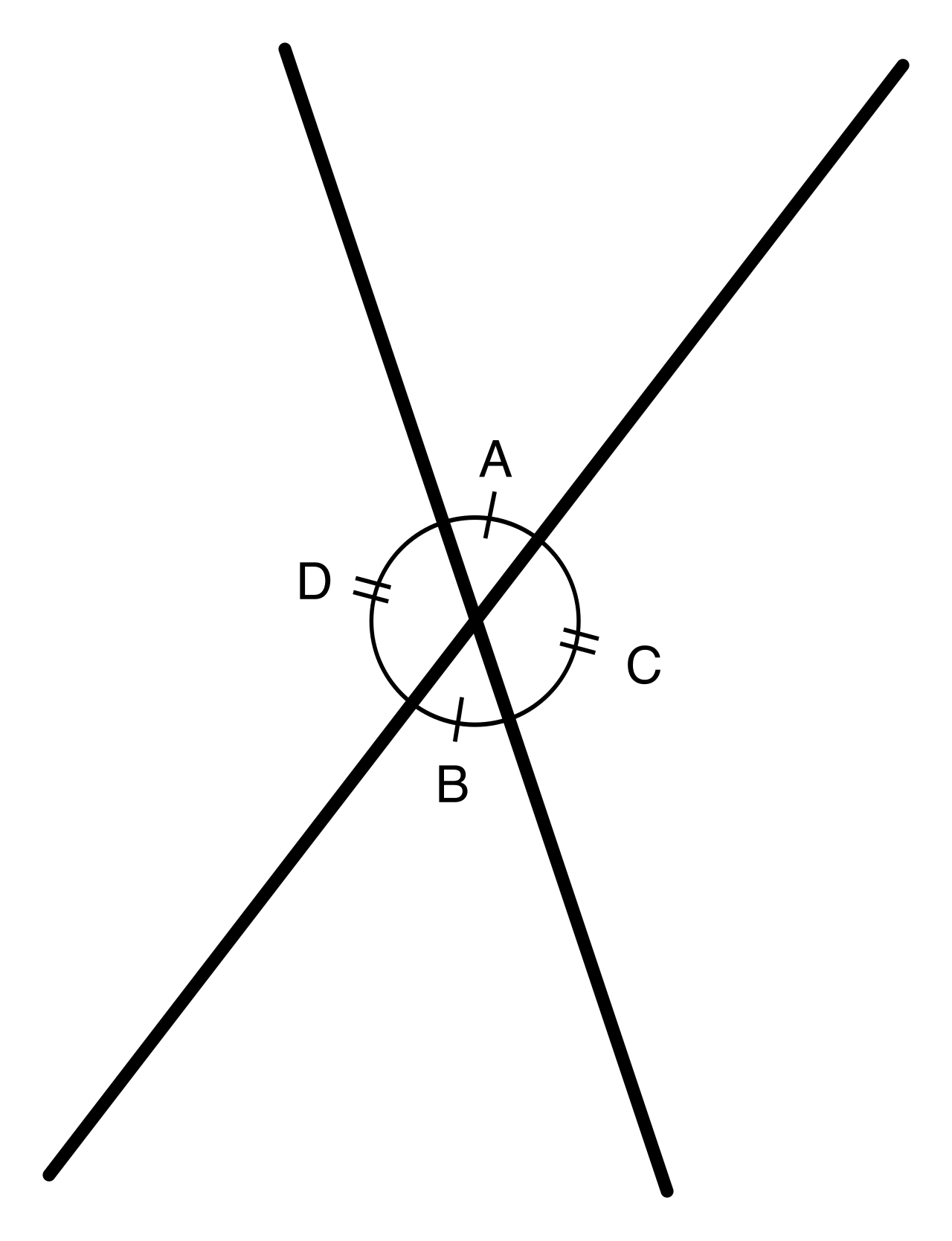
If you look at the four angles around an intersection, you will notice that they come in two varieties based on their placement:
- Adjacent angles are two angles that share a common vertex and a common side. They sit right next to each other. However, to be truly adjacent, adjacent angles do not share any interior points. They are neighbors separated by a fence (the common ray), never overlapping.
- Vertical angles are the pairs of non-adjacent angles formed by the intersection of two lines. They sit directly across the vertex from one another.
Because lines are perfectly straight, they impose a strict mirror-like symmetry on intersections. This leads us to one of the most powerful bedrock rules of geometry: Vertical angles are always congruent to each other. If the top angle of an intersection is 110∘, the bottom angle is fundamentally forced to be 110∘ as well.
Before we scale our view to grander intersections, we need a precise vocabulary for how angles combine. Certain angle measurements are so critical to mathematics that they possess specific names.
A right angle has a measure of exactly 90 degrees. A straight angle has a measure of exactly 180 degrees.
These two measurements form the basis for understanding how adjacent angles interact:
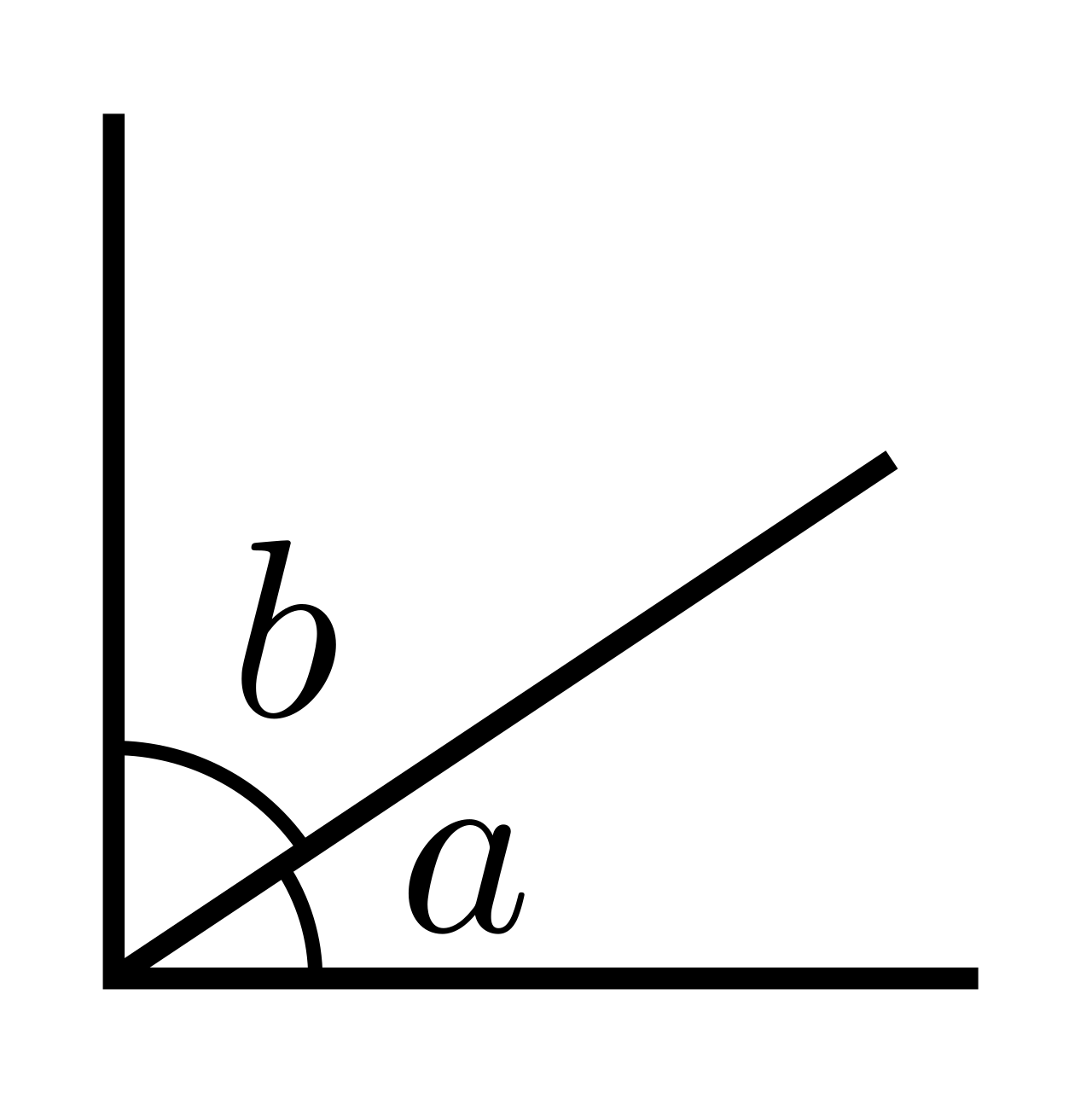
- Complementary angles: These are two angles whose measures add up to exactly 90 degrees. If a right angle is split into two smaller angles, those two angles are complementary.
- Supplementary angles: These are two angles whose measures add up to exactly 180 degrees.
The Linear Pair
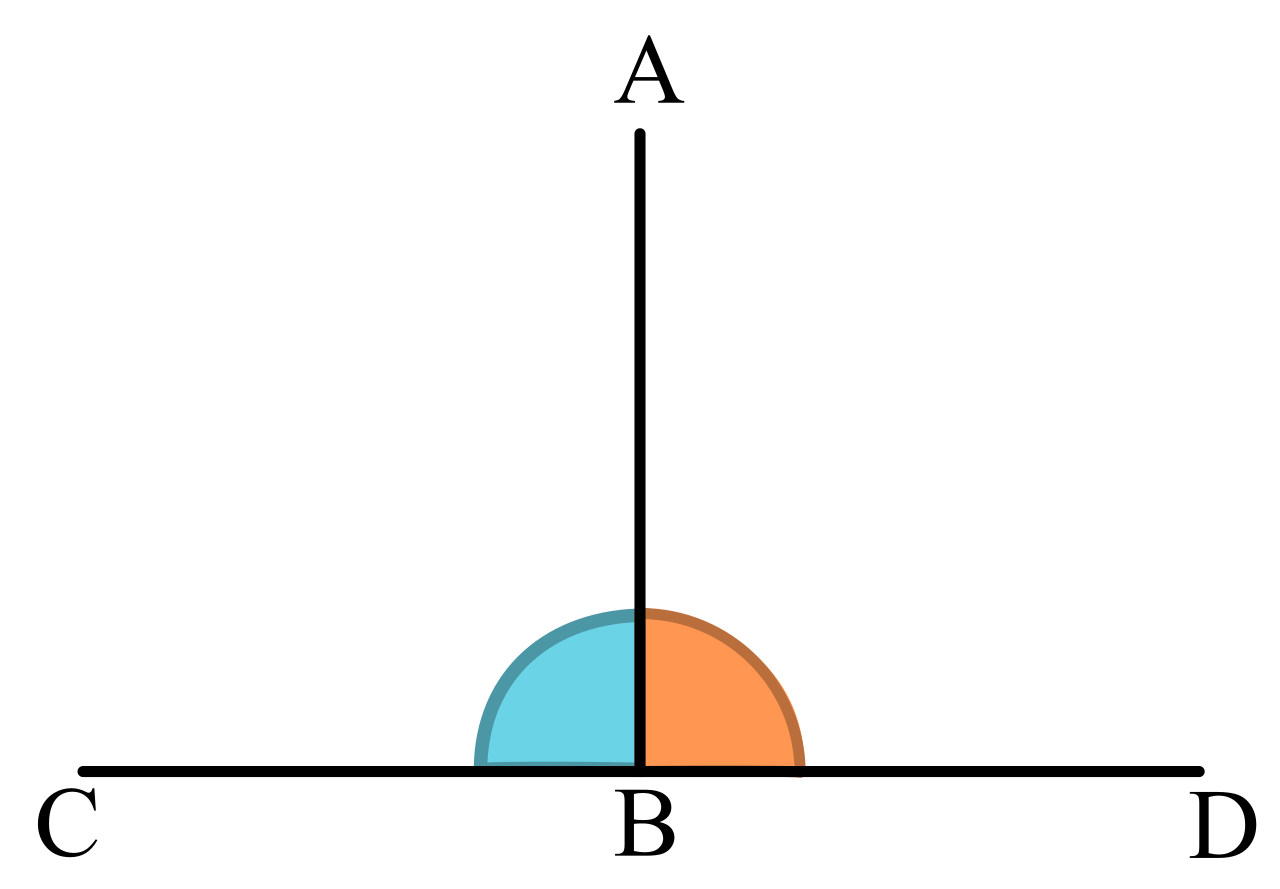
When intersecting lines create adjacent angles, they create a special geometric scenario called a linear pair.
A linear pair is a pair of adjacent angles formed by intersecting lines. Look at the two rays that are not the shared side between the two angles. Because these angles are formed by straight intersecting lines, the non-common sides of a linear pair of angles form a straight line.
Since a straight line represents a straight angle (180∘), the unavoidable conclusion is that two angles that form a linear pair are always supplementary.
Special Case: What happens when lines meet perfectly straight-up-and-down? We call these perpendicular lines—two intersecting lines that form four right angles. Every linear pair here sums to 180∘ (90∘+90∘=180∘), and all vertical angles are perfectly matched (90∘=90∘).
Now, let us expand our view. Imagine railroad tracks extending infinitely into the horizon. These rails represent parallel lines, which are lines in the same plane that never intersect. The reason they never intersect is one of pure, consistent spacing: the perpendicular distance between two parallel lines remains constant.
But geometry becomes infinitely more interesting when a third line crashes the party.
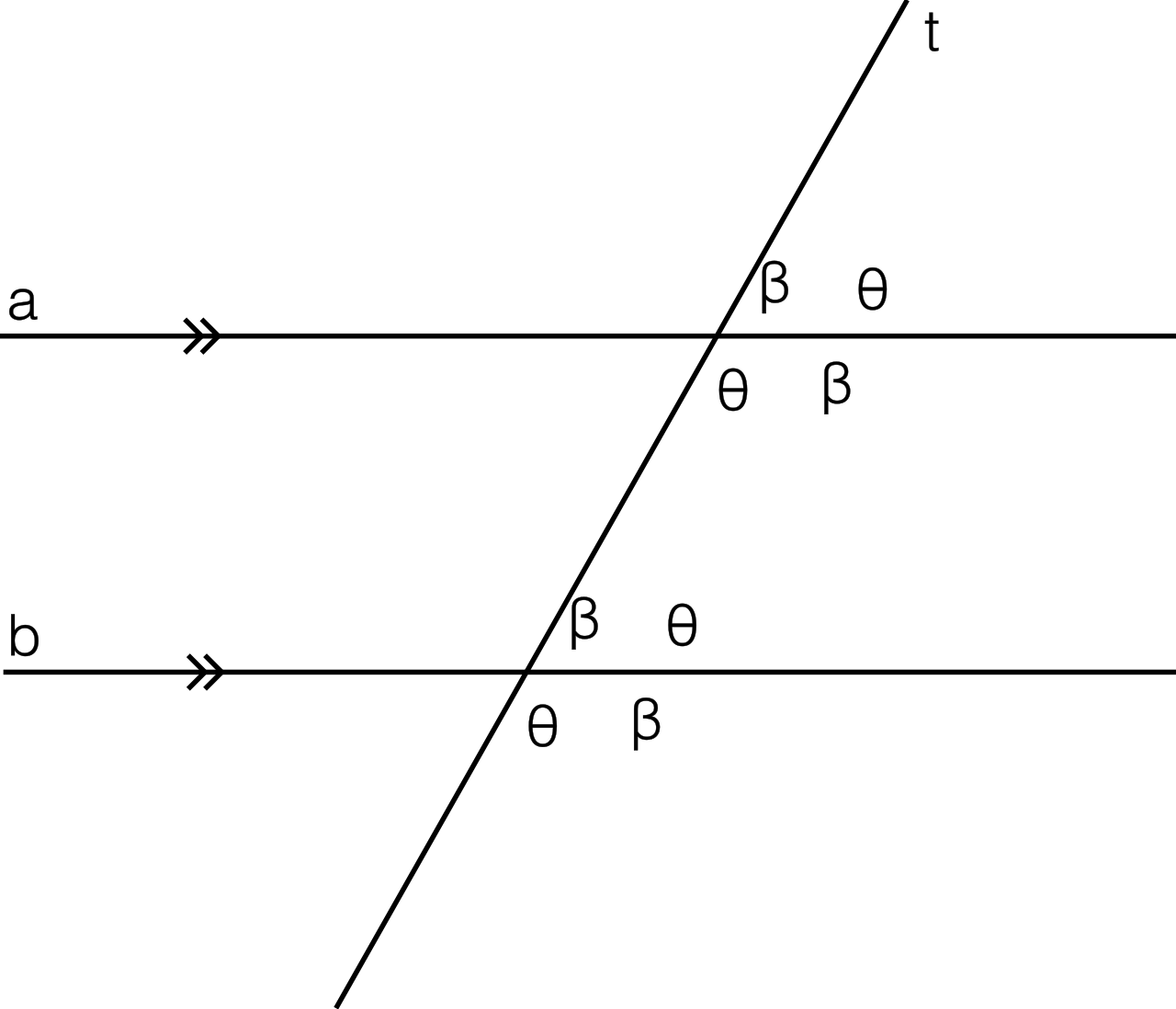
A transversal is a line that passes through two or more other lines in the same plane.
When a transversal slices through a pair of lines, it creates a highly predictable matrix of angles. In fact, a single transversal intersecting two separate lines creates exactly eight distinct angles. Four angles are grouped at the top intersection, and four at the bottom.
To organize these eight angles, geometricians divide the space into two zones:
- Interior angles: These are the angles located in the region between the two lines intersected by the transversal. (Think of this as the space between the railroad tracks).
- Exterior angles: These are the angles located outside the region between the two lines intersected by the transversal.
When a transversal cuts through two lines, it generates specific pairs of angles. It is vital to note that these pairs always exist when a transversal cuts any two lines. However, when the two lines are parallel, a beautiful mathematical harmony occurs: the angle pairs lock into absolute relationships of congruence and supplementation.
Here is how the angles pair up when a transversal cuts two parallel lines:
| Angle Pair Name | Positional Definition | Relationship if Lines are Parallel |
|---|---|---|
| Corresponding angles | Angles in the same relative position at each intersection where a transversal crosses two lines (e.g., both top-right). | Corresponding angles are congruent. |
| Alternate interior angles | A pair of angles on opposite sides of a transversal and between two intersected lines. | Alternate interior angles are congruent. |
| Alternate exterior angles | A pair of angles on opposite sides of a transversal and outside the two intersected lines. | Alternate exterior angles are congruent. |
The "Consecutive" Angle Pairs
While the "alternate" angles cross over the transversal, the "consecutive" angles remain on the same side.
- Consecutive interior angles are a pair of angles on the same side of a transversal and between two intersected lines. Because of their position, consecutive interior angles are frequently referred to as same-side interior angles.
- Consecutive exterior angles are a pair of angles on the same side of a transversal and outside the two intersected lines. Similarly, consecutive exterior angles are frequently referred to as same-side exterior angles.
Unlike the alternate and corresponding pairs, consecutive pairs do not match each other in size. Instead, they complete each other:
- When two parallel lines are cut by a transversal, consecutive interior angles are supplementary.
- When two parallel lines are cut by a transversal, consecutive exterior angles are supplementary.
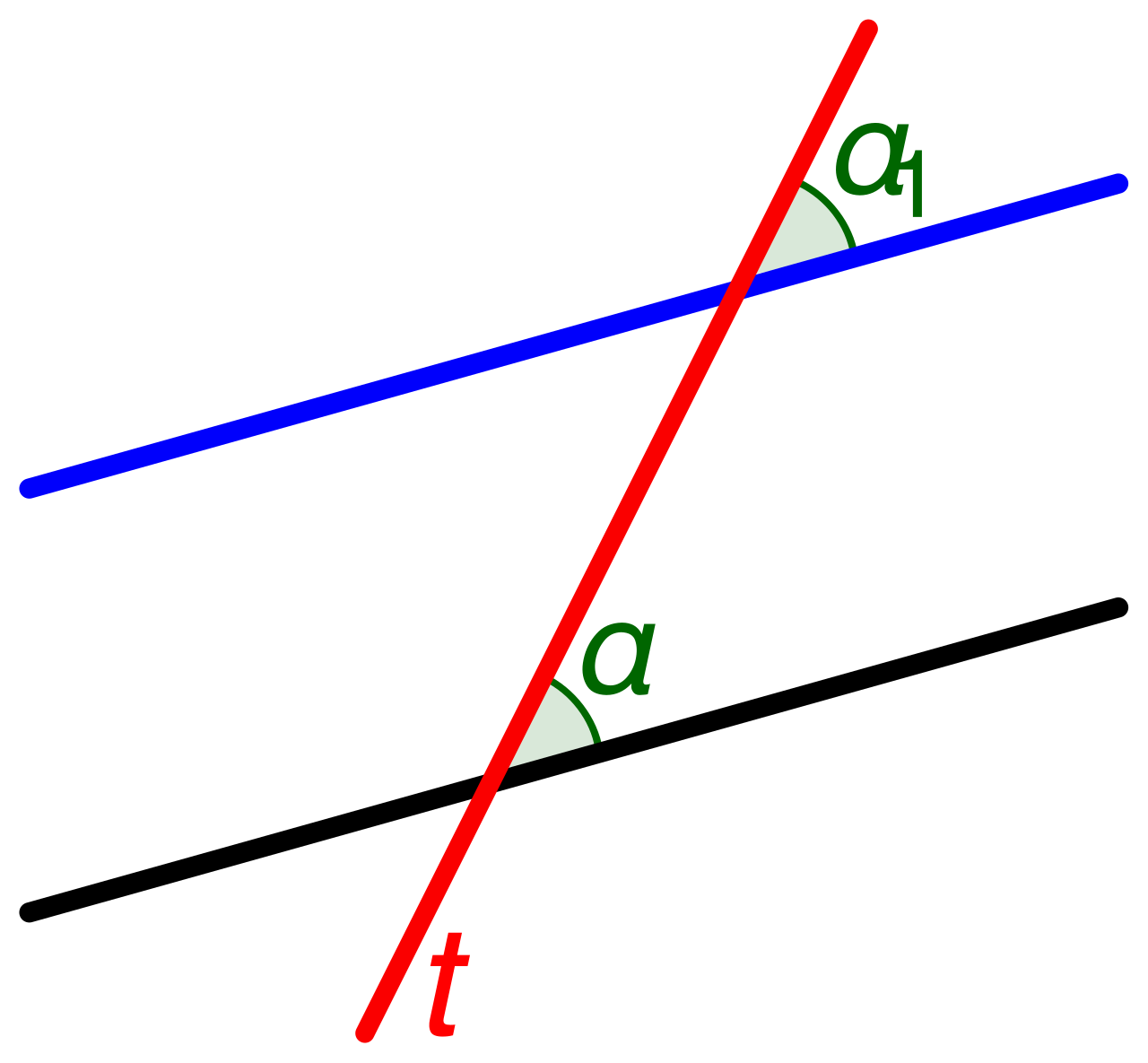
If memorizing those specific pairs feels overwhelming, there is an elegant shortcut—a profound simplification born from the parallel symmetry.
If a transversal cuts two parallel lines at a slant (not perfectly perpendicular), it creates four acute angles (less than 90∘) and four obtuse angles (greater than 90∘).
Because vertical lines are congruent, and parallel lines perfectly clone the top intersection at the bottom intersection, we arrive at the golden rule of transversals:
- A transversal intersecting two parallel lines creates a set of acute angles that are all congruent to each other.
- A transversal intersecting two parallel lines creates a set of obtuse angles that are all congruent to each other.
Therefore, if you look at the eight angles created by parallel lines and a transversal, you only ever have two measurements. Pick any acute angle in the diagram, and it equals all the other acute angles. Pick any obtuse angle, and it equals all the other obtuse angles.
What is the relationship between the two sizes? Because linear pairs must sum to a straight line, when a transversal cuts two parallel lines, any acute angle formed is supplementary to any obtuse angle formed. If you know just a single angle out of the eight, you instantly know the exact measurements of the other seven.
The Perpendicular Exception
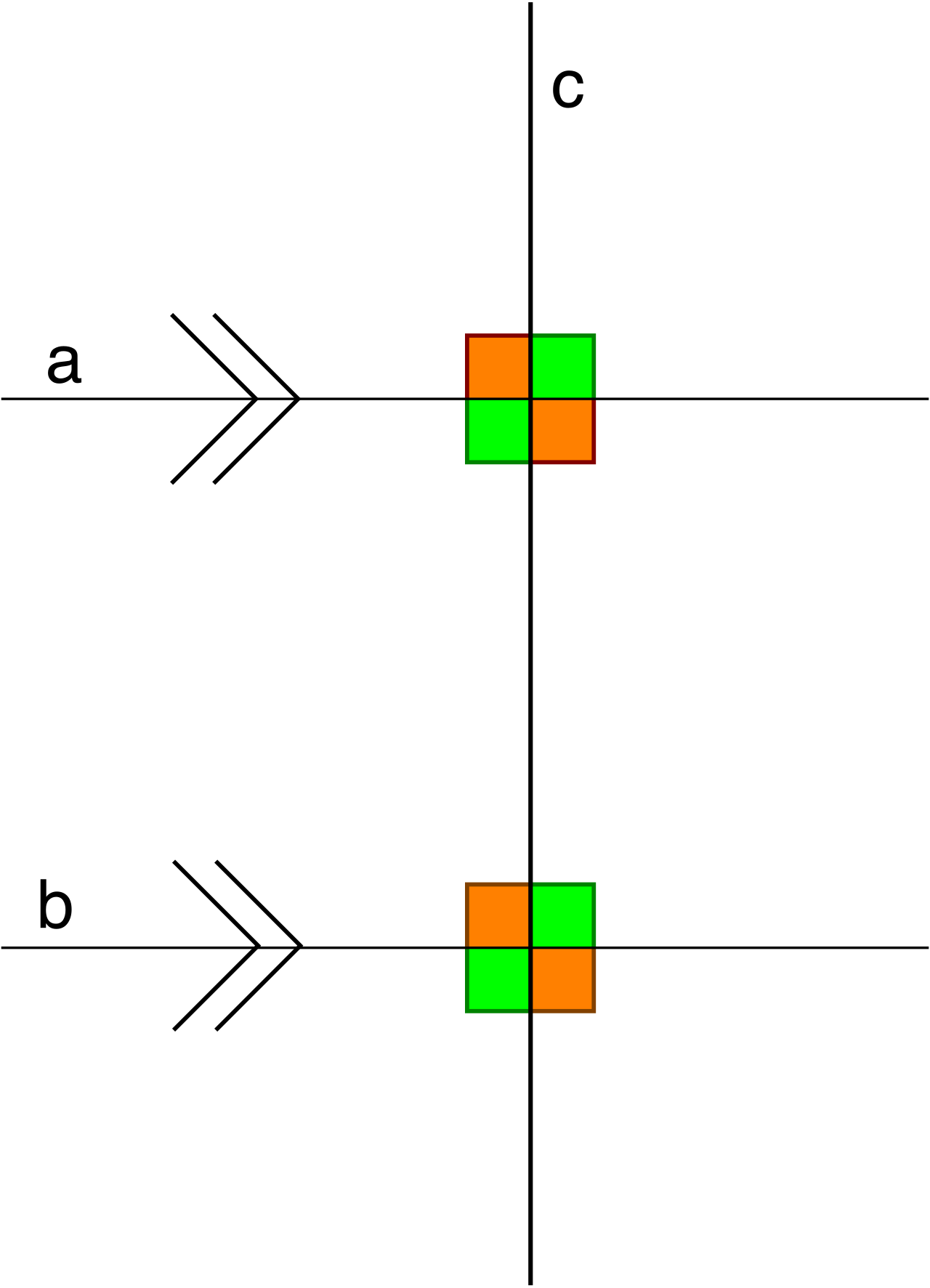
There is exactly one scenario where you do not get acute and obtuse angles: when the transversal comes straight down. But the logic remains completely unbroken.
Because parallel lines maintain a constant perpendicular distance, if a transversal is perpendicular to one of two parallel lines, that transversal is also perpendicular to the second parallel line. In this special case, instead of a mix of acute and obtuse angles, the transversal creates exactly eight right angles. They are all exactly 90∘, all congruent to each other, and any two of them will seamlessly add up to 180∘.
Mastering these laws of intersection is not just an exercise in memorizing vocabulary; it is understanding the ironclad logic that dictates how space itself is assembled. By tracking the vertex, spotting the linear pairs, and recognizing the symmetrical beauty of the transversal, you can effortlessly decode any complex geometry the Praxis Core presents.