Land Use Controls on the Arizona Real Estate Salesperson (AZ-RES): What's Tested and How to Study It
In short
This whole area takes three study hours, and almost all of it is memorizable: four government powers, three zoning exceptions, one conflict rule. Land Use Controls is about the limits on what an owner can do with their land — public controls like zoning and building codes, and private ones like CC&Rs and HOA restrictions.
The four powers, zoning, and private restrictions
Two separate forces constrain every parcel: the government, and whoever wrote the private restrictions the land is subject to. Almost every question here asks you to tell those two apart.
The four powers: PETE
The government side comes as a set of exactly four powers, and the mnemonic is PETE.
Police power is the broad authority to regulate for public health, safety, and welfare. Zoning comes from it, and so do building codes and environmental rules. No compensation is owed when police power costs you money — the line that separates it from the next one.
Eminent domain lets the government take private property for public use, and it does require just compensation. The exam likes to test the vocabulary here. Condemnation is the procedure that exercises the power.
Taxation is the power to levy property taxes, backed by a tax lien that outranks nearly every other claim on the property.
Escheat covers what happens when someone dies with no will and no locatable heirs: the property reverts to the state. Rare in practice, and a reliable free mark on the exam.
Zoning and its three exceptions
Zoning is where police power meets a map. Land gets classified — residential, commercial, industrial, agricultural — with rules on density, height, and setbacks attached to each. Three exceptions come up constantly and get mixed up just as often.
Zoning changes, and the gas station that was there first stays: that's a nonconforming use, often called grandfathering. A variance permits a departure from a specific dimensional requirement, usually because strict application would cause hardship on an unusual lot. A conditional use permit allows an activity the zone doesn't normally permit, where it serves the public — a church or a school in a residential zone.
The last two are what get confused. A variance bends a dimensional rule; a conditional use permit allows a different activity.
Building codes sit alongside zoning and govern construction standards. The certificate of occupancy is the document confirming a completed building meets them and may be lawfully occupied.
Private controls: CC&Rs and deed restrictions
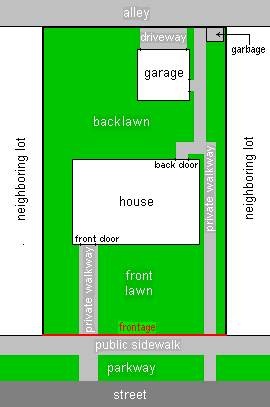
Private controls do similar work through contract. CC&Rs — covenants, conditions, and restrictions — are recorded against a subdivision and bind every buyer who comes after. They can be far stricter than zoning, dictating paint colors, fencing, parking, and roof materials. Enforcement is private. The HOA does it, or a neighbor does.
When a private restriction and a public one conflict, the more restrictive of the two governs. Zoning permitting a 35-foot house doesn't help you if the CC&Rs cap it at 25.
Deed restrictions do the same job on a single parcel. Both are encumbrances: they limit use without transferring ownership.
Arizona adds two of its own. Planned communities and their HOAs are common and heavily regulated by statute. Groundwater is managed through Active Management Areas under the 1980 Groundwater Management Act, and subdividers inside one must show an assured 100-year water supply.
How it shows up on the exam
Only Ever's plan gives Land Use Controls 3 study hours across 3 topics. That's our study-time recommendation, not the exam's weighting, and here the two point the same way: this is a small area.
On the General exam the material sits inside Real Property Characteristics, Legal Descriptions, and Property Use, where public and private land use controls account for 3 of the 80 scored questions. The Arizona State exam splits it across two areas. HOA restrictions and easements sit inside Ownership and Encumbrances, 5 of 60. Property taxes, special assessments, and Arizona utility and environmental regulation sit inside Reasonable Skill and Care, 6 of 60.
Three hours finishes this area outright, which is rare on this exam. The content is definitional, so it stays learned once it's learned. Three hours of Contracts, a fifteen-hour subject tested through fact patterns, buys you a corner of it.
Get PETE cold. Be able to separate a variance from a conditional use permit in one sentence. Know that the more restrictive control wins. Those three things cover most of what this area will ask you.
Common questions
What are the four government powers over private property? Police power, eminent domain, taxation, and escheat — PETE. Only eminent domain requires compensation.
What's the difference between eminent domain and condemnation? Eminent domain is the government's power to take private property for public use. Condemnation is the legal process used to exercise it.
Variance or conditional use permit? A variance allows a departure from a dimensional requirement such as a setback or height limit, usually on hardship grounds. A conditional use permit covers an activity the zone leaves off its list, allowed because it serves the public.
What happens when zoning and CC&Rs disagree? The more restrictive one applies. Private restrictions can be stricter than public zoning, and they're enforced privately.
How many questions is this area worth? Public and private land use controls are 3 of the 80 scored questions on the General exam, with related Arizona material spread through the State paper.
Three study hours is a small enough block to finish this week. Only Ever's study guides and practice questions for this exam are free, including the AI-generated question sets other providers paywall. Try the free practice questions and see whether PETE has stuck.