What's a Passing Score on the CA-RES? (And How to Get There)
In short
Seventy percent. That is 105 of the 150 multiple-choice questions, inside a 3-hour limit, which leaves 45 you can afford to lose. The California Department of Real Estate sets the passing score, and it is the same for every candidate. The useful question is where those 45 misses go.
The passing score
That 70% belongs to the California Department of Real Estate, which sets one standard for the salesperson exam and applies it to everyone sitting it.
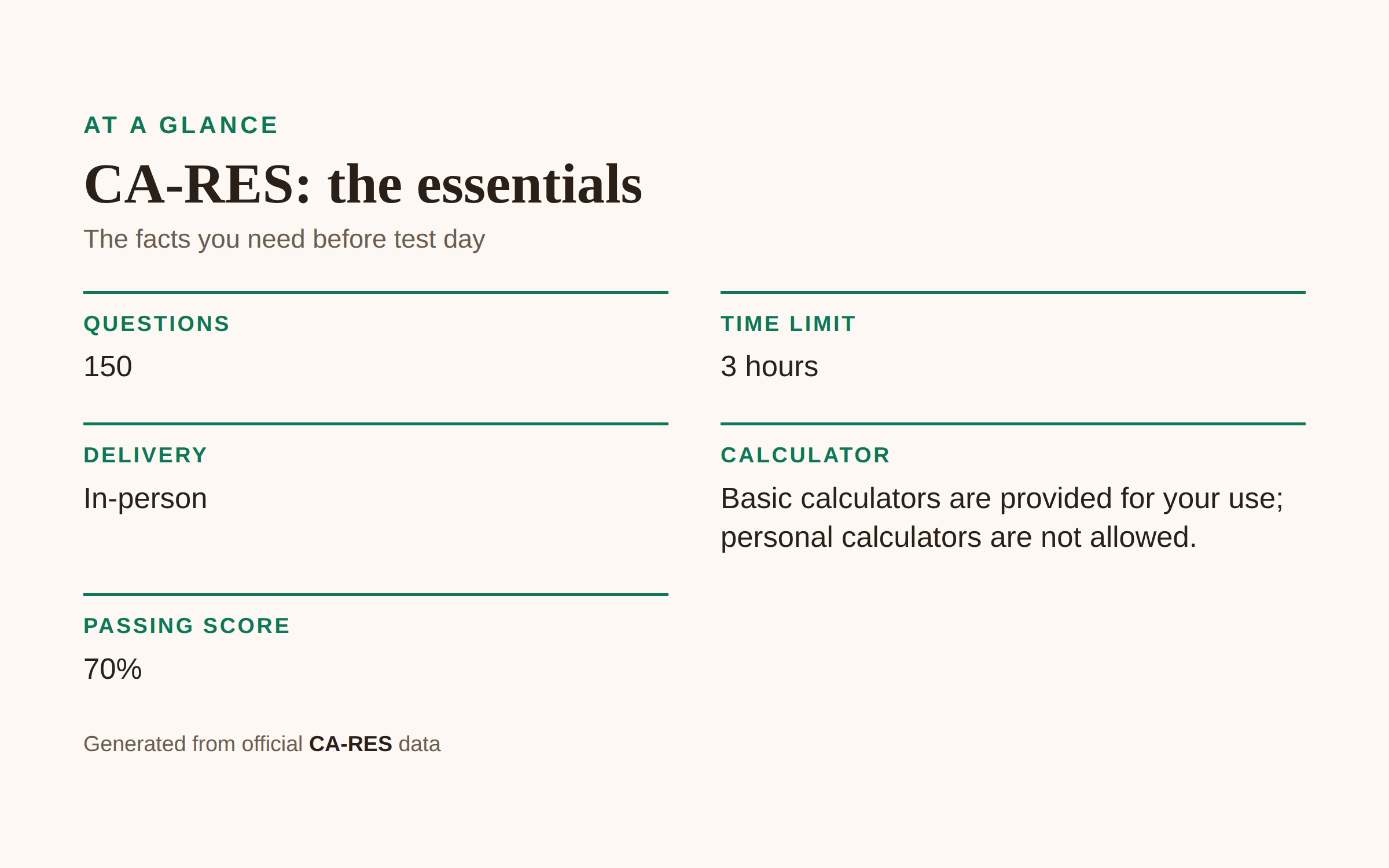
You sit the exam in person, and every question is multiple choice. Your own calculator stays at home; the test center provides a basic one, so do your proration practice on a basic calculator too. Three hours across 150 questions is 1 minute 12 seconds each.
Each form is assembled by sampling from a large subject-matter pool, so the published topic list is the surface area you can be asked about. Not every topic on it reaches the paper you sit.
The exam is also revised as California law and standard practice change, which is a reason to study from current material. Salesperson and broker examinations differ in emphasis and in difficulty, subject by subject, so check which of the two a study set was written for.
The official word on what is examinable is the DRE's own examination description. The shares and hours below are Only Ever's mapping of that syllabus onto study topics.
What that means for how you study
Turn 45 misses into a budget and the weights start making your decisions for you. You can give away 30 of the exam's 100 percentage points. Every domain is priced in those same units, so for each one the question is how much of the 30 you are willing to hand over.
General Principles of Agency is 17 points. Score nothing there and more than half the budget is gone before anything else goes wrong. Add Valuation and Market Analysis at 14 and the pair comes to 31, a point past the entire budget. Writing off both fails you however well the other nine go.
| Domain | Share of the exam | ≈ Questions of 150 | Hours in the plan |
|---|---|---|---|
| General Principles of Agency | 17% | 25–26 | 18 |
| Valuation and Market Analysis | 14% | 21 | 15 |
| Practice of Real Estate | 13% | 19–20 | 15 |
| Contracts | 12% | 18 | 13 |
| Property Ownership | 9% | 13–14 | 10 |
| Financing | 9% | 13–14 | 10 |
| Property Disclosures | 8% | 12 | 9 |
| Transfer of Title | 8% | 12 | 9 |
| Land Use Controls | 6% | 9 | 7 |
| Leasing and Property Management | 2% | 3 | 3 |
| Real Estate Calculations | 2% | 3 | 4 |
Shares are approximate, so the count on a given form moves a little: 1% of 150 is a question and a half. The hours column adds to 113 across all 55 topics, inside the 110 to 120 hours we budget for this exam. Spread over the plan's 16 weeks that is about 7 hours a week.
The four biggest domains — General Principles of Agency, Valuation and Market Analysis, Practice of Real Estate and Contracts — are 56% of the paper between them, about 84 questions. Get those four to 90% and you have spent 8 or 9 of your 45 misses on more than half the exam, which leaves 36 or 37 for the other seven domains.
Real Estate Calculations behaves differently from every other row. It is 2% of the exam and 4 of the 113 hours. That works out at 2 hours of study for every percentage point it is worth, where the nine larger domains run between 1.06 and 1.17 and Leasing runs 1.5.
The plan's study instruction here is the only one that says to practice problems: proceeds and prorations, equity, capitalization rate and loan-to-value, points, commissions, area and volume. Four hours for three questions is a heavy rate. Practiced arithmetic is fast arithmetic, and time saved on these three is time available for the other 147 questions.
California's own law sits inside six of the eleven domains. Nine of the 55 topics are explicitly California ones, and four of them are in Practice of Real Estate alone, which is 13% of the paper: DRE licensing and discipline, trust-fund handling and record keeping, state fair housing law, and California advertising and specialty practice.
The other five sit one apiece in five more domains:
- Community property, vesting and water rights — Property Ownership
- California financing and credit laws — Financing
- California contracts, listing agreements and advance fees — Contracts
- California agency disclosure and relationships — General Principles of Agency
- California required disclosures, the TDS and the Natural Hazard Disclosure — Property Disclosures
So there is no single California block to leave until the last week; the material is in six places.
The weights only become a plan once you have your own error rates to put against them.
Take a full set of free practice questions →
sort every wrong answer into the domain it came from →
multiply each domain's error rate by its question count from the table →
add the predicted misses up and compare the total with 45.
Whichever domain contributes the most predicted misses is where the next session goes, whatever your instinct says. Aim for 85% in practice. Those 15 points of margin absorb the total loss of any single domain on the table. Agency is the largest at 17 points, and losing all of it from an 85% base costs 14.45, which still clears 70.
Common questions
What is the passing score for the California real estate salesperson exam? 70%, which on a 150-question paper is 105 correct answers. The California Department of Real Estate sets it, and the same figure applies to every candidate.
How many questions are there, and how long do I get? 150 multiple-choice questions across eleven subject areas, in a maximum of 3 hours. Spread evenly, that is 1 minute 12 seconds each.
Which area carries the most questions? General Principles of Agency, at about 17% of the exam, so roughly 25 or 26 of the 150 questions. Fiduciary duties, how agency begins and ends, and California's dual-agency disclosure requirements all sit in there.
Can I bring my own calculator? No. Personal calculators are not allowed, and the test center provides a basic one.
How many hours should I plan for? Around 113. That is what the domain-by-domain budget adds up to, inside the 110 to 120 hours we recommend for this exam.
Will every topic on the syllabus be on my exam? No. Each form is sampled from a large subject-matter pool, so not every listed topic reaches the paper. Treat the full list as the surface area you are responsible for.
Only Ever's practice questions and study guides for this exam are free. Try the free practice questions and score yourself by domain. Then re-run the count after every set. Your error rates move as you study, so the domain at the top of the predicted-miss list moves with them, and the plan is worth rebuilding on each new set of numbers.