How to Pass the NHRA Nursing Licensing Exam (Bahrain, 2026): A Realistic Plan
In short
Bahrain's nursing licensure exam runs at a Prometric test center, with 2.5 hours of testing time inside a 3-hour seating. The regulator has never published a question count or a content blueprint, so the honest plan is built from the scope of practice and a standard nursing curriculum. Our plan budgets around 150 hours.
What NHRA publishes about this exam
The National Health Regulatory Authority — NHRA, the body that licenses every health professional practising in Bahrain — does not publish a syllabus for this exam. No question count, no item format, no list of domains, no percentage weights, no official study references. Prometric, the testing company that delivers it, publishes the seating time and the attempt rules; NHRA's own licensure booklet says who may sit and what score passes. Between them, that is the whole of the official record.
Search for a blueprint anyway and you will find plenty. The question counts circulating on prep sites disagree with each other, and so do their domain weightings. They disagree because none of them is reading from a published source.
Here is what is official, and worth planning around:
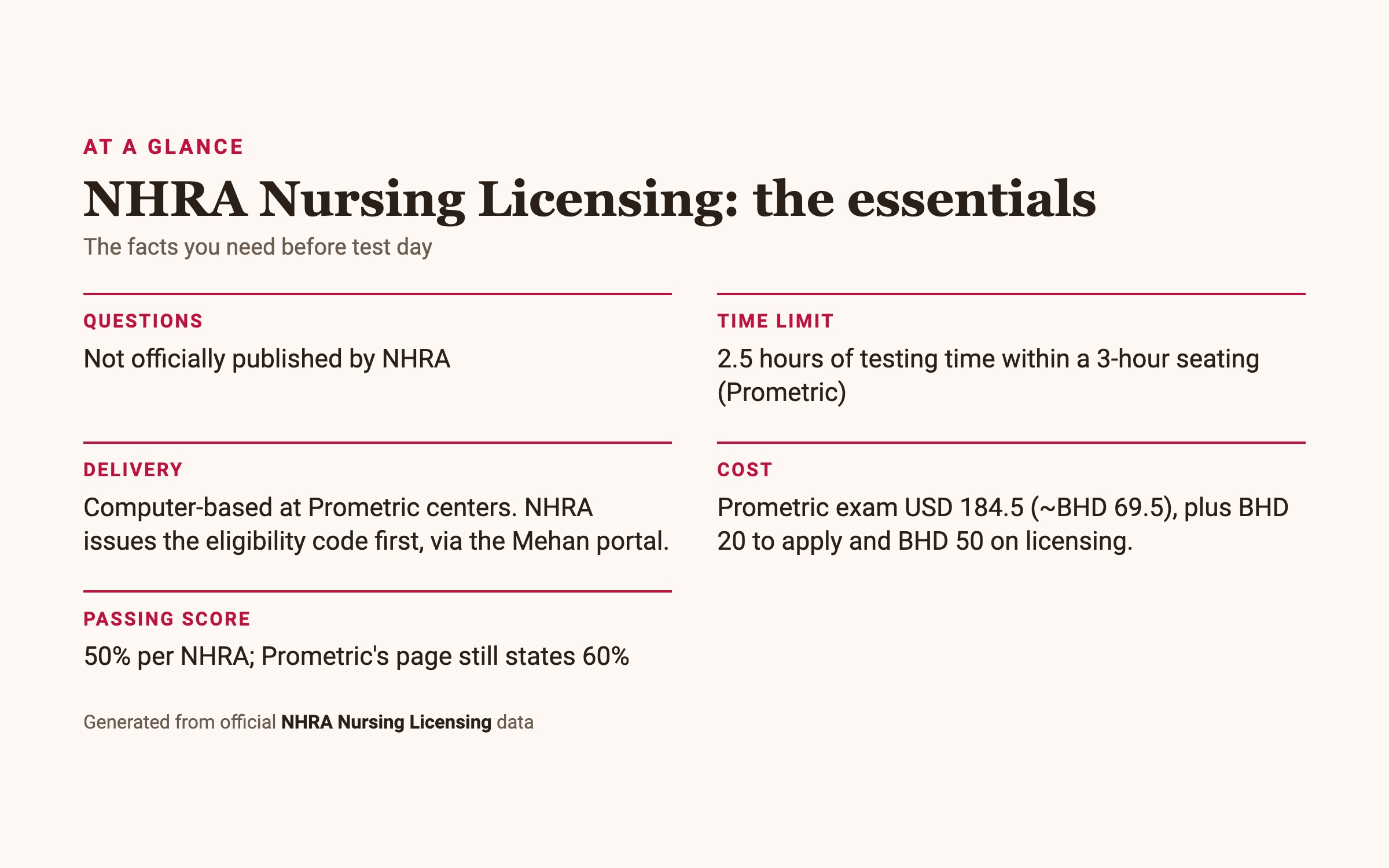
The pass mark is the one place two official sources disagree. NHRA's licensure examination booklet sets the mark at 50% for nursing, midwifery and allied health professions, with 60% reserved for other professions. Prometric's NHRA page still states a blanket 60% for every Bahrain licensure exam. NHRA sets the standard, and its statement is profession-specific, which points to 50%. But Prometric's page is official too, and it is the page a candidate booking a seat actually lands on. Prepare for 60% and the question stops mattering.
Two rules set your timeline before you open a book. You cannot book this exam directly: you apply through Mehan, NHRA's online licensing portal, and NHRA issues an eligibility code that lasts four months and covers a single attempt. An exam sat without that approval is not accepted. You then get four attempts within three years of your first sitting, and a pass stays valid for five years.
The plan, section by section
About 150 hours over roughly five months is a realistic target for a working nurse. Since NHRA publishes no weights, the split below is ours, not a reading of the exam. It is built from NHRA's Scope of Nursing and Midwifery Practice framework, the document that sets out what a general nurse, specialist nurse, midwife and advanced practice nurse may each do in Bahrain. A standard general-nursing curriculum fills in the rest. If the regulator defines the work, the work is a fair proxy for what it will test.
Start with Nursing Fundamentals, about 30 hours →
move to Adult Nursing, about 60 hours, the widest body of content →
then Maternal-Child Nursing, about 45 hours →
finish with Nursing Management and Leadership, about 15 hours.
Fundamentals comes first because physical assessment and pharmacology are what the later material rests on. Get the drug classes, the common adverse effects and safe dosage principles solid early, and the adult and maternal-child work stops feeling like new memorization.
Adult nursing carries the most ground to cover: medical, surgical, critical care, community and psychiatric. Work it through cases. Ask what you would do first for this patient, then check yourself against the rationale — judgment is built by answering questions and reading why the answer was right. A week of reading first tells you nothing that a free diagnostic will not tell you in an hour.
Maternal-child sits third because it is four specialties wearing one name: maternity and gynaecology, neonatal care, and both pediatric medical and pediatric surgical nursing. Each has its own normal values. Group your sessions by developmental stage — newborn, infant, toddler, adolescent — so those values sit together, and drill the things that depart from adult practice: the stages of labor, immunization schedules, and pediatric dose adjustments.
Leave the leadership block until last. It is the block a nurse trained abroad is least likely to have covered, and the one closest to what NHRA itself regulates: the scope of practice, the limits on delegating to other staff, and the professional-conduct expectations for practising here.
Read the scope framework itself rather than a summary of it, because its shape is the lesson. It defines scope by role — practical nurse, general nurse, specialist nurse, midwife, advanced practice nurse — and then declines to give any of them a task list, stating that scope is not limited to specific tasks, functions or responsibilities. Instead it supplies decision-making flowcharts: you establish whether an activity is within your competence, whether it is supported by your education and by policy, and whether you can be accountable for the outcome. A nurse used to a jurisdiction that publishes "you may do X, you may not do Y" has to learn a different habit, which is reasoning to the answer rather than recalling it.
Where candidates get caught out
The first trap is the invented blueprint. Candidates find a weighting online, believe it, and skew their hours toward whichever domain that site called the biggest. With no published weighting, let your diagnostic score set the allocation — find the two areas where you are shakiest and give them the hours.
The second is the eligibility code. Four months sounds generous until you understand what primary source verification involves. A verification agency writes directly to your university and your former employers to confirm that your degree, your experience letters and your good-standing certificate — the letter from your current regulator confirming no disciplinary action against you — are real. Those institutions reply on their own schedule. You cannot speed that up, and the four-month clock does not pause for it, so start verification before you start revising. On NHRA's current guidance the accepted agencies are DataFlow, QuadraBay and Clean Sheet Group.
Third, candidates budget for the wrong exam fee. The Prometric examination fee is USD 184.50, about BHD 69.5. NHRA separately charges BHD 20 to apply and BHD 50 to issue the licence once you pass, and verification runs from BHD 60 upward.
Fourth, check your eligibility before you pay for anything. Non-Bahraini general nurses need at least one year of clinical experience after qualifying and registering. Bahraini new graduates are exempt from that experience requirement when applying as a general nurse.
You may not need this exam at all
Check this before anything else, because it is the one thing that can save you the whole process. Bahraini nationals and nationals of the other Gulf Cooperation Council states who hold a valid GCC licence are exempt. NHRA also accepts several other Gulf licensing exams in place of its own:
- the Dubai Health Authority (DHA) exam
- the Health Authority Abu Dhabi (HAAD) exam
- Qatar's licensing exam
- Oman's "Registered Nurse" exam
- Saudi Arabia's "Nurse Specialist" exam
Saudi Arabia's "Nurse Technician" exam does not qualify.
Common questions
How many questions are on the NHRA nursing exam? Nobody outside NHRA knows. NHRA and Prometric are both silent on it, and the figures circulating on prep sites disagree with each other. What is official is the time: 2.5 hours of testing within a 3-hour seating.
How long do I get? 2.5 hours of testing time, inside a 3-hour seat that also allows for check-in.
What is the passing score? NHRA's booklet says 50% for nursing, midwifery and allied professions. Prometric's page says 60% for all Bahrain licensure exams. Confirm with NHRA at licensure@nhra.bh, and study for the higher number.
How should I split my study time? By your own weak areas, since no official weighting exists to split it by.
How many attempts do I get? Four attempts within three years of your first sitting. A pass is valid for five years.
Where do I book it? Booking starts at NHRA. Prometric only sells you the seat once you hold the code, so apply through Mehan first, then schedule inside the four-month window.
One habit is worth building before any of this: keep NHRA's written replies. A dated email from the regulator naming your profession settles the pass-mark question, and it is also the document you can produce if a test center or an employer later queries your eligibility. Our full question bank and study guides for this exam are free. Try the free practice questions.