How to Pass the CA-RES (2026): A Realistic Plan
In short
The CA-RES is 150 multiple-choice questions in 3 hours, and 70% passes — that is 105 right and 45 you can afford to miss. Eleven subject areas split the paper unevenly, from agency at 17% down to calculations at 2%. Those areas come to 113 hours of study between them, and the weights decide where the hours should land.
What the CA-RES tests
The California Real Estate Salesperson exam is one sitting, taken in person: 150 questions, 3 hours, every one of them multiple choice. The Department of Real Estate sets the bar at 70% and applies the same figure to every candidate, so the target is a flat 105 correct.
Two bodies of material feed the paper. One is general real estate principles: ownership, valuation, financing, title. California's own statutory law sits on top of it — trust-fund handling, agency disclosure, the Transfer Disclosure Statement. The DRE publishes its outline as the Examination Description (RE 425), and the eleven-area breakdown below is ours, mapped from that material onto 55 study topics.
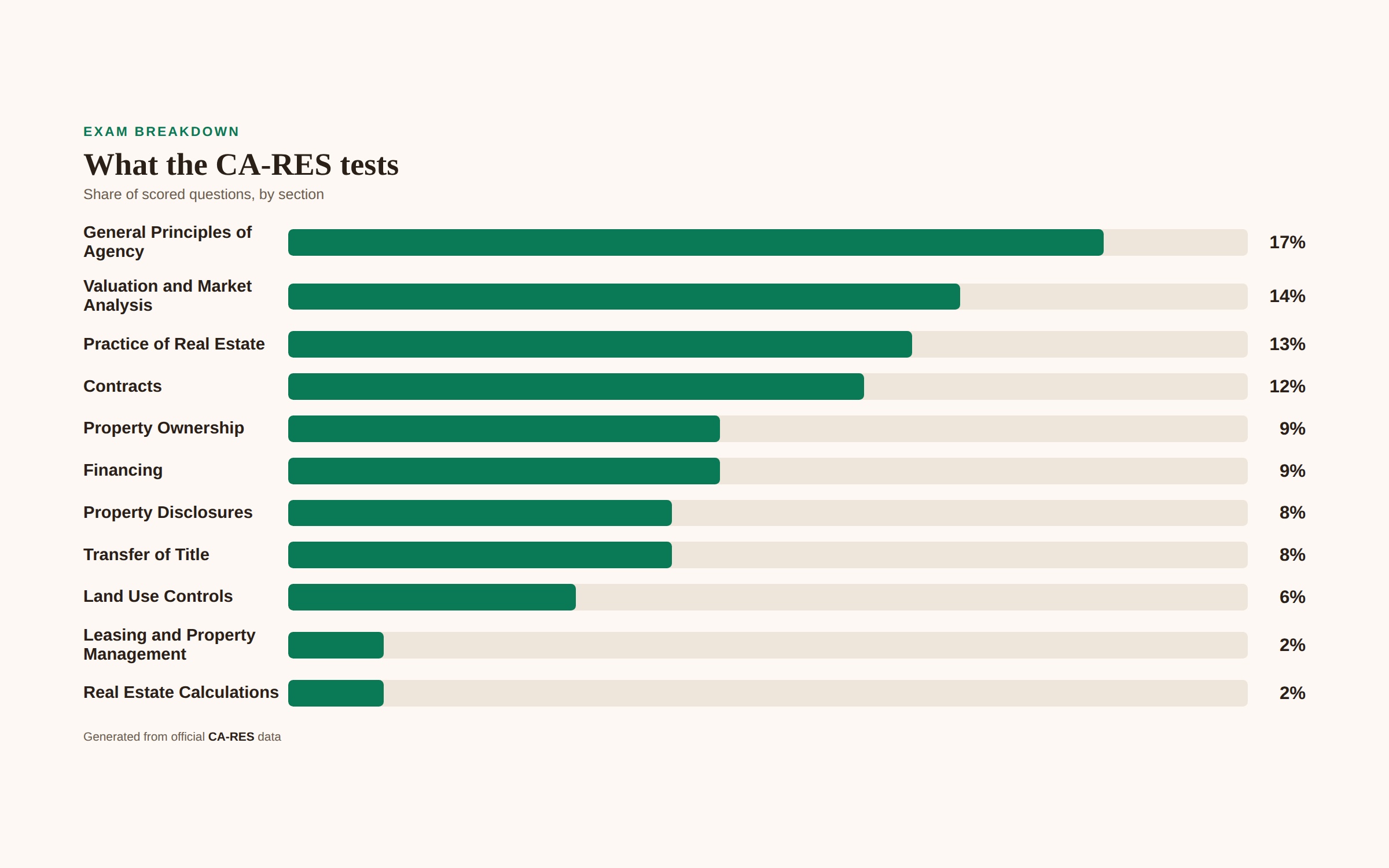
Those eleven areas are weighted from 2% up to 17%:
| Subject area | Weight | Questions | Topics | Study hours |
|---|---|---|---|---|
| General Principles of Agency | 17% | ~26 | 5 | 18 |
| Valuation and Market Analysis | 14% | 21 | 4 | 15 |
| Practice of Real Estate | 13% | ~20 | 8 | 15 |
| Contracts | 12% | 18 | 7 | 13 |
| Property Ownership | 9% | ~14 | 8 | 10 |
| Financing | 9% | ~14 | 7 | 10 |
| Property Disclosures | 8% | 12 | 4 | 9 |
| Transfer of Title | 8% | 12 | 4 | 9 |
| Land Use Controls | 6% | 9 | 3 | 7 |
| Leasing and Property Management | 2% | 3 | 2 | 3 |
| Real Estate Calculations | 2% | 3 | 3 | 4 |
(The eleven areas and their weights are Only Ever's breakdown of the exam material. Each question count is that weight applied to 150 and then rounded, so the column comes to 152 rather than 150, and any subtotal you take from it can run a question high.)
The top four areas — agency, valuation, practice and contracts — are 56% of the exam between them, or 84 of the 150 questions. The bottom two are 4%, or six. The study hours behind the whole table add up to 113.
The plan, section by section
Sixteen weeks. Hold the last two for full timed papers and the 113 hours fall across weeks 1 to 14, a little over 8 hours a week. Spread them over all sixteen instead and it is just over 7.
Weeks 1–2 — General Principles of Agency, 18 hours for 17% of the paper: agency relationships and brokerage contracts, transaction brokers and powers of attorney, and how agency is created and how it ends. Then the fiduciary duties owed to a client, and California's statutory disclosure requirements, dual agency included →
Weeks 3–4 — Valuation and Market Analysis, 15 hours for 14%: the appraisal process and the regulation around it, the sales comparison approach and the economic principles under it, then the cost approach and income analysis. Finish on where a comparative market analysis or an automated valuation model differs from an appraisal →
Weeks 5–6 — Practice of Real Estate, 15 hours for 13%: start national, with fair housing protected classes and prohibited conduct, advertising and ADA compliance, independent-contractor status, and the antitrust and do-not-call rules. Then California: DRE licensing, jurisdiction and discipline, trust-fund handling and record keeping, and the state's own fair housing law →
Weeks 7–8 — Contracts, 13 hours for 12%: the elements that make a contract valid, void or voidable; execution, e-signatures and remedies for breach; purchase agreements, addenda and contingencies. Then leases and rental agreements, handling multiple offers and counteroffers, and California listing agreements with the advance-fee rules →
Week 9 — Property Ownership, 10 hours for 9%: real and personal property and how each is conveyed, legal property descriptions, and measuring structures and land. Then liens, easements and encumbrances; rights to the surface, subsurface, air and water; ownership and tenancy; and California community property and vesting →
Week 10 — Financing, 10 hours for 9%: promissory notes and loan concepts, underwriting and mortgage clauses, and the loan types, from conventional and government to owner financing, reverse, home equity, construction and bridge. Then the disclosure regime — RESPA, TILA, TRID and ECOA — and California's financing and credit laws, usury limits included →
Week 11 — Property Disclosures, 9 hours for 8%: seller disclosure, inspections and red flags; environmental and government disclosures; what counts as a material fact; and the Transfer Disclosure Statement alongside the Natural Hazard Disclosure →
Week 12 — Transfer of Title, 9 hours for 8%: the deed types used to convey property, title searches, title insurance and marketable title, then closing, recordation and warranties, and the foreclosure, short-sale and probate routes →
Week 13 — Land Use Controls, 7 hours for 6%: the government's powers of taxation, eminent domain and escheat; zoning and building codes; and private controls such as CC&Rs →
Week 14 — Leasing and Property Management plus Real Estate Calculations, 7 hours for the 4% they share: landlord and tenant obligations, and fair housing when you qualify a tenant or set a rent. Then the math: proceeds, prorations and transfer fees; equity, capitalization rate and loan-to-value; points, commissions, area and volume →
Weeks 15–16 — full 150-question runs against the clock, scored area by area.
Run the free diagnostic before week 1 and again after week 8. The order above runs the areas heaviest first. If the second diagnostic says valuation is costing you more than agency, move valuation earlier and move its 15 hours with it — reorder the blocks, but do not shrink them.
Where candidates lose points
Start with the calendar, because the even split is the expensive mistake. Divide 113 hours across eleven subject areas and each one gets about 10.3. Agency's own estimate is 18. An even split therefore underfunds it by nearly 8 hours, on the area carrying 17% of the paper — around 26 questions. Meanwhile it hands 10 hours to Leasing and Property Management, which is worth 2% and estimated at 3.
Topic count is not weight. Property Ownership and Practice of Real Estate both carry 8 topics, more than any other area. Property Ownership is 9% of the exam; Practice of Real Estate is 13%. Same volume of reading, six more questions at the end of it, and that is why the plan above gives Practice of Real Estate 15 hours and Property Ownership 10.
The small areas cost the most per mark. Real Estate Calculations is 2% of the paper, about three questions, and its estimate is 4 hours: two hours for every percentage point it is worth. Agency's 18 hours cover 17 points, about an hour each. Spend the four on prorations, capitalization rate, loan-to-value and commission splits, then stop. Do them on a basic calculator, too, because personal calculators are not allowed in the exam and a basic one is provided instead.
Salesperson and broker examinations differ in emphasis and in difficulty, subject area by subject area. So before you build 113 hours on a textbook or a question bank, check which of the two it was written for.
Skipping a topic outright is a bet on a form you have not seen. Questions are sampled from a large pool of subject matter, so the outline lists more ground than any single sitting covers. Across 55 topics and 150 questions the average is under three questions a topic. The pool also moves, because the DRE revises the exam as California law and standard practice change. Check the date on whatever you are studying from, and read it against the current Examination Description.
Three hours across 150 questions leaves 1 minute 12 seconds a question, which is the pace weeks 15 and 16 exist to rehearse. Timed runs are also the only part of the plan that tests whether you can hold that pace for a full paper rather than for a page of practice.
Common questions
How many questions are on the California Real Estate Salesperson exam? 150, all of them multiple choice, drawn from eleven subject areas.
How much time do I get? Three hours for the whole paper.
What is the passing score? 70%, which works out at 105 of the 150 questions. The Department of Real Estate sets that figure and applies it to everyone sitting the exam.
Can I bring my own calculator? No. Personal calculators are not allowed, but a basic calculator is provided for you at the testing center.
Which subject area is worth the most? General Principles of Agency. In our breakdown it is 17% of the exam, roughly 26 questions — more than Land Use Controls, Leasing and Property Management and Real Estate Calculations put together, which come to 10% between them.
How long should I study? We plan for 110 to 120 hours on this exam, and the eleven area estimates add up to 113. Across 16 weeks that is a little over 7 hours a week.
Two questions will tell you where week 1 starts. Can you list the fiduciary duties an agent owes a principal, and walk through California's dual agency confirmation step by step? Both sit inside the 17% block.
Our practice questions and study guides for the CA-RES are free, including the AI-generated sets other providers keep behind a paywall. Try the free practice questions and score yourself area by area — it is the fastest way to find out whether your 113 hours are landing on the 17% or the 2%.