How to Pass the NCLEX-RN (2026): A Realistic Plan
In short
To pass the NCLEX-RN, plan for about 150 hours of study spread over roughly five months, weighted toward the topics that carry the most items — Management of Care (18%) and Pharmacological Therapies (16%). The exam is adaptive: you answer between 85 and 150 items in up to 5 hours, and it stops once your ability is measured against a fixed pass standard.
What the NCLEX-RN tests
The NCLEX-RN runs as Computerized Adaptive Testing (CAT): every time you answer correctly, the next item gets a little harder; miss one, and it eases off. The exam ends when it has enough evidence to place you clearly above or below the passing standard — set by NCSBN at 0.00 logits, the same line for every candidate. That is why one person finishes at 85 items and another goes to the full 150, and why both can pass.
You have up to 5 hours, including breaks and the tutorial. There is an on-screen calculator for dosage math, and 15 unscored pretest items are mixed in — you can't tell them apart from the real ones, so every question gets your full effort.
The content splits into eight client-needs categories, and they are not weighted evenly. This is the single most useful thing to get straight before you build a plan:
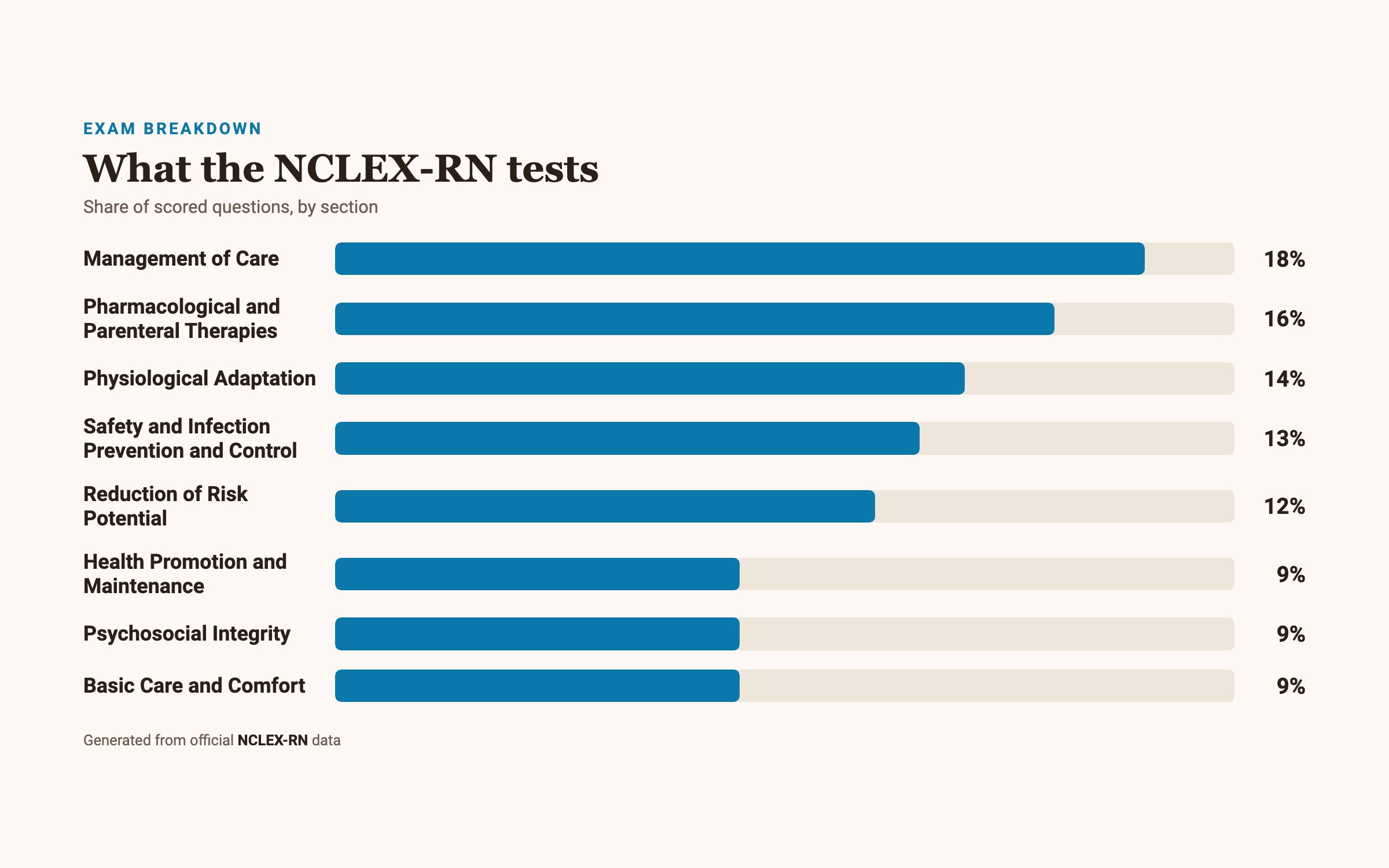
Management of Care alone is 18% of the test — delegation, prioritization, and who-does-what on the care team. Add Pharmacological and Parenteral Therapies (16%) and Physiological Adaptation (14%), and three categories cover almost half the exam.
The plan, section by section
Spread 150 hours across the categories in proportion to their weight, biggest first:
Start with Management of Care, ~27 hours →
move to Pharmacological Therapies, ~24 hours →
then Physiological Adaptation and Safety and Infection Control, about 20 hours each →
finish the four 9% categories (Health Promotion, Psychosocial, Basic Care, Reduction of Risk) at 13.5–18 hours each.
Two habits matter more than the hour count. First, practice in short, focused blocks — 15-minute segments on one topic hold better than a three-hour cram, especially for pharmacology. Second, do questions from day one. The NCLEX tests judgment, and you build judgment by answering questions, reading the rationale, and answering again. A free NCLEX-RN diagnostic will show you which categories are already solid and which need the hours.
Because the test is adaptive, you can't flag a question and come back. Read the assignment, delegation, and supervision topics closely — these Management-of-Care questions decide a big share of your result and reward a clear framework you can apply under pressure.
Where people lose marks
The traps on the NCLEX-RN are specific:
- Many items give you four correct-sounding actions and ask for the first or the priority. The answer is usually the one that protects the patient from the most immediate harm. Practice ranking actions by urgency, so the priority jumps out under pressure.
- Management of Care leans hard on who can safely do a task — RN, LPN, or assistive personnel. Learn the scope lines once and they pay off across 18% of the exam.
- Dosage and drug-class questions are 16% of items and are where tired candidates guess. Budget the hours, and use the on-screen calculator deliberately.
- Watch the item count myth: getting to 85 and stopping doesn't mean you failed, and running to 150 doesn't mean you passed. The engine is measuring consistency, so keep answering carefully to the end.
Common questions
How many questions are on the NCLEX-RN? Between 85 and 150. The number depends on your performance — the exam stops as soon as it can place you confidently on one side of the pass line.
How long do I have? Up to 5 hours, which includes the tutorial and all breaks.
What score do I need to pass? It's Pass/Fail. NCSBN sets the standard at 0.00 logits, and it's identical for every candidate — you pass by performing consistently at or above it.
Can I use a calculator? Yes. An on-screen calculator is available for dosage and other computation questions.
Are some questions unscored? Yes — 15 pretest items that don't count. They look exactly like scored items, so answer everything as if it matters.
Start with a diagnostic so your hours land on the categories that need them, then work the weights and practice your reasoning out loud. The full question bank and study guide are free, where most providers put them behind a paywall. Try the free NCLEX-RN practice questions.