Exemption Clauses, Misrepresentation, and Mistake
A contract is a bargain the parties struck; an exemption clause is one party's attempt to unstrike part of it after the fact. Every SQE1 problem in this area asks the same underlying question in different clothes: has this defendant validly written themselves out of liability, and if not, what other defect — a lie that induced the deal, or a shared delusion about what was being bought — means the contract should never have been formed at all?
A practitioner advising on an exemption clause must apply a three-stage analysis: incorporation, construction, and then statutory control under the Unfair Contract Terms Act 1977 (UCTA) or the Consumer Rights Act 2015 (CRA) as applicable. Fail any stage and the clause does not protect the party relying on it — so work through them in order, never skip to the statute.
An exemption clause is a contractual term that seeks to exclude or limit a party's liability that would otherwise arise for breach of contract, negligence, or another cause of action. Within that family, an exclusion clause removes liability entirely, while a limitation clause caps the amount or type of liability recoverable — a distinction that matters because courts and the reasonableness test under UCTA treat blanket exclusions with more suspicion than sensible caps.
Stage 1: Incorporation
Before an exemption clause can operate, it must first be validly incorporated into the contract as a term. There are three routes.
By signature. In L'Estrange v Graucob [1934], a signed contract document bound the signer to an exemption clause even though she had not read it — signature is treated as conclusive assent to everything the document contains. The rule has one important exception: a signature will not bind a party if the other party misrepresented the effect of the clause before signing. In Curtis v Chemical Cleaning and Dyeing Co [1951], an oral misrepresentation about the scope of a clause meant the signed clause could not be relied on to its full written extent — the shop assistant said the clause only covered damage to beads and sequins; it in fact excluded all liability, and the customer could not be held to more than what she was told.
By reasonable notice. For incorporation by notice, the clause must be contained in a document that a reasonable person would expect to contain contractual terms, not a mere receipt. In Chapelton v Barry Urban District Council [1940], a deckchair ticket was held to be a mere receipt incapable of incorporating an exemption clause — nobody expects a proof-of-payment slip to carry contract terms. Reasonable steps must also have been taken to bring the clause to the other party's attention before or at the time the contract was formed; timing is everything. In Olley v Marlborough Court Hotel [1949], a notice disclaiming liability displayed only in a hotel bedroom came too late because the contract was formed at the reception desk, well before the guest ever saw the notice. The same logic sank the defendant in Thornton v Shoe Lane Parking [1971]: an automatic ticket machine formed the contract the instant it took the customer's money and dispensed a ticket, before the customer could read the exempting condition printed on that ticket, so the clause was never incorporated. Notice given after the contract is concluded cannot incorporate an exemption clause into that contract — there is no going back and adding terms retrospectively.
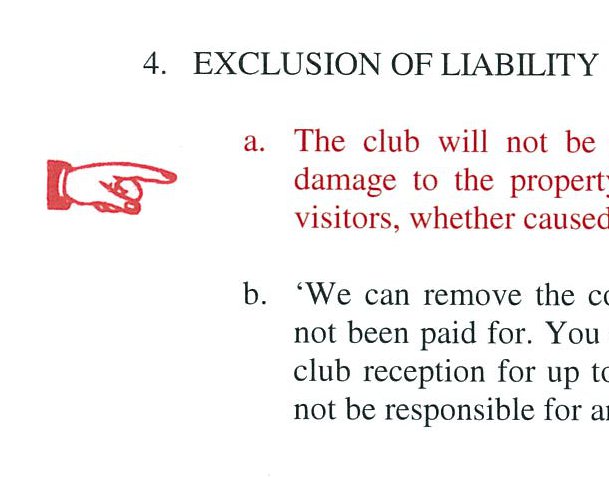
The required degree of notice is not fixed: the more unusual or onerous an exemption clause is, the greater the degree of notice required for it to be validly incorporated. This sliding scale was crystallised in Interfoto Picture Library v Stiletto Visual Programmes [1989], where an onerous holding-fee clause (a punishing daily charge for late return of photographic transparencies) required explicit and clear notice — described judicially as needing to be printed in red ink with a red hand pointing to it. Ordinary clauses can hide in the small print; extraordinary ones cannot.
By course of dealing. A consistent and regular course of dealing between the same parties on the same terms can incorporate an exemption clause even without fresh notice on the particular occasion. In J Spurling Ltd v Bradshaw [1956], a course of dealing over several years was sufficient to incorporate an exemption clause without it being separately drawn to attention each time — the parties had, in effect, already agreed to those terms as their standing arrangement. But the course of dealing must be consistent and sufficiently numerous; a small number of past transactions may be inadequate. In Hollier v Rambler Motors (AMC) Ltd [1972], only three or four past dealings over five years were held insufficient to establish a course of dealing incorporating an exemption clause — too sparse and inconsistent to count as an established pattern.
Stage 2: Construction
Once an exemption clause is validly incorporated, the court must construe its wording to determine whether it actually covers the loss or breach that occurred — incorporation only gets the clause into the contract; construction decides what it does once there.
Contra proferentem: any ambiguity in an exemption clause is construed against the party who drafted it or seeks to rely on it.
A clause that does not expressly and clearly cover negligence will generally not be construed to exclude liability for negligence — courts assume a party would not lightly give up their right to sue for someone else's carelessness, so the drafter must say "negligence" or its clear equivalent. Where a clause could cover a head of liability other than negligence, courts traditionally read it as limited to that other head, unless negligence is the only possible basis of liability on the facts (in which case there is nothing else for the clause to have been aimed at). The main purpose rule operates alongside this: an exemption clause cannot be construed so widely that it would negate the central purpose of the contract — a clause cannot, by strained interpretation, turn a contract into a promise that costs nothing to break.
Historically, courts went further still with the doctrine of fundamental breach — the idea that no exemption clause could ever excuse a breach that went to the root of the contract, no matter how clearly worded. That doctrine is dead. In Photo Production Ltd v Securicor Transport Ltd [1980], the House of Lords held that fundamental breach as a rule of law does not exist, and exemption clauses are a matter of ordinary construction. Following Photo Production, an exemption clause can in principle exclude liability even for a breach that goes to the root of the contract, if its wording is clear enough to cover that breach on its true construction. Courts today apply stricter construction to exemption clauses far less readily, precisely because statutory controls — chiefly UCTA 1977 — now provide the primary mechanism for controlling unreasonable clauses; the courts no longer need to strain the English language to protect a weaker party when a statute does that job directly. That statutory backstop is not theoretical: in George Mitchell (Chesterhall) Ltd v Finney Lock Seeds Ltd [1983], the House of Lords upheld a finding that a limitation clause failed the statutory reasonableness test despite being clearly worded — clarity of drafting is necessary but no longer sufficient.
Stage 3: Statutory control
The Unfair Contract Terms Act 1977 controls the effectiveness of contract terms and notices that exclude or restrict business liability — notwithstanding the Act's misleading short title, it is not a general consumer-fairness code (that role now belongs to the CRA 2015). Section 1(3) confines most of its controls to business liability, meaning liability arising from things done in the course of a business.
Section 2(1) UCTA: it is impossible to exclude or restrict business liability for death or personal injury resulting from negligence. No drafting can save such a clause. Section 2(2) UCTA: any attempt to exclude or restrict business liability for other loss or damage caused by negligence is subject to the reasonableness test. Section 2(3) UCTA: a person's mere agreement to, or awareness of, a negligence exclusion is not by itself to be taken as voluntary acceptance of the risk — knowing about the clause is not the same as consenting to bear the risk it describes.
Section 3 applies where one party deals as a consumer or on the other party's written standard terms of business. Under section 3, a term excluding liability for breach, or allowing substantially different performance, or no performance at all, is subject to the reasonableness test — this is the provision that stops standard-form drafters quietly reserving the right to deliver something quite different from what was promised.
Sections 6 and 7 govern exclusion of the statutory implied terms in contracts for the sale and hire-purchase of goods, and analogous supply contracts. The implied term as to title can never be excluded, even between businesses. As between businesses, the implied terms as to description, satisfactory quality, and fitness for purpose can only be excluded if the exclusion satisfies the reasonableness test.
Section 11 sets out that reasonableness test, asking whether the term was a fair and reasonable one to include, having regard to circumstances known or contemplated by the parties when the contract was made. Schedule 2 lists non-exhaustive guidelines relevant to that assessment, including the relative bargaining strength of the parties, whether the customer knew of the term, whether the customer received an inducement to accept the term, and whether goods were manufactured to the customer's special order. Crucially, the burden of proving that a term satisfies the reasonableness test lies on the party seeking to rely on that term — the drafter must justify the clause, not the victim disprove it. UCTA does not apply to terms required by international supply contracts or certain other excepted contracts listed in Schedule 1.
The Consumer Rights Act 2015 replaced UCTA 1977 and the Unfair Terms in Consumer Contracts Regulations 1999 for business-to-consumer contracts. Part 2 CRA governs the fairness of terms and notices in contracts between a trader and a consumer. Section 62 provides that an unfair term of a consumer contract is not binding on the consumer; a term is unfair if, contrary to the requirement of good faith, it causes a significant imbalance in the parties' rights and obligations to the detriment of the consumer, assessed by reference to the nature of the subject matter and all the circumstances existing when the term was agreed. Section 64 exempts a term specifying the main subject matter of the contract, or setting the price, from the fairness assessment — but only if the term is transparent and prominent; transparency requires plain, intelligible language and, for written terms, legibility. Section 65 provides that a trader cannot exclude or restrict liability for death or personal injury resulting from negligence in a consumer contract or notice — the consumer-facing mirror of UCTA section 2(1). Section 69 provides that if a term could have different meanings, the meaning most favourable to the consumer prevails.
Schedule 2 to the CRA contains an indicative and non-exhaustive list of terms that may be regarded as unfair — the grey list — which includes terms that inappropriately exclude or limit the trader's liability to the consumer. Separately, and without regard to reasonableness at all, the CRA renders terms that exclude a trader's statutory obligations as to the quality and conformity of goods, digital content, or services simply not binding on the consumer.
| Regime | Applies to | Death/personal injury from negligence | Other negligence loss | Breach of contract terms |
|---|---|---|---|---|
| UCTA 1977 | Business liability (B2B and B2C) | Cannot be excluded (s 2(1)) | Reasonableness test (s 2(2)) | Reasonableness test (s 3) |
| CRA 2015 Part 2 | Trader–consumer only | Cannot be excluded (s 65) | Fairness test (s 62) | Fairness test / grey list (Sch 2) |
Misrepresentation is an unambiguous false statement of existing or past fact, made by one contracting party to the other, which induces that other party to enter the contract. Each element is a potential battleground.
Statements of fact versus opinion. A statement of opinion honestly held is not normally treated as a statement of fact capable of amounting to a misrepresentation. In Bisset v Wilkinson [1927], a statement about the likely sheep-carrying capacity of land was held to be an honest opinion rather than an actionable misrepresentation — the seller had no special expertise in sheep farming on that land and was simply guessing, as the buyer knew. But a statement of opinion can become an actionable misrepresentation of fact where the maker had no honest belief in it, or lacked reasonable grounds to hold it — particularly where the maker had special knowledge. In Esso Petroleum Co Ltd v Mardon [1976], a forecast of petrol sales given by an expert without reasonable grounds was treated as an actionable misrepresentation: Esso's experienced representative held himself out as competent to forecast throughput, and got it badly wrong without basis.
Statements of future intention. A statement of future intention is not a misrepresentation of existing fact unless the stated intention did not genuinely exist at the time it was made — the state of a person's mind is, famously, as much a fact as anything else. In Edgington v Fitzmaurice [1885], a false statement about the intended use of loan funds was held actionable because the true intention did not exist when the statement was made.
Silence. Mere silence does not generally amount to misrepresentation, since there is no general duty to disclose material facts before contracting — caveat emptor remains the default. There are important exceptions. A half-truth — technically accurate but misleading because it omits material qualifying information — can amount to an actionable misrepresentation. And a representation that was true when made but becomes false before the contract is concluded must be corrected; failure to do so can itself amount to misrepresentation. In With v O'Flanagan [1936], a statement about a medical practice's takings that became inaccurate before completion was held to impose a duty to correct it, and the failure to do so was a misrepresentation. Certain contracts of the utmost good faith, such as insurance contracts, go further still and impose a positive duty of disclosure, so that silence about a material fact may itself be actionable.
Inducement and reliance. A claimant must show actual and reasonable reliance on the false statement — a misrepresentation not known to the claimant, or not relied upon, gives no remedy. Reassuringly for claimants, a representee can still rely on a misrepresentation even if they also had the opportunity to verify the statement but failed to do so; the representor cannot escape liability just because the lie was, in theory, checkable.
Categories of misrepresentation and their consequences
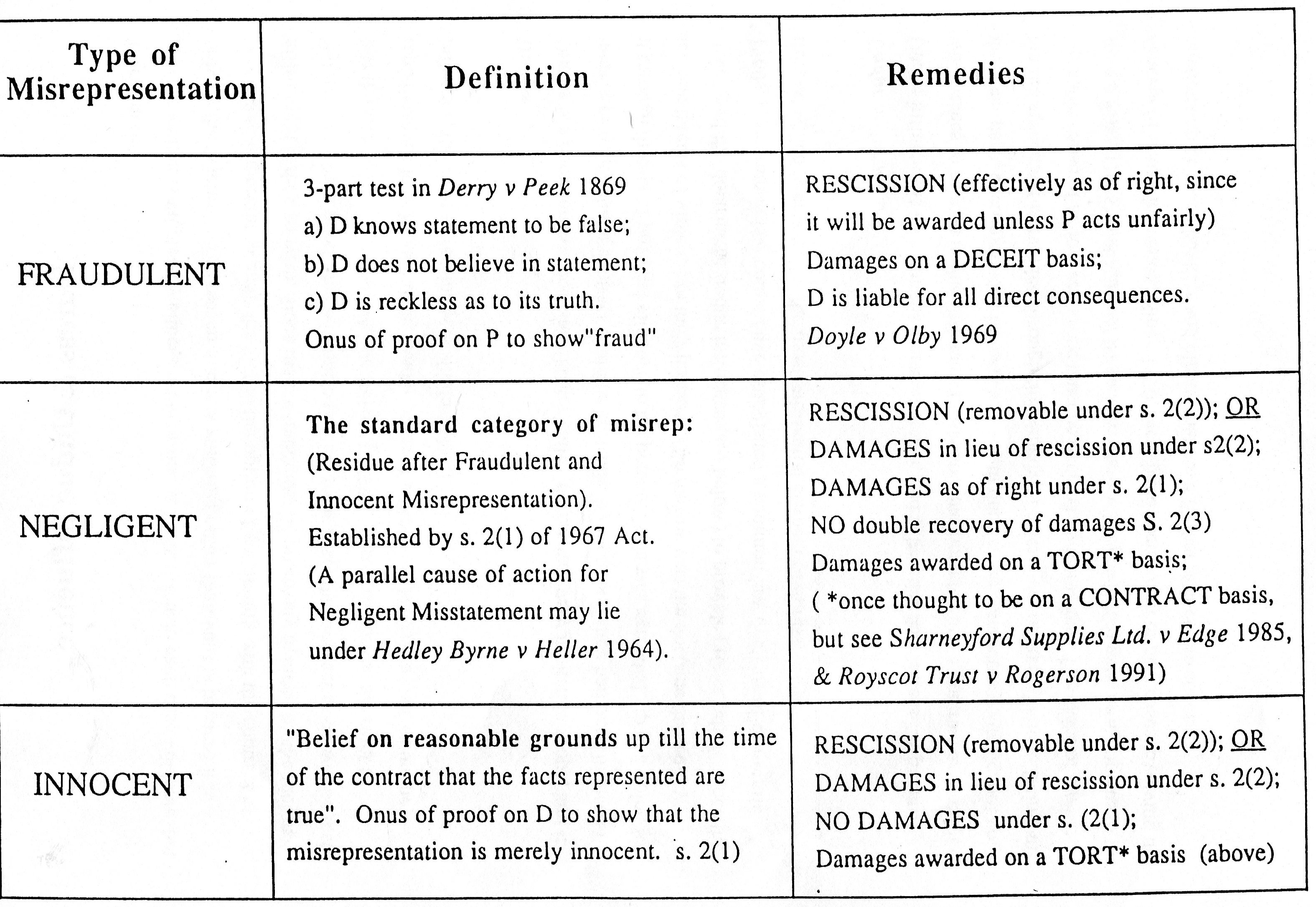
Fraudulent misrepresentation requires the representor to have made the false statement knowingly, without belief in its truth, or recklessly as to whether it was true. Derry v Peek [1889] is the House of Lords authority defining that test — knowledge of falsity, absence of belief in the truth, or reckless indifference to truth or falsity — and it deliberately excludes an honest, if unreasonable, belief.
Outside any contract at all, negligent misstatement at common law can arise where there is a special relationship of proximity giving rise to a duty of care. Hedley Byrne & Co Ltd v Heller & Partners Ltd [1964] recognised liability in tort for negligent misstatement made in such circumstances — this is the tort route, distinct from (though it can overlap with) misrepresentation within a contractual relationship.
The statutory route is more claimant-friendly still. Section 2(1) of the Misrepresentation Act 1967 creates liability for a non-fraudulent misrepresentation made by one contracting party to the other, unless the representor proves reasonable grounds to believe the statement was true. That is a reversed burden of proof: the representee does not have to prove negligence — the representor must disprove it, which is often much harder to do convincingly after the fact. Damages under section 2(1) are assessed on the fraud measure (sometimes called the "fiction of fraud"), covering all direct losses flowing from the misrepresentation, even losses that were not reasonably foreseeable — a generous measure that makes section 2(1) claims a powerful tool.
Section 2(2) gives the court discretion to award damages in lieu of rescission for a non-fraudulent misrepresentation, where it would be equitable to do so — useful where rescission would be a disproportionate remedy for a relatively minor misrepresentation. Under section 2(3), any damages awarded in lieu of rescission under section 2(2) must be taken into account when assessing damages under section 2(1), preventing any double recovery.
Rescission and its bars
Rescission is the equitable remedy that sets the contract aside from the outset and aims to restore both parties to their pre-contractual position. It is available in principle for fraudulent, negligent, and wholly innocent misrepresentation alike — unlike damages, which historically depended on the category of misrepresentation. But the right to rescind is not indefinite; it can be barred by:
- affirmation of the contract after the representee has knowledge of the misrepresentation;
- excessive lapse of time between the contract and the attempt to rescind;
- impossibility of restitution — where the parties can no longer be restored to their original positions; and
- third-party rights — where an innocent third party has acquired rights in the subject matter for value.
Section 1 of the Misrepresentation Act 1967 removed the historic common law bars to rescission that used to apply once a misrepresentation became a term of the contract, or once the contract had been fully performed — before 1967, either of those events could kill the right to rescind outright; now they cannot.
Finally, section 3 of the Misrepresentation Act 1967 renders a term excluding or restricting liability or remedies for misrepresentation ineffective, except to the extent it satisfies the reasonableness test in UCTA 1977 — a party cannot draft their way out of the consequences of their own misrepresentation any more easily than they can draft their way out of negligence.
Mistake operates on a different axis from misrepresentation: instead of one party lying to the other, the parties (or one of them) are simply wrong about the world in a way that undermines genuine agreement. English law confines relief for mistake very narrowly, because a generous doctrine of mistake would let parties escape bad bargains simply by claiming they misunderstood something.
Common mistake occurs where both contracting parties share the same mistaken belief about a fundamental fact existing at the time of contracting. The clearest species is res extincta — mistake as to the existence of the subject matter. In Couturier v Hastie [1856], a contract for the sale of goods that had already perished before the contract was made was held void for common mistake as to the existence of the subject matter — there was, quite literally, nothing to sell. But the bar for common mistake is high: the mistake must render the subject matter essentially and radically different from what the parties believed it to be. Great Peace Shipping Ltd v Tsavliris Salvage (International) Ltd [2002] confirmed a narrow common law doctrine of common mistake and rejected any wider equitable jurisdiction to rescind for common mistake — overruling the earlier, more flexible equitable approach that had allowed contracts to be set aside for common mistake on fairness grounds alone. After Great Peace, there is only the narrow common law doctrine; "it would be fairer to let them out of the deal" is no longer, by itself, enough.
Mutual mistake occurs where the parties are at cross-purposes — each having a different and incompatible understanding of a fundamental term — so that no true agreement is ever reached. Raffles v Wichelhaus [1864], the celebrated "Peerless" case, held a contract void because there were two ships of that name and each party reasonably meant a different one; neither party was lying, but there was never a meeting of minds. Where a mutual mistake produces a latent ambiguity that cannot be resolved objectively, the court may hold that no contract was ever formed at all.
Unilateral mistake comes in distinct flavours, and SQE1 problems hinge on telling them apart.
- As to terms: only one party is mistaken about a term, and the other party knew or ought to have known of that mistake. In Hartog v Colin & Shields [1939], a seller's mistaken offer to sell at a price per pound (rather than the customary price per piece) was not binding, because the buyer knew — or clearly ought to have known — that the price was a slip.
- As to identity: this can render a contract void where the identity of the other contracting party was of fundamental importance and was mistaken — but the outcome turns heavily on how the parties dealt with each other. Where parties deal face to face, there is a strong presumption that each party intends to contract with the physical person actually present, so a mistake as to identity typically renders the contract voidable rather than void. Phillips v Brooks Ltd [1919] and Lewis v Averay [1972] both applied this presumption: face-to-face dealing meant the rogue's fraud rendered the contract voidable, allowing an innocent third party who bought the goods from the rogue to retain good title. By contrast, where parties deal at a distance, such as by written correspondence, a mistaken belief about the other party's identity can render the contract void rather than merely voidable — because there is no physical presence to anchor the presumption of intending to deal with whoever is standing there. Cundy v Lindsay [1878] held a written contract concluded with a rogue impersonating a real, different company void for mistake as to identity, and Shogun Finance Ltd v Hudson [2004] saw the House of Lords hold, by majority, that a written hire-purchase agreement concluded with a rogue impersonating another named individual was likewise void for mistake as to identity.
- As to a quality of the subject matter (as opposed to identity or terms) generally does not render a contract void at common law at all — a mistaken assumption about, say, the authenticity or value of an item is usually just a bad bargain, not an operative mistake.
Finally, the defence of non est factum ("it is not my deed") allows a person who signed a document under a fundamental mistake as to its character or effect to deny being bound by it. The defence is narrowly confined and is unavailable to anyone who signed the document carelessly or without taking reasonable precautions to find out what they were signing. In Saunders v Anglia Building Society [1971], the House of Lords held that non est factum failed precisely because the signer was careless as to the true nature of the document she signed — the defence protects the diligent-but-deceived, not the merely careless.
When advising on vitiating factors, a practitioner should distinguish exemption clause validity, actionable misrepresentation, and operative mistake as separate legal routes that can each affect the enforceability of the same contract. A single fact pattern can raise all three: a signed contract might contain an exclusion clause that fails incorporation or the UCTA reasonableness test, while the seller's pre-contractual sales pitch may separately amount to an actionable misrepresentation, and a garbled description of the goods might separately support an argument on mistake. Work each route through its own stages — incorporation/construction/statute for exemption clauses; fact/inducement/category for misrepresentation; common/mutual/unilateral for mistake — rather than treating "the contract was unfair" as a single, undifferentiated complaint.