Freehold: Completion and Post-Completion
Completion is the single moment a conveyancing file has been building toward since exchange: the seller hands over an executed deed and the keys, the buyer's money moves, and — for one brief, legally awkward interval — the buyer owns a house the register does not yet know about. Everything in this topic is really about managing that gap: closing it safely on the day of completion, and closing it again afterwards at the Land Registry, while making sure nothing rots the buyer's title in between.
By the time exchange has happened, the buyer's solicitor has already checked title once. But contracts can be exchanged weeks or months before completion, and in that time the register can change, the seller can go bankrupt, or a corporate party can slide into insolvency. Pre-completion searches exist to confirm the state of the register and the buyer's solicitor's financial and identity checks are still current in the days immediately before money is released — because releasing hundreds of thousands of pounds on stale information is precisely the kind of mistake that ends careers.
The search you run depends on what you're buying and from whom:
| Search | Form | Used against | Purpose |
|---|---|---|---|
| Official search of whole, with priority | OS1 | Whole of a registered title | Confirms the register and freezes it for the buyer |
| Official search of part, with priority | OS2 | Part of a registered title (e.g., a new-build plot carved off a larger title) | Same function, for part-titles |
| Land Charges Department search | K15 | Unregistered land | Pre-completion priority search where there is no register to search |
| Bankruptcy-only Land Charges search | K16 | An individual buyer | Confirms to a mortgage lender that the buyer isn't subject to a bankruptcy entry |
| Companies House search | — | A corporate seller or buyer | Confirms no insolvency proceedings have started shortly before completion |
The OS1/OS2 mechanism deserves close attention because it is the load-bearing safety net of the whole system. An official search with priority doesn't just tell you what the register says today — it confers a priority period of 30 business days from the date of the search. During that window, the buyer's own application to register can leapfrog most adverse entries made in the meantime: someone could try to register a charge or a second sale against the seller the day after your search, and your buyer still wins, provided the buyer's solicitor lodges the application to register the transfer at HM Land Registry before the priority period expires. Miss that window and the protection evaporates — which is why the deadline is treated as absolute: the application must physically reach HM Land Registry by noon on the last day of the priority period to retain priority. A courier stuck in traffic at 12:05pm has just cost the client their protection.
Rule to memorise: OS1/OS2 priority period = 30 business days from the search date. The registration application must arrive at HM Land Registry by noon on the final day, or priority is lost.
Financial loose ends need tying off in parallel with these searches. The buyer's solicitor requests a completion statement from the seller's solicitor, confirming the exact balance payable on completion once the deposit already paid is deducted — because "purchase price" and "money due today" are rarely the same figure once apportionments are involved. The buyer's solicitor also chases the buyer's mortgage lender for the mortgage advance in good time, so cleared funds are sitting in the client account before completion day, not arriving in a last-minute panic.
On the seller's side, if there's an existing mortgage to be paid off, the seller's solicitor obtains an up-to-date redemption statement from that lender — the sum needed to discharge the mortgage on completion, which typically differs from the outstanding balance because of interest accrual and any early-redemption charge. The seller's solicitor then gives an undertaking to redeem the mortgage out of the sale proceeds, and this undertaking is standardised using one of the Law Society's redemption formulae:

- Formula A — the seller's solicitor already holds the redemption figure at completion.
- Formula B — the seller's own solicitor doesn't act for the lender and doesn't yet hold the figure at completion.
- Formula C — separate firms act for the seller and for the seller's lender on the same transaction.
These formulae exist because an undertaking is a professional promise with teeth — breach one and you're facing the Solicitors Disciplinary Tribunal, not just an awkward phone call — so the precise wording needs to match precisely how much certainty the solicitor actually has about the redemption figure.
Contracts create rights to sue; deeds move legal title. That distinction is the entire reason section 52(1) of the Law of Property Act 1925 requires a conveyance of a legal estate in land to be made by deed — informal handshakes, however sincere, don't transfer freehold ownership.

For a registered freehold (or leasehold) title, the deed used is Land Registry form TR1, and its panels each do a specific job worth knowing cold:
- Panel 1 — the title number of the registered estate being transferred.
- Panel 8 — the consideration paid by the transferee (buyer).
- Panel 9 — the title guarantee given by the transferor: full or limited.
- Panels 10–11 — completed to record a declaration of trust where the property goes to joint buyers, setting out how they hold the beneficial interest between them.
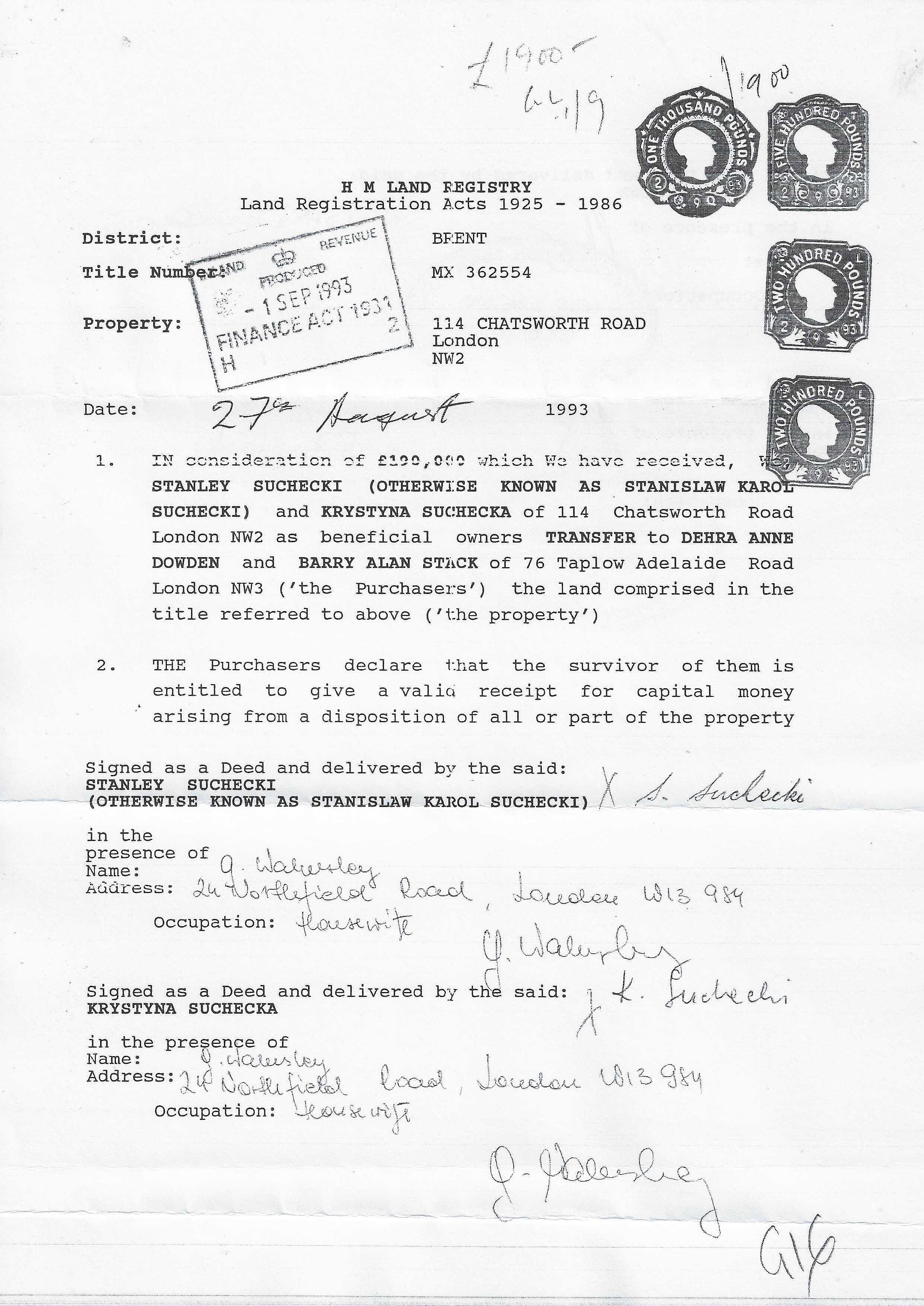
But a document only becomes a deed — with all the legal consequences that word carries — if two things are true. First, section 1 of the Law of Property (Miscellaneous Provisions) Act 1989 requires it to make clear on its face that it is intended to be a deed (TR1's printed form does this for you). Second, it must be validly executed, and execution rules differ by party type:
- An individual executes validly by signing in the presence of a witness who attests the signature.
- A company executes under section 44 of the Companies Act 2006 either by the signatures of two authorised signatories, or by one director's signature witnessed by an independent witness.
The witness matters more than students often assume: a witness to a transfer deed's execution should be independent and should not themselves be a party to the transfer — a witness with a stake in the outcome undermines the evidential value of the attestation.
Once validly executed, the deed takes effect on delivery, and delivery is presumed to occur on execution unless a contrary intention is shown. This is why the deed must be dated with the actual date completion takes place — the date on the document is doing real legal work, not just administrative housekeeping.
Completion is the moment the seller hands over the executed transfer deed and title documents in exchange for the buyer's payment of the balance of the purchase price. Around that core exchange, a few mechanical rules govern how money and adjustments actually move:
- Apportionment at completion divides recurring outgoings — ground rent, service charge — between seller and buyer by reference to the completion date, so neither party pays for the other's period of ownership.
- Under the Standard Conditions of Sale, completion money must move by direct telegraphic or electronic bank transfer — not a banker's draft, and certainly not cash. Modern conveyancing runs on same-day electronic transfers precisely because deadlines are measured in hours.
- Completion must happen by 2pm on the completion date, or — for compensation purposes — it's treated as having taken place on the next working day. A transfer that clears at 2:15pm is, in the eyes of the compensation regime, a transfer that happened tomorrow.
There are three ways to actually do completion:
- In person — representatives of both firms physically attend the same location to exchange deed, title documents, and money simultaneously. Rare now, but conceptually the cleanest.
- Through agents — the seller's solicitor appoints the buyer's solicitor, or another local solicitor, to act as their agent purely for completion purposes.
- By post — no attendance required by either side, and this is by far the most commonly used method in freehold conveyancing today.
Because postal completion means the seller's solicitor is physically holding the buyer's money and the buyer's solicitor is trusting them to hand over documents they can't see, the profession standardised the process through the Law Society's Code for Completion by Post. Under the Code, the seller's solicitor acts as the buyer's solicitor's agent for the limited purpose of completing the transaction; the buyer's solicitor must send sufficient cleared funds and authority to complete before the completion date; and the seller's solicitor holds that money to the order of the buyer's solicitor until authorised to release it. It's a tightly choreographed handoff of trust, precisely because nobody is in the room to catch a mistake in real time.

Why the Code was rewritten in 2019: The current edition took effect on 1 May 2019, directly in response to the Court of Appeal's decision in Dreamvar (UK) Ltd v Mishcon de Reya, which exposed a gap in liability where a fraudster posed as a seller. Paragraph 8 of the 2019 Code now constitutes an undertaking by the seller's solicitor's firm that it has authority from the true owner of the property to receive the purchase money — closing the loophole that let an innocent buyer's solicitor be left holding the risk when the "seller" turned out to be an impostor.
Completion doesn't finish the job — it starts the post-completion clock, and that clock has real financial teeth.
Stamp Duty Land Tax (SDLT) comes first. The buyer's solicitor must file a land transaction return, form SDLT1, with HMRC, and both the return and any tax due must reach HMRC within 14 days of the effective date of the transaction. The "effective date" is normally the completion date, but it can be earlier if the buyer substantially performs the contract (for example, moving in or paying most of the price) before formal completion happens. Miss the 14-day window and an automatic £100 penalty applies for a return filed up to three months late — a flat fine regardless of the tax actually owed. And if that 14-day deadline itself falls on a weekend or bank holiday, the return and payment must reach HMRC by the end of the preceding working day — the deadline moves earlier, not later, which trips up anyone who assumes the usual "next working day" grace period applies.

Only once SDLT is sorted does the buyer's solicitor turn to HM Land Registry, applying to register the transfer using form AP1. This application should be lodged within whatever priority period was secured by the earlier OS1/OS2 search — tying the whole sequence back to the search you ran weeks before.

This brings us to the concept that makes the entire topic cohere: the registration gap. Legal title to a registered freehold estate does not pass to the buyer on completion of the transaction — it passes only on completion of registration at HM Land Registry. Between those two events, the buyer holds nothing more than an equitable interest, and during that gap the buyer's unregistered interest is vulnerable to entries made against the seller's name — most dangerously a bankruptcy or insolvency entry, which could unravel a sale the buyer thinks is already done. This is exactly why the OS1/OS2 priority period and the AP1 application timing matter so much: they are the mechanism that shrinks the registration gap's risk to something manageable. Once HM Land Registry processes the application, it updates the register and issues official copies naming the buyer as the new registered proprietor — and only then is the buyer's ownership actually bulletproof.
Contracts for the sale of land build in an unusual amount of tolerance for lateness. Under a standard land contract, time is not of the essence for completion — meaning a few days' delay doesn't automatically let the innocent party walk away — and the Standard Conditions of Sale expressly say so, right up until a notice to complete is served.
Once the contractual completion date has passed, either party who is ready, able, and willing to complete may serve a notice to complete on the defaulting party. Serving that notice flips a switch: it makes time of the essence, converting what was a tolerant, flexible deadline into a hard one. Under the Standard Conditions of Sale, the notice gives the defaulting party 10 working days after the day of service to complete. Miss that window and the consequences bite:
- If the buyer fails to complete within the notice period, the seller may rescind the contract — and, having rescinded, may forfeit and keep the buyer's deposit.
- If the seller fails to complete within the notice period, the buyer may rescind and recover the deposit paid.
The switch notice to complete flips: before service, time is not of the essence (delay is tolerated); after valid service, time is of the essence and expiry of the notice period triggers a right to rescind.
Short of rescission, the Standard Conditions also compensate for pure delay: the party not in default is entitled to compensation calculated at the contract rate on the purchase price, running for the period between the contractual completion date and the date completion actually occurs. This is a mechanical, formula-driven remedy — no need to prove actual loss — sitting alongside, rather than instead of, the general law.
Beyond the contractual machinery, ordinary contract remedies remain available. A party can seek an order of specific performance from the court to compel the other side to complete — appropriate precisely because land is regarded as unique, so damages alone might not do justice. Alternatively, damages for breach are assessed on ordinary contractual principles, aiming to put the innocent party in the position they'd have been in had the contract been performed properly. And one further trap worth flagging for scenario questions: if the contract requires vacant possession on completion and the seller doesn't give it — furniture left behind, a tenant still in occupation — that failure is itself a breach, entitling the buyer to the same remedies for late or defective completion even if the deed was executed and the money moved on time.
Put together, this topic is a study in risk management across a gap: the gap between exchange and completion (bridged by pre-completion searches), the gap in a postal handover (bridged by the Code for Completion by Post), and the gap between completion and registration (bridged by the priority period and the AP1 application). Every rule here exists to shrink one of those three gaps.