Planning Law Principles
Planning law rests on a deceptively simple question that a solicitor must answer before advising a client to lift a single brick: is this "development"? Get that wrong, and a client builds an extension that has to come down, or pays for a survey that was never required. Everything else in this topic — permitted development, enforcement notices, building regulations — flows from how that one word is defined and policed.

The statutory gateway is section 55 of the Town and Country Planning Act 1990 (TCPA 1990), which defines development as the carrying out of building, engineering, mining or other operations in, on, over or under land, or the making of any material change of use of any buildings or other land. If a proposal falls within this definition, planning permission is required unless an exemption or a permitted development right applies. Everything else in planning control is really just detail hanging off this one clause.
Section 55 TCPA 1990 — the two limbs of development:
- Operational development — building, engineering, mining, or other operations.
- Material change of use — a change in how land or buildings are used that is significant enough to matter.
Operational development: the three kinds of "operations"

- Building operations cover demolition, rebuilding, structural alterations or additions to buildings, and other works normally carried out by someone in the business of building. Think of the physical, structural interventions a builder would recognise as their trade.
- Engineering operations include forming or laying out a means of access to a highway — so a new driveway cut into a road frontage engages planning control, not just Highways legislation.
- Mining operations cover the removal of material from a mineral-working deposit, a waste tip, or a deposit of pulverised fuel ash — the extractive industries limb of the definition.

Material change of use: fact and degree
A material change of use is not defined by a checklist; it is judged as a matter of fact and degree in each case — how different is the new use from the old, and is that difference significant enough to have planning consequences? Two situations are singled out by statute so solicitors do not have to guess:
- Turning a single dwellinghouse into two or more separate dwellinghouses is expressly deemed a material change of use under section 55(3) TCPA 1990 — subdividing a house into flats always needs permission, even though nothing has been built.
- Depositing refuse or waste on land is a material change of use where the superficial area or height of the deposit is extended, even if the land was already used as a tip — intensifying an existing use can itself be development.
What is carved out of the definition
Section 55(2) TCPA 1990 removes several everyday activities from "development" altogether, so they never need planning permission:
- Internal or non-material external works — maintenance, improvement, or alteration affecting only the interior of a building, or not materially affecting its external appearance.
- Incidental curtilage uses — using buildings or land within the curtilage of a dwellinghouse for a purpose incidental to enjoying the dwellinghouse (a garden shed, a home office in the garage).
- Agriculture and forestry — using land for agriculture or forestry, and using buildings occupied together with that land for the same purposes.
- Same-class changes of use — changing use within the same class of the Town and Country Planning (Use Classes) Order 1987 (as amended) is not development, because the statutory scheme treats uses within one class as interchangeable (a shop becoming a different kind of shop in the same use class, for example).
Permitted development and Article 4 directions
Even where something is development, it may not need an individual application. The Town and Country Planning (General Permitted Development) (England) Order 2015 grants automatic planning permission for specified categories of development — many household extensions and changes fall within its schedules. But a local planning authority can claw this back: an Article 4 direction withdraws specified permitted development rights within a defined area, typically to protect a conservation area or manage cumulative change. Advising a client on a loft conversion means checking both instruments — the GPDO grant, and whether an Article 4 direction has removed it locally.
Outline permission and conditions
A developer does not always need every detail settled before permission is granted. Outline planning permission establishes the principle of a development while reserving specified matters — design, layout, landscaping — for later approval, letting a client secure certainty on the big question (can I build here at all?) before spending on detailed drawings.
Where permission is granted, the authority can attach conditions under section 70 TCPA 1990, but only if those conditions are necessary, relevant to planning, and reasonable — a client faced with an onerous condition should always test it against this three-part filter before assuming it is enforceable as drafted.
Here is a trap for the unwary: planning permission and building regulations approval are two entirely separate legal regimes, and obtaining one never removes the need for the other. Planning permission asks whether a development should happen at all and what it should look like; building regulations control the technical construction standards of a building — structural safety, fire safety, energy efficiency — regardless of whether planning permission was needed for the same works.

Building regulations are made under the Building Act 1984, with the current detailed technical requirements set out in the Building Regulations 2010. A developer can secure building regulations approval in one of two ways:
| Route | How it works |
|---|---|
| Full plans procedure | Detailed plans are submitted and approved before work starts. |
| Building notice procedure | Work can begin without prior approval of detailed plans; compliance is checked as the work proceeds. |
A client who has obtained planning permission for an extension still needs building regulations sign-off for the same structure — and vice versa, building regulations compliance says nothing about whether planning permission was required.
A breach of planning control occurs where development is carried out without the required planning permission, or where a condition or limitation attached to a permission is not complied with. Where a local planning authority considers there has been a breach and it is expedient to act, it may issue an enforcement notice under section 172 TCPA 1990.

Timing under section 172: a copy of the enforcement notice must be served not more than 28 days after the notice's date of issue, and not less than 28 days before the date it is to take effect. This dual 28-day window is a favourite examination trap — miss either boundary and the notice's validity is compromised.
An enforcement notice must specify: the breach alleged, the steps required to remedy it, and the period allowed for compliance.
Appealing an enforcement notice
Section 174(2) TCPA 1990 sets out the statutory grounds of appeal to the Secretary of State, and the appeal must be lodged before the notice's stated effective date. The grounds a solicitor needs to recognise instantly:
| Ground | Substance |
|---|---|
| (a) | Planning permission ought to be granted for the development (or a condition/limitation ought to be discharged). |
| (b) | The matters alleged in the notice have not occurred. |
| (c) | The matters alleged do not constitute a breach of planning control. |
| (d) | No enforcement action could be taken at the date of issue because the breach was already immune through expiry of the relevant time limit. |
| (e) | Copies of the notice were not served as section 172 requires. |
| (f) | The steps required exceed what is necessary to remedy the breach or any injury to amenity. |
Grounds (a) and (d) are the ones clients reach for most often in practice: (a) argues the development is actually fine and should simply be permitted; (d) argues the authority is simply too late.
Stop notices and temporary stop notices
An enforcement notice does not itself stop activity on the ground while an appeal runs — for that, the authority needs a stop notice, served alongside or after an enforcement notice, prohibiting a specified activity before the enforcement appeal is finally determined. Two limits matter: a stop notice cannot require demolition of a building, and it cannot be used to prohibit use of a building as a dwellinghouse — Parliament drew a line at putting people out of their homes through this particular mechanism.
Where speed matters more than due process safeguards, a temporary stop notice lets the authority prohibit an activity immediately, without first issuing an enforcement notice, wherever it considers a breach of planning control has occurred.
The lighter-touch tools
Not every breach calls for the full enforcement-notice machinery:
- A breach of condition notice under section 187A TCPA 1990 simply requires compliance with a planning condition, and — unusually — carries no statutory right of appeal to the Planning Inspectorate. The minimum compliance period it must allow is 28 days. Because there is no appeal route, advising a client to comply (or to challenge the underlying condition by other means) becomes urgent.
- A planning contravention notice under section 171C TCPA 1990 is purely an information-gathering tool, used by the authority to investigate a suspected breach before deciding whether to take formal enforcement action at all.
- Where an authority needs the courts' assistance, it may apply for an injunction under section 187B TCPA 1990 to restrain an actual or apprehended breach of planning control — useful where the ordinary notice regime is too slow or has already been flouted.
Time limits for enforcement — the reform that changed everything
This is the area most likely to catch out anyone revising from an older textbook, because the law changed materially and recently.
Before 25 April 2024, the position in England was a two-tier system:
- 4 years — for operational development, and for a change of use of a building to a single dwellinghouse, running from substantial completion (or from the date of the change of use).
- 10 years — for a material change of use other than to a single dwellinghouse, and for a breach of a planning condition.
The Levelling-up and Regeneration Act 2023 reformed this, and its enforcement changes came into force on 25 April 2024, replacing the old two-tier structure with a single unified 10-year time limit for all breaches of planning control in England.
Not retrospective. The new unified 10-year limit does not reach back in time: operational development, or a change of use to a single dwellinghouse, that was substantially completed before 25 April 2024 remains governed by the old 4-year immunity period. A solicitor advising on an older breach must first ask when was this substantially completed before reaching for the new rule.
Once the relevant time limit has expired without enforcement action, the breach becomes immune — lawful, in effect, by the passage of time. A client can convert that practical immunity into documentary certainty:
- A Certificate of Lawfulness of Existing Use or Development, under section 191 TCPA 1990, formally confirms that an existing use, operation, or breach of condition is lawful because the relevant enforcement time limit has expired.
- A Certificate of Lawfulness of Proposed Use or Development, under section 192 TCPA 1990, confirms before development begins that a proposed use or operation would be lawful.
Crucially, neither certificate is a grant of planning permission — it is a statement of legal certainty about lawfulness, useful on a sale where a buyer's solicitor wants comfort that an unauthorised-looking feature cannot now be pursued.
Prosecution with no time limit at all
Two enforcement routes sit outside any limitation period, and examiners like to test the contrast with the 10-year immunity rule above:
- Failure to comply with an enforcement notice within its compliance period is a continuing criminal offence under the TCPA 1990, and there is no time limit for prosecuting it.
- Carrying out building work in contravention of building regulations, prosecuted under section 35 of the Building Act 1984, likewise carries no time limit on prosecution.
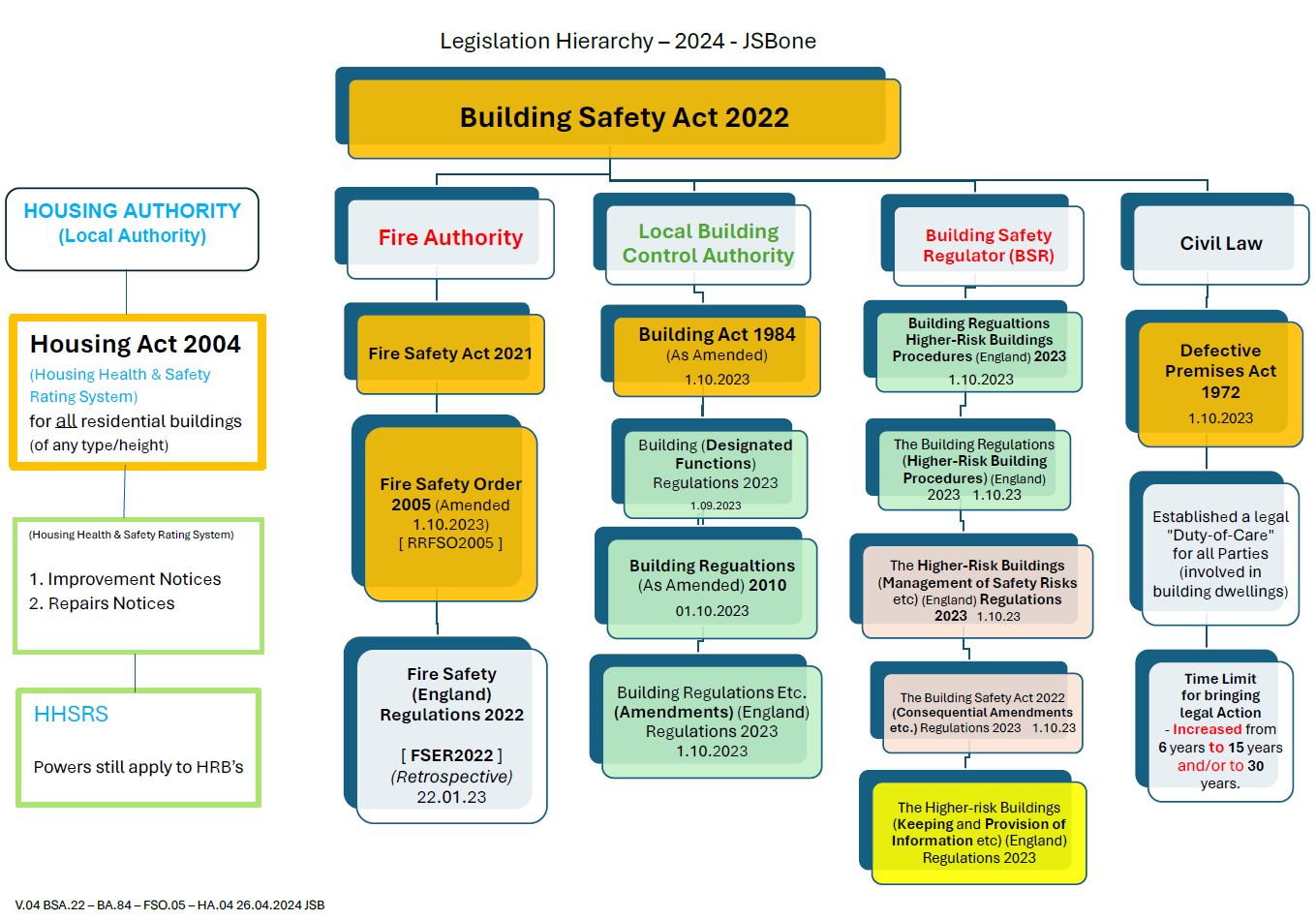
Building regulations enforcement went through a parallel, separate overhaul. Before 1 October 2023, a local authority could not serve a section 36 Building Act 1984 notice — requiring removal or alteration of non-compliant work — more than 12 months after the work's completion. The Building Safety Act 2022 extended that window, from 1 October 2023, from 12 months to 10 years from completion of the work.
And where the non-compliant work is actually unsafe, there is no time limit at all on the authority's power to take enforcement action — safety concerns override the ordinary limitation clock entirely.
Layered on top of planning permission and building regulations is a third and quite distinct system: listed building consent, required for works affecting the character of a listed building. Unauthorised works to a listed building trigger their own, distinct listed building enforcement action, separate from ordinary TCPA enforcement — a reminder that a single property transaction can sit under three overlapping (and independently enforceable) consent regimes at once: planning, building regulations, and listed building consent.

A solicitor advising a property client on works therefore has to run through a short but rigorous checklist: does this fall within section 55's definition of development at all; if so, is it exempt or covered by permitted development rights (subject to any Article 4 direction); separately, does it need building regulations approval; and if something was done without the right consent, how long ago, and under which time-limit regime, so that immunity (or its absence) can be assessed with precision. Planning law rewards exactly this kind of structured, statute-anchored reasoning — which is precisely why SQE1 tests it through realistic transactional scenarios rather than abstract definitions alone.