Trial Procedure and Sentencing
Every criminal case in England and Wales begins with a sorting question: which court gets to try it? Get that question right, and the rest of the procedural map — who decides guilt, what a "no case to answer" submission can achieve, who is allowed or forced onto the witness stand, and ultimately what sentence a judge can lawfully impose — falls into place. Get it wrong, and you have misadvised a client on the single most consequential strategic decision of their case.
Parliament sorts every criminal offence into one of three boxes, and the box dictates the courtroom.

- Summary-only offences (most driving offences, common assault) can be tried only in the magistrates' court.
- Indictable-only offences (murder, rape, robbery) can be tried only in the Crown Court.
- Either-way offences (theft, most fraud, ABH) can be tried in either court, depending on an allocation decision.

Indictable-only cases skip the magistrates' court's trial function entirely: under section 51 of the Crime and Disorder Act 1998, they are sent directly to the Crown Court. The magistrates' role is administrative, not adjudicative — there is no summary trial to have.

Either-way offences are where the interesting procedure lives. A defendant charged with an either-way offence must first go through plea before venue: before any decision is made about which court will try the case, the defendant indicates a plea in the magistrates' court.
- If the defendant indicates guilty, the magistrates proceed exactly as if there had been a summary trial and a conviction — the case stays in the magistrates' court for sentence (subject to the committal-for-sentence point below).
- If the defendant indicates not guilty, the magistrates move to an allocation hearing to decide whether the case is suitable for summary trial or should be sent to the Crown Court.
Key definition: Allocation is the magistrates' court's own assessment of venue. In deciding it, the magistrates must have regard to the National Allocation Guideline and to whether their own sentencing powers would be adequate if the defendant were convicted.
Even where the magistrates decide they are willing to keep the case — accepting jurisdiction — the defendant still holds a trump card: the right to elect Crown Court trial by jury. This is a one-way ratchet in the defendant's favour: the magistrates can send a case up, but only the defendant can pull a case that the magistrates would have kept down to the Crown Court.
The two trial venues differ fundamentally in who decides fact and law.
| Feature | Magistrates' Court | Crown Court |
|---|---|---|
| Tribunal | Bench of 2–3 lay magistrates, or a single District Judge (Magistrates' Courts) | Judge (law) + jury (fact) |
| Law and fact | Same tribunal decides both — no jury | Judge rules on law; jury of (ordinarily) 12 jurors decides fact |
| Verdict route | Bench deliberates and delivers verdict | Judge sums up law and evidence, then jury retires |
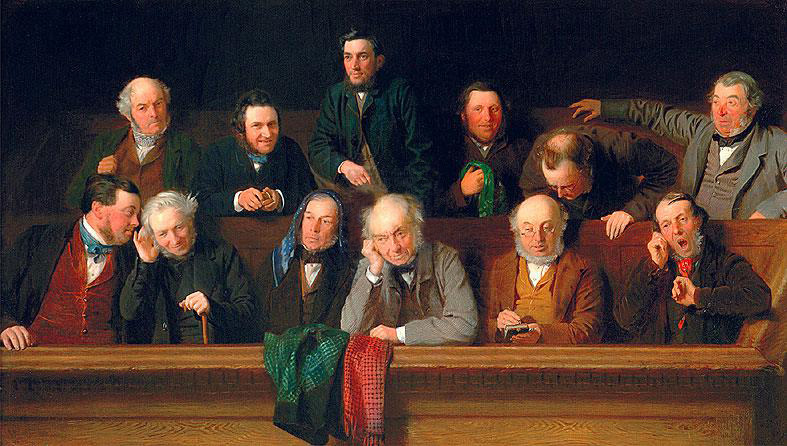
In the magistrates' court, there is no split between judge and jury — the magistrates or District Judge are simultaneously the arbiters of law and the finders of fact. In the Crown Court, that split is the whole architecture of the trial: the judge rules on admissibility and legal directions, but only the jury decides whether the defendant did it.
A Crown Court trial opens with arraignment: the indictment is put to the defendant count by count, and the defendant enters a plea to each. From there, if the plea is not guilty, the trial proper begins.
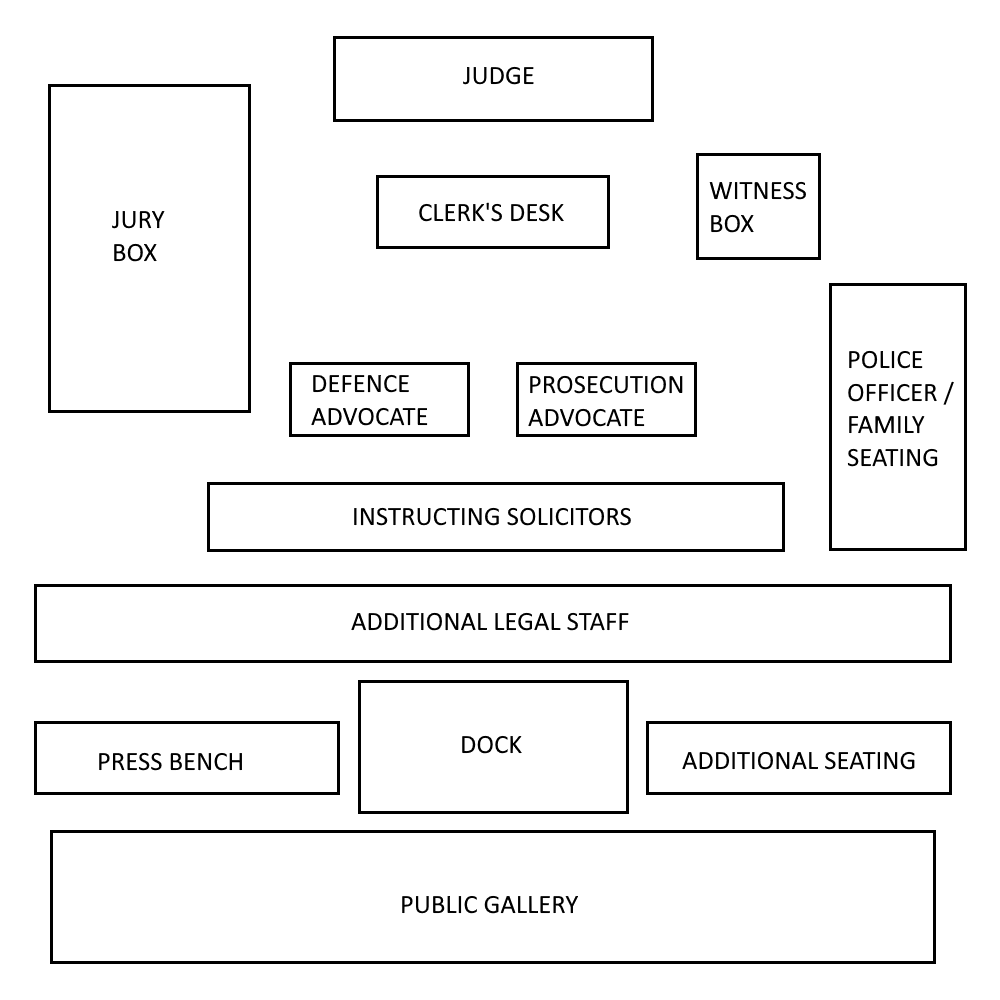
Whether in the magistrates' court or the Crown Court, a contested trial follows a broadly consistent sequence, and knowing the order matters because certain moves (like a no-case submission) are only available at certain points.
- Prosecution opening speech — outlines the case and the evidence to come.
- Prosecution witnesses give evidence-in-chief, are cross-examined by the defence, and the calling party may re-examine — but re-examination is strictly limited to matters that arose in cross-examination; it is not a chance to reopen the whole story.
- Close of the prosecution case — this is the pivot point for a possible submission of no case to answer (below).
- Defence case, if the trial continues — the defendant may (but cannot be compelled to) give evidence, and may call other witnesses.
- Closing speeches from both parties, summarising the evidence and arguments.
- Summing up (Crown Court only) — the judge directs the jury on the law and reviews the evidence before the jury retires.
- Verdict.
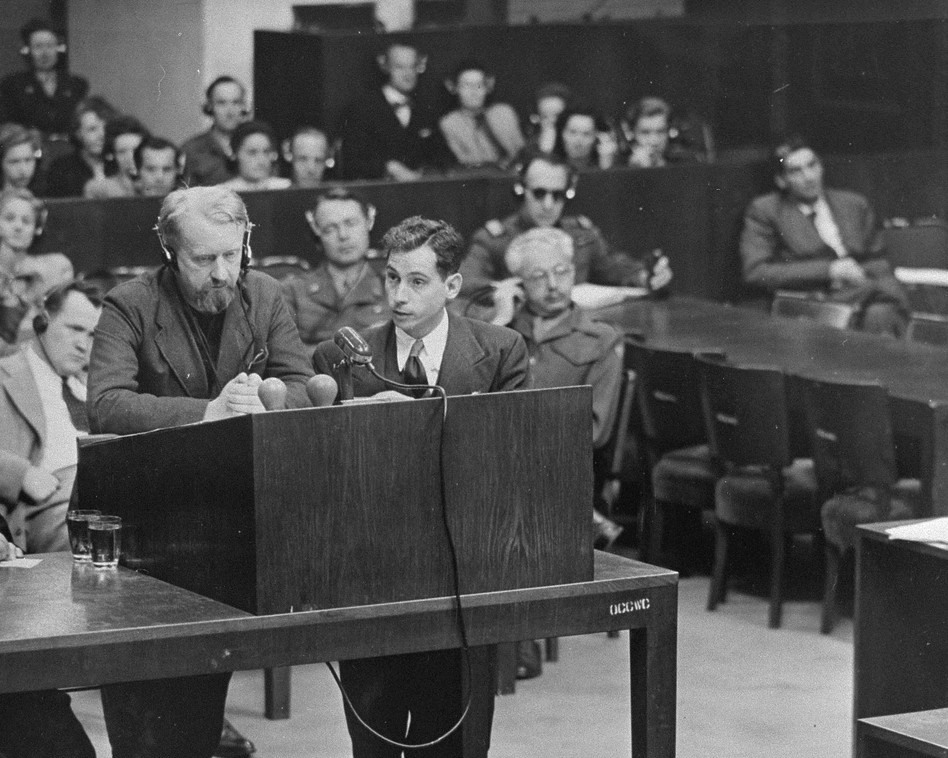
Verdicts in the Crown Court: Unanimity, Then Majority
A jury is always directed first to reach a unanimous verdict. Only after a minimum period of deliberation, and only where statute permits, may the judge accept a majority verdict. Under the Juries Act 1974, that majority must be at least 10–2 (or 10–1, or 9–1 where the jury has been reduced below twelve, for example through discharged jurors). The judge cannot simply "allow" a majority verdict on request — the minimum deliberation period safeguard exists precisely so that majority verdicts remain the exception, not a shortcut.
At the close of the prosecution case, the defence's most powerful procedural weapon is the submission of no case to answer — an invitation to the court to stop the case there and then, without ever hearing defence evidence. Succeed, and the client walks out acquitted on the spot.
The governing test comes from R v Galbraith (1981), and it has two limbs — think of them as two different ways the prosecution's case can fail before the defence even opens its mouth.
Galbraith, first limb: the case must be stopped if there is no evidence that the defendant committed the offence.
Galbraith, second limb: the case must be stopped if the prosecution evidence is so tenuous, inconsistent, or inherently weak that a properly directed jury or bench could not properly convict on it.
The critical discipline in applying Galbraith is that the court must take the prosecution evidence at its highest. This is not an invitation to weigh credibility or resolve conflicts of evidence — that is the jury's job. It is a filter for evidential insufficiency, not a preview of the verdict. And the test is not Crown-Court-specific: it applies equally to no-case submissions in the magistrates' court.
If the submission fails, the trial simply continues, and the defence may call evidence, including — if it chooses — the defendant.
These two concepts are easy to conflate but answer different questions:
- Competence: is this person legally permitted to give evidence at all?
- Compellability: can this person be forced to attend and testify?
The default rule, from section 53(1) of the Youth Justice and Criminal Evidence Act 1999 (YJCEA 1999), is expansive: everyone is competent at every stage of criminal proceedings, whatever their age. The only carve-out, under section 53(3), is a person who cannot understand questions put to them as a witness, or cannot give understandable answers — a functional test of communicative capacity, not an age or status bar. Competence must be resolved before the witness is sworn, and when it is challenged, the court must assess it as if any special measures direction already made (or proposed) for that witness were in place — the question is what the witness can achieve with appropriate support, not without it.
The Defendant's Special Position
The defendant occupies a unique dual status:
- Not competent for the prosecution in their own trial — the prosecution can never call the defendant against themself.
- Competent for the defence — but never compellable. A defendant can choose to give evidence but cannot be forced to.
Co-Defendants
A co-defendant is not compellable for the prosecution while still charged in the same proceedings — the joint-trial structure would otherwise let the prosecution force one defendant to incriminate another mid-trial. That protection dissolves once the co-defendant's case is discontinued, they plead guilty, or they are tried separately — at that point, they become both competent and compellable for the prosecution, because they are, procedurally, no longer "a defendant" in that trial.
Spouses and Civil Partners
Section 80 of the Police and Criminal Evidence Act 1984 (PACE 1984) governs whether a defendant's spouse or civil partner can be forced to testify — a deliberately narrower rule than for ordinary witnesses, reflecting the law's historic reluctance to compel evidence between spouses.
- Defence: always compellable under section 80(2), without restriction.
- Prosecution: compellable only in specified circumstances —
- the offence involves assault on, injury to, or threat of injury to the spouse/civil partner, or to a person then under 16;
- the offence is a sexual offence against a person then under 16; or
- the offence is attempting, conspiring, aiding, abetting, counselling, procuring, or inciting any of the above.
Section 84 of the Civil Partnership Act 2004 extends this whole regime to civil partners, so the rule is genuinely symmetric between marriage and civil partnership.
Part 2 of YJCEA 1999 creates a toolkit of special measures — procedural adjustments designed to help vulnerable or intimidated witnesses testify to the best of their ability, not to change what they say, only how comfortably they can say it.
Eligibility comes from two different sections, each targeting a different vulnerability:
- Section 16 — eligibility on the grounds of age (any witness under 18) or a quality-diminishing condition: mental disorder, significant impairment of intelligence or social functioning, or physical disability.
- Section 17 — eligibility because the quality of evidence is likely to be diminished by fear or distress about testifying. Notably, complainants in sexual offence proceedings are automatically eligible as intimidated witnesses under this section — no separate finding of fear is required.
Watch this exam trap: a defendant can never obtain special measures under sections 16 or 17, because for these purposes a defendant is not treated as a "witness." Special measures exist to help witnesses give evidence, and the defendant's evidence-giving is governed by separate, defendant-specific provisions.
The individual measures available, once eligibility and a court direction (granted where the measure would maximise the quality of the witness's evidence) are established:
| Section | Measure |
|---|---|
| s.23 | Screening the witness from the defendant in court |
| s.24 | Evidence by live link from outside the courtroom |
| s.25 | Evidence in private (public and press excluded) |
| s.26 | Removal of wigs and gowns |
| s.27 | Video-recorded evidence-in-chief |
| s.28 | Video-recorded cross-examination/re-examination |
| s.29 | Examination through an intermediary |
| s.30 | Aids to communication |
There is a separate, narrower gateway for defendants: section 33A of YJCEA 1999 allows a vulnerable or intimidated defendant to give evidence by live link in specified circumstances — a deliberately distinct provision from the sections 16/17 witness scheme, because a defendant's competing fair-trial interests require separate statutory treatment.
Before a court can decide how much punishment, it must be anchored to why it is punishing at all. Section 57 of the Sentencing Act 2020 sets out the statutory purposes of sentencing for offenders aged 18 or over:
- punishment of offenders;
- reduction of crime, including by deterrence;
- reform and rehabilitation of offenders;
- protection of the public; and
- reparation by offenders to those affected by their offences.
No single purpose dominates by default — a sentencer weighs them against the facts of the case. This is the conceptual scaffolding beneath every Sentencing Council guideline that follows.
The Guideline Method: Category, Then Adjustment
Sentencing Council definitive guidelines impose a structured, step-by-step method a court must follow for a specific offence, so that sentencing outcomes are principled rather than idiosyncratic:
- Assess culpability and harm to identify the applicable offence category.
- Each category carries a starting point and a category range.
- The court then moves within (occasionally outside) that range to reflect aggravating and mitigating factors.
Aggravating factors push the sentence up; mitigating factors pull it down. Some aggravating factors are statutory, written directly into the Sentencing Act 2020 — most importantly, previous relevant convictions and committing the offence while on bail for other matters. Others are guideline-based rather than statutory but recur across almost every offence-specific guideline: targeting a vulnerable victim, planning or premeditation, and offending as part of a group or gang.
On the mitigation side, recurring guideline factors include genuine remorse, good character and no previous convictions, the offender's age and/or lack of maturity where it bears on responsibility, and mental disorder or learning disability affecting responsibility for the offence.
Practical translation: a plea in mitigation is where this framework meets client advocacy — an oral submission by the defence advocate, made after conviction or a guilty plea but before sentence, addressing the offender's personal circumstances, remorse, steps taken since the offence, and references. Its entire purpose is to marshal the mitigating factors the guideline recognises, and present them persuasively before the court fixes the number.
A guilty plea earns a sentence discount, but the size of that discount is a race against the clock, not a flat rate. Under the Sentencing Council's guideline on reduction in sentence for a guilty plea:
| Stage plea is indicated | Maximum reduction |
|---|---|
| First stage of proceedings | One-third |
| After the first stage | One-quarter |
| First day of trial | One-tenth |
| During the trial itself | Below one-tenth, potentially nil |
The lesson for a client is blunt: credit decays the longer they wait to admit guilt, and the steepest cliff-edge sits at the very first opportunity to indicate a plea.
When the Plea Isn't the Whole Story: Basis of Plea and Newton Hearings
A guilty plea resolves the question of guilt, but it does not automatically resolve every fact relevant to sentence. A defendant may plead guilty on a specific factual footing — set out in a basis of plea, a written document agreed or resolved by the court — while the prosecution disputes that footing. Critically, the court is not automatically bound by a basis of plea if it conflicts with other evidence in the case.
Where that dispute would materially affect sentence, the court holds a Newton hearing — named after R v Newton (1982), itself a sentencing dispute where the defendant admitted the offence but contested a fact (consent) that mattered enormously to the appropriate sentence.
How a Newton hearing works:
- The judge sits alone as sole finder of fact — no jury, even in the Crown Court.
- The prosecution must prove any disputed fact that would aggravate the sentence to the criminal standard: beyond reasonable doubt.
- A Newton hearing is simply unnecessary if the dispute would make no material difference to sentence — courts do not hold satellite fact-finding hearings over immaterial details.
The sting in the tail: if the defendant's account is rejected following a Newton hearing, the guilty-plea credit otherwise available is typically reduced — often by around half. This is the guideline's way of discouraging a defendant from taking a "have it both ways" run at disputed facts without cost.
Before fixing on a community or custodial disposal, a court will normally need a pre-sentence report — usually prepared by the Probation Service, assessing the offender's risk and suitability for particular sentence types — unless the court considers one unnecessary in the circumstances.

The gateway into custody is the custody threshold test: was the offence so serious that neither a fine alone nor a community sentence can be justified? Crucially, passing that threshold does not automatically mean immediate custody — a suspended sentence order may still be available, allowing the custodial term to be suspended for an operational period during which the offender must comply with imposed requirements. Breach of those requirements, or commission of a further offence during the operational period, can trigger activation of the suspended term.
Where an offender faces multiple offences, the principle of totality requires the court to step back and ensure the overall sentence is just and proportionate — not simply the arithmetic sum of what each offence might attract in isolation, which could produce a disproportionately crushing total.
The Ladder of Disposals
Sentences run, broadly, in ascending severity:
Discharges → Fines → Community orders → Suspended sentence orders → Immediate custody
At the bottom, an absolute discharge is used where the court considers it inexpedient to inflict any punishment at all, even though the offence is proved. A conditional discharge takes no further action unless the offender reoffends within a specified period — a discharge with a tripwire attached, rather than no consequence at all.
The Limits of Each Court's Power
Sentencing power tracks trial venue, and the caps matter enormously for case-strategy advice:
- Magistrates' court: maximum 6 months for a single summary-only offence; following changes effective November 2024, up to 12 months for a single either-way offence.
- Where the magistrates convict on an either-way offence but judge their own powers inadequate, they may commit the offender to the Crown Court for sentence — the venue decision and the sentencing-power decision are not the same question, and this committal route is precisely why they can come apart.
- Crown Court: bounded by whatever statutory maximum applies to the specific indictable offence — there is no single Crown Court cap; it is offence-specific.
Put together, this is the full arc of the topic: a classification decision that routes the case to a court; a procedural sequence inside that court, punctuated by tests like Galbraith that can end the case early; evidential rules about who must, may, or cannot testify; and finally a sentencing framework that translates a conviction — however it was arrived at — into a proportionate, guideline-anchored outcome.