Planning Project Iterations
Not sure you’re ready?
Take the ~3-minute readiness diagnostic and see where you stand.
When constructing a commercial high-rise, the exact blueprints, the tonnage of steel, and the sequence of pouring concrete are calculated entirely in advance before a single shovel strikes the earth. Traditional project management adopts this exact architectural philosophy, attempting to map the entire endeavor upfront. But if you are rolling out a new internal software platform, launching a marketing campaign, or restructuring a corporate supply chain, reality rarely complies with an upfront blueprint. Requirements shift, stakeholder opinions evolve, and hidden technical complexities emerge. To survive in an environment defined by uncertainty, we cannot plan the entire trajectory at once. We must learn to step forward, observe the results, and adjust our course. This fundamental shift—from plotting a static, predictable parabola to continuously steering a moving vehicle—is the essence of adaptive project planning.
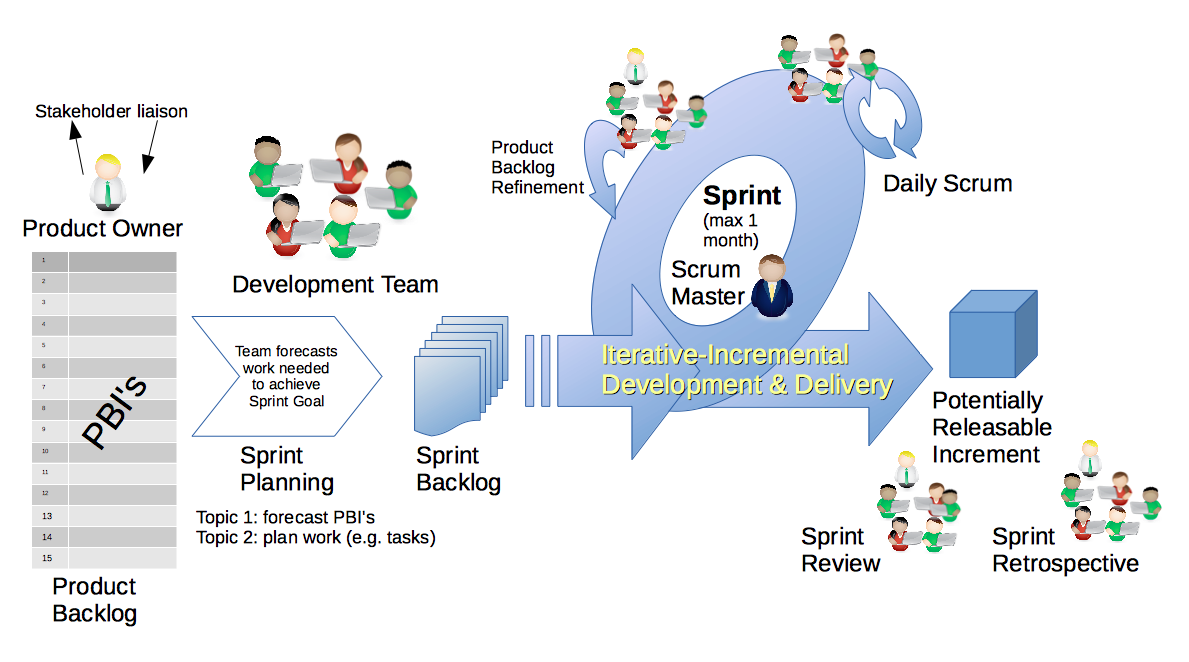
To maneuver a project through constant change, we abandon the monolithic project phase and instead adopt a cyclic engine of delivery. The heartbeat of this engine is the iteration.
An agile iteration is a timeboxed cycle of development usually lasting one to four weeks. During this strict window of time, the project team plans, executes, and evaluates a specific slice of work. If you are operating specifically within the Scrum framework, an agile iteration is specifically referred to as a sprint. Regardless of the terminology, the underlying physics remain the same: the primary goal of an agile iteration is to deliver a potentially shippable product increment.
We do not wait six months to see if a system works. Every few weeks, we produce a tangible, working piece of the final product that could, in theory, be handed directly to a user.
To feed this cyclic engine, we must understand how to break massive, abstract ideas into actionable work. This requires a specific hierarchy of logical units:
- Theme: At the very top of our taxonomy, a theme is a high-level strategic focus area that groups multiple agile epics together. Think of a theme as a broad business objective, such as "Modernize the E-Commerce Experience."
- Epic: Below the theme, we find the epic. An epic is a large body of work that cannot be completed within a single agile iteration. "Overhaul the checkout process" is an epic. It is too massive to finish in two weeks, meaning epics are decomposed into smaller, manageable backlog items called user stories.
- Feature: Often serving as a bridge between epics and the stories themselves, a feature is a group of related user stories that delivers a distinct capability to the customer. For example, "Guest Checkout" is a feature.
- User Story: This is the atomic unit of the agile methodology. A user story represents a small piece of business value from the perspective of an end user. Crucially, user stories are the primary logical unit of work planned and executed within an agile iteration.
- Technical Task: To actually build the user story, the abstraction must be grounded in engineering or operational reality. Therefore, user stories are further broken down into technical tasks by the development team during iteration planning. A technical task represents the specific, execution-level work needed to fulfill a user story (e.g., "Update the database schema to allow null values for account IDs").
The Anatomy of the User Story
Because the user story is the primary currency of iteration planning, it requires a standardized structure to ensure that project specialists and developers never lose sight of why they are doing the work.
A standard user story format follows the strict template: As a [role], I want [action], so that [benefit].
"As a busy shopper, I want to check out without creating an account, so that I can finish my purchase faster." Notice the elegance of this structure. It provides context, requirement, and business justification in a single sentence.
However, before a team can claim this story is finished, it must pass through two critical quality filters. The first is the Definition of Done (DoD), which serves as an overarching quality checklist required for completing any agile user story across the entire project (e.g., all code is peer-reviewed, documentation is updated, and security tests are passed).
When planning how much work can fit into an iteration, we do not traditionally measure user stories in absolute hours. Instead, story points are a common agile unit of measure used to estimate the relative effort of user stories. We ask, "Is building the guest checkout twice as complex as building the password reset button?" By estimating relative effort, teams account for risk, complexity, and volume simultaneously without the false precision of guessing exactly how many minutes a task will take.
Why do operations professionals and career switchers increasingly find themselves in iteration-driven environments? The benefits are highly practical for managing modern knowledge work, though they come with distinct trade-offs.
The Advantages
- Immediate Course Correction: Short agile iterations provide the benefit of frequent stakeholder feedback. By demonstrating a working increment every two weeks, you eliminate the risk of building the wrong product for six months.
- Risk Mitigation: Short agile iterations reduce project risk by identifying issues early in the development lifecycle. If a technical architecture is flawed, the team discovers it in week two, not week forty.
- Fluidity: Iterations allow project teams to adapt to changing requirements much more easily than predictive project phases. If market conditions shift, the team simply reprioritizes the next iteration's scope.
- Operational Rhythm: A predictable iteration cadence establishes a consistent delivery rhythm for the agile project team. This steady pace protects teams from burnout and creates reliable velocity metrics for project coordinators.
The Disadvantages
- Meeting Fatigue: A major disadvantage of short iterations is the administrative overhead of frequent planning and review meetings. Every two weeks requires a new planning session, a review, and a retrospective, which consumes valuable execution time.
- Contractual Friction: Iteration-based planning can be difficult to apply to projects with strict fixed-price and fixed-scope contracts. If procurement has legally bound the project to deliver a specific $500,000 scope by November 1st, the adaptive nature of an iteration directly conflicts with the rigidity of the contract.
- Technical Debt: Iteration-based development may cause integration issues if separate iteration increments are not continuously tested together. If Team A builds a shopping cart in Sprint 1, and Team B builds a payment gateway in Sprint 2, failing to integrate and test them simultaneously will result in a fractured final product.
If you are transitioning from a traditional project management environment into an agile space, you must learn to translate the vocabulary and the underlying philosophy. In predictive project management, scope is controlled by the Work Breakdown Structure.
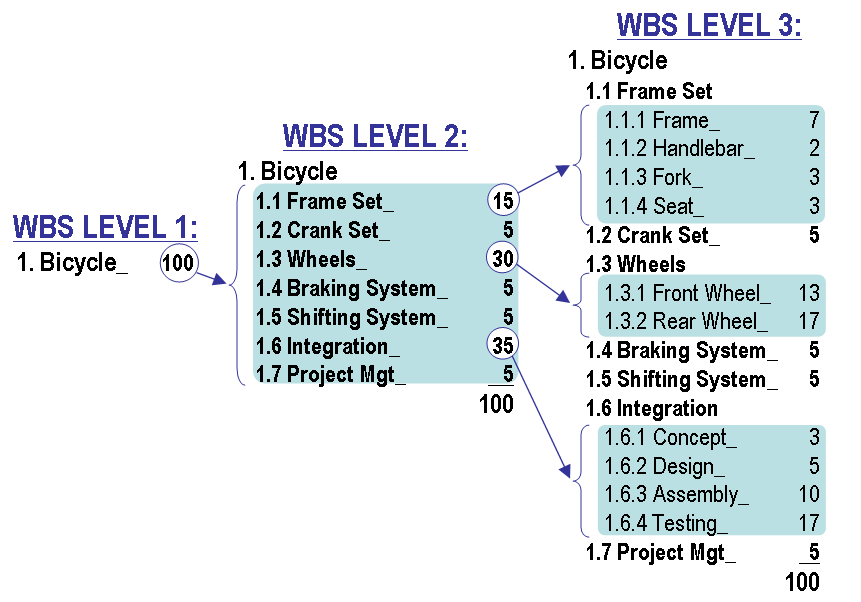
A predictive Work Breakdown Structure (WBS) is a deliverable-oriented hierarchical decomposition of the entire project scope.
Governing this structure is an ironclad law: The 100 Percent Rule states that a Work Breakdown Structure must capture 100 percent of the project scope. If a deliverable is not in the WBS, it does not exist in the project. Consequently, predictive Work Breakdown Structure planning occurs entirely upfront before project execution begins.
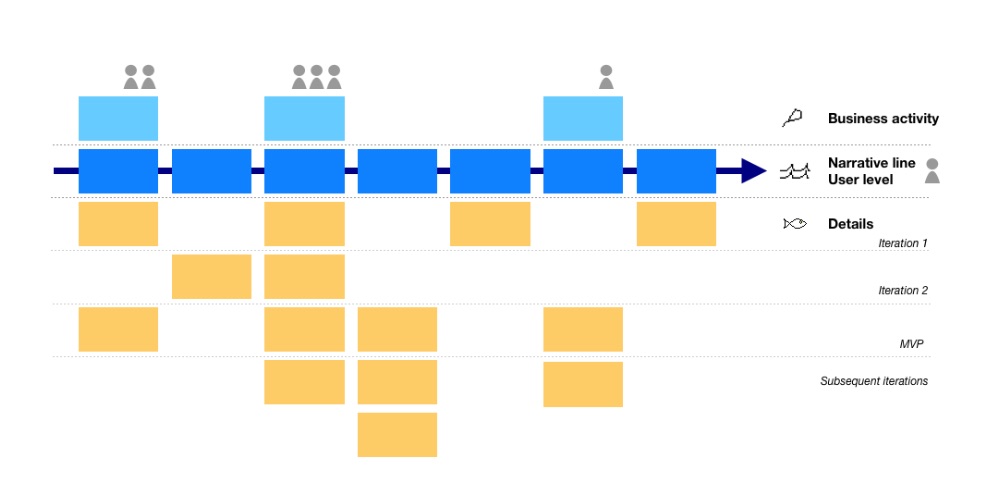
In contrast, an agile backlog is a linearly prioritized list of user-centric features and requirements. You do not plan 100 percent of it on day one. Instead, agile backlog planning relies on progressive elaboration where requirements are refined continuously throughout the project.
The Translation Matrix
To effectively manage projects in a hybrid environment, an astute project professional must be able to seamlessly convert predictive structures into adaptive workflows. Translating a Work Breakdown Structure to an agile structure requires shifting the focus from deliverable components to user value delivery.
Observe how the components of a traditional WBS map to an iterative environment:
| Predictive Concept (WBS) | Adaptive Translation (Agile) | Explanation of the Shift |
|---|---|---|
| Work Package | Epic / Large User Story | A predictive WBS work package roughly corresponds to an agile epic or a large user story depending on the size of the work package. Rather than a static deliverable noun, it becomes an action-oriented value statement. |
| WBS Dictionary | Acceptance Criteria | The detailed component descriptions found in a predictive WBS dictionary translate functionally to acceptance criteria in an agile user story. Both explicitly define what constitutes a successful completion of the unit of work. |
| Absolute Estimation | Relative Estimation | Predictive Work Breakdown Structure tasks are typically estimated using absolute time measurements like hours or days. Agile transitions this to relative measures, utilizing story points to gauge complexity. |
| Change Control Boards | Dynamic Backlog | In a WBS, scope changes require formal change requests. Conversely, an agile product backlog dynamically changes as new requirements are discovered during iteration reviews. |
| Sequential Phases | Parallel Iterations | Transforming predictive WBS phases into agile iterations converts sequential milestones into parallel cycles of design, build, and test. You no longer design the entire project, then build the entire project. You design, build, and test a single user story in a matter of days. |
For aspiring project managers, understanding this translation is the master key to the CAPM exam. The shift from predictive to adaptive planning is not merely a change in paperwork. It is a fundamental shift in how we conceptualize work—moving from a rigid obsession with completing upfront deliverables to a flexible, resilient pursuit of delivering continuous value to the end user.