Predictive Processes and Activities
Not sure you’re ready?
Take the ~3-minute readiness diagnostic and see where you stand.
Constructing a commercial high-rise requires a rigid, sequential mastery of logistics. You cannot pour the 30th-floor concrete before the steel foundation cures, and you certainly cannot order the structural steel before the municipal planning board signs your zoning permit. In predictive project management, this strict causal chain of events is formalized into specific processes. However, a common trap for new project professionals is confusing the management processes with the actual timeline phases of the work.
Crucial Distinction: Project management process groups are not identical to project phases. A single project phase (for example, the "Design Phase" of a software build) can, and almost always does, involve activities from all five project management process groups.
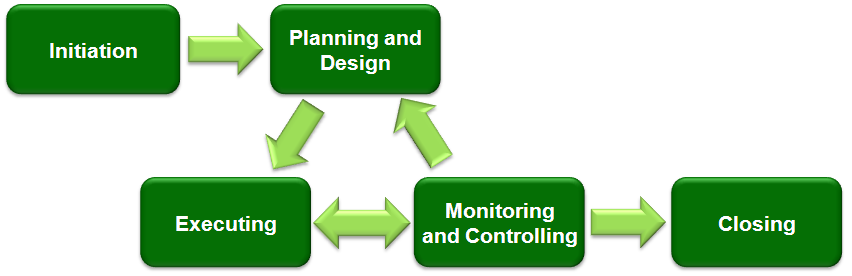
The five Process Groups—Initiating, Planning, Executing, Monitoring and Controlling, and Closing—are not a chronological timeline. They are categories of cognitive and administrative effort. Let us dissect exactly what activities occur inside these groups, why they exist, and how they interact to drive a predictive project to success.
Before a single dollar is spent or a single line of code is written, a project must be officially born. The Initiating Process Group consists of activities performed to define a new project or a new phase of an existing project. Its ultimate goal is simple: it establishes the formal authorization to start.
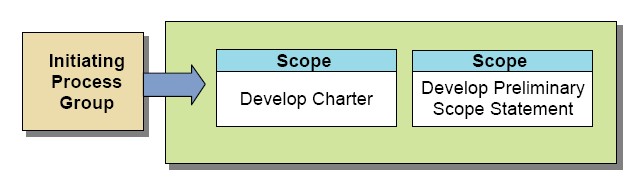
There are two primary activities here, and they represent the foundation of your authority and your awareness:
- Developing the project charter: This is a primary activity within the Initiating Process Group. Think of the charter as the project manager's badge. The development of the project charter provides the project manager with the authority to apply organizational resources to project activities. Without it, you are just a person with an idea; with it, you have the company’s backing to spend money and assign work.
- Identifying stakeholders: You cannot succeed if you do not know who cares about your project. Identifying stakeholders is a core activity that involves documenting relevant information regarding stakeholder interests. More importantly, it includes assessing stakeholder involvement and their potential impact on project success. You need to know early on who holds the power to champion your project—or derail it.
Once you have the charter, you must figure out exactly how to achieve the project's goals. The Planning Process Group establishes the total scope of the predictive project effort. Because predictive projects rely heavily on upfront analysis, this group contains the largest number of individual project management processes.
At the center of this group is developing the project management plan. This master document is essentially a compilation of all other planning activities. It defines exactly how the predictive project is executed, how it is monitored and controlled, and ultimately how it is formally closed.
To build this master plan, you must systematically plan every dimension of the project:
Scope and Schedule
- Collecting requirements: A Planning activity used to determine stakeholder needs to meet project objectives. You must ask: What exactly do they want?
- Defining scope: This activity develops a detailed description of the project and the product. You are drawing the boundary lines of what is included (and explicitly, what is not included).
- Creating the Work Breakdown Structure (WBS): You cannot accurately estimate "build a house." You can estimate "pour 400 square feet of concrete." Creating the Work Breakdown Structure subdivides project deliverables into smaller, manageable components.
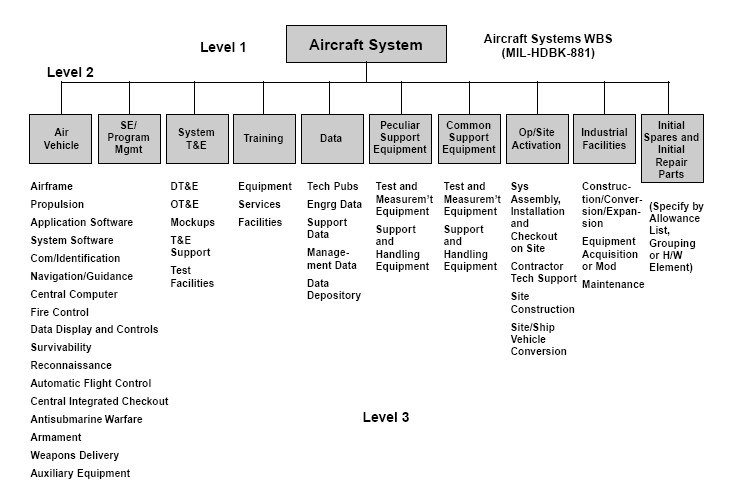
- Defining activities: Once the deliverables are broken down, this process identifies the specific actions required to produce the project deliverables.
- Sequencing activities: This identifies and documents relationships among the project activities (e.g., you must frame the walls before you install the drywall).
- Estimating activity durations: Provides quantitative assessments of time periods required to complete specific tasks.
- Developing the schedule: This crucial Planning activity creates the project schedule model. It analyzes activity sequences, durations, and resource requirements to map out the realistic timeline.
Costs, Quality, and Resources
- Estimating costs: Develops an approximation of the monetary resources needed to complete project work.
- Determining the budget: This activity aggregates the estimated costs of individual activities to establish an authorized cost baseline. This baseline is the standard against which your financial performance will be judged.
- Planning quality management: Identifies quality requirements and standards for the project deliverables. What constitutes "good enough"?
- Planning resource management: Defines how to estimate, acquire, manage, and use both physical resources and human resources.
- Estimating activity resources: Identifies the exact type and quantities of materials, equipment, and supplies necessary to perform project work.
Risk, Communications, Procurement, and Stakeholders
- Planning risk management: Defines how to conduct risk management activities for a project.
- Identifying risks: Determines which risks may affect the project and includes documenting the characteristics of potential project risks.
- Performing qualitative risk analysis: Prioritizes individual project risks for further analysis by assessing their risk probability of occurrence and potential impact.
- Performing quantitative risk analysis: Numerically analyzes the combined effect of identified individual project risks on overall project objectives.
- Planning risk responses: Develops options and actions to address overall project risk exposure (e.g., buying insurance or changing a supplier).
- Planning communications management: Develops an appropriate approach for project communication activities based on the information needs of each stakeholder.
- Planning procurement management: Documents project procurement decisions, specifies the procurement approach, and importantly, identifies potential sellers for project resources.
- Planning stakeholder engagement: Develops approaches to involve project stakeholders based on their specific needs, expectations, and interests.
With the blueprint drawn, it is time to build. The Executing Process Group consists of activities performed to complete the work defined in the project management plan. Because this is where the physical labor, coding, or manufacturing happens, the Executing Process Group typically consumes the largest portion of the project budget and typically requires the largest amount of physical and human project resources.
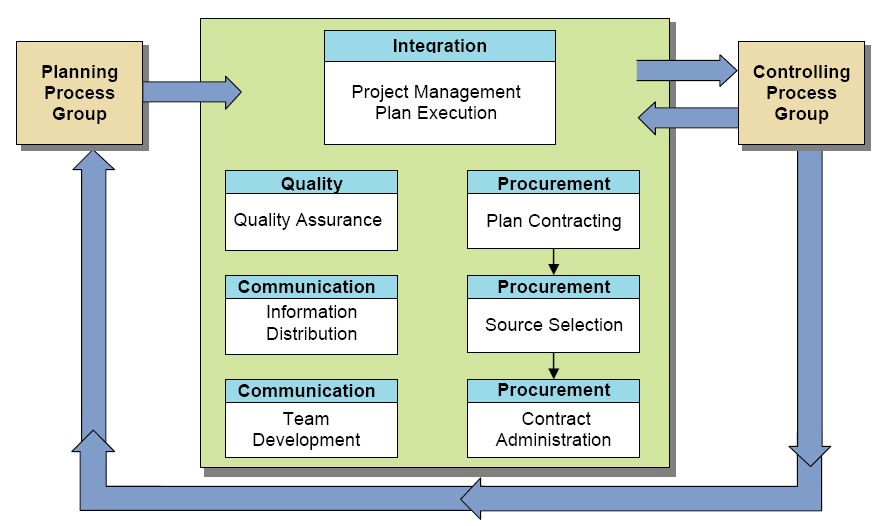
Key Executing activities include:
- Directing and managing project work: This involves leading and performing the work defined in the project management plan. Crucially, gathering work performance data is a typical Executing activity that occurs here. (We will see where this data goes shortly).
- Managing project knowledge: Uses existing knowledge and creates new knowledge to achieve the project objectives (e.g., documenting best practices).
- Managing quality: Translates the quality management plan into executable quality activities. Think of this as the ongoing audits and process improvements that happen while the work is being done.
- Acquiring resources: Obtains team members, facilities, equipment, and materials necessary to complete project work.
- Developing the team: Improves competencies, team member interaction, and the overall team environment (e.g., team-building exercises or training).
- Managing the team: Tracks team member performance and provides feedback. Managing the team includes resolving issues and managing team changes.
- Managing communications: Ensures the timely collection, creation, distribution, and storage of project information.
- Implementing risk responses: Enacts the agreed-upon risk response plans when a risk trigger occurs.
- Conducting procurements: Obtains seller responses, selects a seller, and awards a contract.
- Managing stakeholder engagement: Communicates and works directly with stakeholders to meet their needs and expectations.
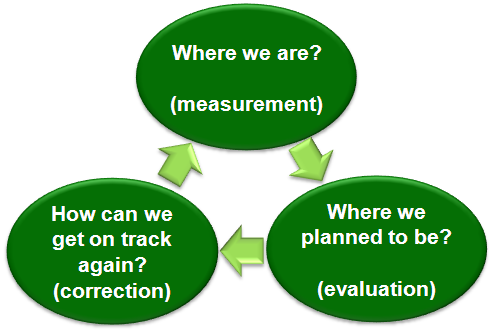
If Execution is the engine of a car, Monitoring and Controlling is the dashboard and the steering wheel. This process group consists of activities required to track, review, and regulate project progress.
The Universal Process: The Monitoring and Controlling Process Group interacts continuously with all other process groups throughout the project life cycle. You do not wait until execution is finished to monitor it; you monitor from day one until the project closes.
The Flow of Project Information
To understand Monitoring and Controlling, you must understand the flow of information on a project. This is a vital concept for the CAPM exam:
- Data: Gathering work performance data happens during Executing.
- Information: Analyzing work performance data to produce work performance information is a typical Monitoring and Controlling activity.
- Reports: Work performance reports are generated as an output of the Monitoring and controlling project work process (which tracks overall progress against the project management plan).
- Distribution: Finally, those work performance reports are distributed to stakeholders during the Executing process of managing communications.
Reacting to Variances
When Monitoring and Controlling reveals that the project is veering off course, three types of actions are generated:
- Corrective actions are generated to realign current project performance with the project management plan.
- Preventive actions are recommended to ensure future project performance aligns with the project management plan.
- Defect repairs are identified to modify nonconforming product components.
To implement these changes without creating chaos, you rely on Performing integrated change control. This activity involves reviewing all change requests and approving changes. It includes managing changes to project deliverables and organizational process assets (OPAs) in a controlled, documented manner.
Validating vs. Controlling
The CAPM exam frequently tests the distinction between scope and quality activities in this group:
- Controlling quality: Records the results of executing quality management activities to assess performance. It ensures the project outputs are complete and meet customer expectations. Controlling quality focuses on the correctness of the deliverables and meeting specified quality requirements (often done by your internal QA team).
- Validating scope: Focuses on the formal acceptance of deliverables by the customer or sponsor. It is not about correctness (Quality Control did that); it is about getting the client to sign off on the finished product.

- Controlling scope: Monitors project scope status and manages changes to the scope baseline (e.g., preventing "scope creep").
Monitoring and Controlling the Remaining Domains
- Controlling the schedule and Controlling costs: Monitor project status to manage changes to the schedule and cost baselines, respectively.
- Controlling resources: Ensures the physical resources assigned to the project are available as planned.
- Monitoring communications: Ensures the information needs of the project and stakeholders are actively being met.
- Monitoring risks: Involves tracking identified risks and identifying new risks. It includes evaluating risk process effectiveness and monitoring residual risks.
- Controlling procurements: Manages procurement relationships and monitors contract performance.
- Monitoring stakeholder engagement: Monitors project stakeholder relationships and involves tailoring strategies for engaging stakeholders based on project progress.
Eventually, the work finishes. The Closing Process Group consists of activities performed to formally complete a project, phase, or contract. You cannot simply walk away when the final product is built; you must shut the system down cleanly.
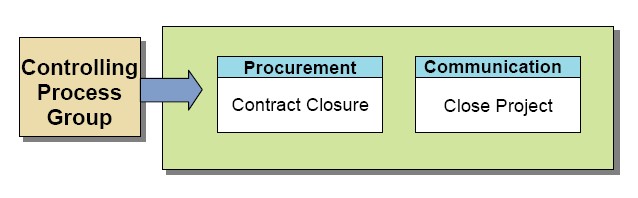
Closing the project or phase is an activity that finalizes all activities across all Project Management Process Groups. It serves as the official administrative end.
During this wrap-up, you will perform three critical activities:
- Archiving project information: An activity performed to retain records for future reference. If the company undertakes a similar project in five years, your records will be their starting point.
- Updating organizational process assets (OPAs): An activity performed to capture final lessons learned. What worked? What failed? This institutional knowledge makes the entire organization smarter.
- Releasing organizational resources: An activity performed to free up personnel and physical assets for other projects. This allows your team members to formally transition to their next roles, and equipment to be reassigned to the next lucrative endeavor.
By mastering how these five Process Groups interact—how Planning directs Executing, how Executing yields Data, how Monitoring transforms Data into Information, and how Closing captures Lessons Learned—you stop seeing project management as a list of chores. You begin to see it as a beautiful, self-correcting system designed to turn an abstract idea into tangible reality.