Plan and Manage Procurement: Strategy
Not sure you’re ready?
Take the ~3-minute readiness diagnostic and see where you stand.
Imagine constructing a next-generation commercial airliner. You are not going to mine the bauxite, smelt the aluminum, develop the complex avionics software, and stitch the leather seating yourself. You will architect the overall integration, but to bring the project to life, you must rely on specialized external vendors. A project is rarely an isolated endeavor; it is an orchestrated synthesis of internal capabilities and external partnerships. How you choose to acquire those external pieces—how you evaluate vendors, structure the agreements, and allocate financial risk—is the essence of procurement strategy. A poorly structured contract can bankrupt a project before the first deliverable is inspected, whereas a strategically aligned agreement turns external vendors into seamless extensions of your own team.

Before reaching out to the market, you must objectively determine what you actually need to buy. This begins with a make-or-buy analysis, an analytical process that determines whether project work should be accomplished by the internal project team or purchased from outside sources. You must weigh internal capacity, proprietary knowledge, and long-term strategy against the speed, cost, and expertise offered by external vendors.
Once you decide to buy, you must formulate a plan. You will establish a procurement management plan, which explicitly defines how the project team will acquire goods and services from outside the performing organization. This is your operational playbook. Layered above this is the procurement strategy, a higher-level framework that outlines the project delivery methods, the specific types of agreements you will use, and the sequencing of the procurement phases.
To bring a vendor to the table, you must clearly articulate your needs. This is achieved through the procurement Statement of Work (SOW). A well-crafted SOW describes the item in sufficient detail to allow prospective sellers to determine if they are capable of providing the products or services. If the SOW is vague, the resulting proposals will be equally ambiguous.
When approaching the vendor ecosystem, you do not use a one-size-fits-all document. You tailor your request based on the clarity of your needs and the complexity of the solution required.
- Request for Information (RFI): Use this when the landscape is unknown. An RFI is used to gather information on vendor capabilities before formalizing your procurement requirements. You are asking the market, "What is possible?"
- Request for Proposal (RFP): Use this when the project problem is complex and the buyer seeks vendor solutions. You know the problem, but you want the vendors to propose the how.
- Request for Quotation (RFQ): Use this when the buyer knows exactly what is needed and primarily seeks price information. This is for commodities or highly standardized services. You are asking, "How much for this exact specification?"
Curating and Evaluating the Bidders
Who gets to see your RFx documents? You might rely on a prequalified seller list, which ensures that invitations to bid are only sent to vendors with a proven historical capability to perform the required work.
In some cases, the competitive landscape is restricted. You must understand the distinct difference between two often-confused scenarios:
- Single-source procurement occurs when a buyer actively chooses a specific seller despite the availability of other qualified vendors in the market (a choice based on preference or past relationship).
- Sole-source procurement occurs when only one vendor in the entire market is technically capable of providing the required goods or services (a market reality).
To ensure fairness during the bidding process, you host a bidder conference. This forum allows prospective sellers to ask questions and ensures all vendors receive the exact same information simultaneously, preventing any single vendor from gaining an unfair informational advantage.

When the proposals arrive, how do you judge them objectively? You evaluate them against source selection criteria—the standardized metrics (e.g., technical expertise, past performance, cost, delivery speed) used to rate or score vendor proposals during the procurement evaluation process. Furthermore, to ensure you are not being overcharged, you should utilize independent estimates. These serve as a third-party benchmark to evaluate the reasonableness of vendor bids and proposals.
A contract is not merely a legal formality; it is a mechanism for allocating financial risk between the buyer and the seller. In traditional, predictive project management, contracts fall into three primary families: Fixed-Price, Cost-Reimbursable, and Time & Materials.
1. Fixed-Price Contracts (Seller Risk)
When the scope is perfectly understood, the financial risk is shifted entirely to the seller. If the seller underestimates the effort, they absorb the financial loss.
- Firm Fixed Price (FFP): These contracts set a strict, non-negotiable price for a well-defined product or service. In an FFP contract, the seller bears the highest financial risk for cost overruns.
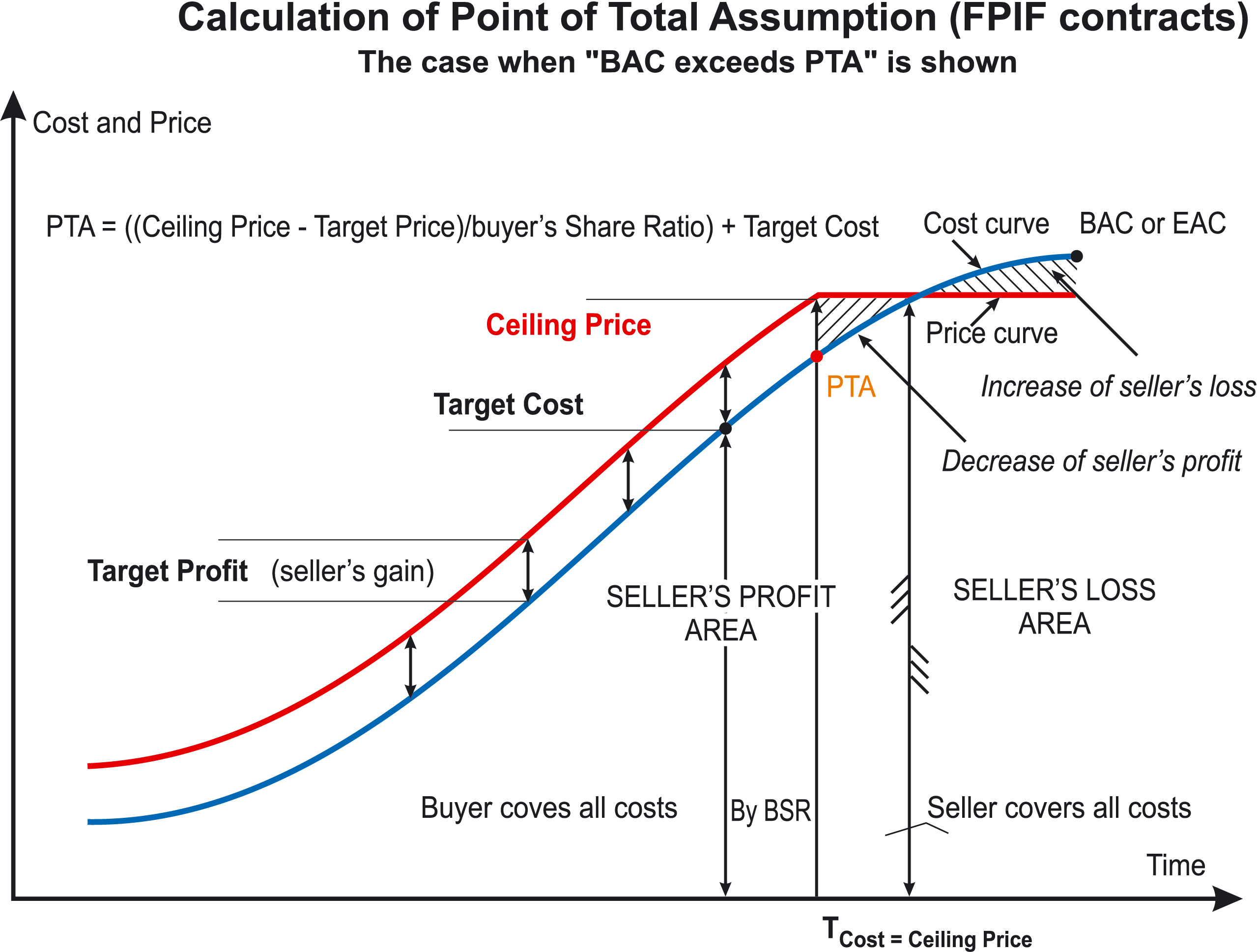
- Fixed Price Incentive Fee (FPIF): These contracts include a price ceiling and offer financial rewards for vendor performance above the established baseline. They incentivize the seller to finish early or under budget.
The Point of Total Assumption (PTA): A critical concept within FPIF agreements. The PTA is the cost point in a Fixed Price Incentive Fee contract where the seller assumes all subsequent financial cost overruns. Past this point, the contract essentially behaves like a Firm Fixed Price agreement, and the seller's profit margin diminishes dollar-for-dollar.
- Fixed Price with Economic Price Adjustment (FPEPA): If you are building a multi-year infrastructure project, macroeconomics will shift. FPEPA contracts allow predefined price adjustments to protect against inflation or resource cost changes over a long period.
2. Cost-Reimbursable Contracts (Buyer Risk)
Cost-reimbursable contracts are utilized when the project scope is highly uncertain or expected to change significantly. Because the seller cannot accurately estimate a final cost, the buyer agrees to pay them for all actual, allowable costs incurred, plus a fee representing profit. Consequently, in cost-reimbursable contracts, the buyer bears the highest financial risk for cost overruns.
- Cost Plus Fixed Fee (CPFF): The contract reimburses the seller for allowable costs and pays a fixed, pre-negotiated fee representing the seller profit. The fee does not change, regardless of how high the actual costs climb.
- Cost Plus Incentive Fee (CPIF): The contract reimburses the seller for allowable costs and provides an additional fee based on achieving specific, measurable performance metrics (like keeping costs below a target).
- Cost Plus Award Fee (CPAF): The contract reimburses the seller for allowable costs and provides an award fee based on a subjective buyer evaluation of seller performance.
3. Time and Materials (Hybrid Risk)
Time and Materials (T&M) contracts combine elements of both fixed-price and cost-reimbursable contracts. You agree on a fixed rate (e.g., $150 per hour), but the total cost is open-ended.
T&M contracts are commonly used for staff augmentation when the exact duration or amount of work is unknown. Because an open-ended contract presents massive risk to the buyer, T&M contracts often include not-to-exceed values to limit the total financial exposure of the buyer.
| Contract Family | Best Used When... | Who Bears Highest Risk? | Key Variations |
|---|---|---|---|
| Fixed-Price | Scope is crystal clear. | Seller | FFP, FPIF, FPEPA |
| Cost-Reimbursable | Scope is highly uncertain. | Buyer | CPFF, CPIF, CPAF |
| Time & Materials | Staffing needs are open-ended. | Shared | Includes "Not-to-Exceed" |
Traditional fixed-price contracts demand a rigidly defined scope upfront. However, agile projects thrive on changing requirements and emerging discoveries. If you lock an agile project into a firm fixed-price contract with a rigid scope, you destroy the very flexibility agile is meant to provide.
Instead, agile procurements favor Master Services Agreements (MSAs) that define overall governing terms while using lightweight, flexible statements of work for individual iterations. To balance risk, agile contracts often employ fixed-price increments to allow buyers to inspect deliverables and verify value before funding subsequent iterations.
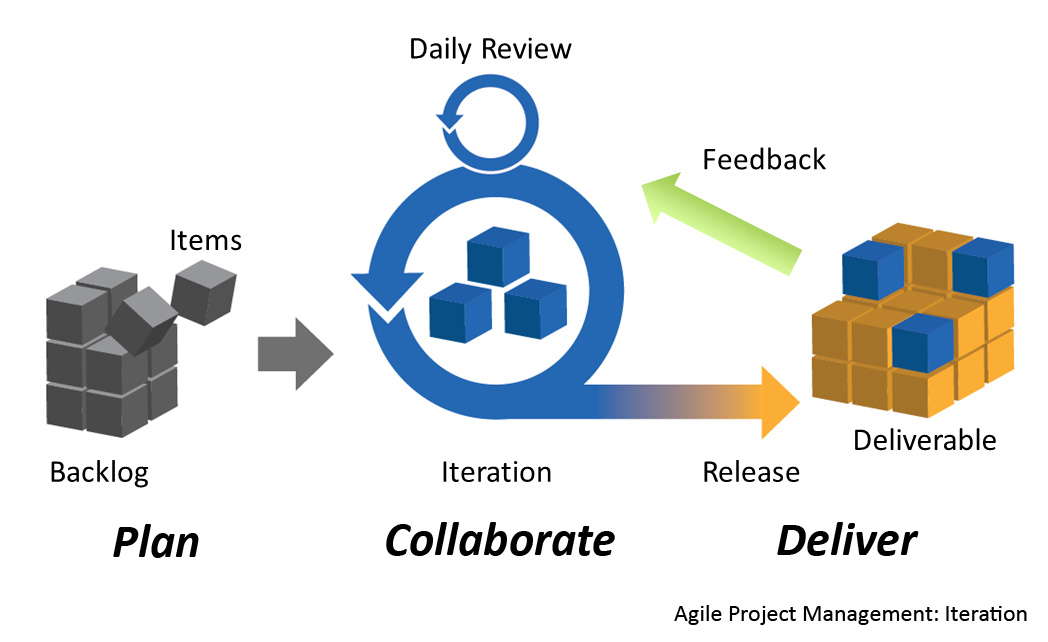
Agile procurement introduces highly adaptive contracting structures:
- Early Cancellation Clause: This allows the buyer to terminate the agreement early once sufficient business value has been delivered, preventing wasted spend on low-value, end-of-backlog features.
- Graduated Fixed-Price Contract: This establishes different hourly rates based on performance—for example, higher rates for early delivery, standard rates for on-time delivery, and reduced rates for late delivery.
- Target Cost Contracts: These share the financial risk of cost overruns and underruns between the buyer and the seller based on a predetermined sharing ratio (e.g., a 60/40 split on cost savings).
Procurement is not a zero-sum game. The primary goal of procurement negotiation is to reach a fair and reasonable price while developing a good relationship with the seller. If you negotiate a vendor into a ruinous deficit, their quality will suffer, their top talent will be pulled from your project, and your deliverables will fail. Therefore, a win-win negotiation strategy seeks mutual gain and builds a foundation for a healthy long-term buyer-seller relationship.
During these negotiations, roles must be strictly defined. The project manager is responsible for clarifying project requirements and technical specifications during procurement negotiations. You are there to ensure the vendor understands the physics of the bridge, the architecture of the software, or the timeline of the rollout.
However, project managers generally do not have the legal authority to sign contracts binding their organization. That domain belongs exclusively to specialized roles. Procurement managers or contracting officers hold the designated legal authority to sign contracts on behalf of the buyer organization. Do not overstep this boundary; binding your company without authority is a catastrophic career error.
Signing the contract is only the beginning. Once work commences, you must rigorously track performance. Procurement performance reviews formally evaluate a seller's progress against the statement of work and contract terms. Are they hitting their milestones? Are they adhering to quality standards?
Inevitably, disagreements will arise regarding what is "in scope" versus "out of scope." Claims administration involves managing these contested changes where the buyer and seller disagree on scope variations or compensation.
When claims cannot be resolved through routine negotiation, they escalate into formal disputes. Litigation in a courtroom should always be the absolute last resort—it is public, brutally expensive, and destroys vendor relationships. Instead, project managers and legal teams rely on Alternative Dispute Resolution (ADR) methods, such as mediation (a neutral third party facilitates an agreement) or arbitration (a neutral third party makes a binding decision). ADR methods are vastly preferred over litigation for resolving contract claims efficiently and privately.