RESPA, TILA, and TRID Disclosures
Not sure you’re ready?
Take the ~3-minute readiness diagnostic and see where you stand.
Information asymmetry defines the relationship between institutional lenders and everyday homebuyers. When a consumer approaches a bank for a mortgage, they are navigating a labyrinth of origination fees, yield spread premiums, and settlement charges that can obscure the true cost of the transaction. Federal law intervenes in this space not to dictate prices, but to mandate daylight. By forcing transparent, uniform disclosures, the government attempts to level the playing field, ensuring that the financial mechanics of buying a home are legible to the person paying for it.

Before we dissect the individual laws, you must know who enforces them. The Consumer Financial Protection Bureau (CFPB) is the federal agency responsible for enforcing both RESPA and TILA regulations. Born out of the 2008 financial crisis, the CFPB acts as the referee in the consumer finance arena, ensuring that lenders play by the strict rules of disclosure and fairness outlined below.

As a real estate professional, you are the guide taking your client through this process. To do that, you must master two distinct pillars of federal law:
Let us break these down, conceptually and practically.
TILA stands for the Truth in Lending Act, and it is implemented federally by Regulation Z. You can remember this pairing by thinking: TILA gives consumers the "A to Z" of their loan costs.
TILA requires lenders to disclose the true cost of consumer credit so borrowers can meaningfully compare loan terms from different lenders. A bank cannot quote a seemingly magical 3% interest rate if they are secretly burying $15,000 in mandatory upfront fees to achieve it. TILA demands that the entire financial burden of the loan is laid bare.
Scope: Who Does TILA Protect?
TILA applies strictly to consumer credit transactions, which prominently includes residential mortgage loans. Crucially for your exam: TILA does not apply to business or commercial loans. A multi-national corporation buying a skyscraper has an army of lawyers to negotiate loan terms; a nurse buying a townhouse does not. TILA exists to protect the everyday consumer.
The Annual Percentage Rate (APR)
The centerpiece of TILA is the Annual Percentage Rate (APR). The APR represents the total cost of credit expressed as a single yearly percentage rate.
Why do we need both an interest rate and an APR? Because the nominal interest rate is just the base cost of borrowing the money. The Annual Percentage Rate (APR) calculation incorporates the nominal interest rate along with certain lender fees and closing costs (like broker fees and origination points).
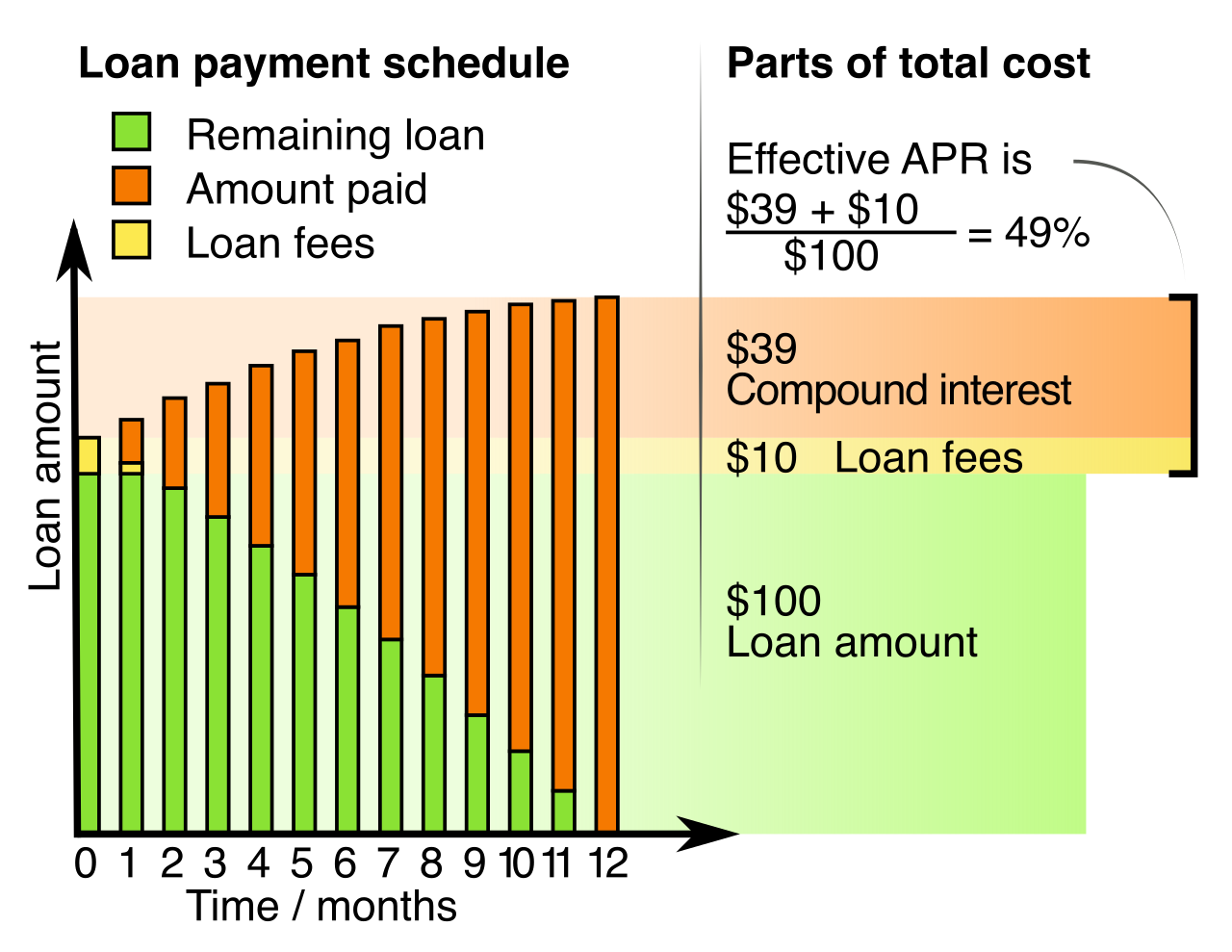
Intuition Check: Think of buying a car. The nominal interest rate is the sticker price of the car itself. The APR is the "out-the-door" price that includes the destination charge, the dealer prep fee, and the documentation fee, all rolled into one percentage. The APR will almost always be higher than the nominal interest rate.
TILA Advertising Rules: The "Trigger Term" Trap
Real estate marketing is heavily regulated by TILA to prevent bait-and-switch tactics. This brings us to the concept of trigger terms.
A "trigger term" in real estate advertising is a specific financial term that legally mandates the full disclosure of all other financing terms under TILA. The logic is simple: if you tease the specific math to lure a buyer in, you must provide the complete mathematical equation so they aren't misled.
Under TILA, the following specific numbers act as trigger terms:
- Stating the specific amount of a down payment (e.g., "$5,000 down gets you the keys!").
- Stating the specific amount of any periodic mortgage payment (e.g., "Own this home for just $1,250 a month!").
- Stating the exact number of loan payments (e.g., "Pay it off in just 360 payments!").
- Stating the specific period of loan repayment (e.g., "30-year fixed term available!").
If a TILA trigger term is used in an advertisement, the advertisement must explicitly disclose three additional facts:
- The required down payment amount.
- The complete terms of loan repayment.
- The Annual Percentage Rate (APR).
What is NOT a trigger term? General advertising phrases—often called puffery—like "low down payment," "easy financing," or "affordable monthly terms" do not constitute trigger terms under TILA. Because they contain no specific digits or binding math, they do not trigger the strict disclosure requirements.
The TILA Right of Rescission
The TILA right of rescission grants borrowers a legal window to unilaterally cancel certain loan transactions without penalty. It is a mandatory "cooling-off" period designed to prevent consumers from losing their homes due to high-pressure lending tactics.
- The Timeline: The TILA right of rescission lasts for exactly three business days following loan consummation or the delivery of required disclosures (whichever is later).
- When it Applies: The TILA three-day right of rescission applies to home equity loans and to the refinancing of an existing primary mortgage.
- The Massive Exam Trap: The TILA three-day right of rescission does NOT apply to loans used to initially purchase a primary residence.
Why this matters: Imagine the chaos in the real estate market if a buyer could close on a house, get the keys, move their furniture in, and then unilaterally cancel the entire transaction two days later just because they got cold feet. The right of rescission protects people from accidentally signing away the equity in the home they already own. It does not apply to initial home purchases.
If TILA is about the cost of the loan, RESPA is about the cost of the settlement (the closing process).
RESPA stands for the Real Estate Settlement Procedures Act, and it is implemented federally by Regulation X. (Mnemonic: X marks the spot where you sign the settlement documents).
The primary purpose of RESPA is to ensure consumers receive timely information on the nature and costs of the real estate settlement process, while protecting them from artificially inflated closing costs.
Scope: When Does RESPA Apply?
RESPA applies to federally related mortgage loans secured by a one-to-four family residential property. This covers almost every standard residential mortgage in the United States (FHA, VA, conventional loans sold to Fannie Mae/Freddie Mac, etc.).
However, RESPA is fiercely specific about what it does not cover. RESPA does not apply to:
- Loans used to purchase commercial properties.
- Loans used to purchase agricultural properties containing 25 or more acres.
- Vacant land purchases.
- All-cash real estate transactions (because there is no federally related mortgage loan involved!).
RESPA Section 8: The Ban on Kickbacks
This is perhaps the most critical rule for your daily survival as a real estate agent. RESPA Section 8 prohibits giving or receiving fees or kickbacks in exchange for referrals of settlement service business.
You cannot accept a $500 check, a case of expensive wine, or a free vacation from a title company, a mortgage broker, or a home inspector simply for sending your buyer to them. Why? Because when settlement providers compete for your referral by bribing you, they ultimately pass those bribery costs down to the consumer in the form of higher closing fees.
Furthermore, RESPA Section 8 prohibits fee-splitting for settlement services that were not actually performed. You cannot invent a fake "administrative closing fee," slap it on the closing documents, and split it with the mortgage broker if no actual work was done to earn it.
Affiliated Business Arrangements (AfBAs)
Real estate is a highly integrated industry. Sometimes, a real estate brokerage might actually own a mortgage company or a title agency.
An affiliated business arrangement exists when a person in a position to refer settlement services has an ownership interest of more than one percent (1%) in a settlement service provider.
Are these illegal? No. RESPA allows affiliated business arrangements as long as the consumer is provided a written disclosure of the relationship. The crucial caveat is that in an affiliated business arrangement, the referring party cannot compel the consumer to use the affiliated settlement service provider. You can say, "My brokerage owns this title company, and here is a disclosure of that fact; you are free to use them, but you are equally free to shop around."
RESPA Section 9: Title Insurance Mandates
RESPA Section 9 prohibits a property seller from requiring the buyer to use a particular title insurance company as a condition of the sale.
If a seller violates this rule, the penalty is severe: A buyer can sue a seller for an amount equal to three times the charges made for title insurance if the seller violates RESPA Section 9. This treble-damages penalty is highly testable on the national exam.
RESPA Section 10: Escrow Account Limits
Lenders naturally want to ensure that a property's taxes and insurance are paid, so they don't lose their collateral to a tax foreclosure or a fire. They do this by requiring the borrower to pay into an escrow account every month.
However, a lender cannot hoard a borrower's cash unnecessarily. RESPA Section 10 limits the amount a lender may require a borrower to hold in an escrow account for paying future taxes and insurance. Under RESPA, the maximum cushion a lender can require in an escrow account is two months of estimated property taxes and insurance.

For decades, the TILA and RESPA disclosure requirements were entirely separate. A borrower arriving at the closing table was bombarded with a Truth-in-Lending disclosure form and a RESPA HUD-1 Settlement Statement. The forms used different definitions, overlapping math, and created massive consumer confusion.
Enter TRID, which stands for TILA-RESPA Integrated Disclosures.
The TRID rules combined older, overlapping TILA and RESPA disclosure documents into unified forms to simplify the loan process for consumers. This initiative created two absolute pillars of modern real estate finance:
- The Loan Estimate (LE): TRID replaced the Good Faith Estimate (GFE) and the initial Truth-in-Lending disclosure with a single form called the Loan Estimate.
- The Closing Disclosure (CD): TRID replaced the HUD-1 Settlement Statement and the final Truth-in-Lending disclosure with a single form called the Closing Disclosure.
Triggering TRID: The 6-Piece Application
When does the TRID clock start ticking? A mortgage application is officially received under TRID when a lender collects six specific pieces of applicant information. You can memorize this using the acronym ALIENS:
- Address of the property
- Loan amount sought
- Income of the consumer
- Estimated property value
- Name of the consumer
- Social Security Number
Once the lender possesses those six pieces of information, the legal gears of TRID begin turning.
The Loan Estimate (LE) Timeline and Rules
Upon receiving that complete, 6-piece mortgage application, a lender must deliver or mail the Loan Estimate to the consumer within three business days.
During this sensitive window, a lender is strictly prohibited from charging any fees prior to the consumer receiving the Loan Estimate and indicating an intent to proceed. There is exactly one exception to this rule: A lender is allowed to charge a reasonable credit report fee before the consumer receives the Loan Estimate. They cannot charge application fees, appraisal fees, or processing fees until the borrower has seen the initial LE and agreed to move forward.
The Closing Disclosure (CD) Timeline and Rules
Fast forward to the end of the transaction. The lender must provide the Closing Disclosure to the consumer at least three business days before the official consummation of the loan. This ensures the borrower has time to review the final numbers in quiet contemplation, away from the pressure of the closing table.
Exam Alert - Defining a Business Day: For the purpose of providing the Closing Disclosure, a TRID business day includes all calendar days except Sundays and federal legal public holidays. (Yes, Saturdays count as a TRID business day for CD delivery, even if the bank's local branch is closed!).
Restarting the 3-Day Clock
If the numbers change significantly at the last minute, the lender cannot just cross them out with a pen. Issuing a new Closing Disclosure due to significant loan changes legally restarts the mandatory three-business-day waiting period before consummation.
What constitutes a "significant" change that requires a new CD and restarts the 3-day clock? Exactly three things:
- If the Annual Percentage Rate (APR) increases by more than 1/8 of a percent (0.125%) for a fixed-rate loan before closing.
- If a prepayment penalty is added to the loan terms before closing.
- If the underlying loan product changes before closing (e.g., switching from a 30-year fixed to an Adjustable Rate Mortgage).
If a minor typo is found, or the seller agrees to buy a $500 home warranty at the last minute, the CD can be updated at the table without delaying the closing. The three-day clock only restarts for the major structural changes listed above.
TRID Tolerance Limits
To prevent "bait-and-switch" pricing where a lender promises low fees on the initial Loan Estimate but jacks them up on the final Closing Disclosure, TRID establishes tolerance limits. These limits legally restrict how much certain settlement costs can financially increase from the initial Loan Estimate to the final Closing Disclosure.
Understanding why these categories exist makes them easy to memorize. The tolerance limit depends entirely on how much control the lender has over the fee.
| Tolerance Limit | What it means | Which Fees Fall Here? | The "Why" |
|---|---|---|---|
| Zero Percent (0%) Tolerance | The fee cannot increase at all at closing. | • Origination fees paid directly to the creditor<br>• Fees paid to a mortgage broker<br>• Real estate transfer taxes | The lender or broker sets these fees directly, or they are fixed state math (transfer taxes). If they quote it, they must honor it exactly. No excuses. |
| Ten Percent (10%) Cumulative Tolerance | The sum total of these fees cannot increase by more than 10%. | • Government recording fees | The lender can estimate what the local county clerk will charge to record the deed and mortgage, but the exact page-count fees might vary slightly. |
| No Tolerance (Infinite) | The fee can increase by any amount prior to closing. | • Prepaid mortgage interest<br>• Property insurance premiums<br>• Property taxes | The lender has absolutely no control over these. They do not set the local property tax rate, nor do they control what Allstate or State Farm charges the buyer for homeowners insurance. |
Conclusion for the Future Licensee
When you sit for the national portion of your real estate exam, do not view RESPA, TILA, and TRID as mere alphabet soup. View them as the mechanical safeguards of the US housing market.
TILA (Reg Z) forces the lender to be honest about the cost of the money (APR, Triggers, Rescission). RESPA (Reg X) forces the settlement industry to be honest about the cost of closing (Banning kickbacks, Title mandates, Escrow limits). And TRID is the modern delivery mechanism (LE and CD) that puts this crucial data into the hands of your client before they sign on the dotted line. Master this framework, and you are ready to pass the exam and protect your future clients.