California Fair Housing Laws
Not sure you’re ready?
Take the ~3-minute readiness diagnostic and see where you stand.
The architecture of American fair housing law treats the federal Fair Housing Act of 1968 as the foundation, but in California, that foundation supports a much larger, more highly engineered structure. The federal government established a baseline to prevent discrimination, but California law expands these protections exponentially, regulating not just who can buy or rent a property, but how businesses operate, how banks lend, and how real estate licensees conduct their daily practice. To practice real estate in California is to operate within a strictly monitored ecosystem where equity is enforced across multiple layers of state legislation.

Understanding these laws is not merely about passing the California Department of Real Estate (DRE) exam. It is about understanding the fundamental boundaries of your professional license. The state delegates to you the authority to facilitate the transfer of its most valuable resource—land. In exchange, you are bound by a legal framework that ensures this resource is available to all participants without prejudice.
To understand California’s legal landscape, you must first recognize where federal law stops and state law begins. California fair housing laws protect a broader range of demographic classes than the federal Fair Housing Act.
The federal Fair Housing Act protects individuals based on race, color, religion, national origin, sex, familial status, and disability. However, the modern California demographic landscape demands more granular protections. The state achieves this through the California Fair Employment and Housing Act, which meticulously fills the gaps left by federal legislation.
Consider these critical distinctions, which frequently appear on the licensing exam:
| Protected Characteristic | Federal Fair Housing Act | California Fair Employment & Housing Act |
|---|---|---|
| Marital Status | The federal Fair Housing Act does not explicitly protect marital status. | The California Fair Employment and Housing Act protects individuals from housing discrimination based on marital status. |
| Sexual Orientation | The federal Fair Housing Act does not explicitly list sexual orientation as a protected class. | The California Fair Employment and Housing Act protects individuals from housing discrimination based on sexual orientation. |
| Gender Identity | Not explicitly listed under federal statute. | Protects individuals from housing discrimination based on gender identity and gender expression. |
| Source of Income | The federal Fair Housing Act does not explicitly list source of income as a protected class. | The California Fair Employment and Housing Act protects individuals from housing discrimination based on source of income. |
The Reality of "Source of Income"
The protection of a tenant's "source of income" has profound daily implications for property management and leasing. Specifically, Section 8 housing vouchers are considered a legally protected source of income under California law.
Imagine you are representing a landlord who tells you, "I only want tenants who earn their paycheck from a standard employer; I don't want to deal with government programs." You must inform your client that this is illegal. California landlords cannot refuse to rent to a tenant solely because the tenant uses a government housing subsidy.
Beyond the categories above, California law casts an even wider net. The California Fair Employment and Housing Act protects individuals from housing discrimination based on immigration status, their primary language, and their veteran or military status.
California’s fair housing framework is built upon three distinct legislative pillars. Each targets a specific vector where discrimination might occur: everyday business interactions, the core housing market, and the financial sector.
1. The Unruh Civil Rights Act (The Business Pillar)
The Unruh Civil Rights Act applies to all business establishments in California. Its core premise is beautifully simple: if you open your doors to the public for commerce, you must serve the public equally. The Unruh Civil Rights Act prohibits arbitrary discrimination by business establishments.
Why does this matter for your license? Because real estate brokerages operate as business establishments under the Unruh Civil Rights Act. When a prospective buyer walks into your office, they are protected by Unruh.
A defining feature of the Unruh Act is its specific protection regarding age. The Unruh Civil Rights Act prohibits age discrimination in housing. A landlord or seller cannot refuse to deal with a buyer or tenant simply because they are young or old. However, the law recognizes the necessity of planned retirement communities. Consequently, certain senior citizen housing developments are legally exempt from the Unruh Civil Rights Act age discrimination prohibitions.
2. The Fair Employment and Housing Act (The Housing Pillar)
The California Fair Employment and Housing Act is formerly known as the Rumford Fair Housing Act. This is the definitive state law governing real estate transactions.
It is comprehensive. The California Fair Employment and Housing Act prohibits discrimination in the sale or rental of housing accommodations, and equally importantly, it prohibits discrimination in the financing of housing accommodations.
The Single-Room Exemption: California law heavily restricts exemptions, but it does make a narrow allowance for highly intimate living arrangements. The California Fair Employment and Housing Act contains an exemption for renting a portion of an owner-occupied single-family home to one person. (Think of a homeowner renting out a single spare bedroom in the house they currently live in).
However, you must separate the act of renting from the act of advertising. The owner-occupied exemption in the California Fair Employment and Housing Act does not permit discriminatory advertising. Even if the homeowner is legally allowed to choose their one roommate based on a personal preference, they cannot publish a discriminatory advertisement to find them.
3. The Holden Act (The Financial Pillar)
Money is the lifeblood of real estate, and historically, lending institutions manipulated the flow of money to segregate neighborhoods. To stop this, California passed the Holden Act, which is formally known as the Housing Financial Discrimination Act of 1977.
The Holden Act prohibits discriminatory loan practices by state-regulated financial institutions. Its primary target is a historical practice that starved minority neighborhoods of capital.
Redlining is the refusal to lend money in specific geographic areas based on the racial or ethnic composition of those areas.
The Holden Act strictly prohibits the practice of redlining in California. Under this law, the mathematical risk of a loan must be disconnected from the demographics of the neighborhood. Under the Holden Act, lenders must evaluate loans based solely on the creditworthiness of the borrower and the condition of the property. Furthermore, California lenders cannot deny a loan based on the neighborhood demographic trends of the property securing the loan.
Enforcement of the Pillars
Who policies these boundaries? Both Unruh and FEHA are overseen by a single unified state agency.
- The California Civil Rights Department enforces the Fair Employment and Housing Act.
- The California Civil Rights Department enforces the Unruh Civil Rights Act.
For examination purposes, note the agency's history: The California Civil Rights Department was formerly known as the Department of Fair Employment and Housing (DFEH).
Abstract laws become highly concrete the moment you begin interacting with clients. Your license requires you to proactively police your own behavior and the instructions you accept from clients.
The Traps of Advertising
Words matter. Real estate advertisements must not state any preference or limitation based on any protected class under California law.
It is easy for a well-meaning but ignorant agent to try and market a quiet condominium by writing, "Perfect for retirees!" or "Quiet complex." But using phrases like 'adults only' or 'no children' in general real estate advertising violates California fair housing laws. Unless the property is a legally exempt senior citizen housing development, you must market the property features, never the preferred people.
Steering and Blockbusting
Two specific behavioral prohibitions are heavily tested on the DRE exam because they represent the most common ways real estate agents historically manipulated neighborhood demographics.
1. Steering (The Buyer Side) Real estate licensees must not engage in steering.
Steering is the practice of directing buyers toward or away from specific neighborhoods based on protected class characteristics.
Imagine you are working with a Korean-American buyer. You assume they want to be near specific cultural markets and schools, so you only show them homes in neighborhoods with a high concentration of Asian-American residents. You are making geographic decisions for your client based on their race or national origin. That is steering, and it is strictly illegal. You must show them homes that meet their financial and architectural criteria, regardless of the neighborhood's demographics.
Similarly, answering a client's question about the racial demographics of a neighborhood violates fair housing laws. If a buyer asks you, "What is the racial makeup of the local high school?" or "Is this a safe neighborhood for my religion?", you cannot answer. You must direct them to objective, third-party demographic data or local police websites to do their own research.
2. Blockbusting (The Seller Side) Real estate licensees must not engage in blockbusting.
Blockbusting involves inducing property sales by predicting the entry of a specific demographic into the neighborhood.
This is an aggressive listing tactic rooted in fear. Blockbusting is also commonly known as panic selling. If an agent tells a homeowner, "You should sell now before property values drop, because a lot of Section 8 renters are moving into the area," they are weaponizing a protected class (source of income) to generate a listing commission. This is a severe violation.
Managing Discriminatory Clients
You are an agent—a fiduciary bound to follow your client's lawful instructions. The keyword is lawful.
If you take a listing and the seller says, "I've lived here for thirty years, and I want to make sure this house goes to a traditional, married, native-English-speaking family," what do you do?
Real estate agents must decline instructions from a seller wishing to restrict the sale of a property to specific protected classes. You must educate the seller on the law. If they refuse to comply, you must walk away from the listing. Protecting your license is worth vastly more than a single commission check.
California's commitment to fair housing extends into the permanent public records of the state and the internal hierarchies of real estate brokerages.
Historically, developers would place restrictions in the actual title documents of a property, forbidding future owners from selling to specific minority groups. Today, California real estate law prohibits discriminatory restrictive covenants in property deeds.
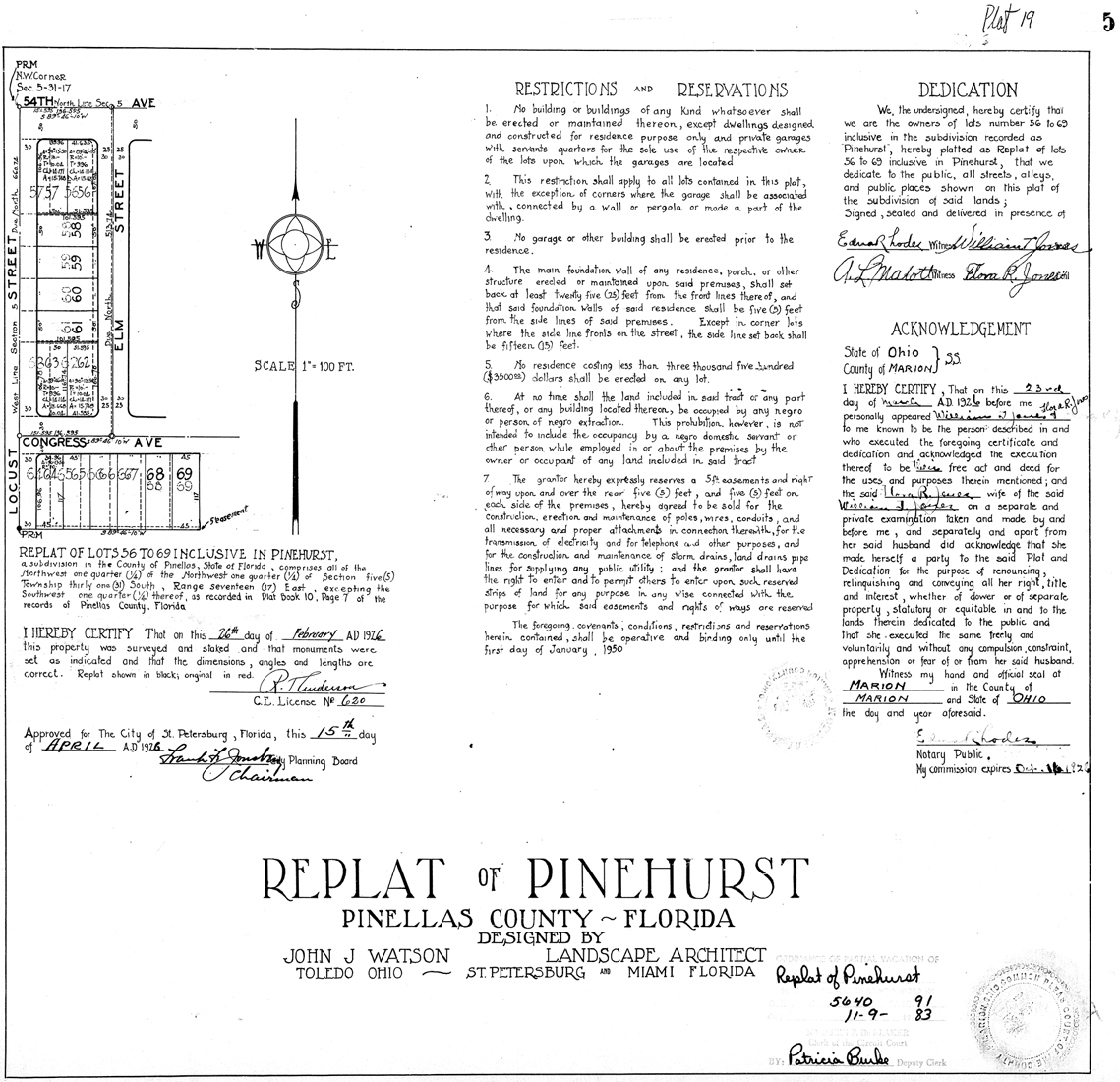
If you pull a title report on a home built in 1940, you might still see one of these racist clauses written into the historical text. Do not panic. As a matter of law, discriminatory restrictive covenants in recorded real estate documents are void and unenforceable in California. The state even provides a mechanism for homeowners to file a modification document to strike the offensive language from the public record entirely.
Inside the brokerage, compliance is not just an individual responsibility; it is a structural mandate. A real estate broker must supervise agents to prevent discriminatory housing practices. If an agent violates fair housing laws, the managing broker can be held liable for a failure of supervision.
California does not treat fair housing violations lightly. The consequences are dual-tracked: administrative and civil.
Administrative Penalties: Your ability to work is governed by the California Department of Real Estate. Article 10 of the California Real Estate Commissioner's Regulations strictly prohibits discriminatory conduct by real estate licensees.
If you violate these regulations, the DRE acts swiftly. A real estate licensee's license can be suspended or revoked by the California Department of Real Estate for violating fair housing laws.
Civil Liability: Beyond losing your license, you expose yourself to devastating financial liability. California law allows individuals to file a lawsuit in state court for fair housing violations.
In these courts, the financial penalties are designed to be punitive enough to destroy a career. Victims of housing discrimination in California can seek actual damages and punitive damages in civil court. Actual damages cover the victim's tangible losses (like moving expenses or higher rent). Punitive damages are specifically awarded to punish the agent or landlord and to make a public example of their behavior.
Understanding California fair housing law is about recognizing that every client, regardless of their background, language, marital status, or the source of their income, has an equal right to the California housing market. Your role is not to be a gatekeeper, but a facilitator, ensuring that every transaction you touch reflects the strict, uncompromising equity demanded by state law.