Condo Purchasing and Closing
Not sure you’re ready?
Take the ~3-minute readiness diagnostic and see where you stand.
Imagine purchasing a highly complex, multi-layered machine where the components are not gears and wires, but overlapping property rights, statutory regulations, and municipal safety codes. In New York, transferring ownership of a newly constructed condominium unit is exactly this process. It is not merely the exchange of money for keys; it is a meticulously choreographed legal sequence. Before a concrete foundation is fully poured, a developer must legally describe every physical and financial parameter of the future building. Before a buyer can cross the threshold, the local government must officially certify the structure’s safety. And at the closing table, a unique matrix of state and municipal taxes, developer fees, and insurance premiums must be perfectly balanced. Understanding the architecture of condominium sales—from the initial legal filings to the specific closing costs—is fundamental to navigating and mastering New York real estate.

To understand New York real estate, you must first understand the invisible regulatory shield that protects consumers from buying an illusion. We call this shield the Martin Act.
The Martin Act is a powerful New York State law that regulates the sale of condominiums and cooperatives. Because buying into a newly constructed building involves purchasing a unit that may not even exist yet, the law requires strict transparency. The New York Attorney General enforces the Martin Act, acting as the absolute gatekeeper for new developments.
Before a developer (often called a "sponsor") can sell a single condo unit to the public, they must file an offering plan with the New York Attorney General. You can think of the offering plan as the DNA sequence of the condominium. It is a detailed disclosure document provided to potential purchasers of a new condominium, designed so that buyers know exactly what they are getting into.
What is inside an Offering Plan?
- Detailed information about the physical aspects of the condominium building (materials, layouts, amenities).
- A declaration detailing the exact legal rights and obligations of the condominium unit owners.
- The projected real property taxes for the individual condominium units.
- An outline of the estimated monthly common charges for the first year of condominium operation.
Until the New York Attorney General formally accepts this offering plan, the developer's hands are tied. Sponsors cannot enter into legally binding contracts of sale until the New York Attorney General accepts the offering plan.
Drafting an offering plan is an immensely expensive and time-consuming process. Imagine spending millions of dollars legally engineering a 500-page document for a new luxury high-rise, only to discover that buyers aren't interested in that neighborhood.
To solve this, New York created a "prototype" phase. Cooperative Policy Statement Number 1 (CPS-1) allows developers to test the market for a new condominium before filing a full offering plan.
However, a developer cannot simply throw up a billboard and start taking cash. The New York Attorney General must approve a CPS-1 application before a developer can begin testing the condominium market. Once approved, a highly regulated testing period begins.
During the CPS-1 phase, the rules of engagement are incredibly strict:
- Developers are legally permitted to advertise the proposed condominium project (with prominent disclaimers).
- Developers are strictly prohibited from entering into binding contracts of sale. There is no actual offering plan yet, so there is nothing legally binding to sell.
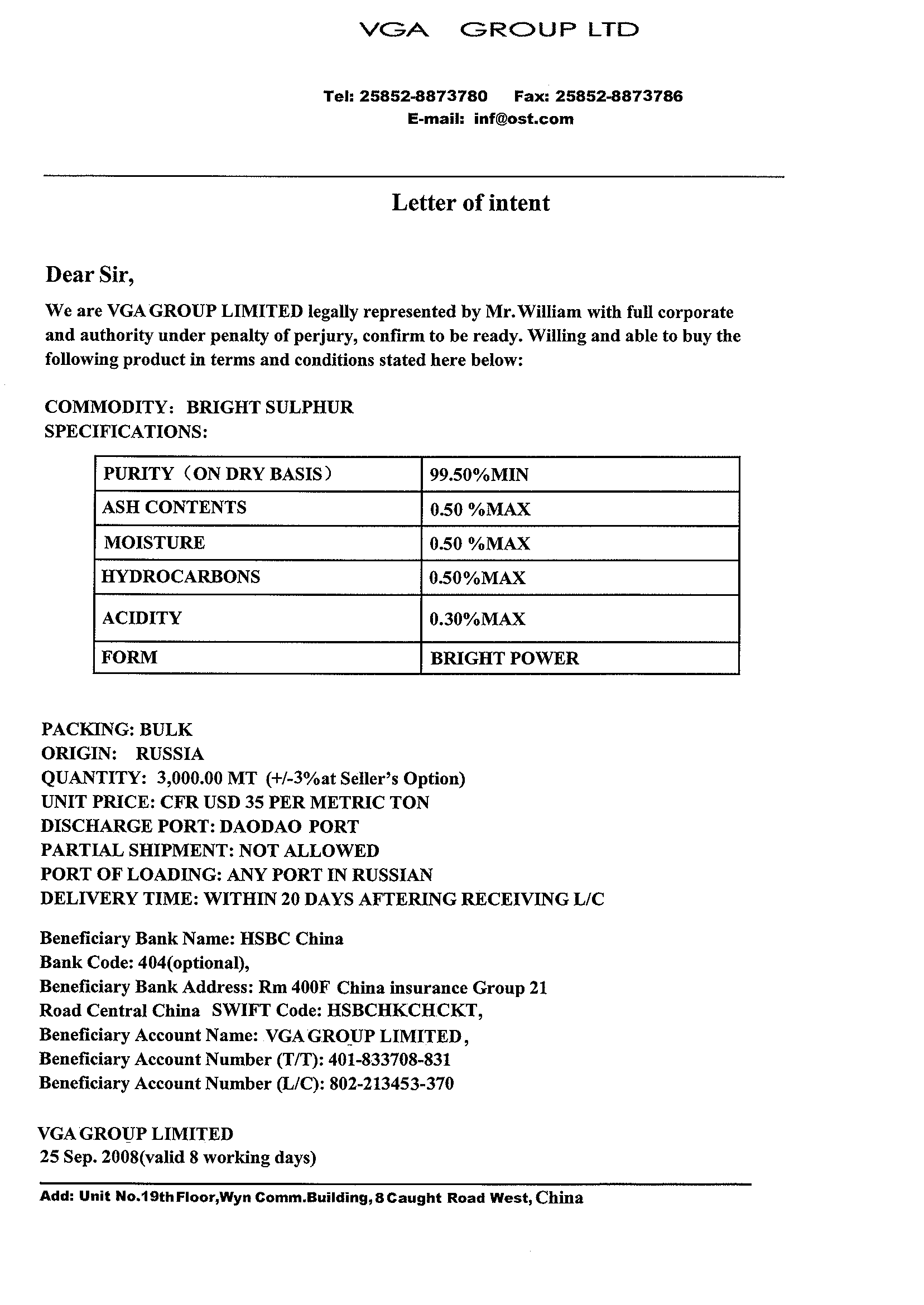
- Developers use a letter of intent to gauge potential buyer interest. A letter of intent is simply a non-binding agreement indicating a prospective buyer's interest in purchasing a specific condo unit.
- Developers are strictly prohibited from accepting non-refundable deposits from potential buyers. Any monetary deposit collected from a prospective buyer during the CPS-1 phase must be fully refundable.
The CPS-1 phase is about measuring temperature, not locking in commitments. It allows the developer to prove to their lenders that there is demand before moving forward with the heavy machinery of the full offering plan.
Let us fast forward. The offering plan was accepted, the building is constructed, and your client is eager to move in. But a finished building is not necessarily a legal dwelling.
Before anyone unpacks a box, the building must receive a Certificate of Occupancy (often abbreviated as a C of O). This is a document issued by the local government verifying that a building strictly complies with current building codes. More profoundly, a Certificate of Occupancy officially certifies that a building is safe for human habitation.
- The Legal Reality: A newly constructed condominium unit cannot be legally occupied by a resident without a valid Certificate of Occupancy.
- The Financial Reality: Mortgage lenders are highly risk-averse. They will typically refuse to fund a mortgage for a new condominium unit without a valid Certificate of Occupancy.
The Temporary Certificate of Occupancy (TCO)
Construction is notoriously messy, and often, the residential units are perfectly safe and finished while the lobby or the basement gym is still under construction. Does the buyer have to wait six months to move in?
No. The city issues a Temporary Certificate of Occupancy (TCO). A Temporary Certificate of Occupancy allows buyers to legally move into a condominium unit while minor building work is being completed elsewhere on the premises.
Important Fact for the Exam: A Temporary Certificate of Occupancy in New York is typically valid for 90 days. Developers must continually renew the TCO until the building is completely finished and eligible for the final, permanent C of O.
When an aspiring real estate professional looks at closing costs, they must recognize a fundamental truth of New York real estate: Condominium buyers typically pay higher closing costs compared to buyers purchasing cooperative apartments.
Why? Because when you buy a condominium, you are buying actual real property (a deed), whereas buying a co-op means buying shares in a corporation. Transferring real property triggers a distinct set of legal mechanisms, taxes, and insurance requirements.

Let’s break down the specific physics of condo closing costs into logical categories.
1. Due Diligence and Protection
A buyer isn't just paying for the physical walls; they are paying to ensure their legal right to exist within them is unshakeable.
- Title Search Fee: A title search fee is charged to the condominium buyer at closing. This pays professionals to dig through municipal records to verify the seller has clear legal title to the unit, free of liens or hidden disputes.
- Title Insurance: Once the title is searched, it must be insured. Condominium purchasers must buy title insurance to protect against undisclosed defects in property ownership that the search might have missed.
- Homeowner's Insurance: Lenders require condominium buyers to present a paid homeowner's insurance policy prior to closing the mortgage loan. The lender will not risk funding a $1 million asset that could burn down tomorrow without insurance in place today.
2. Financing and Operating Taxes
- New York State Mortgage Recording Tax: If your client is financing their purchase with a loan, they must pay this tax. The New York State Mortgage Recording Tax is calculated as a specific percentage of the total mortgage loan amount. (Note: Co-op buyers do not pay this, because a co-op loan is technically not a real estate mortgage!).
- Prorated Real Property Taxes: Condominium buyers are responsible for paying prorated real property taxes from the official date of closing onward.
- Common Charges: Common charges are mandatory monthly fees paid by condominium owners for the maintenance of shared building areas (hallways, elevators, roofs). At the closing table, condominium buyers typically prepay a specified number of months of common charges to establish a cushion for the condo association.
3. The New York State Mansion Tax
This is a critical concept that frequently trips up buyers. New York State imposes a Mansion Tax on residential property purchases of $1 million or more.
Despite the name, a $1 million apartment in New York City is rarely a "mansion." But the tax applies nonetheless. The base New York State Mansion Tax rate is 1 percent of the total property purchase price.
Here is the vital mechanic you must explain to your clients: The New York State Mansion Tax applies to the ENTIRE purchase price of a condominium sold for $1 million or more. It is not just taxed on the amount over $1 million. If you buy a condo for $999,999, the tax is zero. If you buy it for $1,000,000, the tax is $10,000.
Furthermore, this tax is strictly the buyer's burden. The buyer is legally responsible for paying the New York State Mansion Tax. And as property values climb, the state takes a larger cut: The Mansion Tax rate increases progressively for residential properties sold at $2 million or higher in New York City.
4. The Sponsor Sale Add-Ons
When a client buys a resale condo from a regular person, the seller typically pays the state and city transfer taxes. But when a client buys a brand-new condominium directly from a sponsor (the developer), the developer usually forces the buyer to shoulder the seller's traditional costs.
If your client is buying new construction, prepare them for this reality check:
| Cost Transferred to Buyer | Explanation |
|---|---|
| State Transfer Tax | Condominium buyers purchasing directly from a sponsor are often required to pay the sponsor's New York State Transfer Tax. |
| City Transfer Tax | Condominium buyers purchasing directly from a sponsor in New York City are often required to pay the sponsor's Real Property Transfer Tax. |
| Developer's Attorney Fees | Purchasers of new construction condominiums from a sponsor are typically required to pay the developer's attorney fees at closing. |
| Working Capital Fund | Sponsor sales in new condominium developments often require the buyer to make a one-time contribution to the building's working capital fund. A working capital fund contribution at closing is typically equivalent to one or two months of the unit's common charges. |
Your value as a real estate professional is not in simply opening doors; it is in illuminating the dark corners of the transaction. When you can fluently explain why an offering plan protects them under the Martin Act, how a CPS-1 letter of intent keeps their deposit safe, why a lender demands a Certificate of Occupancy, and exactly why their closing costs include a Mansion Tax and a sponsor's transfer tax—you transition from being a salesperson to an indispensable advisor. Mastering these technical mechanics is the foundation of an elite real estate practice.