Account Types and Registrations
The architecture of a brokerage account is not merely administrative paperwork; it is the legal physics defining how capital moves, who controls the lever, and how assets are shielded from—or exposed to—taxes, liability, and mortality. When you sit across from a client, the account registration you select dictates the entire operational reality of their money. Choosing between a joint tenancy and a tenancy in common is not a matter of semantics; it determines whether a surviving spouse inherits a portfolio instantly or watches it sink into the quagmire of probate court. Understanding these mechanics is the foundational duty of a General Securities Representative.
Before a client can execute a single trade, you must establish the financial gravity of the account: how will they pay, and how will you charge them?
Account Payment Types
At its simplest, an investor pays for what they buy. Under Regulation T, a federal rule established by the Federal Reserve, a broker-dealer is required to ensure customers pay for securities in a cash account in full by the designated settlement date. If they buy $10,000 of stock, they owe $10,000 in cash.
However, capital is a tool, and leverage is an accelerator. Margin accounts allow customers to borrow funds from a broker-dealer to purchase securities. To unlock this capability, opening a margin account requires the customer to sign a formal margin agreement. Embedded within this document is a critical piece of financial plumbing: the hypothecation agreement. This allows the broker-dealer to pledge customer securities as collateral for a bank loan, which funds the client's leverage.
Fee Structures
Once the account type is settled, the economic relationship between the client and the firm must be defined.
- Commission-based accounts charge a distinct transaction fee for each individual trade executed. This structure is generally the most cost-effective structure for buy-and-hold investors. If a client buys a mutual fund and holds it for ten years, they pay the toll once.
- Fee-based accounts flip this model. They charge a single periodic fee based on a percentage of the assets under management (AUM). This model aligns the broker's compensation with the portfolio's growth and is most suitable for investors engaging in a moderate to high volume of trading activity, as it removes the friction of per-trade costs.
The retail investor buys and holds; the institutional or active trader operates in an entirely different velocity, requiring specialized account structures.
Prime Brokerage
Imagine a massive hedge fund executing trades across ten different broker-dealers to mask its strategy or secure the best execution. Settling these trades individually would be a logistical nightmare.
A prime brokerage account provides a central clearing facility for an institutional customer executing trades through multiple different broker-dealers. In this "hub and spoke" arrangement:
- The executing broker (the spoke) is responsible for executing the customer's trade.
- The prime broker (the hub) is responsible for clearing and settling the customer's trade.
Institutional Settlement (DVP/RVP)
Institutional trades often settle using specialized bank protocols rather than standard brokerage sweeps.
- Delivery versus Payment (DVP) accounts settle institutional trades by delivering securities to the buying institution's bank in exchange for simultaneous payment.
- Receive versus Payment (RVP) accounts operate in reverse, settling institutional trades by delivering payment to the selling institution's bank in exchange for simultaneous receipt of securities.
Crucial Rule: DVP trades are granted an extended window for institutional coordination, possessing a maximum allowable legal settlement period of 35 calendar days.
Pattern Day Trading
FINRA heavily regulates retail investors who attempt to day-trade, given the extreme risk profile. A pattern day trader is officially defined as an investor who executes four or more day trades within a five-business-day period.
Because of the intraday leverage and volatility risk, pattern day traders must maintain a minimum equity requirement of $25,000 in their brokerage account. Furthermore, this $25,000 minimum equity must be deposited into the account before any day trading activities commence. Because the risks are uniquely severe, opening a day trading account requires the delivery of a specific risk disclosure document to the customer prior to account approval.
When multiple humans pool capital, the legal registration dictates the rules of engagement and the rules of succession.
Establishing any joint brokerage account requires the signatures of all account owners on the joint account agreement. Once opened, the system operates on a principle of unified operational control but strict distribution protocol: Any single owner of a joint brokerage account possesses the authority to initiate trades on behalf of the entire account, but distributions of funds from a joint brokerage account must be made payable to all named account owners.
Survivorship vs. Estate (JTWROS vs. TIC)
The most heavily tested distinction in joint registrations is what happens when an owner dies.
| Registration Type | Post-Mortem Mechanics | Ownership Ratios |
|---|---|---|
| Joint Tenants with Right of Survivorship (JTWROS) | A deceased owner's fractional interest passes directly to the surviving account owner. It entirely bypasses the probate process upon death. | Ownership is strictly undivided and equal. |
| Tenants in Common (TIC) | A deceased owner's fractional interest passes directly to the deceased owner's estate, subjecting it to probate. | TIC accounts legally permit the owners to hold unequal percentage ownership interests (e.g., 70/30) in the account assets. |
Marital Exceptions
Certain states offer highly specific registrations for married couples:
- Tenants by the Entirety (TBE): A joint account registration restricted exclusively to legally married spouses, providing robust creditor protection.
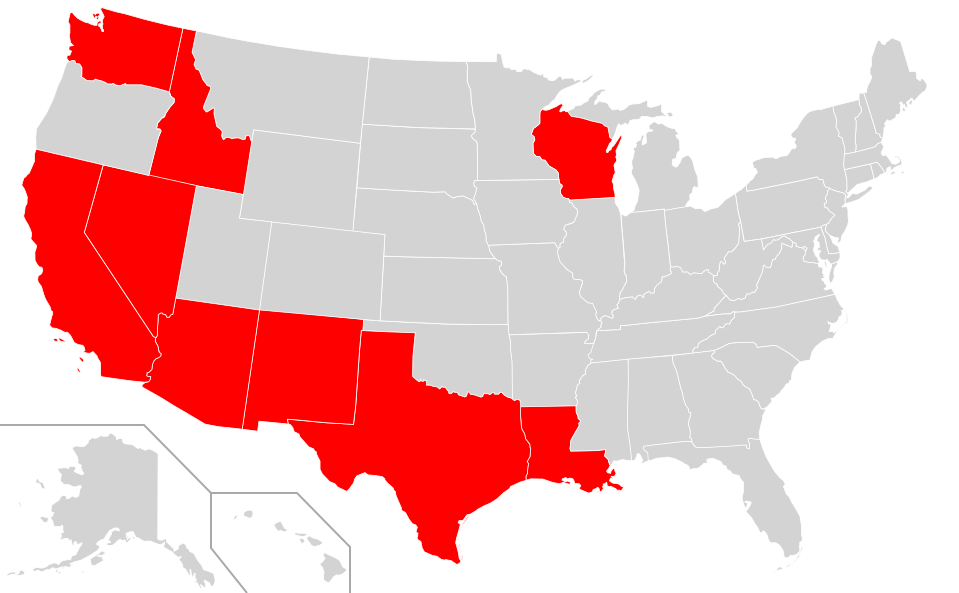
- Community Property: Jointly owned marital accounts recognized only in specific states adopting community property laws. In these states, assets acquired during the marriage are deemed equally owned by both spouses, regardless of whose name is on the paycheck.
When the account owner is not a natural person—or is a fiduciary acting for another—the broker-dealer must collect specific legal documentation to prove authority.
Business Entities
- Sole Proprietorship: A business owned by one person. The account must be opened under the name of the individual business owner. Crucially, the business assets and personal assets of a sole proprietorship are treated as the same legal entity for liability purposes. If the business is sued, the owner's personal brokerage account is fair game.
- Partnership Account: Opening this requires a certified copy of the partnership agreement. This document is vital because a partnership agreement dictates exactly which partners possess the authority to execute trades on behalf of the partnership.
- Corporate Account: To open a standard corporate account, the firm requires a corporate resolution to formally identify the individuals authorized to execute trades. If the corporation wishes to utilize leverage, opening a corporate margin account requires a corporate charter proving the corporation is legally permitted to borrow money.
Fiduciary Registrations: Trust Accounts
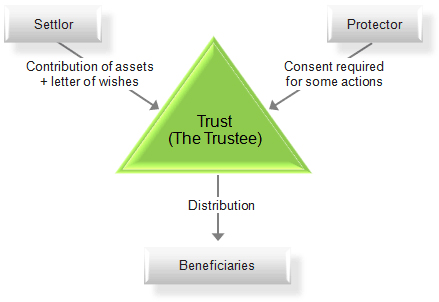
A trust account is an intricate legal structure managed by a designated trustee for the financial benefit of one or more beneficiaries. Because the broker-dealer must verify the trustee's powers, opening a trust account requires the broker-dealer to obtain a copy of the trust agreement.
Trusts come in two distinct metabolic states:
- Revocable Trust: Allows the grantor to alter the trust terms or cancel the trust entirely during the grantor's lifetime. Because the grantor retains ultimate control, assets held in a revocable trust are included in the grantor's estate for estate tax calculation purposes.
- Irrevocable Trust: Cannot be modified or terminated by the grantor without the explicit permission of the beneficiary. By severing this control, assets placed into an irrevocable trust are permanently removed from the grantor's taxable estate.
Fiduciary Registrations: Custodial Accounts for Minors
Minors cannot legally contract to buy and sell securities. Adults must manage assets for them using standardized legal frameworks: Uniform Gifts to Minors Act (UGMA) and Uniform Transfers to Minors Act (UTMA).
These accounts are bound by rigid constraints:
- An account must be strictly limited to exactly one adult custodian.
- An account must be strictly limited to exactly one minor beneficiary.
- All financial gifts made to a minor inside a UGMA account are legally irrevocable. The donor cannot take the money back.
- Because a fiduciary cannot expose a minor's assets to borrowed risk, custodial accounts for minors are legally prohibited from being opened as margin accounts.
The distinction between UGMA and UTMA: A UGMA account strictly restricts allowable assets to financial instruments like cash and securities. A UTMA account is far more flexible, allowing the custodian to hold real estate as an account asset.
You cannot simply take money from a stranger and start buying stocks. The broker-dealer operates as a gatekeeper to the U.S. financial system, bound by both FINRA rules and federal anti-money laundering laws.
FINRA Rule 4512
To create the foundational record, FINRA Rule 4512 requires the broker-dealer to obtain the customer's legal name and physical residence address to open a new account. (A P.O. Box is not sufficient for identity, only for mailing). Furthermore, a customer's date of birth is a mandatory data point required to open a new individual brokerage account.
Who authorizes the account? A registered principal's signature is legally required on the new account form to approve the opening of a customer account. Surprisingly to many new representatives, FINRA rules do not require the customer's physical signature on a standard cash account new account form (though the margin agreement, as discussed, does require one).
The USA PATRIOT Act and CIP
In the wake of 9/11, the USA PATRIOT Act required broker-dealers to establish and maintain a formalized Customer Identification Program (CIP).
- A CIP requires a broker-dealer to verify a customer's identity using an unexpired government-issued identification card (like a passport or driver's license).
- Broker-dealers must verify every new customer's name against the federal Office of Foreign Assets Control (OFAC) restricted list to ensure they are not doing business with known terrorists or sanctioned entities.
The firm must also make a reasonable effort to obtain:
- The customer's Social Security number or tax identification number prior to account opening.
- The customer's current employment status and employer name.
Finally, broker-dealers must explicitly ascertain whether a new customer is an associated person of another broker-dealer, as this triggers strict communication and duplicate statement rules to prevent insider trading and conflicts of interest.
An account is a dynamic entity. Assets move between registrations, between firms, and inevitably, from the deceased to the living.
Internal and External Transfers
Moving assets between two accounts with identical registrations is simple. However, transferring funds between two separate accounts with different legal registrations (e.g., from an individual account to a joint account) requires written authorization from the account owner.
When a client moves their entire portfolio to a competing firm, the process is heavily regulated to prevent anti-competitive hostage-taking. Customer account transfers between competing broker-dealers are electronically facilitated through the Automated Customer Account Transfer Service (ACATS).
- Once requested, the carrying firm (the one losing the account) must officially validate or take exception to an ACATS request within one business day.
- Following validation, the carrying firm must complete the transfer of assets through ACATS within three business days.
The Death of a Customer
When a customer dies, the legal authority of that individual ceases to exist. As a registered representative, your immediate actions are defensive. Upon receiving notice of a customer's death, the registered representative must:
- Immediately cancel all open orders in the account.
- Freeze the account to prevent unauthorized transactions.
To unfreeze and disburse any assets from a deceased individual's brokerage account, the broker-dealer must obtain a certified copy of the death certificate.
What happens next depends on the registration:
- To merely remove a deceased owner from a JTWROS account, a certified death certificate is usually all that is required, as the surviving owner automatically absorbs the assets.
- However, if the account was individual or a TIC, moving assets from a deceased individual's account to an estate account requires the executor to provide letters testamentary, a court-issued document proving their legal authority to manage the estate.