Product-Specific Advertisements
A pharmaceutical manufacturer cannot legally market a new cardiovascular drug by simply stating it cures heart disease; they must simultaneously disclose the mechanism of action, the severe side effects, and precisely who should avoid taking it. The financial markets operate under an identical principle of asymmetric information. As a registered representative, you possess specialized knowledge about complex financial instruments that the general public lacks. To prevent the exploitation of this asymmetry, the Securities and Exchange Commission (SEC), the Financial Industry Regulatory Authority (FINRA), and the Municipal Securities Rulemaking Board (MSRB) have engineered a rigorous framework governing how you may communicate with the public.

These rules are not arbitrary bureaucratic hurdles. They are the structural physics of market integrity, designed to ensure that when you speak about a product’s potential upside, the gravity of its risks is presented with equal force.
Before we examine the rules for specific products, we must understand how regulators classify the messages you send. FINRA Rule 2210 establishes the foundational architecture by classifying all communications with the public into three distinct categories: retail communications, correspondence, and institutional communications.
Retail Communication: Any written or electronic communication distributed or made available to more than 25 retail investors within any 30 calendar-day period.
Because retail communications have the power to influence a mass audience, they carry the heaviest regulatory burden, often requiring principal pre-approval and filing with FINRA. Correspondence, by contrast, is distributed to 25 or fewer retail investors within a 30-day window. Institutional communications are distributed exclusively to institutional investors (like banks or mutual funds) and contain zero retail audience.
Mutual funds and other investment companies are uniquely accessible to the everyday investor. Consequently, regulators are hyper-vigilant about how these products are marketed. When you advertise a mutual fund, you are governed primarily by two SEC mandates: Rule 482 and Rule 156.
SEC Rule 482: The "Omitting Prospectus" Advertisement
Investment Company Act SEC Rule 482 governs the content and delivery of investment company advertisements. Think of a Rule 482 advertisement as a billboard; it is not the full legal prospectus, but it acts as a legally binding summary. To ensure investors do not make blind decisions based on a billboard, an SEC Rule 482 advertisement must clearly state where a prospective investor may obtain a prospectus.

Furthermore, the advertisement must explicitly advise investors to carefully consider the investment objectives, risks, charges, and expenses before investing.
If you wish to highlight how well the fund has performed, you cannot invent your own metric. Investment company performance data used in advertisements must be calculated according to SEC standardized methods to allow for accurate, apples-to-apples comparisons across the industry.
There is an exception that proves the rule: occasionally, a firm may want to use a bespoke ranking system created by an independent entity to show how their fund compares to a highly specific peer group. If you distribute retail communications regarding investment companies that include custom performance rankings, they must be filed with FINRA at least 10 business days prior to first use.
SEC Rule 156: The Prohibition on Misleading Statements
While Rule 482 dictates what must be in the ad, SEC Rule 156 establishes guidelines to determine if investment company sales literature is materially misleading. It addresses the psychological framing of the investment. Most critically, SEC Rule 156 explicitly prohibits investment company sales literature from suggesting that past performance guarantees future results. The market is a dynamic system; yesterday's bull run is mathematically irrelevant to tomorrow's volatility.
Variable life insurance and variable annuities are complex hybrid products. They combine the tax-deferral and mortality features of insurance with the market risk of securities. Because the underlying sub-accounts look exactly like mutual funds, investors frequently mistake them for standard investment accounts.
Regulators demand absolute clarity regarding the nature of these products. Therefore, variable life insurance policies and variable annuities must be clearly identified as life insurance or annuities in all advertisements.
A common pitfall for inexperienced representatives is selling a variable annuity as a place to park cash. This is fundamentally deceptive. Variable contracts cannot be presented as short-term or liquid investments in any public communication.
If your marketing materials make any advertising statement regarding the liquidity of a variable contract, the communication must explicitly state the negative impact of surrender charges. Furthermore, it must explicitly state the negative impact of tax penalties for early withdrawal (such as the 10% IRS penalty for withdrawals prior to age 59½).
When demonstrating how these products might perform over a lifetime, you must use controlled hypotheticals. If you provide hypothetical illustrations of rates of return in variable life insurance advertisements, the illustration may not exceed a gross rate of 12 percent. To ensure the investor understands that they bear the investment risk, these hypothetical illustrations must also include a 0 percent gross rate of return scenario, demonstrating the sheer cost of the insurance wrapper if the market stalls completely.
Derivatives require the strictest communication protocols in the securities industry. Options carry the risk of total principal loss—and in the case of uncovered calls, theoretically infinite loss.
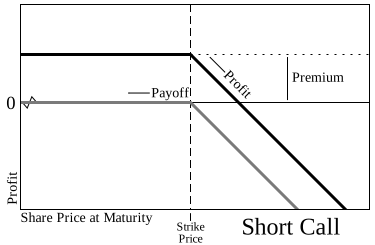
Because of this asymmetrical risk profile, all retail communications concerning options must be pre-approved by a Registered Options Principal (ROP) before initial use. Additionally, these retail communications regarding options must be filed with FINRA at least 10 calendar days prior to first use.
Note the critical distinction: Custom mutual fund rankings require filing 10 business days prior, whereas options retail communications require filing 10 calendar days prior.
The Options Disclosure Document (ODD)
The bedrock of options regulation is the Options Disclosure Document (ODD), formally titled Characteristics and Risks of Standardized Options. The timing of when you must deliver this document depends entirely on what your advertisement says.
An Options Disclosure Document must precede or accompany any retail communication concerning options that contains:
- Past performance
- Projected performance
- A specific recommendation
Why? Because if you are going to tempt an investor with historical wins, theoretical profits, or a specific strategic play, they must simultaneously hold the official risk disclosures in their hands.
Conversely, options advertisements that do not show past performance or make recommendations do not require delivery of the Options Disclosure Document prior to viewing. You can publish a purely educational pamphlet explaining the mechanics of a call option without an ODD. However, regardless of whether the ODD is triggered, all options advertisements must explicitly state that options are not suitable for all investors.
Finally, what about a quick email to a single client regarding an options strategy? This falls under correspondence. Options correspondence does not require pre-approval by a principal prior to use. However, to maintain systemic integrity, options correspondence must be subject to routine supervision and review by a Registered Options Principal.
The MSRB operates with slight variations from FINRA, reflecting the unique institutional and retail dynamics of the tax-exempt debt market.
First, municipal securities advertisements must be approved by either a Municipal Securities Principal or a General Securities Principal before initial use.
Second, the MSRB's definition of mass communication differs slightly from FINRA's "retail communication." Under MSRB rules, a form letter is defined as any written letter or electronic mail message distributed to 25 or more persons within any period of 90 consecutive days. Contrast this with FINRA's 30-calendar-day window; the MSRB sweeps a broader timeframe to capture distributed campaigns.
When a municipality issues new bonds, they produce detailed disclosure documents rather than standard prospectuses. Because these documents are crafted by the municipal issuer (the local government) and not the broker-dealer, Preliminary Official Statements (POS) and Final Official Statements (FOS) for municipal securities are explicitly excluded from the MSRB definition of advertising.
Investment banks operate a highly profitable business underwriting new securities for corporations. Concurrently, the same broker-dealers employ research analysts whose job is to objectively evaluate those very securities. The conflict of interest is obvious: the firm has a massive financial incentive to publish glowing research on the companies paying them underwriting fees.
To prevent the corruption of market data, regulators have built structural walls between investment banking and research, enforced through "quiet periods" and mandatory disclosures.
Quiet Periods for Public Offerings
A quiet period restricts a firm from publishing research reports regarding the subject company of a securities offering. Furthermore, it restricts a firm's research analysts from making public appearances regarding the subject company.
The duration of this silence depends on the nature of the offering and the firm's role in the underwriting syndicate:
| Type of Offering | Firm's Role in Syndicate | Quiet Period Duration |
|---|---|---|
| Initial Public Offering (IPO) | Manager or Co-Manager | 10 days |
| Initial Public Offering (IPO) | Syndicate or Selling Group Member | 10 days |
| Follow-on (Secondary) Offering | Manager or Co-Manager | 3 days |
| Follow-on (Secondary) Offering | Syndicate or Selling Group Member | None (0 days) |
Notice that the 3-day quiet period for a follow-on offering does not apply to syndicate members or selling group members who are not managers or co-managers.
Crucially, these quiet period requirements for research reports do not apply to securities offered under SEC Rule 144A (offerings restricted strictly to Qualified Institutional Buyers). Because QIBs are highly sophisticated entities, they do not require the same paternalistic quiet period protections as the retail public.
Disclosing Conflicts of Interest
When a broker-dealer speaks—either through its own analysts or by distributing someone else's work—it must lay all its financial biases on the table.
Distributing Third-Party Research: If your firm distributes research created by an outside entity, third-party research reports distributed by a broker-dealer must clearly disclose that the report was prepared by a third party. When a broker-dealer distributes third-party research, the broker-dealer must disclose:
- If the broker-dealer makes a market in the subject company's securities.
- If the broker-dealer owns 1% or more of the subject company's equity securities.
- Any other material conflict of interest regarding the subject company.
However, a broker-dealer distributing independent third-party research is exempt from certain firm-specific investment banking disclosures if the research firm has no affiliation with the distributing broker-dealer.
Publishing Proprietary Research: When a firm's own analysts write the report, FINRA demands absolute transparency regarding the firm's investment banking relationships. Under FINRA rules, research reports must disclose:
- If the publishing firm has managed or co-managed a public offering for the subject company within the past 12 months.
- If the publishing firm received investment banking compensation from the subject company in the past 12 months.
- If the publishing firm expects to receive investment banking compensation from the subject company in the next 3 months.
Finally, to sever the direct financial incentive to issue a "Buy" rating on a banking client, a broker-dealer must not base a research analyst's compensation on specific investment banking services transactions. Analysts must be paid for the accuracy and quality of their research, not the volume of underwriting deals their firm secures.
As a General Securities Representative, your words have legal gravity. Whether you are generating a custom mutual fund ranking, sending an email to a client about a covered call strategy, or distributing an analyst's evaluation of an upcoming IPO, the regulatory framework ensures that the public receives the unvarnished truth. Master these timelines, definitions, and disclosure triggers—not merely to pass the Series 7, but to safeguard the systemic trust upon which the entire market relies.