Fractions and Decimals
Not sure you’re ready?
Take the ~3-minute readiness diagnostic and see where you stand.
Numbers do not merely count whole objects; they measure the infinite spaces between them. A single apple can be divided, a mile can be run in segments, and a geometric plane can be partitioned. To navigate this continuous reality, mathematics relies on rational numbers, primarily expressed through fractions, decimals, and percents. These are not completely distinct mathematical species, but rather three interconnected dialects describing the exact same underlying concept: the division of a whole into quantifiable, equal parts. Understanding how to translate between these representations, and how to compose or decompose them, is fundamental to describing the physical world with precision.
At its core, a fraction represents a part of a whole or a proportion of a set. It is a masterclass in mathematical elegance, communicating two distinct pieces of information simultaneously through a vertical arrangement of numbers.
A fraction consists of a numerator placed above a fraction bar and a denominator placed below the fraction bar.
- The denominator represents the total number of equal parts that make up a single whole. It defines the size of the pieces.
- The numerator represents the specific number of equal parts being considered or counted. It tells us how many of those pieces we have.
We categorize fractions based on the relationship between these two numbers:
- Proper fraction: A fraction whose numerator is strictly less than the denominator (e.g., 2/5). It represents a value less than one.
- Improper fraction: A fraction whose numerator is equal to or greater than the denominator (e.g., 7/4). It represents a value equal to or greater than one.
- Mixed number: An alternative representation consisting of a whole number combined with a proper fraction (e.g., 143).
Crucial Equivalence: An improper fraction can always be rewritten as a mathematically equivalent mixed number, and vice versa. The improper fraction 7/4 tells us we have seven quarters; the mixed number 143 tells us those same quarters can be grouped to form one complete whole (using four quarters) with three quarters left over.
To master fractions, one must see them not as monolithic blocks, but as structures built from smaller, identical bricks. The fundamental brick of this system is the unit fraction, which is defined as a fraction with a numerator of exactly one (e.g., 1/4,1/7,1/10).
Every fraction can be represented as the sum of multiple unit fractions possessing the same denominator.
This brings us to the operations of construction and deconstruction:
- Decomposing a fraction means breaking the fraction down into a sum of smaller fractions with identical denominators.
- Composing fractions involves adding smaller fractions with identical denominators to form a single larger fraction.
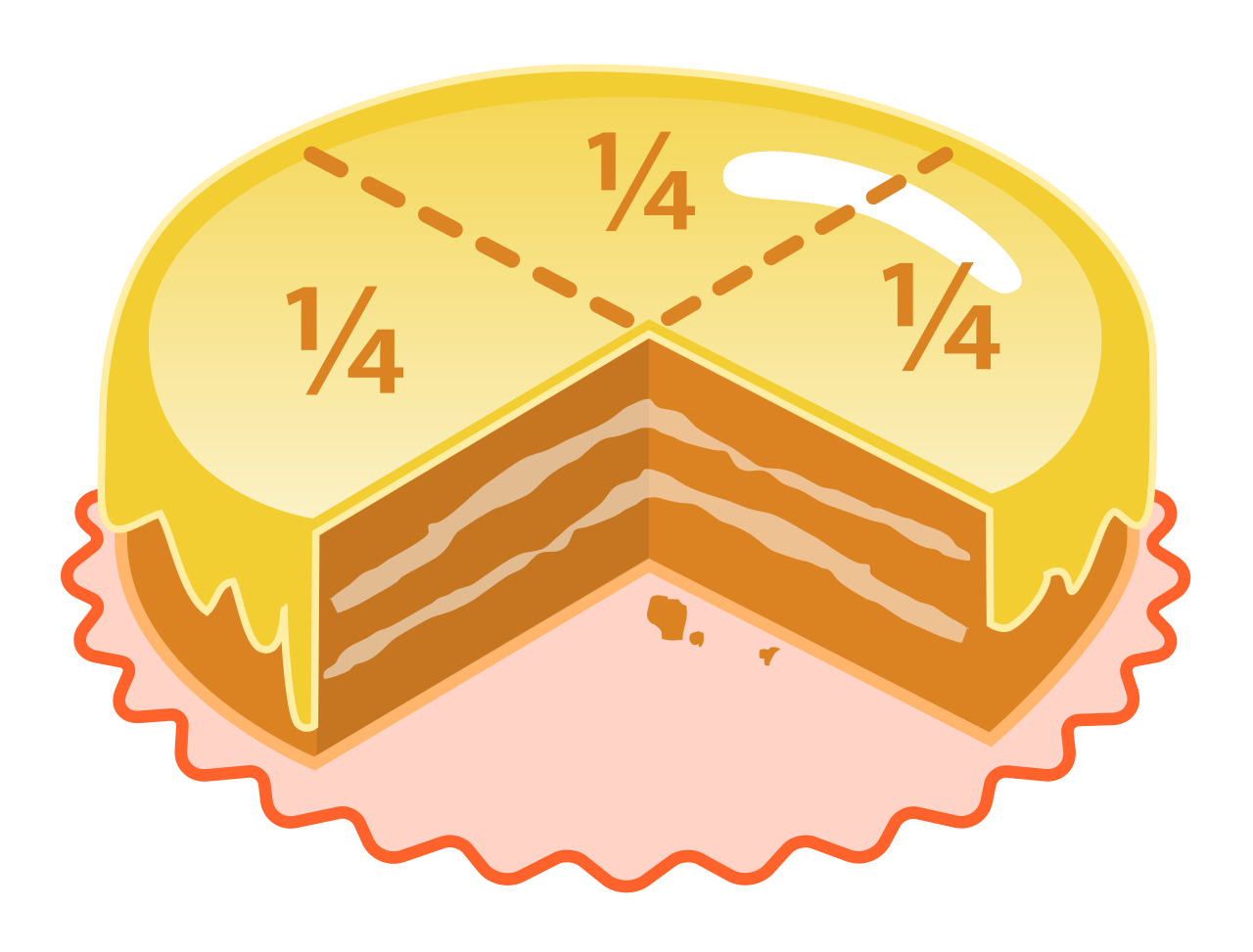
For instance, consider the fraction 3/4. Through decomposition, we reveal its fundamental components: the fraction 3/4 is mathematically equal to the sum of 1/4 plus 1/4 plus 1/4. We can write this formally as: 43=41+41+41 By composing those same unit fractions back together, we return exactly to 3/4. This additive property is the foundation upon which all fraction arithmetic is built.
To bridge the gap between abstract symbols and physical reality, we utilize various models to represent rational numbers.
The Number Line
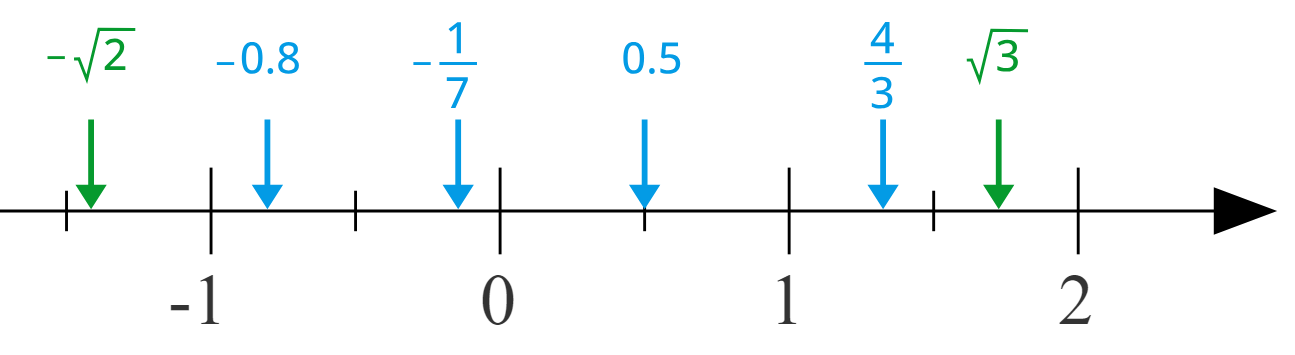
Rational numbers can be represented as specific coordinate points on a continuous number line. This model is powerful because it perfectly illustrates that fractions are not just isolated shapes, but actual magnitudes existing between whole integers. To plot a proper fraction on a number line between zero and one, the interval is divided into equal segments matching the fraction's denominator. If the denominator is 8, the space between 0 and 1 is segmented into eight equal intervals, and a point at the fifth tick mark represents 5/8.
The Area Model
An area model visualizes a fraction by dividing a two-dimensional geometric shape into equal-sized regions. Imagine a rectangle or a circle cleanly sliced.
- In an area model, the total number of equal-sized regions represents the denominator of the fraction.
- Conversely, the shaded regions represent the numerator of the fraction.
Concrete Fraction Models
Beyond drawings, concrete fraction models use physical manipulatives like fraction strips to physically represent parts of a whole. When a student holds a half-strip and places two quarter-strips beneath it to see that they align perfectly, the abstract arithmetic becomes tangible geometry.
One of the deepest realizations in mathematics is that two superficially different expressions can represent the exact same truth. Equivalent fractions represent the same exact portion of a whole using different numerators and denominators. For example, cutting a pizza into two halves and taking one (1/2) yields the same amount of food as cutting it into four quarters and taking two (2/4).
We manipulate equivalent fractions using two primary rules:
- Scaling Up: Multiplying the numerator and denominator of a fraction by the same non-zero integer creates a mathematically equivalent fraction.
- Simplifying: Dividing the numerator and denominator of a fraction by their greatest common factor simplifies the fraction to its lowest terms.
Comparing Fractions
When tasked with comparing the magnitude of two fractions, logic dictates three distinct scenarios:
- Identical Denominators: The pieces are the same size. Therefore, when comparing two fractions with identical denominators, the fraction with the larger numerator has the greater mathematical value. (Having 5 eighths is strictly more than having 3 eighths).
- Identical Numerators: We have the same number of pieces, but the pieces are different sizes. Because a larger denominator means a whole is cut into more pieces (making each individual piece smaller), when comparing two fractions with identical numerators, the fraction with the smaller denominator has the greater mathematical value. (3/4 is greater than 3/10).
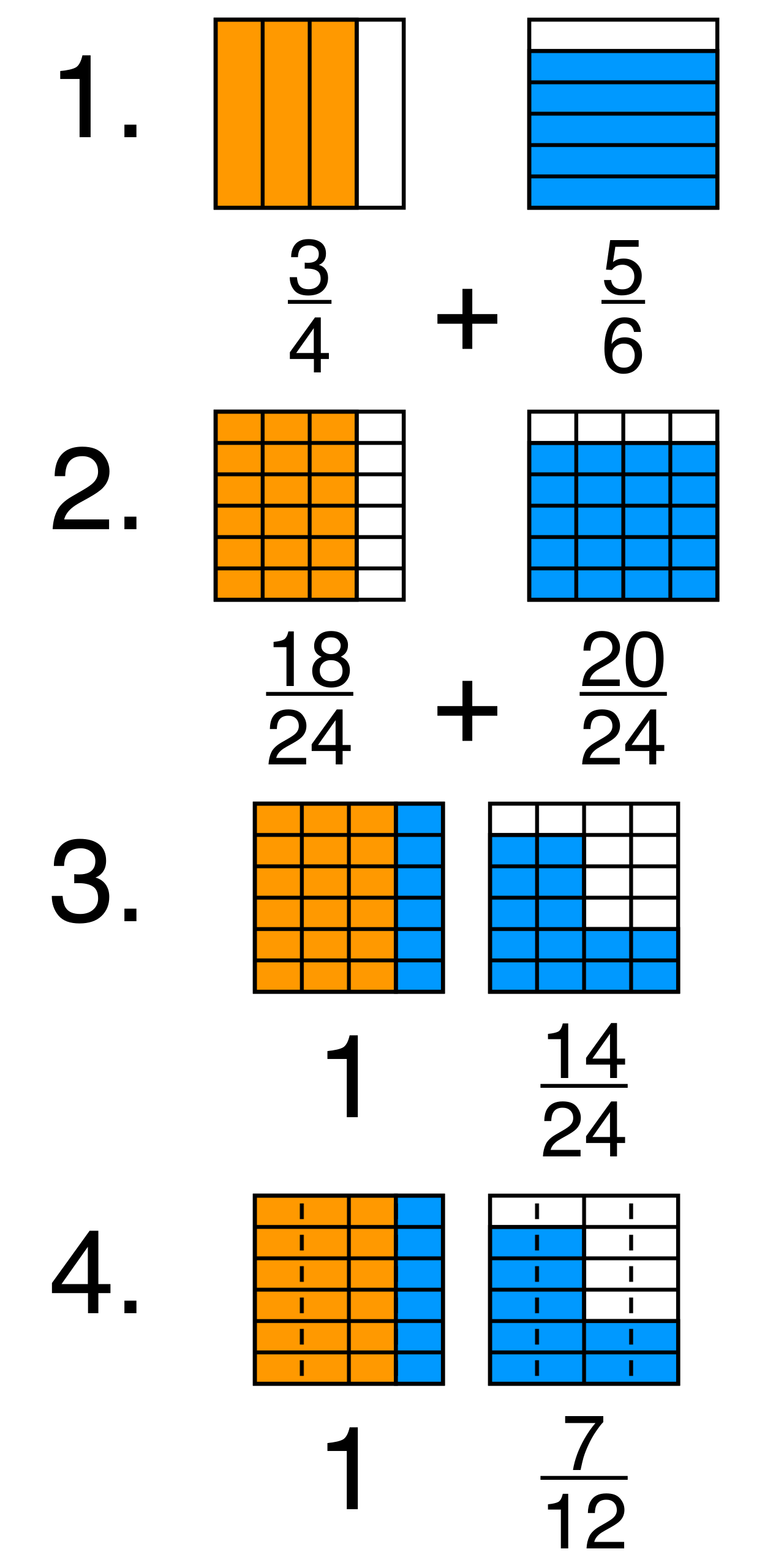
- Different Denominators: This is an apples-to-oranges comparison. To resolve it, fractions with different denominators can be compared by converting both fractions to equivalent fractions sharing a common denominator. Once the denominators match, we simply compare the numerators.
If fractions are a universal language, decimals are a highly specialized dialect. A decimal is simply a representation of a fraction where the unwritten denominator is a power of ten.
Our numbering system is a "Base-10" system. Just as place values to the left of the decimal point increase by factors of ten (ones, tens, hundreds), decimal place values positioned to the right of the decimal point decrease by a factor of ten for each consecutive position.
- The first numerical place value immediately to the right of the decimal point represents tenths (1/10).
- The second numerical place value immediately to the right of the decimal point represents hundredths (1/100).
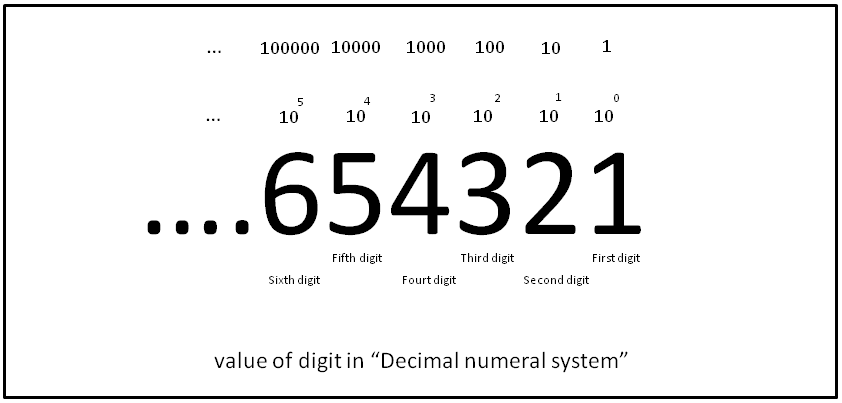
This structured alignment makes comparison remarkably straightforward. Decimals are compared by examining individual place values from left to right until a differing digit is found. When comparing 0.45 and 0.48, the tenths match (4), but examining the hundredths reveals that 8>5, proving 0.48 is the larger value.
Converting and Classifying Decimals
A fraction can be converted to a decimal equivalent by mathematically dividing the numerator by the denominator. This division yields two distinct typologies of decimals:
- Terminating Decimals: A decimal that ends naturally. A terminating decimal has a finite number of numerical digits after the decimal point. For example, 3/4 divides cleanly into 0.75. To reverse this process, a terminating decimal can be converted to a fraction by writing the decimal digits over the corresponding place value power of ten (e.g., 0.75 becomes 75/100, which simplifies to 3/4).
- Repeating Decimals: A decimal that never terminates. A repeating decimal has a digit or specific group of digits that repeats infinitely after the decimal point. For example, dividing 1 by 3 yields 0.333333... infinitely.
If fractions allow any denominator, and decimals restrict denominators to powers of ten, percents take standardization to its absolute limit. The term percent literally translates to "parts per one hundred."
By definition, a percent represents a mathematical ratio where the second term of the ratio is exactly one hundred. Because of this rigid standardization, it provides a universal metric for comparison. If you have a complete, unbroken whole, you have 100 parts out of 100. Thus, a value of 100 percent represents a complete whole.
The Mathematics of Conversion
Translating between decimals, percents, and fractions is an exercise in shifting magnitudes and understanding the number 100.
- Decimal to Percent: A decimal value is converted to a percent value by multiplying the decimal by one hundred. Because of our Base-10 system, multiplying a decimal value by one hundred shifts the decimal point exactly two places to the right. (0.45×100=45%).
- Percent to Decimal: The inverse is equally clean. A percent value is converted to a decimal value by dividing the percent by one hundred. Consequently, dividing a percent value by one hundred shifts the decimal point exactly two places to the left. (45%÷100=0.45).
- Fraction to Percent: There are two pathways here. Generally, a fraction can be converted to a percent by first converting the fraction to its equivalent decimal form (via division), and then multiplying by 100. However, as a shortcut, a fraction possessing a denominator of exactly one hundred can be converted directly to a percent by using the numerator as the percent value. (45/100 is instantly recognizable as 45%).
A mathematically literate student should recognize the most common proportional relationships instantly, seeing the fraction, decimal, and percent as interchangeable masks on the same underlying magnitude.
The Foundational Equivalencies
- The Half: The fraction 1/2 is mathematically equivalent to the decimal 0.5, and conversely, a value of 50 percent is mathematically equivalent to the fraction 1/2.
- The Quarters:
- The fraction 1/4 is mathematically equivalent to the decimal 0.25, which maps perfectly to the fact that a value of 25 percent is mathematically equivalent to the fraction 1/4.
- The fraction 3/4 is mathematically equivalent to the decimal 0.75, echoing that a value of 75 percent is mathematically equivalent to the fraction 3/4.
- The Fifths: The fraction 1/5 is mathematically equivalent to the decimal 0.2 (or 20%).
- The Eighths: The fraction 1/8 is mathematically equivalent to the decimal 0.125 (or 12.5%).
- The Thirds: As previously noted, the fraction 1/3 is mathematically equivalent to the repeating decimal 0.333333... (or 33.3%).
By viewing numbers not as rigid integers, but as infinitely divisible continuums—capable of being composed, decomposed, and translated across different mathematical notations—we gain the exact language required to describe the beautiful, fractional complexity of the physical world.