Interactions of Energy and Matter
Not sure you’re ready?
Take the ~3-minute readiness diagnostic and see where you stand.
Look up at the night sky, and you are witnessing a profound physical asymmetry: you can observe the brilliant nuclear furnace of a star millions of light-years away, but you cannot hear it explode. The universe communicates its visual history across the immense, silent void of space, yet sound remains entirely trapped within the thin atmosphere of our own planet. This fundamental difference in how energy travels—how it interacts with the physical matter it encounters—forms the foundation of our physical world. The principles governing these interactions are not just abstract mathematical curiosities; they are the exact same mechanics that explain the colors of a rainbow, the magnification of a telescope, and the electric currents powering the device you are reading this on.
To understand the physical universe, we must first understand how energy moves from one place to another. Energy travels in waves, but not all waves are created equal. The most fundamental distinction in physics lies between waves that require a physical medium to carry them, and those that do not.
The Electromagnetic Marvel of Light
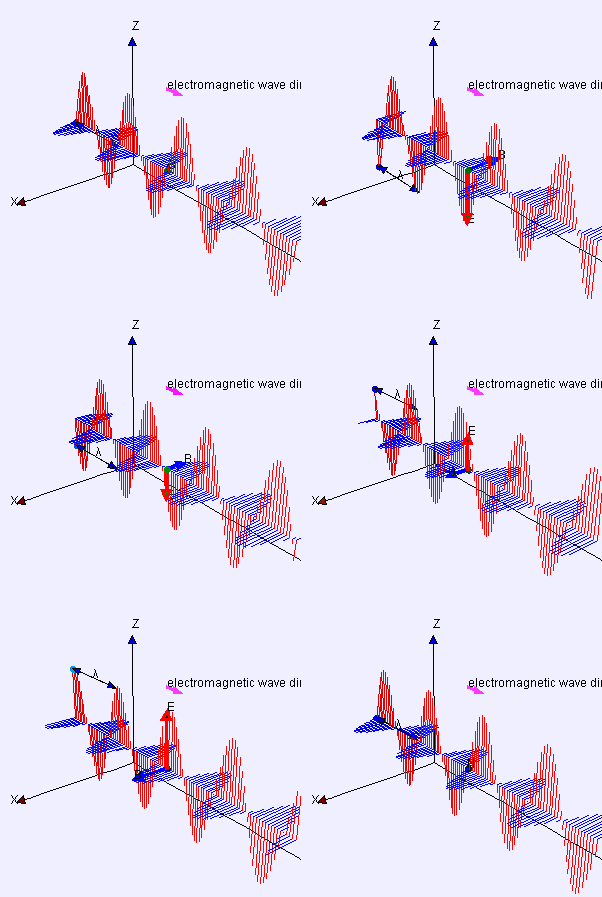
Light waves are electromagnetic waves. They are self-sustaining, intertwined oscillations of electric and magnetic fields. Because they carry their own fields with them, light waves do not require a physical medium to travel. This is why the light from distant stars reaches us at all: light waves can travel through a vacuum, traversing the absolute emptiness of deep space.
When observing their geometry, light waves are transverse waves. This means the oscillation of the wave is perpendicular to the direction the energy is traveling—much like the motion of a plucked guitar string. Nature has imposed a strict, universal speed limit on these electromagnetic messengers: the speed of light in a vacuum is exactly 299,792,458 meters per second.
The Mechanical Reality of Sound and Water
Conversely, sound waves are mechanical waves. They are essentially waves of pressure. Because sound is merely the organized bumping of atoms and molecules against one another, sound waves require a physical medium to travel. Consequently, sound waves cannot travel through a vacuum; without matter to compress, there is profound silence.
Sound behaves differently in its geometry as well. Sound waves are longitudinal waves, meaning the particles of the medium oscillate back and forth parallel to the direction of the energy's travel, creating a sequence of compressions and rarefactions. Because they rely on sluggish physical matter, sound travels much slower than light. For instance, the speed of sound in dry air at 20 degrees Celsius is approximately 343 meters per second.

If we look at a pond, we see another familiar type of wave. Water waves are mechanical waves, but they are fascinating hybrids of the two geometric motions. Water waves involve both transverse and longitudinal particle motion. As a wave passes across the surface of the water, the water molecules actually move in circular orbits, moving up and down (transversely) while simultaneously swaying back and forth (longitudinally).
Summary Comparison of Waves
| Wave Type | Classification | Medium Required? | Geometry |
|---|---|---|---|
| Light | Electromagnetic | No (Travels in vacuum) | Transverse |
| Sound | Mechanical | Yes | Longitudinal |
| Water | Mechanical | Yes | Transverse & Longitudinal |
When a light wave traveling through the air encounters a new physical material, a profound interaction between energy and matter occurs. Depending on the surface, the light will primarily do one of two things: bounce back into the original medium, or push its way into the new medium.
Reflection
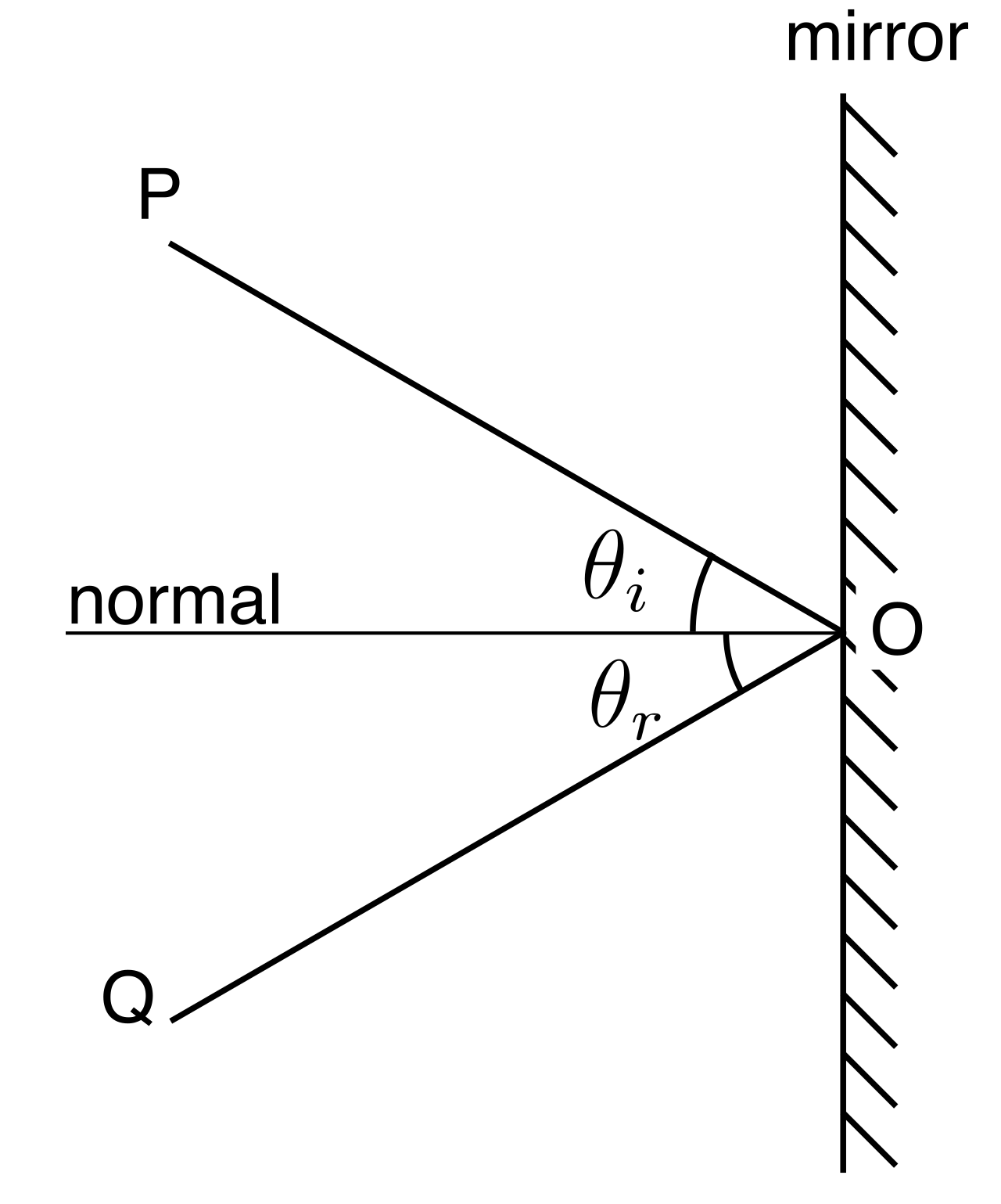
Reflection occurs when a light wave bounces off a surface. Think of a billiard ball striking the cushion of the table. The geometry of this bounce is perfectly predictable, governed by a simple geometric truth:
The Law of Reflection: The angle of incidence equals the angle of reflection.
If a beam of light strikes a flat surface at a 45-degree angle, it will rebound at exactly a 45-degree angle. By engineering perfectly smooth surfaces that reflect nearly all incident light uniformly, we create tools for human observation: mirrors utilize reflection to form visual images.
Refraction
But what happens when light penetrates the new material, like glass or water? The light wave bends. Refraction is the bending of a light wave during passage from one medium to another.
Why does the wave bend? It is a matter of velocity. Though light's speed in a vacuum is an immutable absolute, light actually slows down when it plows through physical matter like glass or water, because it interacts with the dense atomic structure. Refraction occurs due to a change in the speed of light as the wave enters a new medium. If the wave hits the new medium at an angle, the part of the wave that hits the dense medium first slows down before the rest of the wave, causing the entire path of the light to pivot.
We harness this bending in brilliant ways:
- Lenses utilize refraction to bend light for magnifying or reducing images. By precisely curving the glass, we can force light rays to converge to a focal point (convex lenses) or spread apart (concave lenses).
- A prism separates white light into an observable color spectrum through refraction. This beautifully demonstrates a fundamental fact of our universe: white light is a mixture of all colors in the visible spectrum. Because different colors of light have slightly different wavelengths, they slow down by different amounts when entering the prism. Violet light slows down more than red light, so it bends more sharply, fanning the white light out into a magnificent rainbow.

Energy's interaction with matter isn't limited to waves traversing space; it also includes the microscopic movement of atomic particles. Electrons carry electric charge, and when we force these electrons to move in an organized procession, we can accomplish tremendous physical work.
Electrical current is the flow rate of electric charge. But charge will not flow without motivation and a clear path.
The Anatomy of a Circuit
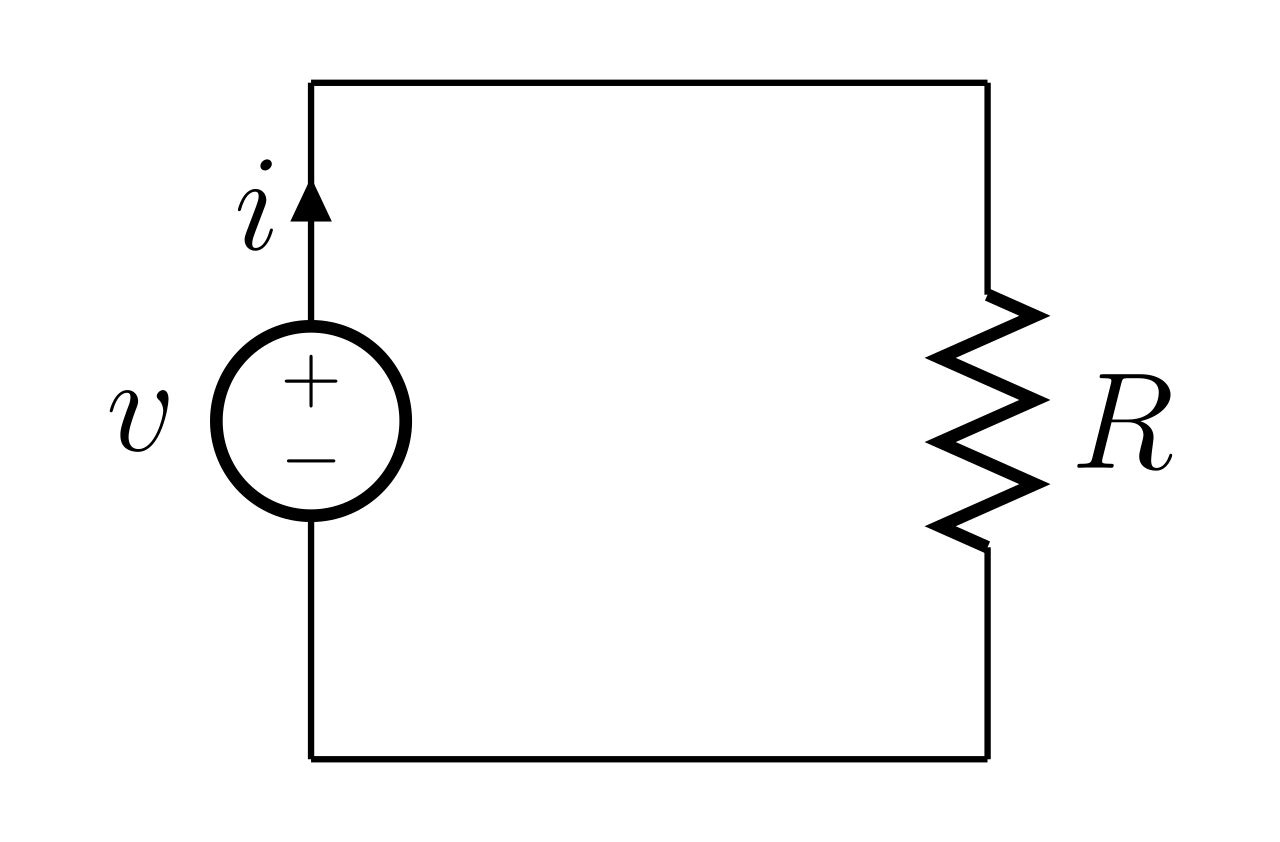
To put electrical current to work, we must build a specific structure. An electric circuit requires a continuous closed path for electrical current to flow. We call the most basic version of this a simple electric circuit, which requires three mandatory components and one optional (but highly practical) component:
- The Power Source: A simple electric circuit requires a power source to provide voltage. Voltage is the "push"—the electrical pressure—that forces electrons to move. Commonly, a battery serves as a direct current power source in a simple electric circuit.
- The Pathways: A simple electric circuit requires conductive pathways to transport electric charge. These pathways must be made of electrical conductors—materials allowing electric charge to flow freely. Because of its excellent conductivity, copper wire is a standard conductive pathway used in simple electric circuits. Conversely, we must contain that flow so it doesn't escape where we don't want it. To do this, we wrap the copper in electrical insulators, which are materials resisting the flow of electric charge. For example, rubber is a common electrical insulator used to coat wiring safely.
- The Load: A circuit with only a battery and wire is a short circuit—it will just overheat. We build circuits to do work, so a simple electric circuit requires a load to convert electrical energy into another form of energy, such as kinetic energy, heat, or light. A classic example is the incandescent filament: a lightbulb serves as a load in a simple electric circuit, converting the flowing electrical energy into radiant light and thermal heat.
- The Control: To prevent the circuit from running continuously until the battery dies, we introduce a gatekeeper. A switch is a component used to open or close an electric circuit.
Open vs. Closed Circuits
The state of the switch fundamentally alters the topology of our electrical pathway:
- An open electric circuit contains a broken path. When you turn a light switch "off," you are physically pulling two pieces of metal apart inside the wall. Because the physical bridge is gone, an open electric circuit prevents the flow of electrical current.
- When you turn the switch "on," the metal snaps back together. Now, a closed electric circuit contains a complete path. The loop is sealed, and a closed electric circuit allows electrical current to flow continuously from the negative terminal of the battery, through the load, and back to the positive terminal.
The interaction of matter and energy culminates in one of the most beautiful unifications in all of physics: the relationship between electricity and magnetism.
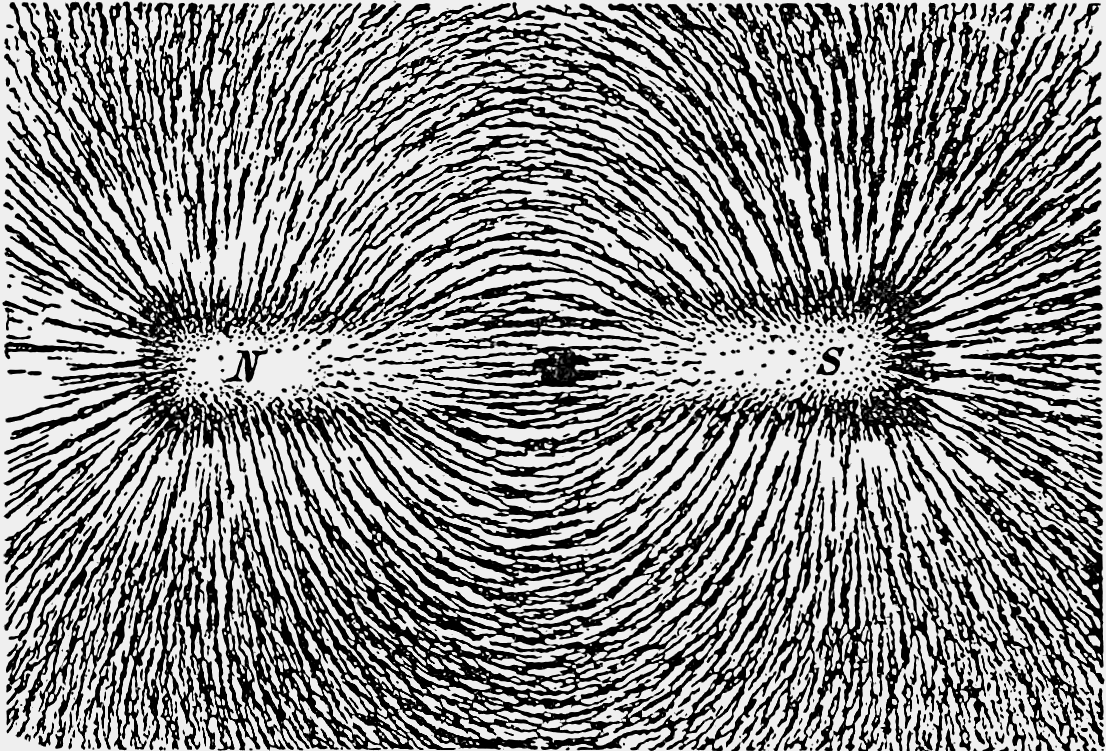
First, let us define classical magnetism. Magnets have a designated north magnetic pole and a south magnetic pole. The rules governing their interaction are rigidly deterministic: opposite magnetic poles exert an attractive force on each other (North pulls South), while identical magnetic poles exert a repulsive force on each other (North pushes North away).
These pushing and pulling forces do not require the magnets to physically touch. Instead, the magnet alters the geometry of the space around it. A magnetic field is the invisible space around a magnet where magnetic forces are active.
The Grand Unification
For centuries, humanity believed that electricity (flowing charge) and magnetism (lodestones) were completely separate phenomena. The great triumph of 19th-century physics was realizing they are two sides of the exact same coin.
The profound truth is this: moving electrical charges generate magnetic fields.
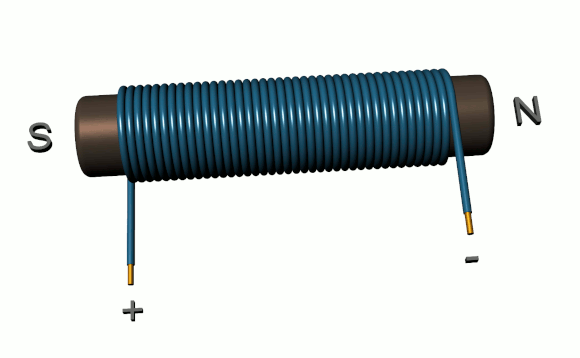
Whenever electrical current flows through your standard copper wire, a weak, circular magnetic field blooms into existence around that wire. By manipulating the shape of the wire, we can focus and multiply this invisible field. If we take our conductive copper wire and wrap it around a core like a spool of thread, the overlapping magnetic fields combine into a unified, powerful directional field.
Through this method, an electromagnet is created by running an electric current through a coiled wire. Unlike permanent magnets found in nature, an electromagnet is entirely under human control. We can turn its magnetism on or off simply by opening or closing the electrical switch. Furthermore, we can easily dictate its sheer power, because the strength of an electromagnet increases with the number of wire coils.
From the transverse waves of light crossing the vacuum of the cosmos, to the engineered loops of copper wire generating magnetic fields in our power plants, the interactions of energy and matter are not a set of disjointed trivia. They are a single, beautifully cohesive system—a system governed by absolute laws, driven by fundamental forces, and entirely comprehensible to the curious mind.