Developing and Supporting a Written Argument
Not sure you’re ready?
Take the ~3-minute readiness diagnostic and see where you stand.
When a high school junior hands you a persuasive essay asserting that the driving age must be raised because "everyone knows teenagers are careless, and if we don't change the laws, society will collapse into a Mad Max wasteland," you are looking at an architectural marvel of structural failure. As an English educator, your task goes far beyond circling grammatical errors in red ink. You are teaching young minds how to build, dismantle, and evaluate the machinery of human thought. To pass the Praxis or your state's certification exam, and more importantly, to teach your students how to navigate a world flooded with misinformation, you must understand exactly how a written argument operates. We do not evaluate texts merely by asking if they sound convincing; we evaluate them by inspecting their structural integrity—we look at the load-bearing columns, the foundational premises, and the precise angles of the logic.
This guide will dismantle the mechanics of argumentation, starting from the ancient bedrock of Aristotelian rhetoric, moving through modern analytical frameworks, and finally diagnosing the logical fallacies that frequently contaminate our reasoning.
Every text has a heartbeat, driven by the author's purpose, which is simply the primary reason the author writes a text. While texts can serve countless nuanced functions, the three most common literary purposes are to persuade, informing, and entertaining an audience.
When an author decides to persuade, they construct an argument. In literature or informational text, an argument is not a screaming match; it consists of a central claim supported by reasons and evidence. At the very top of this structure sits the claim, which is a debatable statement that an author aims to prove or defend.
But how does one build a path to that claim? Human logic typically flows in one of two directions.
Inductive Reasoning
Inductive reasoning moves from specific observations to broader generalizations. Think of this as a detective gathering clues. If a student notices that the school library is locked on Monday, Tuesday, and Wednesday, they might use inductive reasoning to conclude, "The library is closed this week." Inductive reasoning deals in probability, not absolute certainty. It relies heavily on evidence gathering.

To support an inductive claim, an author must rely on a steady supply of factual statements, which are objectively verifiable through observation, measurement, or historical record, rather than mere opinions, which are subjective beliefs or judgments lacking objective verification. Furthermore, the evidence provided must pass two tests:
- It must be relevant evidence, meaning the data or information directly supports the specific claim being made.
- It must be sufficient evidence, meaning the author provides an adequate amount of data to establish a claim's validity. A single locked door does not prove the library is permanently shut down.
Deductive Reasoning
In contrast, deductive reasoning moves from general principles to specific logical conclusions. Instead of building up from clues, it filters down from established truths.
Deduction relies on a premise, which is a foundational proposition used to justify a conclusion in logical reasoning. The classic engine of deductive logic is the syllogism, a deductive reasoning structure comprising a major premise, a minor premise, and a conclusion.
The Syllogism in Action
- Major Premise: All mammals are warm-blooded.
- Minor Premise: A whale is a mammal.
- Conclusion: Therefore, a whale is warm-blooded.
If the premises are true, and the structure is sound, the conclusion must be true. When analyzing an author's argument on your exam, look for their hidden premises. Often, an argument falls apart not because the data is wrong, but because the foundational premise is fundamentally flawed.
Long before modern debate, the ancient Greek philosopher Aristotle originally defined the three rhetorical appeals of ethos, pathos, and logos. These are the primary frequencies on which all persuasion broadcasts.
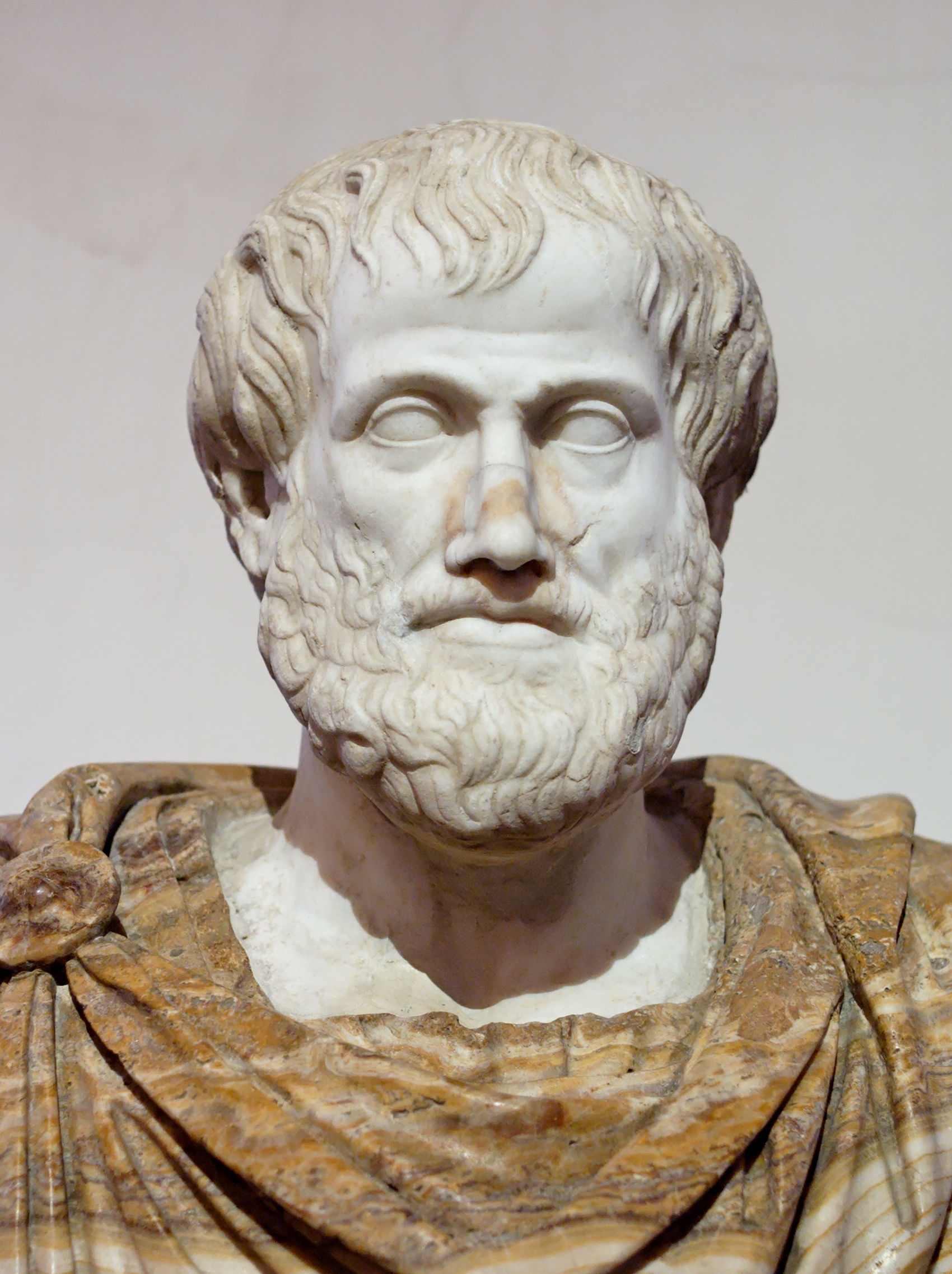
- Ethos is a rhetorical appeal based on the credibility or ethical character of the speaker. When a doctor writes an op-ed about public health, they leverage their medical degree (ethos) to make you trust them.
- Pathos is a rhetorical appeal designed to evoke an emotional response from the audience. This is the ASPCA commercial featuring shivering puppies and melancholic music. It bypasses the brain's logic centers to strike directly at empathy, fear, or joy.
- Logos is a rhetorical appeal based on logical reasoning and objective evidence. This is the realm of charts, statistics, and syllogisms.
While Aristotle gave us the trinity of appeals, later rhetoricians emphasized a fourth, equally critical dimension: Kairos. Kairos is a rhetorical concept referring to the opportune moment for making an argument. An argument about updating hurricane building codes possesses immense kairos the week after a Category 5 storm, but might fall on deaf ears during a quiet winter. It is the "when" that makes the "what" hit home.
While Aristotle explains how we persuade, the British philosopher Stephen Toulmin developed the Toulmin model of argumentation to explain the precise, functional anatomy of why an argument works.
If you want to teach students how to write essays that aren't just a disconnected pile of quotes, you must master this model. The Toulmin model includes six elements of argumentation: claim, data, warrant, backing, counterclaim, and rebuttal.
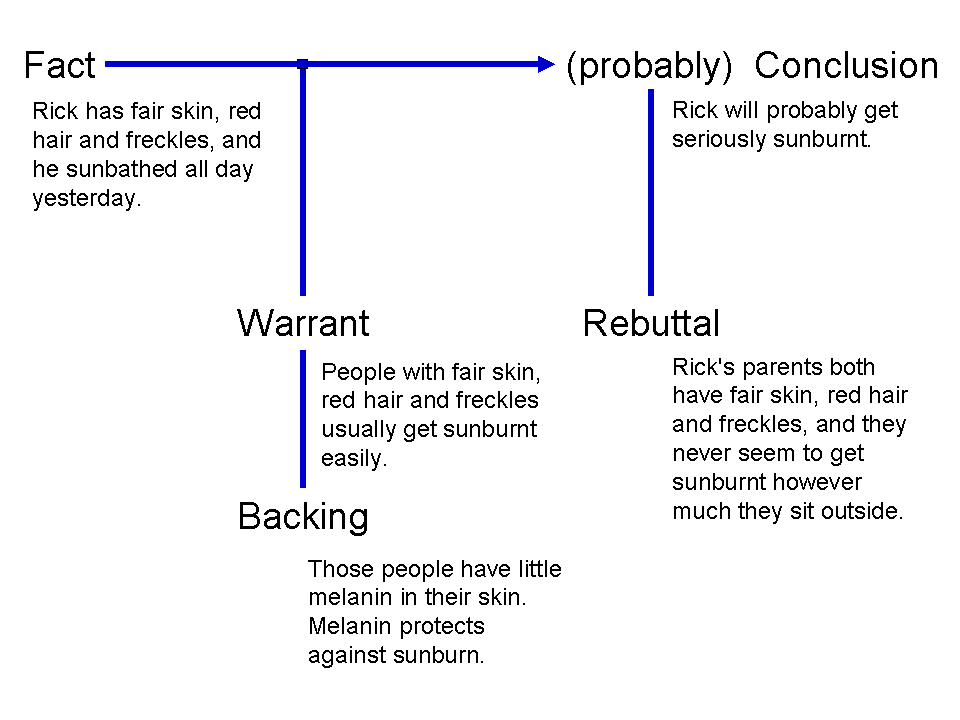
| Element | Definition & Role in the Argument | Classroom Example |
|---|---|---|
| Claim | The debatable statement the author wants to prove. | "Schools should ban smartphones in classrooms." |
| Data | The facts or evidence used to prove the argument. | "Studies show test scores drop 10% when phones are present." |
| Warrant | The underlying assumption connecting an author's claim to the provided evidence. | "Academic performance is a top priority for schools." (If the audience doesn't care about test scores, the data won't support the claim!) |
| Backing | Additional support to establish the reliability of the warrant. | "State funding is tied directly to these standardized test scores." |
| Counterclaim | An acknowledgment of the opposing viewpoint. | "Some argue phones are necessary for emergency communication." |
| Rebuttal | A statement that addresses and refutes an opposing viewpoint. | "However, every classroom is equipped with a landline for emergencies." |
Skilled writers will often employ two additional tools within the Toulmin framework to make their arguments bulletproof:
- Qualifier: A strong argument knows its own limits. A qualifier in an argument places limits on a claim to indicate that the claim is not universally true (e.g., "Schools should generally ban smartphones," rather than "Smartphones are always evil").
- Concession: A concession is an argumentative strategy where an author acknowledges the validity of an opponent's point. Conceding a minor point ("It is true that phones offer great educational apps") dramatically boosts the author's ethos by making them appear reasonable and objective, right before they drop their rebuttal.
A logical fallacy is a flaw in reasoning that undermines the validity of an argument. To an untrained reader, a fallacy often sounds like perfectly good logic, which is exactly what makes it so dangerous. For your exam, you must be able to spot these errors in reading passages and help your future students eradicate them from their writing.
We can categorize these fallacies into four behavioral groups: Distractions, Distortions, Faulty Causation, and Flawed Generalizations.
Group 1: The Distractions (Ignoring the Argument)
These fallacies operate like a magician's sleight of hand. They redirect the audience's attention away from the actual issue.
-
Red Herring: A red herring fallacy occurs when a speaker introduces an irrelevant topic to divert attention from the original issue. (e.g., "You bring up the school budget deficit, but what we really need to focus on is the deteriorating spirit of our football team!")
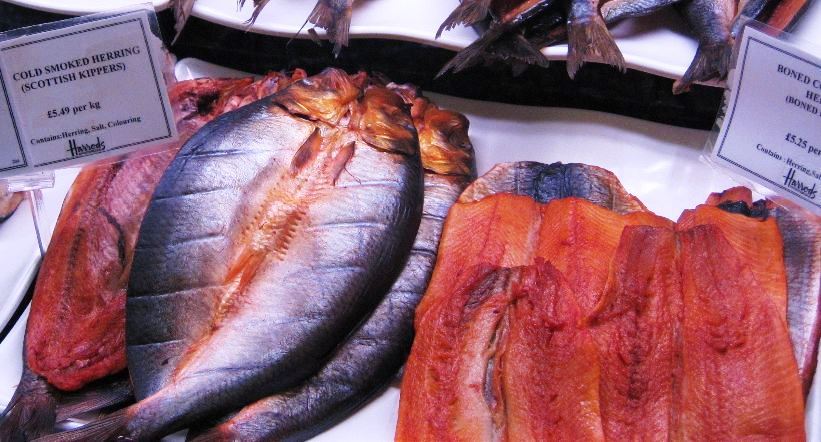
The "red herring" fallacy takes its name from the historical practice of using pungent smoked fish to distract hunting dogs from their target scent. Source: Red herring by misocrazy from New York, NY, CC BY 2.0. -
Ad Hominem: An ad hominem fallacy attacks the character of the person making an argument rather than addressing the argument itself. (e.g., "We shouldn't listen to the senator's tax proposal; he was caught speeding twice last year.")
-
Tu Quoque: The tu quoque fallacy attempts to discredit an opponent's argument by asserting that the opponent has acted inconsistently with the argument. It is the "you too" fallacy. (e.g., A father tells his son smoking is bad for his health, and the son replies, "But you smoked when you were my age!")
-
Appeal to False Authority: An appeal to false authority uses the opinion of a person who lacks expertise in the relevant subject area as evidence. (e.g., A famous actor endorsing a complex pharmaceutical drug).
Group 2: The Distortions (Manipulating the Reality)
These fallacies warp the opponent's argument or the nature of reality to make the author's conclusion seem inevitable.
-
Straw Man: A straw man fallacy involves misrepresenting an opponent's argument to make the opponent's argument easier to attack. (e.g., If someone argues for healthier school lunches, a straw man response would be, "My opponent wants to starve our children by taking away all the food they actually like!")
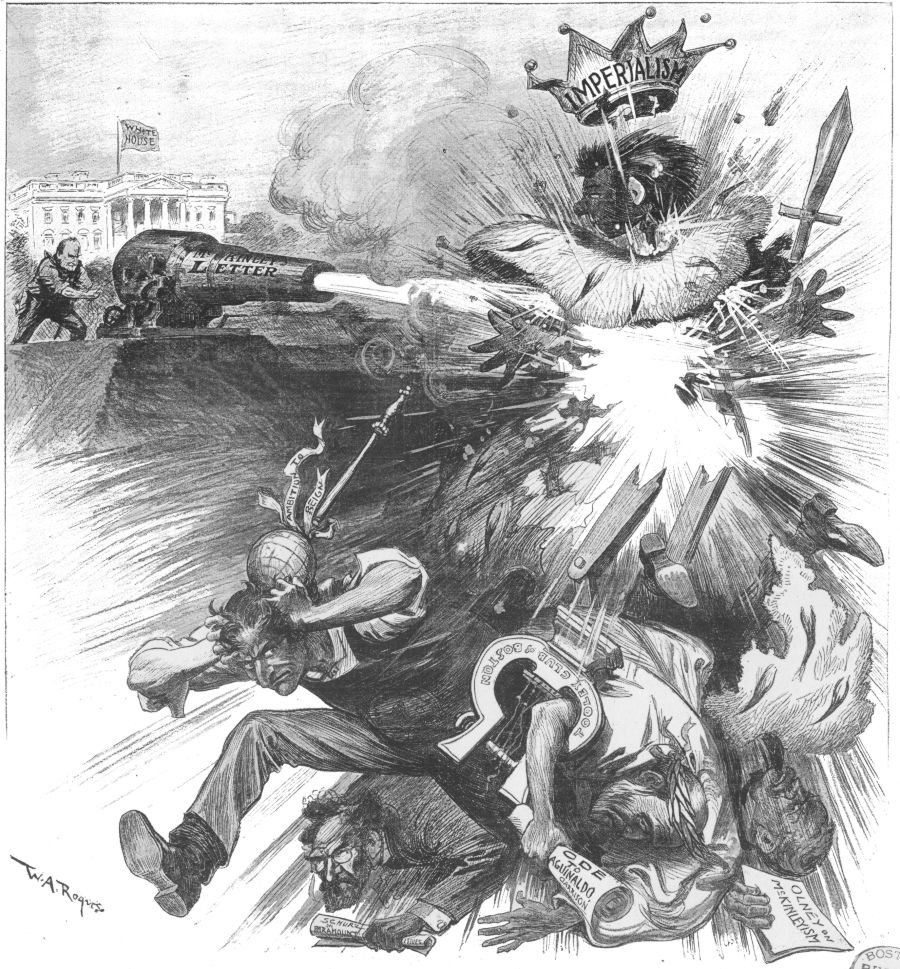
A 1900 political cartoon depicting a literal "straw man," illustrating how rhetoricians construct easily defeated, exaggerated versions of an opponent's argument. -
False Dilemma: A false dilemma fallacy presents only two options when multiple possibilities actually exist. (e.g., "We either ban all standardized testing, or we accept that our students will be mindless robots.")
-
Equivocation: Equivocation involves using an ambiguous term in more than one sense within the same argument. (e.g., "The sign said 'fine for parking here', so since it was fine, I parked there." The word fine shifts from meaning 'a financial penalty' to 'acceptable').
Group 3: Faulty Causation & Logic Leaps
These fallacies break the mechanical chain of cause and effect, forcing a conclusion that the evidence simply cannot bear.
-
Slippery Slope: The slippery slope fallacy asserts that a relatively small first step will inevitably lead to a chain of related negative events. (e.g., "If we let students choose their own reading books, soon they'll choose to read nothing, then they'll stop coming to school, and eventually society will collapse.")
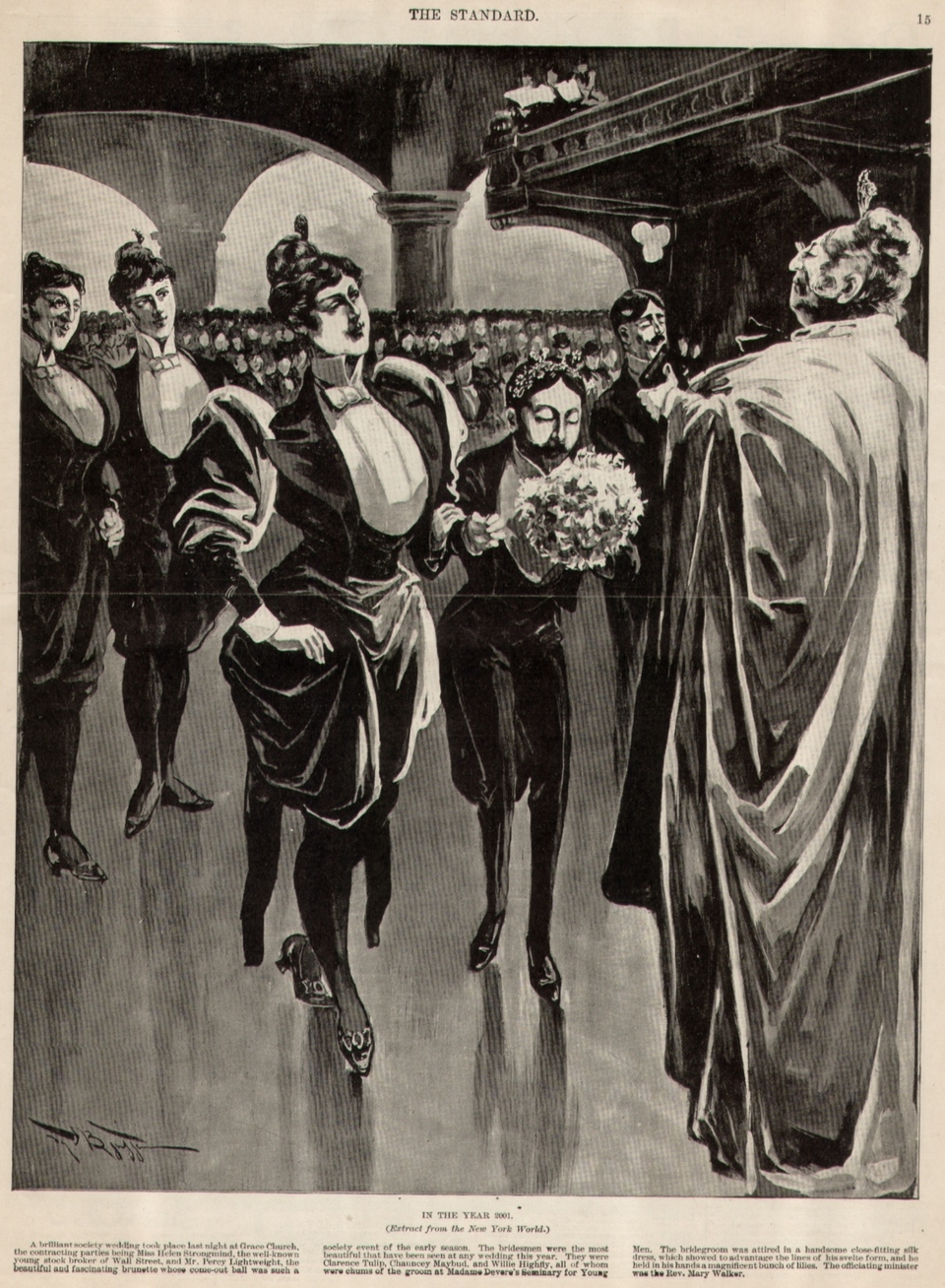
An 1895 cartoon utilizing a slippery-slope argument, baselessly suggesting that granting women the right to vote would inevitably lead to a dystopian reversal of gender roles by 2001. -
Post Hoc Ergo Propter Hoc: Latin for "after this, therefore because of this." The post hoc ergo propter hoc fallacy assumes that the first event caused the second event simply because the first event occurred earlier. (e.g., "I wore my lucky socks, and I aced my exam. Therefore, the socks made me smarter.")
-
Non Sequitur: Latin for "it does not follow." A non sequitur is a conclusion or statement that does not logically follow from the previous argument or statement. (e.g., "I love reading Shakespeare, so I should definitely buy a new car.")
-
False Analogy: The false analogy fallacy assumes that two things alike in one respect are alike in another unrelated respect. (e.g., "People who have to have a cup of coffee every morning to function have no less a problem than alcoholics who have to have their alcohol each day to sustain them.")
Group 4: Flawed Generalizations & Circularities
These fallacies occur when an author fails to handle the scope of their inductive or deductive reasoning properly.
-
Hasty Generalization: A hasty generalization fallacy draws a broad conclusion from a small or unrepresentative sample size. (e.g., "I met two people from New York and they were both rude; therefore, all New Yorkers are rude.")
-
Sweeping Generalization: A sweeping generalization fallacy applies a general rule to a specific case where the general rule does not actually apply. It is the reverse of the hasty generalization. (e.g., "Exercise is good for everyone. Therefore, a patient recovering from a massive heart attack should run a marathon today.")
-
Bandwagon: The bandwagon fallacy argues that a claim must be true because many people believe the claim. (e.g., "Millions of people believe in astrology, so the alignment of the stars must affect our personalities.")
-
Begging the Question: Begging the question occurs when an argument's premises assume the truth of the conclusion. The argument circles back on itself without ever providing actual proof.
-
Circular Reasoning: It is vital to know that circular reasoning is another term for the begging the question fallacy. (e.g., "The new dress code is unjust because it is unfair." Unjust and unfair mean the same thing; the claim is being used as its own evidence).
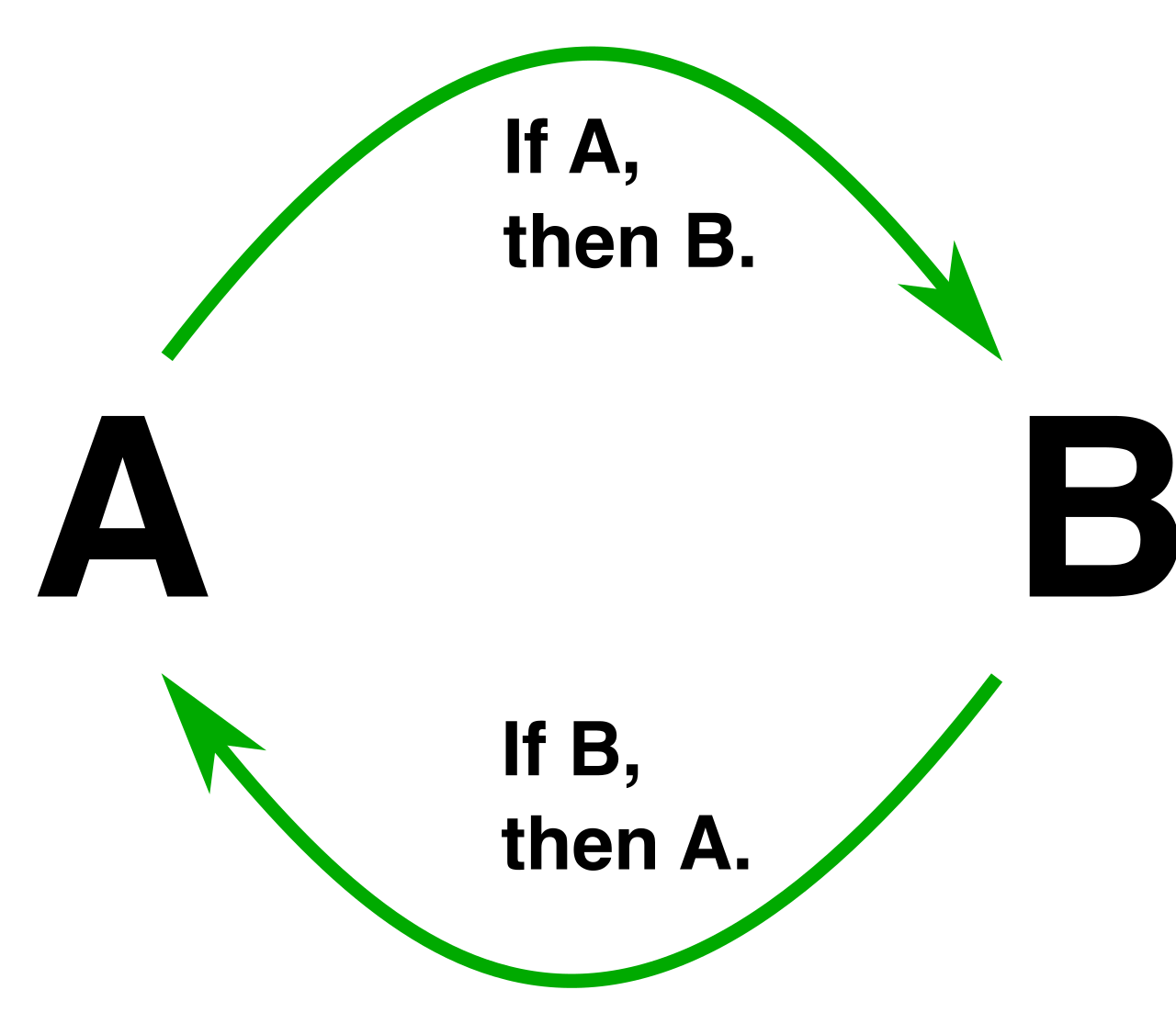
In circular reasoning, the premise and the conclusion simply restate each other, creating a closed loop of logic that provides no actual proof. Source: Circular reasoning by Michel Bakni, CC BY-SA 4.0.
When you step into your classroom, you are the custodian of your students' intellectual development. The ELA Content Knowledge exam tests these concepts not to torture you with Latin phrases, but to ensure you can look at a piece of rhetoric—whether it's an impassioned political speech, a dense historical document, or a 16-year-old's plea for less homework—and understand precisely how its gears are turning.
By mastering the transition from premise to conclusion, by uncovering the hidden warrants that bridge data to claims, and by relentlessly hunting down logical fallacies, you prepare yourself to be more than just a teacher of literature. You become a teacher of profound, bulletproof thought.