Analyzing Literary Elements
Not sure you’re ready?
Take the ~3-minute readiness diagnostic and see where you stand.
A literary text is not a spontaneously occurring phenomenon; it is a meticulously engineered mechanism. When a middle school student reads a novel, they experience the output—suspense, heartbreak, triumph—but they rarely perceive the gears turning beneath the surface. As an English language arts educator, your task is to teach them how to dismantle the engine. You are training them to see how an author manipulates characterization, curates setting, and orchestrates plot to manufacture meaning. Understanding these literary elements is not merely an exercise in vocabulary; it is the rigorous study of human empathy and narrative architecture. To master the Praxis 5047 exam, you must understand not just the definitions of these tools, but the mechanics of their interaction.
Every narrative is filtered through a specific lens. Point of view defines the perspective from which a story is narrated. The choice of lens governs what information is available to the reader, thereby controlling the text's psychological distance and emotional impact.
Navigating Narrative Lenses
The pronouns an author uses are the most immediate indicators of perspective, but the true impact lies in the boundaries of knowledge those pronouns establish.
- First-Person Point of View: First-person point of view uses pronouns like "I" and "we". Crucially, first-person narration limits the reader's knowledge to the narrator's specific experiences and thoughts. We only see what they see; we only know what they know.
- Third-Person Limited: Third-person limited point of view restricts the narrative perspective to the thoughts and feelings of a single character. The camera sits on one character's shoulder, using pronouns like "he," "she," or "they," providing intimate insight into that specific individual while keeping the rest of the world opaque.
- Third-Person Omniscient: Third-person omniscient point of view provides the narrator with complete knowledge of the thoughts and feelings of all characters. The narrator possesses a god-like vantage point, capable of diving into the minds of any character at any time.
- Third-Person Objective: Third-person objective point of view describes events without revealing any character's internal thoughts or feelings. The narrator acts as a fly on the wall or an impassive recording device, forcing the reader to deduce internal states entirely from external actions and dialogue.

Truth, Trust, and Irony
Narrative perspective is not always reliable. An unreliable narrator provides a perspective that compromises the objective truth of the narrative. This might be due to youth, mental instability, bias, or deliberate deceit. Pedagogically, this is a vital concept: unreliable narrators force readers to question the accuracy of the events being described, transforming the reading experience from passive reception into active investigation.
Alternatively, an author might splinter the narrative entirely. Multiple points of view in a text allow the author to present conflicting perspectives on a single event. This technique teaches students that "truth" in literature is often subjective and dependent on who is telling the story.
When the author bypasses the narrator's limitations and gives the reader a superior vantage point, we encounter irony.
Dramatic irony occurs when the reader knows crucial information that a character does not know.
These differences between a character's knowledge and the reader's knowledge create dramatic irony. Think of a horror story where the reader knows the monster is hiding in the closet, but the protagonist is blithely walking toward the door. Why use this? Dramatic irony builds suspense within a narrative. The tension arises from the reader's helpless anticipation of the character discovering the truth.
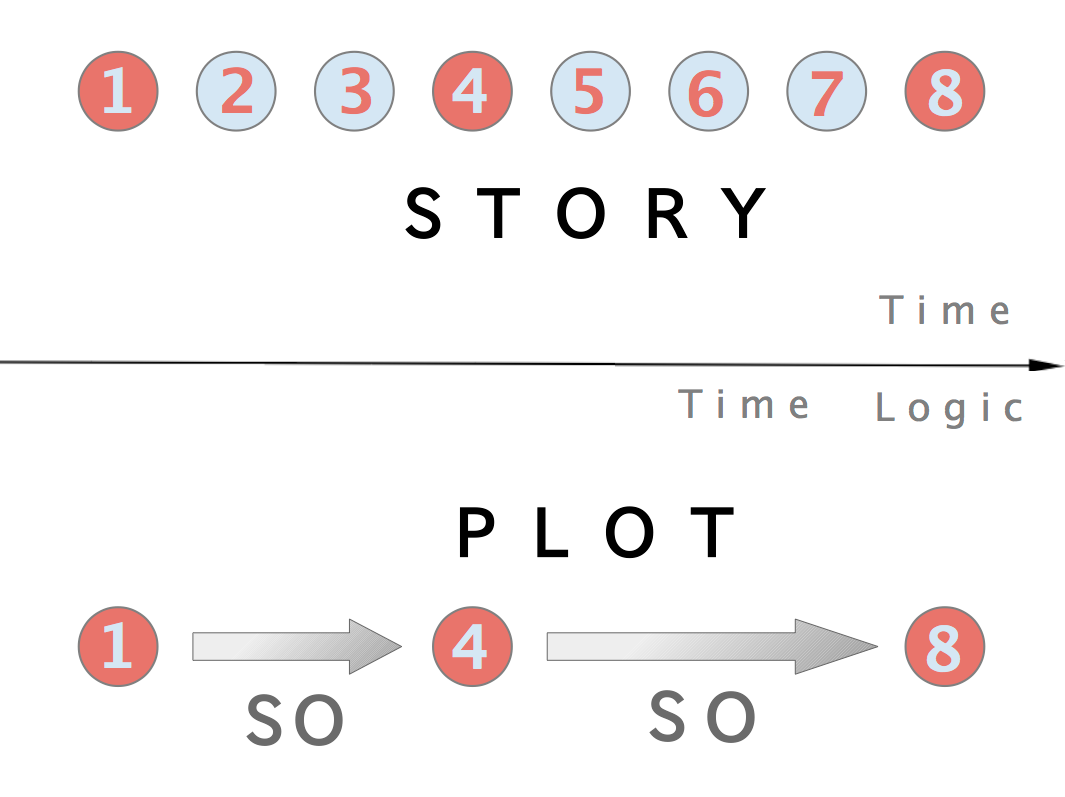
If point of view is the lens, plot is the engine. Plot structure organizes the sequence of events within a narrative. It is the chronological and causal framework that gives a story its forward momentum.
The Linear Progression of Conflict
Most traditional narratives follow a distinct, escalating trajectory, often visualized as Freytag's Pyramid.
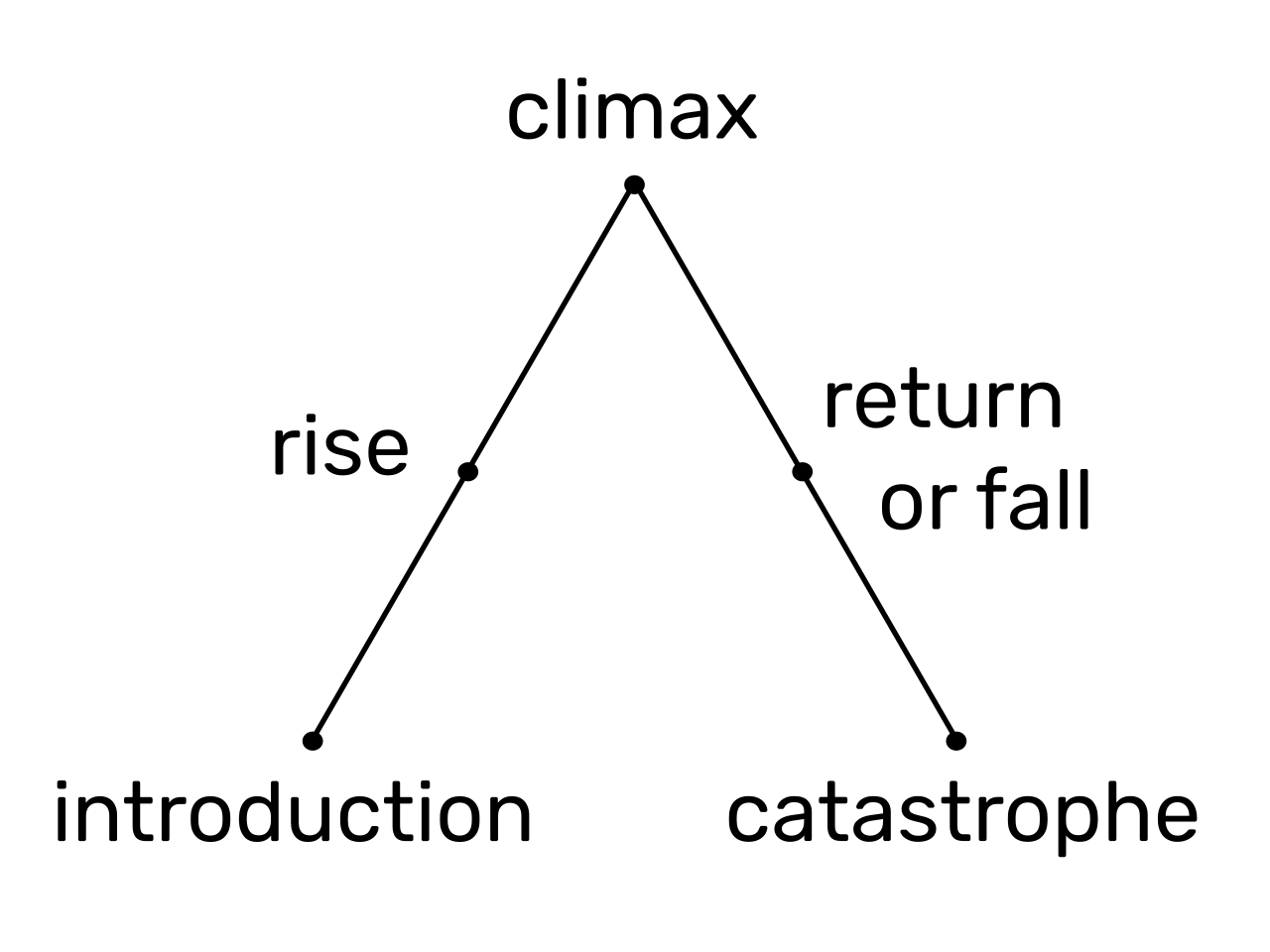
- Exposition: The exposition introduces the characters, setting, and basic situation of a story. It is the baseline reality before the disruption occurs.
- Inciting Incident: The inciting incident is the specific event that introduces the central conflict of the story. It is the spark that ignites the engine, making a return to the initial exposition impossible.
- Rising Action: Rising action consists of a series of events that build tension and develop the conflict. This is the bulk of the narrative, where complications arise and stakes increase.
- Climax: The climax is the point of highest tension or turning point in a narrative. It is the crucible where the central conflict must finally be confronted directly.
- Falling Action: Falling action encompasses the events that occur after the climax and lead toward the resolution. The dust begins to settle, and the immediate consequences of the climax are revealed.
- Resolution / Denouement: The resolution concludes the narrative and resolves the central conflict. It establishes a new normal. Note that the term denouement is a literary synonym for the resolution of a narrative, often explicitly referring to the final tying up of loose ends.
Nonlinear Manipulations of Time
Authors frequently break linear chronology to manipulate pacing and information delivery.
- Flashback: A flashback is a narrative device that interrupts chronological order to present a past occurrence. This is not mere nostalgia; flashbacks provide background information about characters or events, granting necessary context that explains present motivations.
- Foreshadowing: Foreshadowing involves the use of clues to hint at events that will occur later in the plot. Subconsciously, foreshadowing creates anticipation and prepares the reader for future plot developments, making the eventual climax feel both surprising and inevitable.
- In Medias Res: In medias res is a Latin phrase meaning "in the midst of things." The in medias res narrative technique drops the reader directly into the middle of the action. Instead of starting with the exposition, the author begins in the rising action, forcing the reader to catch up and immediately engaging their attention.
Far too often, novice readers view setting as a static painted backdrop. In reality, setting encompasses the time, geographical location, and social environment of a narrative. It is a dynamic force that shapes everything else in the text.
The Psychological Impact of Place
Setting dictates the emotional resonance of a text. It is crucial to distinguish between two frequently confused terms: mood and tone.
- Mood: Mood is the emotional atmosphere that a text creates for the reader. It is how the text makes the audience feel. Setting directly influences the mood of a literary text. Through sensory language, an author's choice of descriptive details about the setting establishes the mood. A dark, rain-swept castle evokes a radically different mood than a sunlit, bustling bazaar.
- Tone: Tone represents the author's attitude toward the subject matter or audience. It is the voice behind the camera. Setting reflects the author's tone through specific word choices and imagery. An author describing a high school cafeteria with words like "cacophony," "prison," and "slop" is utilizing setting to establish a deeply cynical tone.
Beyond physical space, we must consider the temporal reality of the characters. Historical context is an element of setting that shapes character motivations and social rules. A character's decision to rebel or conform cannot be analyzed without understanding the era in which they exist.
Setting as an Active Participant
Setting does not merely host the conflict; it can be the conflict. Setting can act as an antagonistic force in a narrative.
- Man versus Nature: A "man versus nature" conflict occurs when characters struggle against elements of their physical environment. Survival stories like Gary Paulsen’s Hatchet rely entirely on the setting as the primary antagonist.
- Man versus Society: A "man versus society" conflict involves a character opposing the cultural or social norms of their setting. In dystopian literature like Lois Lowry’s The Giver, the societal rules of the setting are the very thing the protagonist must overcome.
When the environment is weaponized against the protagonist, the narrative accelerates. A hostile setting increases the stakes of the central conflict, forcing characters to the limits of their endurance and revealing their true nature.
Characters are the vehicles through which readers experience a plot. Characterization is the process by which an author reveals the personality of a character.
Explicit vs. Implicit Revelation
Authors have two primary methods for constructing the illusion of human personality:
- Direct Characterization: Direct characterization occurs when the author explicitly states a character's traits to the reader. (e.g., "Mr. Darcy was a proud and arrogant man.") It is efficient but requires the reader to simply take the author's word for it.
- Indirect Characterization: Indirect characterization requires the reader to infer a character's traits through their behaviors and interactions. This mimics how we understand people in the real world—by watching them and drawing conclusions.
To help middle schoolers analyze indirect characterization systematically, educators rely on a powerful heuristic:
The acronym STEAL stands for Speech, Thoughts, Effect on others, Actions, and Looks. The STEAL acronym is a mnemonic tool used to analyze indirect characterization.
When applying STEAL, we look closely at how a character manifests in the physical world. For example, a character's dialogue provides indirect insight into their background, education, and emotional state. Similarly, a character's physical actions indirectly demonstrate their internal values and motivations. A character who quietly pockets a dropped wallet is indirectly characterized as dishonest, without the author ever having to use the word.
The Dimensions of Character
Characters can be categorized by how much they change and how deeply they are drawn.
| Classification | Definition | Application |
|---|---|---|
| Dynamic | Dynamic characters undergo significant internal changes throughout the course of a narrative. | They learn, grow, or regress due to the central conflict. |
| Static | Static characters remain fundamentally unchanged from the beginning to the end of a story. | Often serve as reliable anchors or unyielding obstacles in the plot. |
| Round | Round characters are psychologically complex and possess multiple distinct personality traits. | They feel like real people, capable of contradiction and nuance. |
| Flat | Flat characters are one-dimensional and embody a single prominent trait. | They are often functional, serving a specific narrative purpose without deep psychological exploration. |
Finally, authors often pair characters strategically to control how the reader perceives them. A foil is a character whose traits contrast with those of the protagonist to highlight specific qualities of the protagonist. If an author wants to emphasize a hero's profound courage, they will place a cowardly foil right next to them. The contrast brightens the hero's virtues.

Synthesis for the ELA Educator
When analyzing literature, middle school students often try to isolate these concepts—studying setting on Tuesday and characterization on Wednesday. Your role as an elite educator, and your goal for the Praxis 5047, is to recognize the interplay. The setting creates the hostile environment that acts as the inciting incident of the plot, forcing the dynamic character into actions that provide indirect characterization, all while the first-person point of view limits our knowledge to build suspense.
Literature is an interconnected system. Teach your students how to read the blueprints, and they will never look at a story the same way again.