US Constitution and Federalism
Not sure you’re ready?
Take the ~3-minute readiness diagnostic and see where you stand.
The United States Constitution is not a peace treaty; it is a blueprint for engineered friction. It deliberately divides, overlaps, and pits centers of power against one another. This mechanical tension is not a design flaw—it is the fundamental architecture of American liberty. For the aspiring social studies educator, mastering this framework is not merely an exercise in memorizing clauses and court dates. It is about understanding how political gravity operates in the United States. To teach civics effectively, you must show students that the government is not a monolith, but a dynamic, often argumentative relationship between the national authority, sovereign states, and competing branches of power.
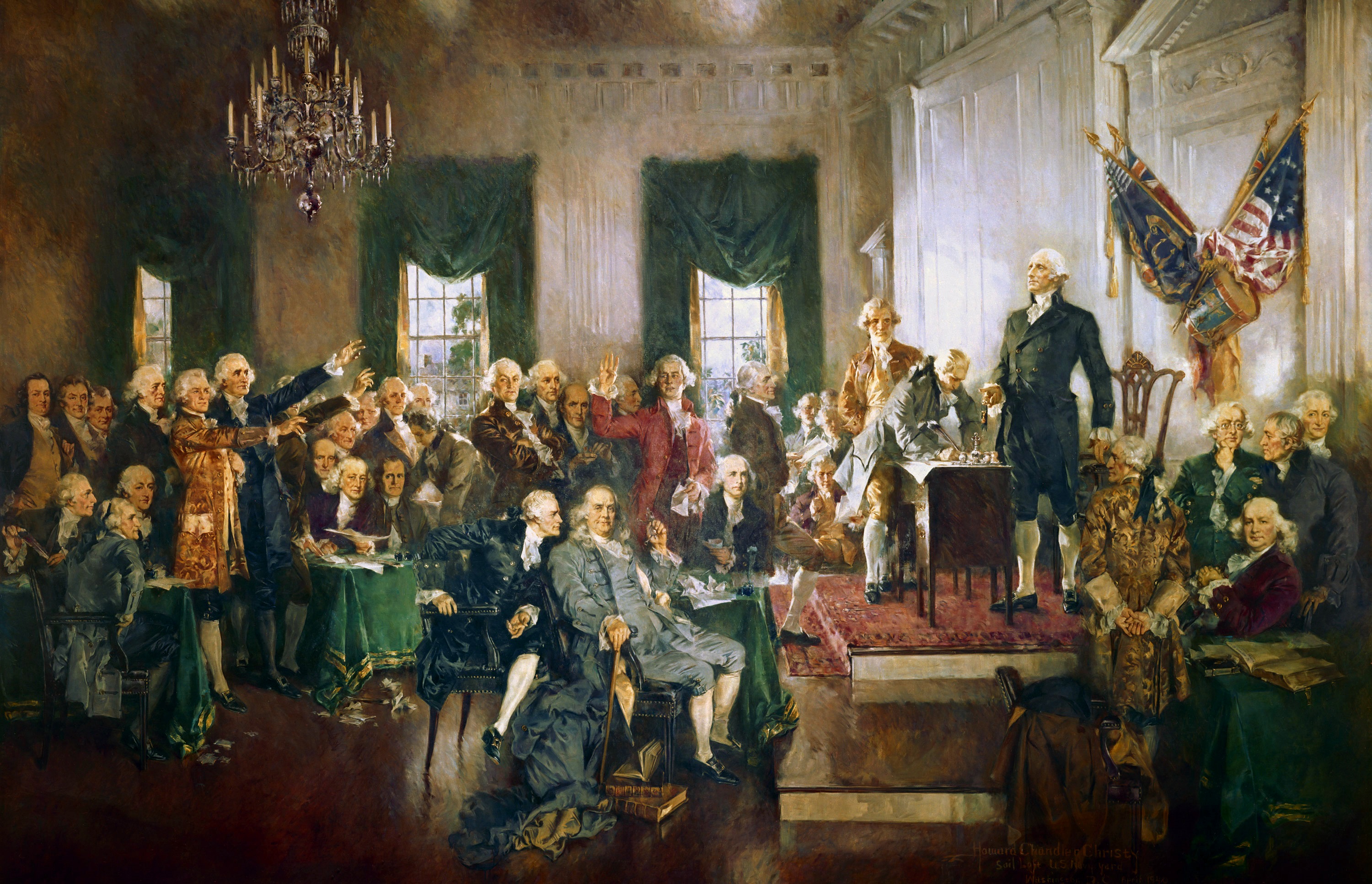
Here is the definitive guide to the constitutional underpinnings and the mechanics of American federalism.
Federalism is a system of government dividing power between a central national government and regional state governments. The United States Constitution establishes federalism by delegating specific powers to the national government while preserving localized authority.
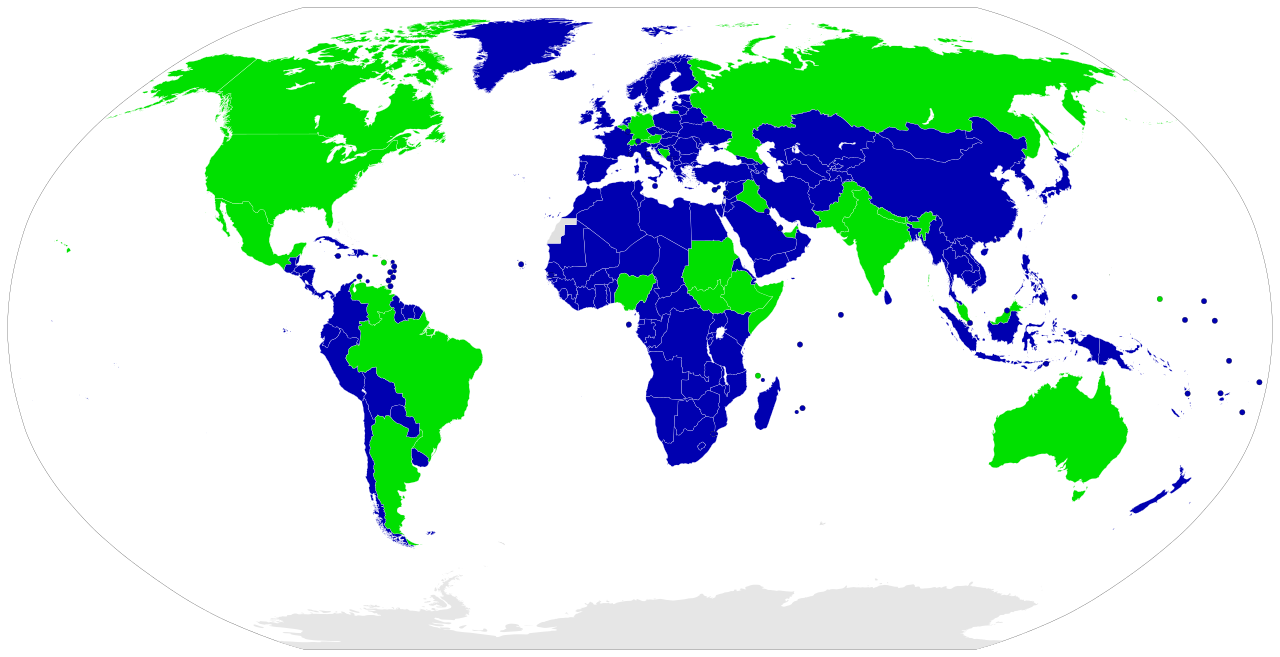
To help students conceptualize this, think of governmental power as an ecosystem. Different organisms have different biological jurisdictions. In our system, these jurisdictions fall into five distinct categories:
| Type of Power | Definition | Constitutional Basis | Real-World Examples |
|---|---|---|---|
| Enumerated Powers | Government powers specifically listed in the United States Constitution. | Article I, Section 8 contains the enumerated powers of the United States Congress. | The power to coin money; the power to declare war. |
| Implied Powers | National government powers not explicitly listed in the Constitution, but logically necessary to function. | The Necessary and Proper Clause (also known as the Elastic Clause) allows Congress to exercise implied powers necessary to execute enumerated congressional powers. | Creating a national bank; establishing the IRS to collect taxes. |
| Inherent Powers | Powers assumed by the national government simply because the national government exists as a sovereign state on the world stage. | Rooted in the very definition of national sovereignty. | The power to regulate immigration; acquiring new territory. |
| Reserved Powers | Government powers retained by the states rather than delegated to the national government. | The Tenth Amendment to the United States Constitution establishes the principle of reserved powers for the states. | The power to regulate intrastate commerce (trade entirely within one state's borders); establishing schools. |
| Concurrent Powers | Government powers shared by both the national government and state governments. | Areas where both entities must operate simultaneously to survive. | The power to levy taxes (you pay both state and federal income tax); the power to establish courts. |
When state and federal powers collide, or when states interact with one another, the Constitution provides a strict set of operating rules.
Vertical Rules (Federal vs. State)
The Supremacy Clause Located in Article VI of the United States Constitution, this clause establishes that the United States Constitution is the supreme law of the land.
Crucially, the Supremacy Clause dictates that federal laws take precedence over state laws in cases of conflict. If a state passes a law directly violating a federal statute or constitutional provision, the federal law wins.
Horizontal Rules (State vs. State)
If you get married in New York, you do not have to remarry when you move to Texas. If you crash your car in Ohio, you cannot simply flee to Michigan to escape the lawsuit. Why? The Constitution mandates a cooperative interstate network:
- The Full Faith and Credit Clause: Located in Article IV of the United States Constitution, this requires states to recognize the public acts and judicial proceedings of every other state.
- The Privileges and Immunities Clause: This prevents a state from treating citizens of other states in a discriminatory manner. (A Californian visiting Nevada pays the same sales tax as a local).
- The Extradition Clause: This requires states to return a fleeing criminal suspect to the state where the crime was committed, preventing states from becoming safe havens for fugitives.
Federalism has not looked the same across U.S. history. We can track its evolution through distinct operational eras:
Dual federalism characterized the early republic. This is a political arrangement strictly dividing power between the federal government and state governments. Think of it as a "layer cake"—the federal government does its job (e.g., foreign policy), the state does its job (e.g., local policing), and the layers do not mix.
Following the Great Depression, the system shifted toward cooperative federalism, a system featuring collaboration between federal and state governments to solve societal problems. This is the "marble cake." The federal government doesn't just issue commands; it partners with states. Cooperative federalism often involves the federal government providing grants-in-aid to state governments to fund infrastructure, education, and social programs.

The Power of the Purse
How the federal government funds the states dictates the balance of power:
- Categorical grants are federal funds provided to states for highly specific purposes with strict conditions attached. (e.g., "Here is $50 million, but you must spend it entirely on reinforcing highway bridges to federal safety codes.")
- Block grants are federal funds provided to states for broad purposes with fewer restrictions on the expenditure of the funds. (e.g., "Here is $50 million for transportation infrastructure; you decide where it is needed most.")
In the late 20th century, a conservative pushback emerged against federal overreach. New Federalism is a political philosophy championing devolution—the transfer of certain powers and responsibilities from the federal government back to the state governments—primarily through the use of block grants.
However, states often suffer from unfunded mandates, which are federal regulations requiring state or local governments to perform actions without receiving federal funding. (e.g., A federal law mandating that all local transit systems be universally accessible, but providing zero dollars to the cities to build the ramps and elevators).
The boundaries of federalism are constantly tested in court. To understand the Constitution, you must understand the landmark decisions that have interpreted it.
Establishing the Umpire's Authority
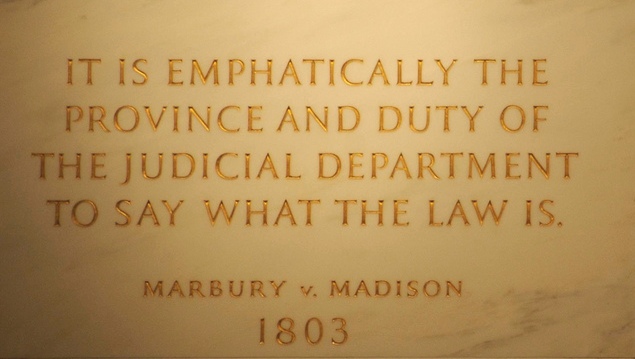
- Marbury v. Madison (1803): This is the bedrock of American constitutional law. Decided in 1803, Marbury v. Madison established the principle of judicial review in the United States. Judicial review is the power of the federal courts to declare legislative and executive acts unconstitutional. Without this case, the Supreme Court would have no teeth.
Expanding Federal Power
- McCulloch v. Maryland (1819): When the state of Maryland tried to tax the Second Bank of the United States, the Court stepped in. Decided in 1819, this case affirmed the constitutionality of implied powers through the Necessary and Proper Clause. Furthermore, McCulloch v. Maryland established that a state government cannot tax a legitimate agency of the federal government ("the power to tax involves the power to destroy").
- Gibbons v. Ogden (1824): This dispute over steamboat monopolies established that the federal government possesses the exclusive power to regulate interstate commerce. The decision hinged on the Commerce Clause, which grants the United States Congress the power to regulate trade among the several states.
Constraining Federal Power
For over a century, the Commerce Clause was used to justify massive expansions of federal authority. In the 1990s, the Court pushed back, marking a victory for devolution.
- United States v. Lopez (1995): A high school student carried a concealed weapon into his school, violating the federal Gun-Free School Zones Act. The Supreme Court struck down the federal Gun-Free School Zones Act, ruling that carrying a gun in a local school zone is not an economic activity. United States v. Lopez severely limited the power of the federal government under the Commerce Clause.
- Printz v. United States (1997): Dealing with the Brady Handgun Violence Prevention Act, Printz v. United States ruled that the federal government cannot compel state officials to enforce federal regulatory programs. This affirmed state sovereignty against federal commandeering.
While federalism divides power geographically between the nation and the states, the internal architecture of the federal government relies on dividing power functionally.
The separation of powers is a constitutional principle dividing government authority into legislative, executive, and judicial branches.
- Article I of the United States Constitution establishes the legislative branch (Congress).
- Article II of the United States Constitution establishes the executive branch (The Presidency).
- Article III of the United States Constitution establishes the judicial branch (The Federal Courts).
James Madison authored Federalist No. 51, an essay that brilliantly explains the necessity of the separation of powers in the United States Constitution. Madison understood human nature; he knew that people in power will invariably try to seize more power. His solution? "Ambition must be made to counteract ambition."
This counteraction is achieved through checks and balances, a constitutional mechanism allowing each government branch to limit the powers of the other branches.
Mechanisms of Tension
Here is how the branches keep one another in check:
- Veto Power: The President of the United States holds the power to veto legislation passed by Congress.
- Veto Override: Congress can override a presidential veto with a two-thirds majority vote in both the House of Representatives and the Senate.
- Appointments and Treaties: The President nominates judges and negotiates with foreign powers, but the United States Senate holds the power to confirm presidential appointments to the federal judiciary, and the United States Senate holds the power to ratify treaties negotiated by the executive branch.
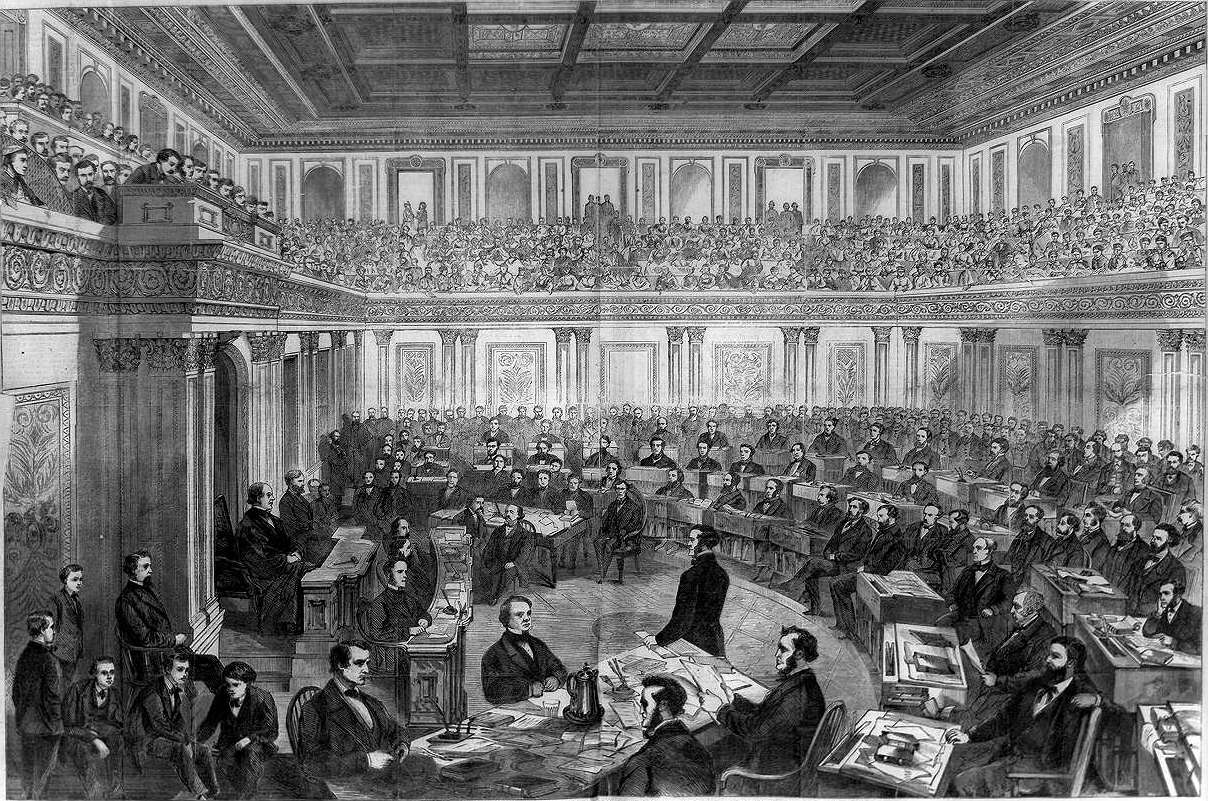
- Impeachment: The United States House of Representatives holds the sole power to impeach (formally accuse) federal officials. However, the United States Senate holds the sole power to conduct impeachment trials and actually remove the official.
- Clemency: The President of the United States holds the power to grant pardons for federal crimes, serving as a check on the judicial branch.
Finally, there are certain acts that the Constitution deems so tyrannical that it denies them to the government outright. These foundational civil liberty protections represent an absolute limit on state and federal authority.
- Bill of Attainder: A bill of attainder is a legislative act declaring a person guilty of a crime without a trial. The United States Constitution explicitly prohibits Congress from passing bills of attainder. (Congress cannot simply pass a law declaring "John Doe is guilty of treason and must go to prison").
- Ex Post Facto Law: An ex post facto law is a law criminalizing an act that was legal when the act was originally committed. The United States Constitution explicitly prohibits Congress from passing ex post facto laws.
- Habeas Corpus: Habeas corpus is a legal recourse requiring a person under arrest to be brought before a judge or into court to determine if their detention is lawful. The United States Constitution protects the privilege of the writ of habeas corpus from suspension outside of rebellion or invasion. You cannot be thrown into a dungeon and forgotten.

As an educator, showing your students how these individual protections operate within the larger machinery of federalism and separated powers is the key to unlocking civics. The Constitution is a masterclass in human psychology—designing a system strong enough to govern, but divided enough to prevent tyranny.