US National Institutions
Not sure you’re ready?
Take the ~3-minute readiness diagnostic and see where you stand.
A machine designed to operate efficiently is a marvel of engineering. A machine intentionally designed to grind, stall, and clash against itself is the United States Constitution. When your future high school students observe the federal government and complain that it is slow, argumentative, and frustratingly complex, your most critical pedagogical task is to help them understand that this is not a malfunction. It is the blueprint.
The framers of the Constitution lived in terror of concentrated power, having just waged a revolution against a monarchy. To prevent any single faction or individual from acting too swiftly, they shattered the authority of the state into three distinct, competing branches: legislative, executive, and judicial. To understand U.S. National Institutions for the Praxis 5081 exam—and to teach them effectively—you must approach these branches not as isolated lists of powers, but as a dynamic ecosystem of overlapping jurisdictions and calculated friction.
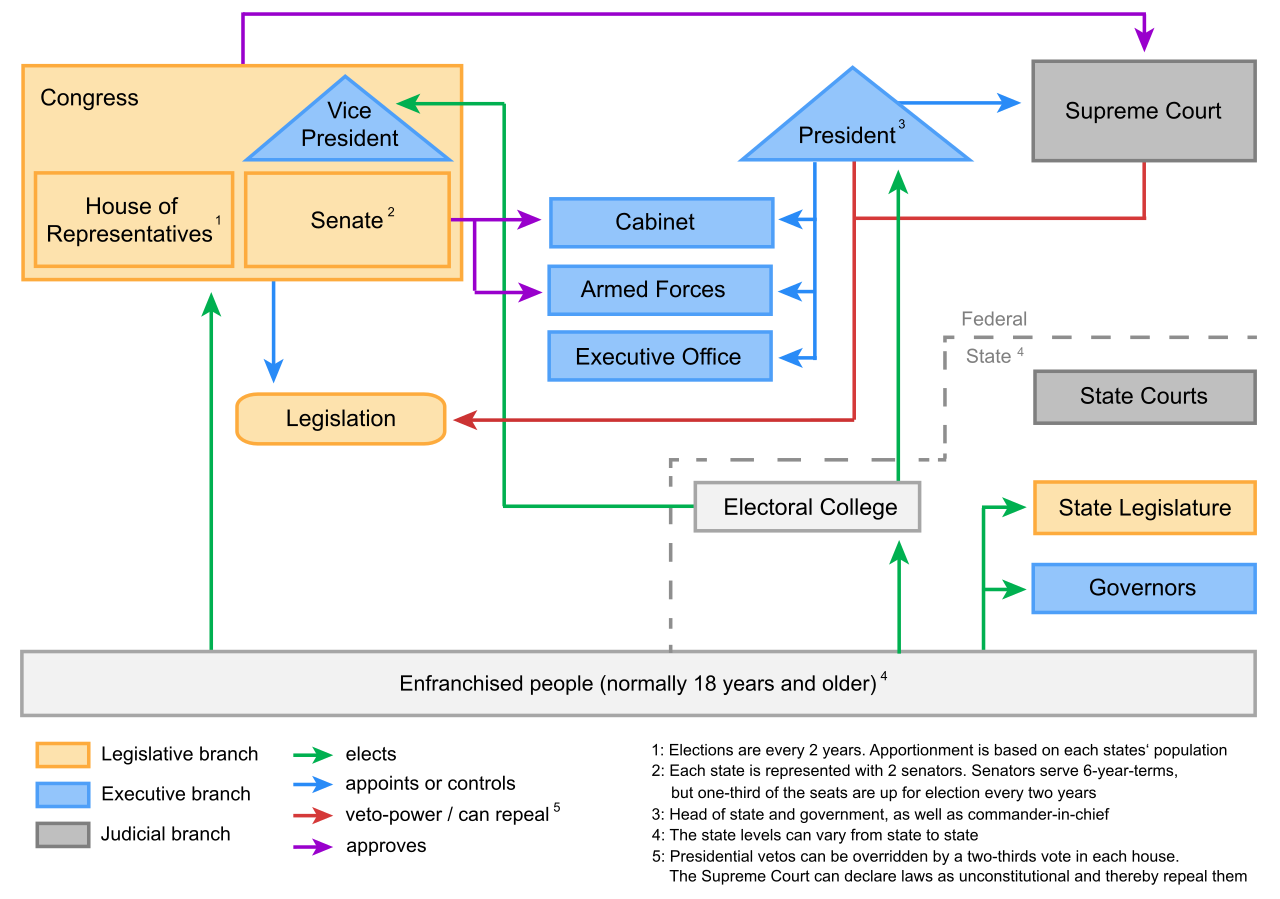
The framers believed that the legislature should be the preeminent branch of government, as it is closest to the citizenry. However, they feared the tyranny of the majority. Their solution was the Great Compromise, which forged a bicameral legislature consisting of the House of Representatives and the Senate. This two-chamber system guarantees that any legislation must survive distinct institutional environments before becoming law.
House vs. Senate: Thermometer and Thermostat
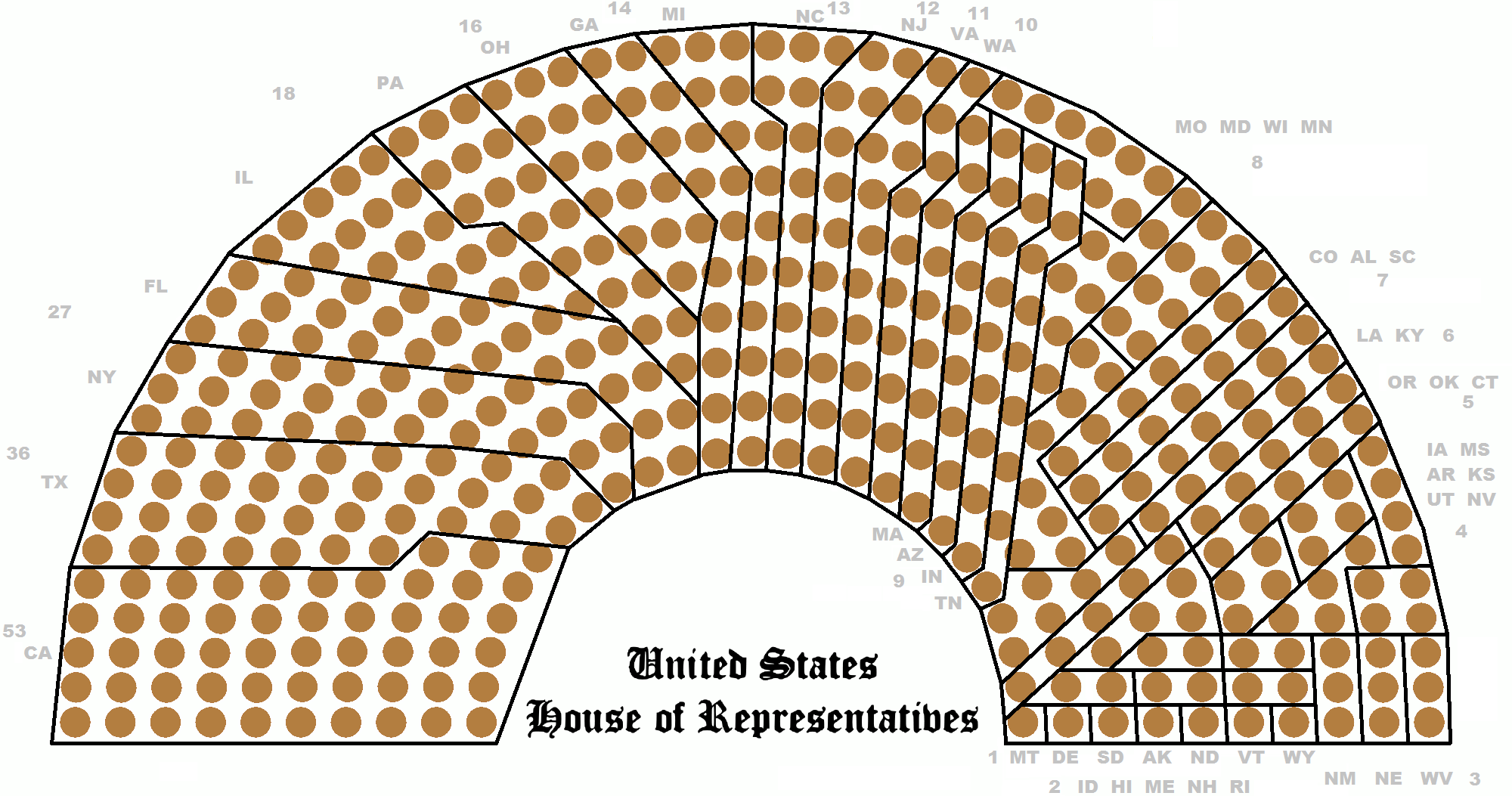
The two chambers are engineered with fundamentally different political metabolisms. The framers designed the House of Representatives to be highly responsive to the immediate will of the people. It acts as the government's thermometer, reading the day-to-day heat of public opinion. In contrast, the framers designed the Senate to be a deliberative body insulated from short-term public passions—a thermostat meant to cool the legislative process.
| Feature | House of Representatives | United States Senate |
|---|---|---|
| Membership | 435 voting members | 100 voting members |
| Apportionment | Determined by the state's population | Exactly two senators per state |
| Term Length | Two-year terms (perpetual campaign cycle) | Six-year terms (staggered elections) |
| Culture | Majoritarian, fast-acting, rule-bound | Individualistic, slow, deliberative |
Leadership and the Committee System
The massive size of the House requires strict hierarchy. The Speaker of the House is the presiding officer of the United States House of Representatives and holds immense control over the chamber’s agenda. Because of the weight of this office, the Speaker of the House is second in the United States presidential line of succession, immediately following the Vice President.
The Senate’s leadership structure is inherently different. Constitutionally, the Vice President of the United States serves as the official President of the Senate, though they rarely preside over daily debates. Their primary legislative power is realized only when the chamber is deadlocked, as the Vice President of the United States casts the tie-breaking vote in the Senate.
Because neither chamber can vote on every issue as a whole, Congress utilizes a system of specialized committees. Within this structure, congressional committee chairs wield significant power over the scheduling and advancement of the legislative agenda, essentially acting as gatekeepers. When a bill miraculously survives both chambers, it rarely emerges with identical text. At this stage, conference committees are formed to resolve textual differences between House and Senate versions of a specific bill before it can be sent to the President's desk.
The Allocation of Exclusive Powers
While both chambers must pass legislation, the Constitution grants exclusive powers to each to maintain balance.
The House's Exclusive Powers: Because the House is the most direct voice of the people, the power to tax and spend is anchored there. All bills for raising revenue must originate in the House of Representatives. Furthermore, as the chamber closest to the voters, the House of Representatives has the sole constitutional power to impeach federal officials, serving effectively as a grand jury bringing formal charges.
The Senate's Exclusive Powers: The Senate serves as the ultimate jury and the President's advisory council.
- The United States Senate has the sole constitutional power to conduct impeachment trials. To ensure a removal is not purely partisan, a two-thirds vote in the Senate is required to convict a federal official in an impeachment trial.
- In matters of foreign policy, the United States Senate has the exclusive power to approve treaties negotiated by the executive branch, and ratification of an international treaty requires a two-thirds vote.
- Finally, the United States Senate has the exclusive power to confirm presidential appointments to the cabinet and federal courts, acting as a check on executive administration.
Procedural Bottlenecks: The Filibuster
The Senate’s rules further its identity as a deliberative body, most notably through the filibuster.
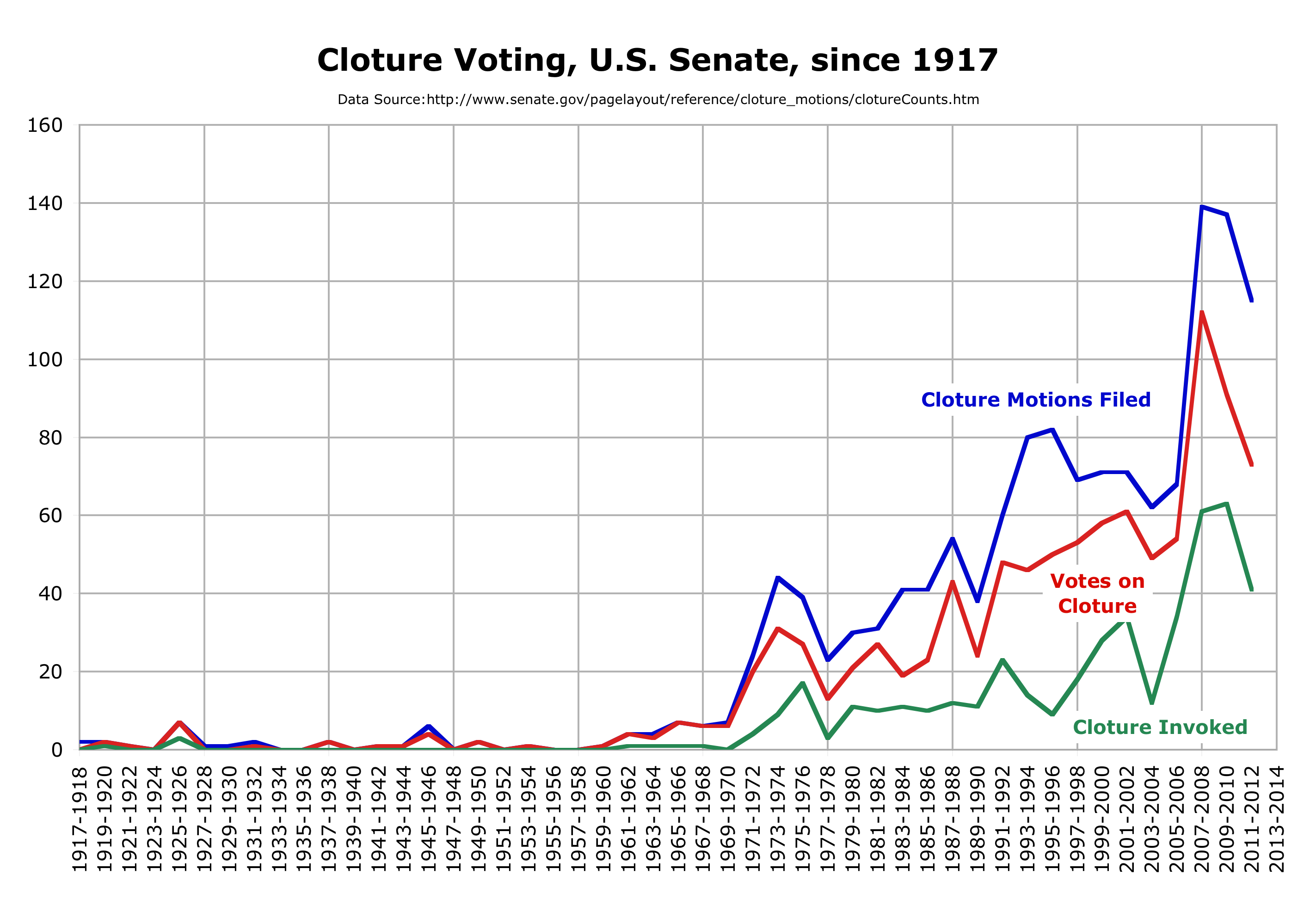
The filibuster is a procedural tactic used in the Senate to delay or block a vote on a legislative bill by continuously holding the floor or refusing to end debate.
To break this gridlock, senators must utilize cloture. Cloture is the only formal procedure provided by Senate rules to break a filibuster. However, it is not easy to achieve; invoking cloture on most legislation in the Senate requires the affirmative votes of three-fifths of all senators (typically 60 votes). This effectively means that controversial legislation in the Senate requires a supermajority, not just a simple majority, to pass.
While Congress debates the law, the executive branch must execute it. Article II of the United States Constitution vests executive power in the President. The framers intended for a single executive capable of decisive action, particularly in crises. The President of the United States is elected to serve a four-year term, and following the precedent set by George Washington and later codified by the Twenty-second Amendment to the Constitution, the President is limited to two elected terms in office.
Core Constitutional Powers
The President commands vast authority, checking both Congress and the judiciary:
- Military: The President serves as the Commander in Chief of the United States Armed Forces, ensuring civilian control over the military.
- Judicial Check: The President has the power to grant pardons for federal crimes, serving as a final safeguard against judicial overreach.
- Legislative Check: The President has the constitutional power to veto legislation passed by Congress. This forces Congress to compromise with the executive. If Congress wishes to pass the law anyway, they can override a presidential veto with a two-thirds majority vote in both the House and the Senate.
A unique timing-based mechanism is the pocket veto.
A pocket veto occurs when the President fails to sign a bill within ten days while Congress is adjourned. Because Congress is not in session to override it, the bill simply dies.
The Expansion of Unilateral Power
In the modern era, Presidents frequently rely on tools that bypass the slow gears of Congress. You must teach your students that while these tools are powerful, they are often temporary.
- Executive orders are official directives issued by the President that manage the operations of the federal government. Crucially, these carry the force of federal law without requiring congressional approval, though they can be undone by the next President or struck down by the courts.
- Executive privilege is the presidential right to withhold certain internal executive branch communications from Congress and the courts, justified by the need for candid advice.
- In foreign policy, Presidents often use executive agreements. Executive agreements are international pacts made by the President that do not require formal Senate ratification, allowing the executive to bypass the steep two-thirds treaty threshold.
Congressional Checks on the Executive
Congress has tools to reign in the President. The State of the Union address is a constitutional requirement for the President to periodically report to Congress, forcing the executive to publicly justify their agenda.
Historically, Presidents expanded military operations without congressional declarations of war (e.g., Vietnam). In response, Congress passed the War Powers Resolution of 1973, which requires the President to notify Congress within 48 hours of committing armed forces to military action, an attempt to reassert legislative authority over war-making.
The Federal Bureaucracy
The President cannot govern alone. The federal bureaucracy is responsible for implementing, administering, and enforcing the laws passed by Congress. When Congress passes an environmental law, it is the bureaucracy that actually measures the pollutants and issues the fines.
At the top of this structure is the Cabinet. The United States presidential cabinet consists of the Vice President and the heads of the 15 executive departments (e.g., Department of Defense, Department of Education). These presidential cabinet secretaries are officially appointed by the President of the United States, but in keeping with the Senate's advisory role, they must be confirmed by a majority vote in the United States Senate.
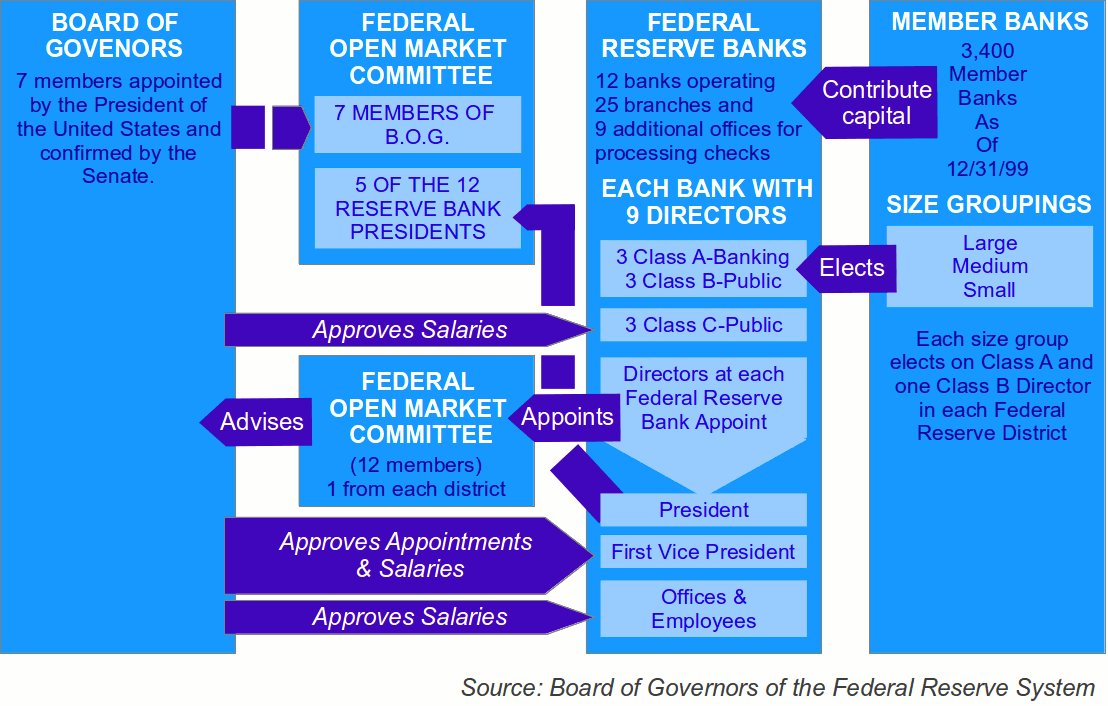
Not all agencies answer directly to the President. Independent regulatory commissions operate with a degree of structural autonomy from direct presidential control. This protects them from partisan whims. The Federal Reserve is a primary example of an independent regulatory commission within the US government, managing monetary policy without political interference.
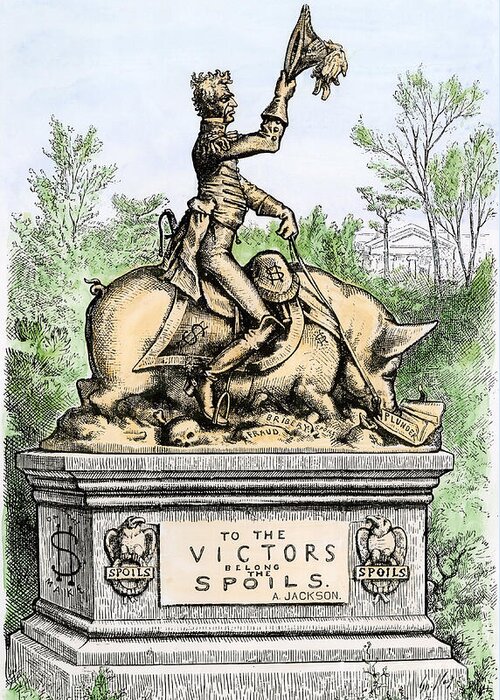
Historically, federal jobs were given as political favors (the "spoils system"). This led to gross incompetence. Today, the federal merit system ensures civil service jobs are awarded based on individual qualifications rather than political patronage. This shift was catalyzed by a tragedy—the assassination of President James A. Garfield by a disgruntled office-seeker. Consequently, the Pendleton Civil Service Reform Act of 1883 established the foundation of the federal merit system.
Even though the bureaucracy falls under the executive branch, Congress maintains strict authority over it. Congress exercises oversight over the federal bureaucracy through regular committee hearings, calling agency heads to testify. More importantly, Congress shapes the actions of executive agencies by controlling agency budgets through the power of the purse. An agency cannot spend what Congress does not appropriate.
The third pillar of the American system is the judiciary. Article III of the United States Constitution establishes the judicial branch of the federal government. It is the shortest of the first three articles, laying a brief framework and leaving much of the architecture to Congress.
Specifically, Article III explicitly creates the Supreme Court of the United States, but it grants Congress the power to create inferior federal courts.
To insulate the judiciary from the ballot box and the pressure of public opinion, federal judges are nominated by the President of the United States and must be confirmed by the United States Senate. Once confirmed, Article III federal judges serve lifetime appointments during good behavior. They do not need to campaign, fundraise, or bend to the political winds.
Structure of the Federal Judiciary
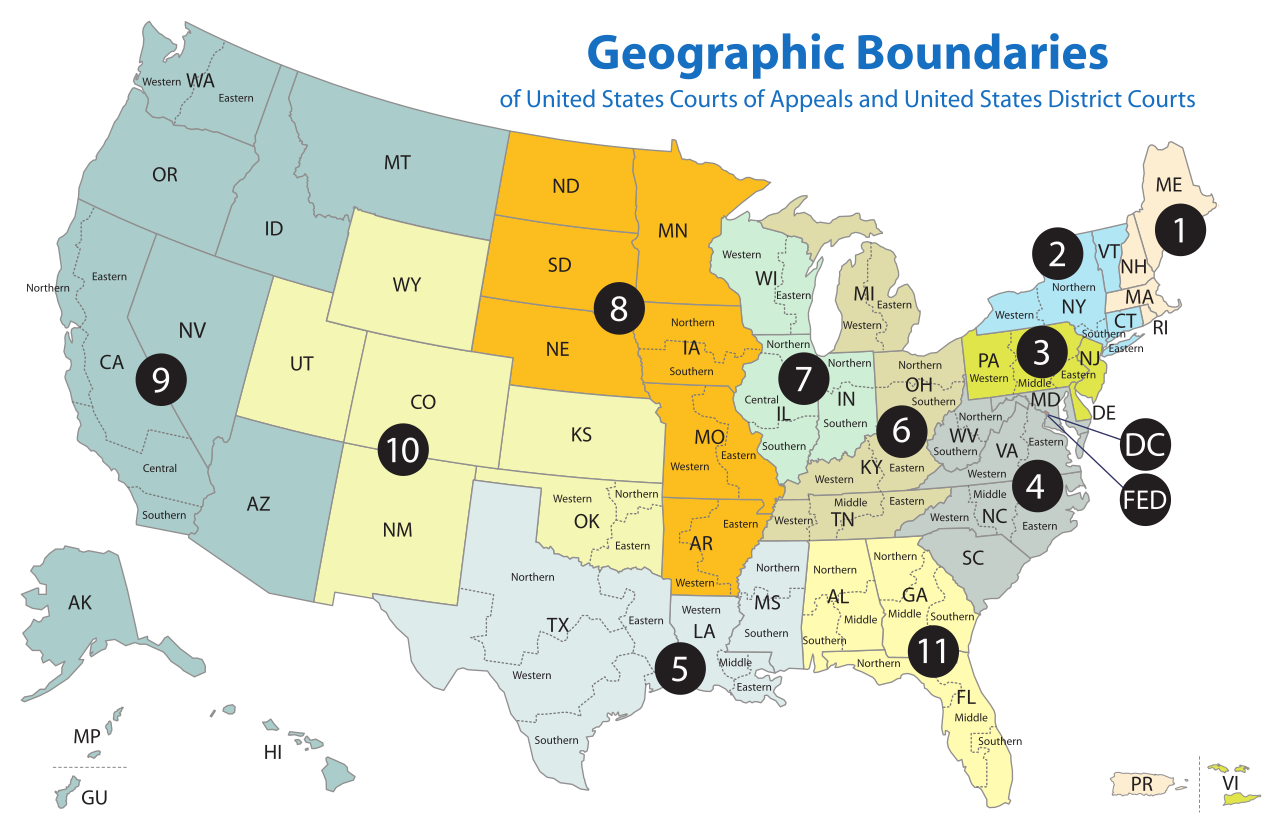
The system Congress built consists of a three-tiered hierarchy. The United States federal judiciary consists of district courts, circuit courts of appeals, and the Supreme Court.
- District Courts: There are 94 federal district courts operating across the United States. These are the workhorses of the system. Federal district courts function as the primary trial courts of the federal judicial system; this is where juries sit, witnesses testify, and evidence is presented.
- Appellate Courts: Above the district courts are the circuits. There are 13 appellate courts in the United States federal judicial system. Trials do not happen here. Instead, federal appellate courts exist to review legal decisions previously made by the federal district courts, looking for errors in how the law was applied.
- The Supreme Court: The Supreme Court of the United States is the highest judicial authority in the federal system. By law, the Supreme Court consists of one Chief Justice and eight Associate Justices.
The Power of Judicial Review
The courts would be largely ceremonial if not for their greatest weapon, which is notably absent from the text of the Constitution.
Judicial review is the power of the courts to evaluate and declare legislative laws and executive actions unconstitutional.
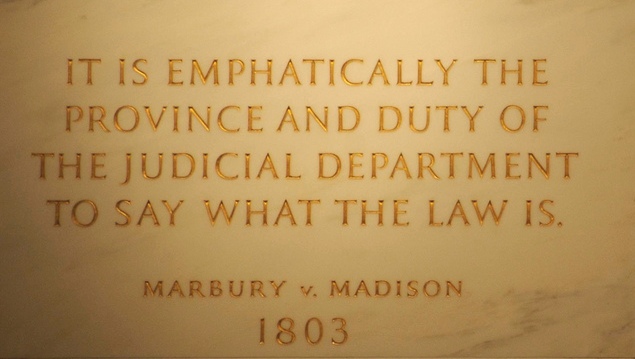
Without judicial review, the Constitution is merely a list of suggestions. The Supreme Court explicitly established the power of judicial review in the 1803 landmark case Marbury v. Madison. By declaring an act of Congress unconstitutional, Chief Justice John Marshall cemented the Court as a co-equal branch of government.
Jurisdiction and Process
How does a case reach the Supreme Court? Jurisdiction dictates the path.
In a tiny fraction of scenarios, the Supreme Court hears a case first. The Supreme Court has original jurisdiction in cases involving foreign ambassadors, as well as original jurisdiction in legal disputes arising directly between two or more US states (e.g., a water rights dispute between Colorado and Nebraska).
However, the vast majority of cases reach the Supreme Court through the exercise of its appellate jurisdiction, meaning they are appealed upward from lower courts.
If a party loses in an appellate court, they petition the Supreme Court. If the Court agrees to hear the case, it issues a writ. A writ of certiorari is a formal legal order for the Supreme Court to review the decision of a lower court. The Court receives thousands of petitions but accepts only a few dozen each year. To grant this review, they utilize an internal mechanism: The Rule of Four dictates that four Supreme Court justices must agree to grant a writ of certiorari for a case to be heard.
Judicial Philosophy and Precedent
When deciding cases, justices rely heavily on history. Stare decisis is the legal doctrine of adhering to established precedent when deciding subsequent legal cases. This provides stability and predictability to American law.
Yet, justices approach the Constitution through different philosophical lenses. These are not explicitly partisan labels, but rather views on the role of the judge:
- Judicial activism is the philosophy that courts should interpret laws loosely to consider broader societal implications, often stepping in to protect rights when the legislative branch fails to act.
- Judicial restraint is the philosophy that judges should strictly limit their own power and defer to elected legislative branches, striking down laws only when they blatantly and undeniably violate the Constitution.
When you teach these institutions, frame them as a continuous tug-of-war. The President claims a power; the Court reviews it; Congress attempts to defund it. The friction is constant, loud, and thoroughly intentional. Grasping this interplay is the key not only to mastering the Praxis 5081 exam, but to fostering a profound civic understanding in your future students.