Congruence and Similarity
Not sure you’re ready?
Take the ~3-minute readiness diagnostic and see where you stand.
When an architect drafts a floor plan and a builder subsequently pours the concrete foundation, they rely on a fundamental mathematical guarantee: the geometric relationships meticulously plotted on paper will map reliably to physical structures of steel and wood. This mapping—the preservation of proportionality, shape, and structure across different physical spaces—is the essence of congruence and similarity. We are not merely comparing static lists of angles and side lengths; we are studying how geometric figures behave when subjected to motion and scaling across a coordinate plane or through three-dimensional space.
For your future middle school students, geometry must transition from an exercise in memorizing vocabulary to an intuition for spatial relationships. As an educator preparing for the Praxis 5164 exam, your task is to understand the rigorous machinery behind these concepts. You must be able to prove precisely why shrinking a photograph, dragging a triangle across a graphing calculator screen, or comparing the volumes of two cylinders all stem from the same elegant set of proportional rules.
To understand congruence and similarity, we must first understand the actions that create them: transformations. Think of transformations as the verbs of geometry.
Rigid transformations are spatial movements that strictly preserve size and shape. They include translations (sliding), rotations (spinning), and reflections (flipping). If you pick up a wooden block and move it across your desk, you have performed a rigid transformation; the block's physical dimensions have not changed.
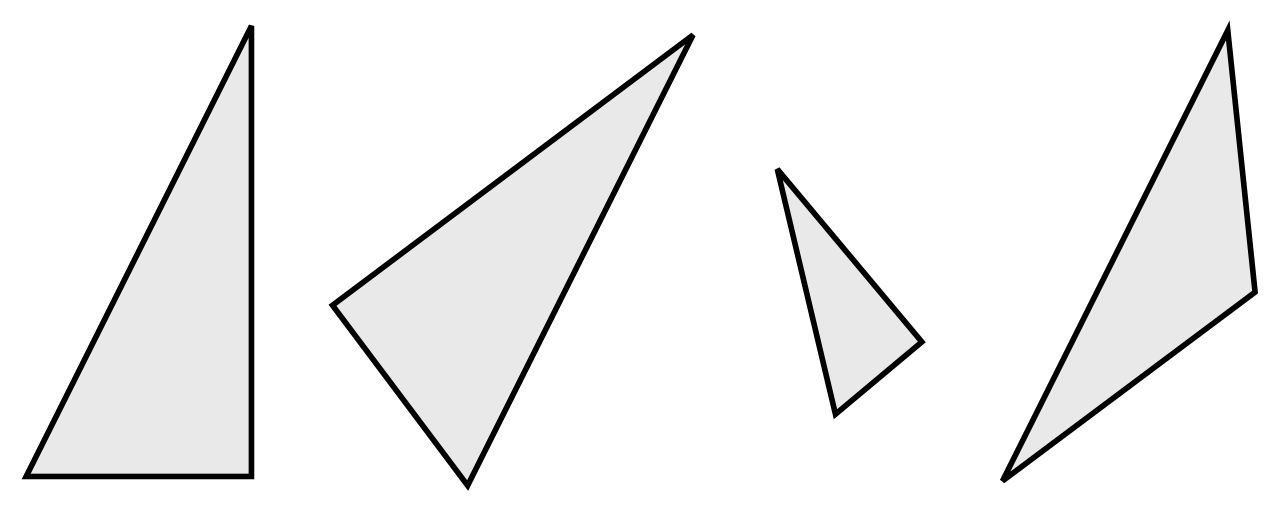
Because rigid transformations preserve exact measurements, they form the basis of congruence. Two geometric figures are congruent if there is a sequence of rigid transformations that maps one figure exactly onto the other. Consequently, congruent figures have exactly the same size and the same shape.
However, not all transformations are rigid. A dilation is a transformation that alters the size of a figure without changing its shape, much like zooming in or out on a digital map.
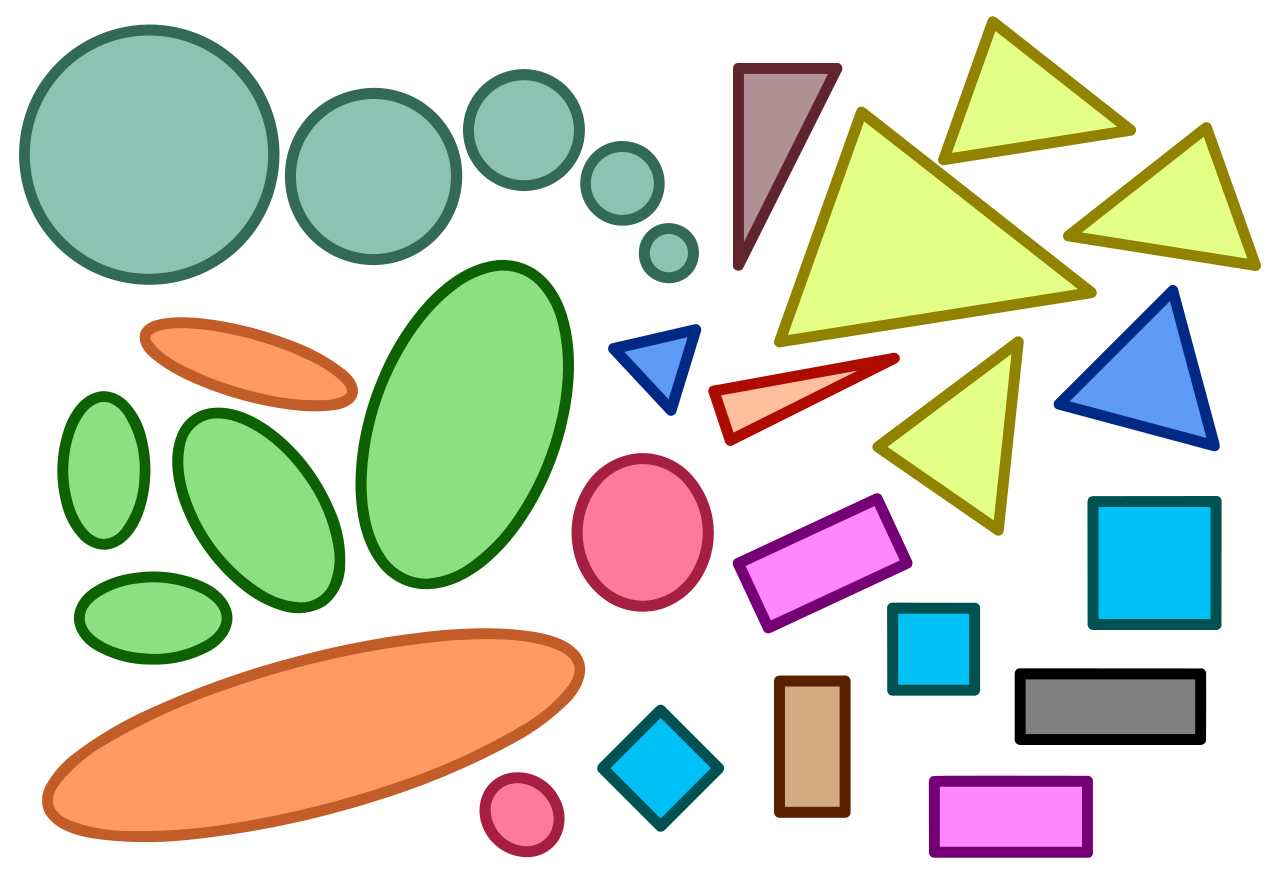
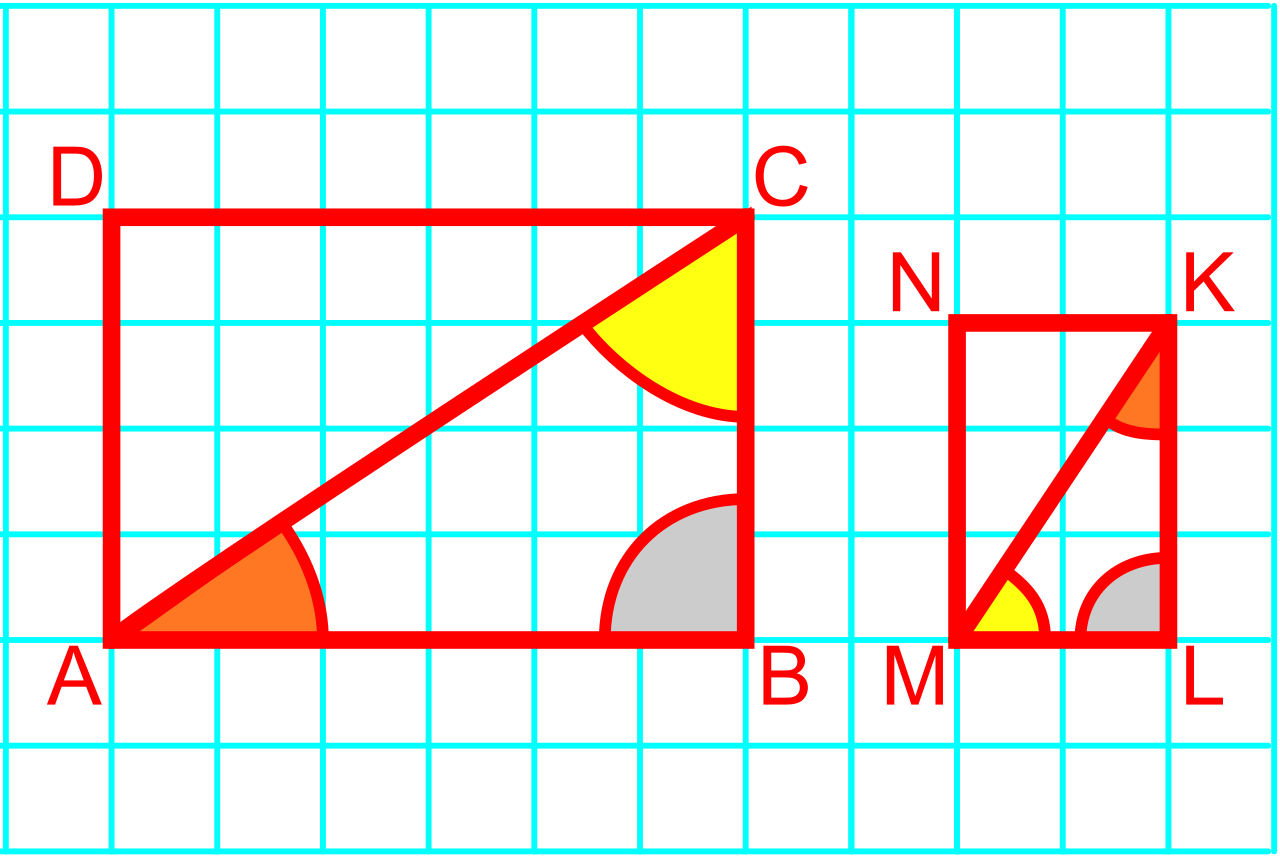
When we introduce dilations, we enter the realm of similarity. Two geometric figures are similar if there is a sequence of rigid transformations and dilations that maps one figure onto the other. Because dilations strictly preserve internal angles and proportions, similar figures have the same shape regardless of their relative sizes.
The Scale Factor
The mathematical engine driving a dilation is the scale factor, defined as the ratio of the lengths of any corresponding sides of similar figures. Let us call this scale factor k. The value of k dictates the relationship between the pre-image (original) and the image (new figure):
- A scale factor strictly greater than 1 represents an enlargement of the original figure.
- A scale factor strictly between 0 and 1 represents a reduction of the original figure.
- A scale factor exactly equal to 1 indicates that the two geometric figures are congruent. (A dilation by a factor of 1 changes nothing, leaving us with a purely rigid transformation).
When we apply these transformational definitions to polygons, rigid rules emerge regarding their internal components.
For congruence, there is zero tolerance for deviation:
- The corresponding angles of congruent polygons are strictly equal in measure.
- The corresponding sides of congruent polygons are strictly equal in length.
For similarity, the rules reflect the presence of a dilation:
- The corresponding angles of similar polygons are strictly equal in measure. (If the angles changed, the shape would warp).
- The corresponding sides of similar polygons are proportional in length.
Furthermore, this proportionality extends to all linear measurements within the shape. In similar polygons, any corresponding linear measures like diagonals or altitudes have the exact same ratio as the corresponding side lengths. If a scale factor doubles the sides of a rectangle, the diagonal of that rectangle is also exactly doubled.
A Note on Universal Similarity: Some shapes possess such perfect symmetry that they are immune to distortion. All circles are geometrically similar to one another. Likewise, all regular polygons with the same number of sides are geometrically similar to one another. A regular hexagon cannot be "warped" into a different shape of regular hexagon; its angles are fixed, meaning any variation in size is simply a dilation of a master template.
In middle school geometry, triangles are the supreme objects of study. Because any polygon can be decomposed into triangles, proving relationships between triangles unlocks the rest of two-dimensional geometry.
Triangle Congruence Postulates
We do not need to measure all six components (three angles, three sides) to prove two triangles are exactly the same. Certain combinations mathematically "lock" the triangle into only one possible size and shape.
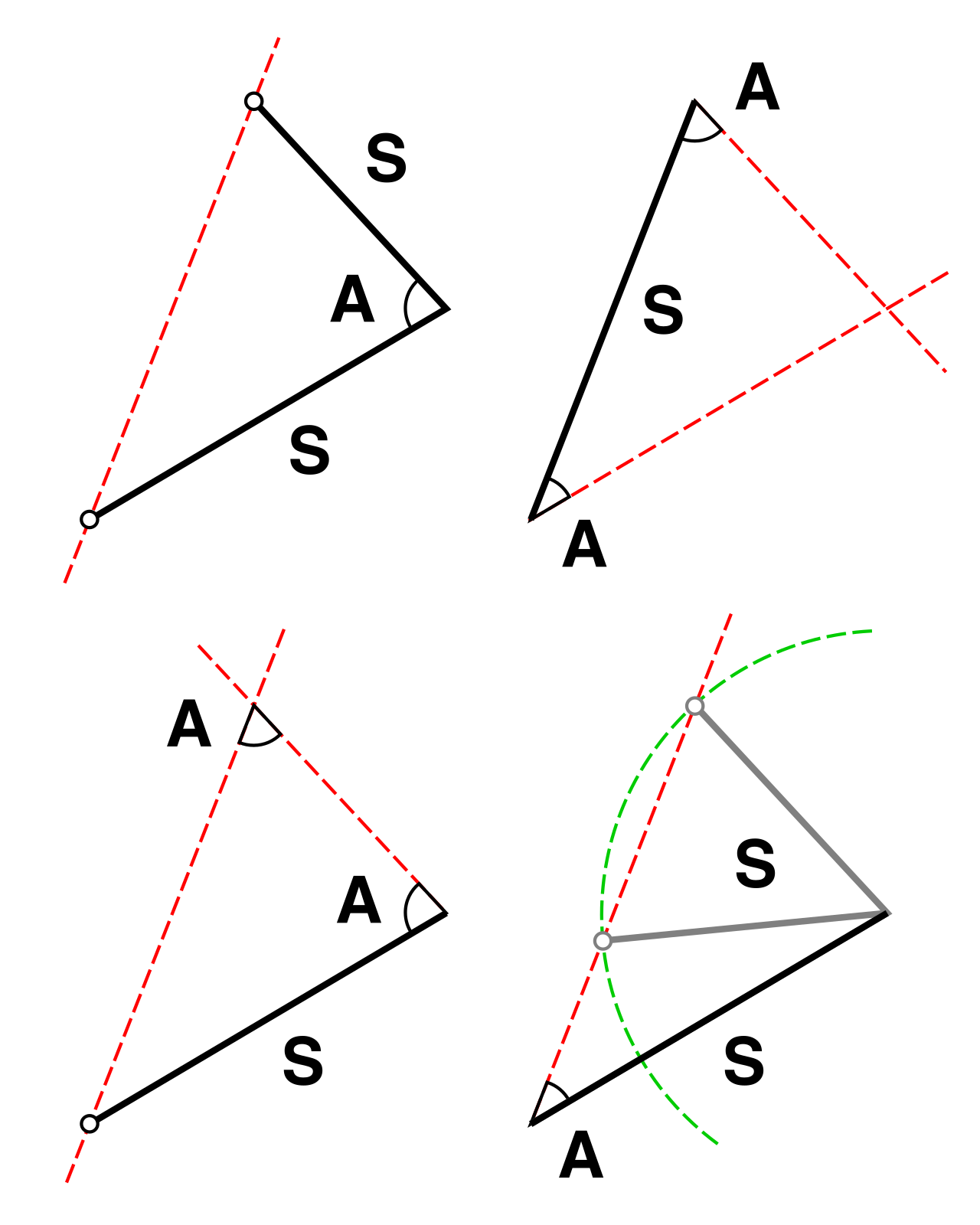
- Side-Side-Side (SSS) congruence: States that two triangles are congruent if three sides of one triangle are congruent to three sides of the other triangle.
- Side-Angle-Side (SAS) congruence: States that two triangles are congruent if two sides and the included angle of one triangle are congruent to two sides and the included angle of the other triangle.
- Angle-Side-Angle (ASA) congruence: States that two triangles are congruent if two angles and the included side of one triangle are congruent to two angles and the included side of the other triangle.
- Angle-Angle-Side (AAS) congruence: States that two triangles are congruent if two angles and a non-included side of one triangle are congruent to two angles and the corresponding non-included side of the other triangle.
- Hypotenuse-Leg (HL) congruence: This is a special case for right triangles. It states that two right triangles are congruent if the hypotenuse and one leg of one right triangle are congruent to the hypotenuse and one leg of the other right triangle. (Because the angle is fixed at 90∘, HL is effectively a valid manifestation of SSA constrained by the Pythagorean theorem).
What Does NOT Work for Congruence:
- Side-Side-Angle (SSA) is not a valid criterion for proving general triangle congruence. This is known as the "ambiguous case" or "swinging door" problem. The unanchored side can swing into two distinct positions, creating two entirely different triangles.
- Angle-Angle-Angle (AAA) is not a valid criterion for proving triangle congruence. Knowing all three angles only proves the triangles have the same shape. A tiny triangle and a massive triangle can share the exact same angles.
The Payoff: CPCTC
Once you leverage SSS, SAS, ASA, AAS, or HL to prove two triangles are congruent, you unlock a powerful logical consequence. Corresponding Parts of Congruent Triangles are Congruent (CPCTC) means that once two triangles are proven congruent, all of their corresponding parts are automatically known to be congruent. If you use SAS to prove congruence, you can invoke CPCTC to state definitively that the remaining third sides are equal.
Triangle Similarity Postulates
Similarity requires less rigid criteria because we are only proving shape, not size.
- Angle-Angle (AA) similarity: States that two triangles are similar if two angles of one triangle are congruent to two angles of another triangle. (The third angles must also be congruent because triangle angles always sum to 180∘).
- Side-Side-Side (SSS) similarity: States that two triangles are similar if all three pairs of corresponding sides are proportional.
- Side-Angle-Side (SAS) similarity: States that two triangles are similar if two pairs of corresponding sides are proportional and the included angles are congruent.
One of the most profound and frequently tested applications of similarity involves right triangles. Imagine a standard right triangle resting on its hypotenuse.
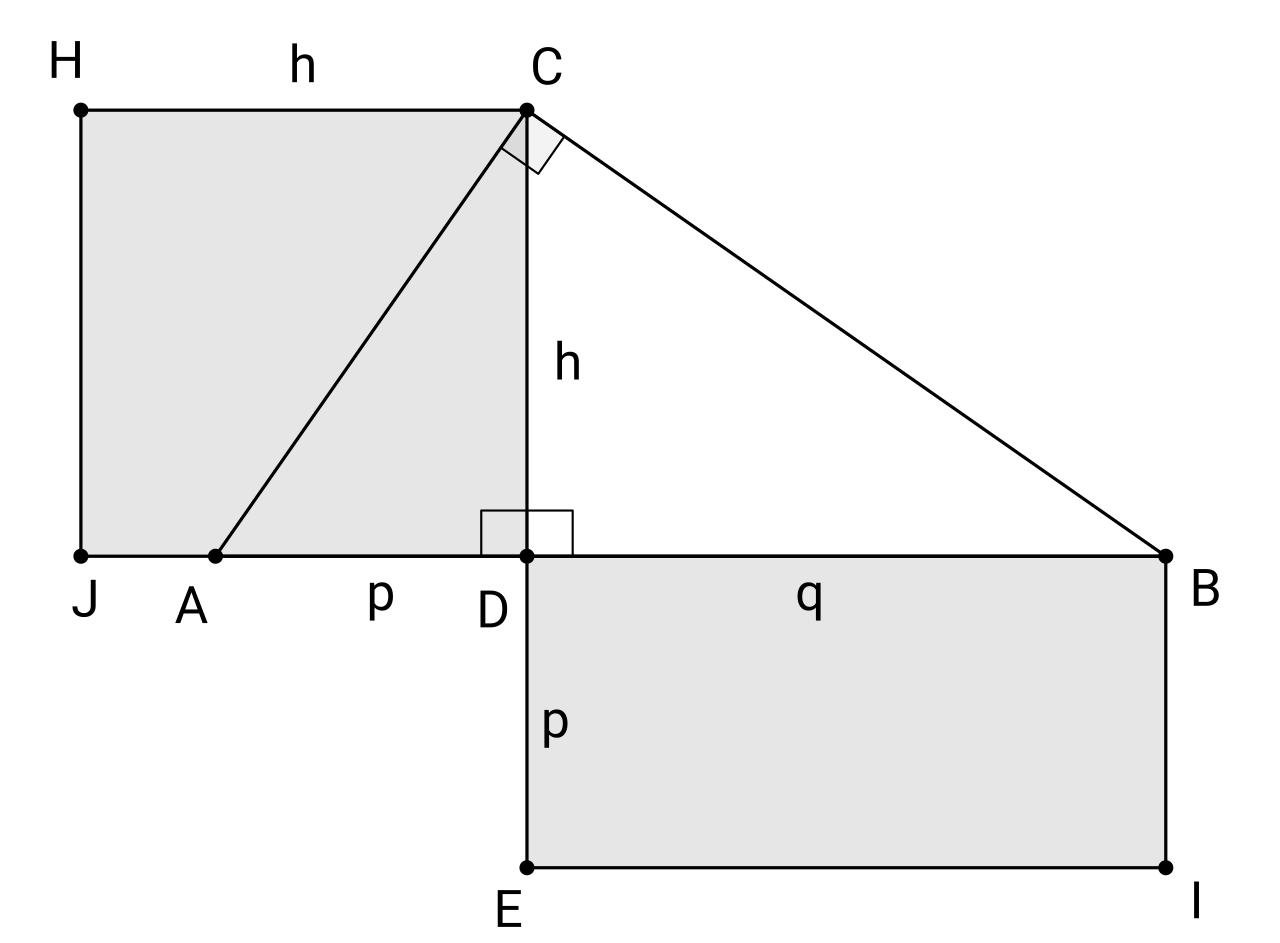
Drawing an altitude from the right angle to the hypotenuse of a right triangle divides the original triangle into two smaller triangles.
Because they share angles with the "mother" triangle, a beautiful recursive property emerges:
- The two smaller triangles formed by the altitude to the hypotenuse of a right triangle are similar to the original right triangle.
- By the transitive property of similarity, the two smaller triangles formed by the altitude to the hypotenuse of a right triangle are similar to each other.
This geometric phenomenon generates the geometric mean theorem. This theorem states that the altitude drawn to the hypotenuse of a right triangle divides the hypotenuse into two segments such that the altitude is the geometric mean of the lengths of those two segments.
Mathematically, if the hypotenuse is split into segments a and b, and the altitude is h, the similarity of the small triangles guarantees that: ha=bh h2=a⋅b h=a⋅b
This will be an essential tool in your algebraic problem-solving toolkit on the Praxis.
The most common misconception middle school students harbor about similarity is the assumption that scaling a shape by k scales everything about it by k. If you double the length of a rectangular garden (k=2), students often assume the area of the garden also doubles.
As an educator, you must disabuse them of this intuitively flawed idea using the geometry of dimensions.
Two-Dimensional Scaling
For 2D shapes, scaling impacts dimensions differently depending on the units involved:
- 1D measures (Length): If the scale factor of two similar two-dimensional figures is k, the ratio of their perimeters is also k. A polygon that is 3 times wider and taller requires exactly 3 times as much fencing.
- 2D measures (Area): If the scale factor of two similar two-dimensional figures is k, the ratio of their areas is k squared (k2).
If a student has a 6-inch pizza and a 12-inch pizza, the scale factor is k=2. The amount of crust (perimeter/circumference) is doubled (k=2). But the amount of cheese (area) is multiplied by 22=4. The 12-inch pizza has exactly four times as much food.
Three-Dimensional Scaling
When we move to spatial geometry, the same logic applies to solids. Two three-dimensional solids are similar if they have the same shape and all their corresponding linear dimensions are proportional.
If you have two similar cylinders, and the larger one has a radius and height that are both k times larger than the smaller one, here is how the properties scale:
- 2D measures (Surface Area): If the scale factor of two similar three-dimensional figures is k, the ratio of their surface areas is k squared (k2). If a toy box has all its dimensions tripled (k=3), it will require 32=9 times as much paint to coat the outside.
- 3D measures (Volume): If the scale factor of two similar three-dimensional figures is k, the ratio of their volumes is k cubed (k3). If you have a wading pool and you double its length, double its width, and double its depth (k=2), you do not need twice as much water to fill it; you need 23=8 times as much water.
Why This Matters in the Classroom
On the Praxis, and in your future classroom, problems involving similarity and congruence rarely ask for mere definitions. They will embed a scale factor inside a word problem, forcing you to recognize that a linear ratio must be squared to find an area ratio, or cubed to find a volume ratio. By anchoring your understanding in the behavior of transformations and dimensions, you elevate geometry from arbitrary formulas to a logical, cohesive study of the physical world.