Evaluating and Manipulating Expressions
Not sure you’re ready?
Take the ~3-minute readiness diagnostic and see where you stand.
To state that "water freezes at 32 degrees Fahrenheit" and "water freezes at 0 degrees Celsius" is to describe the exact same physical reality using two different frameworks. Neither statement is more true than the other, but depending on whether you are calibrating a European thermometer or analyzing American weather data, one form is vastly more useful. In mathematics, rewriting expressions serves precisely the same function. We do not manipulate algebraic expressions merely to satisfy arbitrary rules; we manipulate them to expose hidden structural truths. When an expression changes form, its underlying value remains identical, but a new facet of its behavior is illuminated. For the aspiring middle school mathematics teacher, mastering these transformations means equipping your students with a dynamic lens through which they can model, analyze, and understand the universe.
-v2.svg)
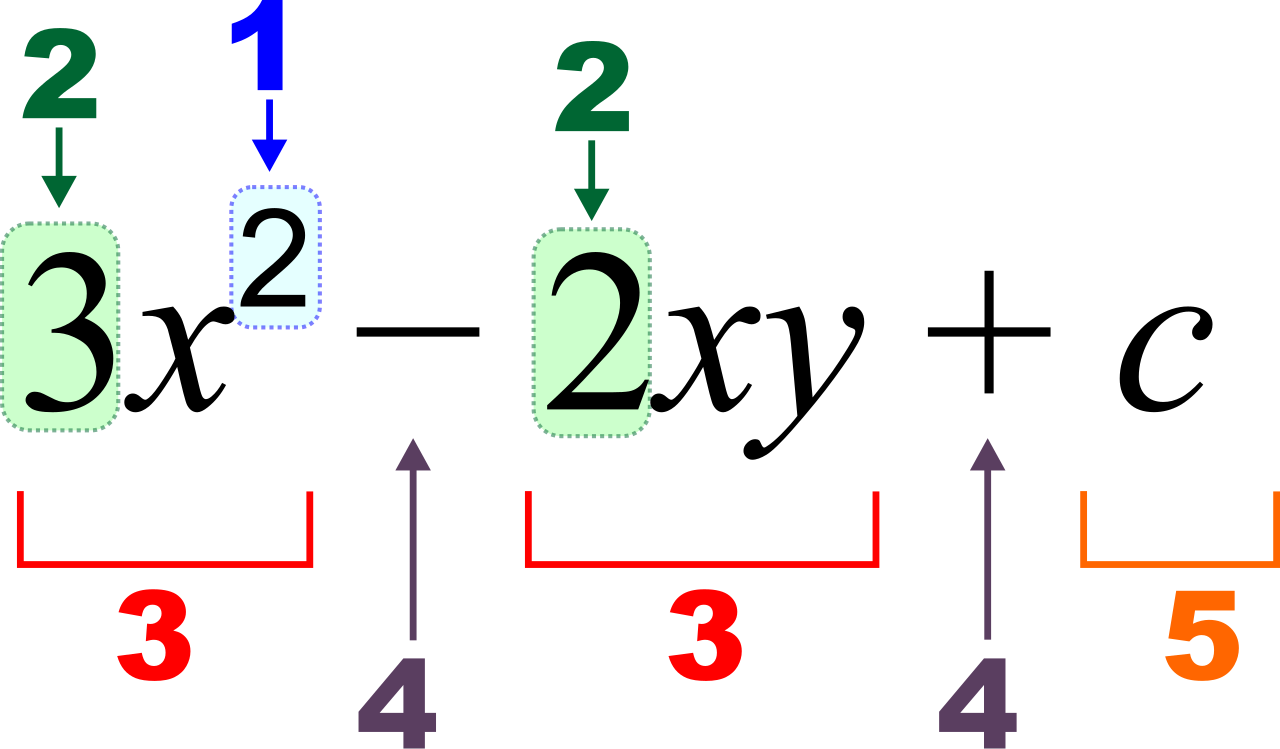
Before we can manipulate a mathematical structure, we must understand its fundamental building blocks. In algebra, an expression is composed of distinct pieces, each carrying specific real-world meaning.
A term in an algebraic expression is a single number, a variable, or the product of numbers and variables, partitioned from other terms by addition or subtraction. Consider the expression modeling the total cost of a rental truck: 0.75m+50. This expression contains two terms.
Within a term that contains a variable, the numerical factor is known as the coefficient. In our rental example, 0.75 is the coefficient. In the context of a real-world linear expression, the coefficient typically represents a constant rate of change—here, $0.75 per mile driven.
Conversely, a constant term is a number in an expression that does not change its value because it lacks a variable. The 50 in our expression is a constant. In a real-world linear expression, the constant term typically represents an initial value or starting amount—the flat $50 fee just to drive the truck off the lot.
Teaching Connection: Middle school students often view algebraic expressions as abstract strings of symbols. By grounding linear expressions in daily realities—like flat fees and per-unit rates—you allow them to see variables as flexible tools rather than frightening unknowns.
When analyzing more complex scenarios, we use grouping symbols like parentheses to define a single quantity that can be interpreted as a distinct unit within a real-world context. If a catering company charges $20 per guest, but the first 10 guests are free, the cost expression becomes 20(g−10). The grouping (g−10) functions as a single conceptual unit: "the number of billable guests."
To simplify such expressions, we rely on the distributive property, which allows multiplication to be distributed over addition or subtraction within an algebraic expression. Distributing the 20 transforms 20(g−10) into 20g−200. Both expressions model the exact same cost, but the latter isolates the gross per-guest revenue (20g) from the total discount value (200).
To model phenomena that scale multiplicatively—like population growth, compound interest, or bacterial decay—we use exponents. Exponents are simply a bookkeeping mechanism for repeated multiplication, but extending this bookkeeping beyond positive integers requires strict logical consistency.
The Rules of the Game
Let us deduce the rules of exponents by demanding that the logic of arithmetic holds steady.
- Multiplying Bases: When multiplying two expressions with the same base, the exponents are added together. Why? If you have x3⋅x2, you are multiplying (x⋅x⋅x) by (x⋅x), yielding five x's in total: x3+2=x5.
- Dividing Bases: Conversely, when dividing two expressions with the same base, the exponent of the denominator is subtracted from the exponent of the numerator. x2x5 cancels two x's out of the five, leaving x5−2=x3.
- The Zero Exponent: What happens if we divide x3 by x3? Any nonzero quantity divided by itself is 1. But according to our subtraction rule, x3x3=x3−3=x0. Therefore, any nonzero base raised to the power of zero equals one.
- Negative Exponents: What if we divide x2 by x5? The subtraction rule gives x2−5=x−3. Conceptually, canceling two x's leaves three x's in the denominator: x31. Thus, a negative exponent indicates the reciprocal of the base raised to the corresponding positive exponent.
- Power of a Power: When raising a power to another power, the exponents are multiplied together. For instance, (x3)4 means four groups of x3, which totals 12 x's, or x3⋅4=x12.
- Power of a Product: When raising a product to a power, the power is applied to each factor within the product. (3x)2 is (3x)(3x), which regroups to 32⋅x2=9x2.
Translating Between Radicals and Rational Exponents
Just as division reverses multiplication, taking a root reverses an exponent. We can express roots seamlessly within our exponent bookkeeping using fractions.
A rational exponent of the form n1 represents the n-th root of the base. For example, x1/2=x. Why? Because if we square x1/2, the power-to-a-power rule dictates we multiply the exponents: (x1/2)2=x1=x. The only operation that squares to yield x is the square root.
Building on this, a rational exponent nm represents the n-th root of the base raised to the m-th power. The denominator specifies the root, and the numerator specifies the power. Thus, x3/4 is the fourth root of x3, written as 4x3.
Manipulating Radicals
Radicals follow intuitive multiplicative rules derived directly from exponent rules.
- The product of two radicals with the same index equals the radical of the product of their radicands: A⋅B=AB.
- Similarly, the quotient of two radicals with the same index equals the radical of the quotient of their radicands: BA=BA.
These properties are essential for simplification. Radicals can be simplified by factoring out perfect n-th powers from the radicand. For example, to simplify 50, we look for the largest perfect square within 50. We rewrite it as 25⋅2=25⋅2=52.
When a radical appears in the denominator of a fraction, mathematical convention often dictates we eliminate it. Rationalizing a denominator involves multiplying the numerator and denominator by an expression that removes the radical from the denominator. If you have 23, you multiply by 22 to get 232.
Why this matters: Your students may ask why we bother rationalizing denominators when we have calculators. Historically, dividing by a long, non-terminating decimal like 2 by hand was arduous; dividing by an integer like 2 was simple. Today, rationalizing remains a vital algebraic reflex that standardizes expressions so they can be easily compared and combined.
When analyzing scenarios like compound interest or radioactive half-lives, we use exponential functions. In an exponential expression of the form a(bx), the variable 'a' represents the initial quantity. This is because at time zero (x=0), the expression becomes a(b0). Since any nonzero base to the power of zero is one, the result is simply a.
The variable 'b' represents the growth or decay factor, which is the multiplier applied in each time step.
- An exponential growth factor greater than one (b>1) indicates that the modeled quantity is increasing over time. (e.g., 1.05 represents a 5% increase).
- An exponential decay factor between zero and one (0<b<1) indicates that the modeled quantity is decreasing over time. (e.g., 0.80 represents a 20% decrease).
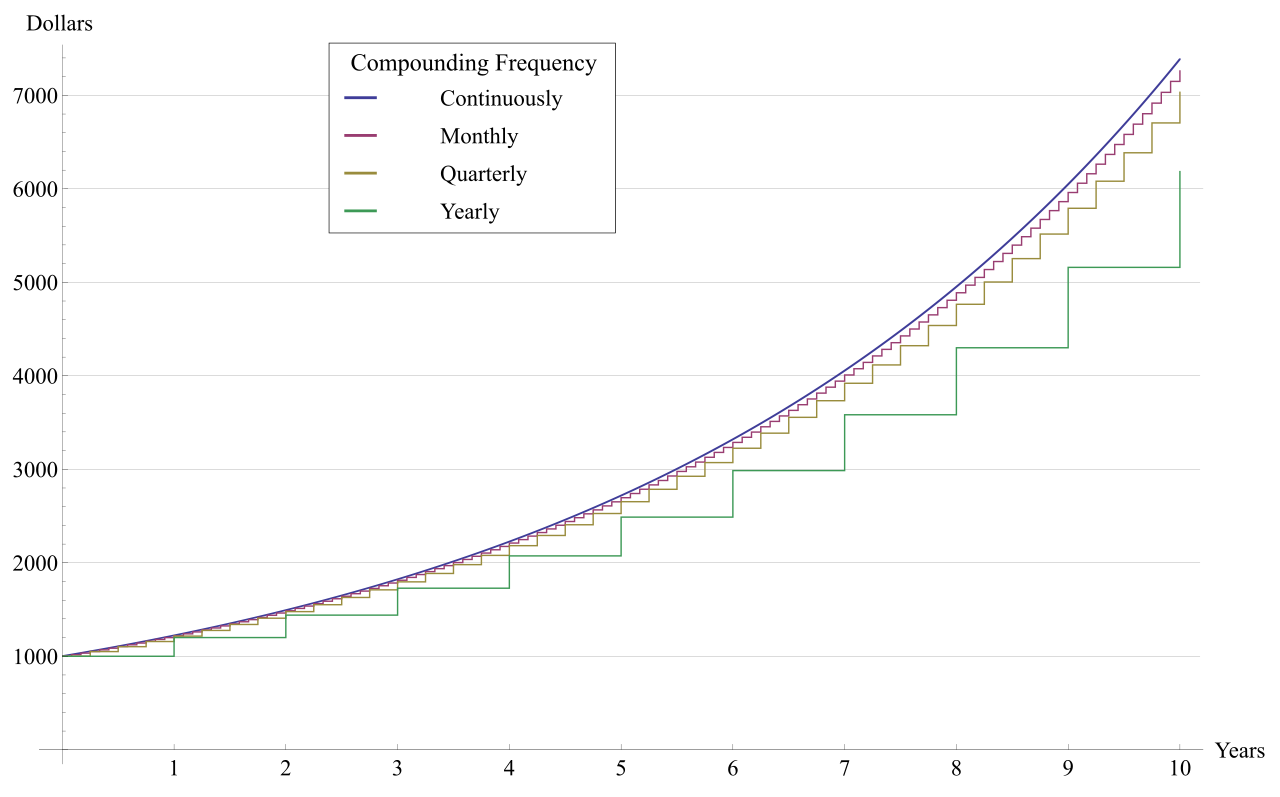
The exponent in a real-world exponential expression typically represents the number of time periods that have elapsed. But time is flexible, and here the power-to-a-power rule proves tremendously useful.
Imagine a population of bacteria that doubles every year, modeled by 100(2t), where t is in years. What if we want to find the monthly growth rate? We can manipulate the expression without changing its value. We know that t=12⋅12t. By applying the power-of-a-power rule in reverse, rewriting an exponential expression using the power of a power property can reveal the effective growth rate for a different time interval: 100(2t)=100(212⋅12t)=100((21/12)12t). By evaluating 21/12≈1.059, we instantly reveal that the bacteria grows by approximately 5.9% each month.
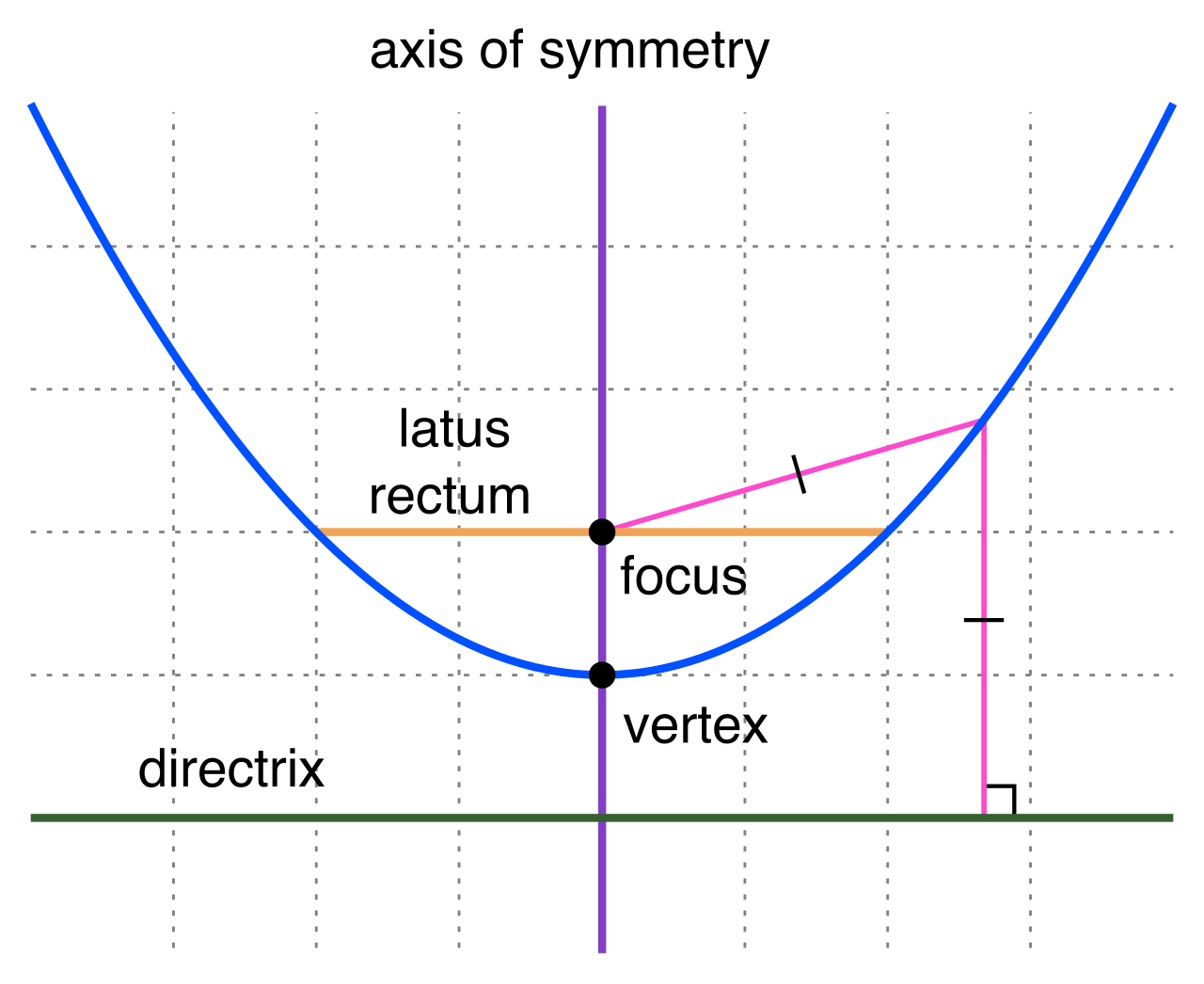
If linear expressions describe steady movement and exponential expressions describe explosive compounding, quadratic expressions describe arcs, gravity, and areas. A quadratic function graphs as a parabola, but its algebraic expression can be written in several distinct forms. Transforming a quadratic expression is like walking around a sculpture: the shape remains exactly the same, but different angles reveal different features.
Factored Form: Finding the Ground
Factoring a quadratic expression reveals the zeros of the expression. If we have the standard expression x2−5x+6, we can rewrite it in factored form as (x−2)(x−3). By the Zero Product Property, this expression equals zero when x=2 or x=3.
Graphically, the zeros of a factored quadratic expression correspond to the x-intercepts of the modeled quadratic function. If this equation modeled the trajectory of a leaping dolphin, factoring tells us precisely when the dolphin breaks the surface of the water and when it dives back under.
Two specific factoring patterns are so foundational they warrant instant recognition:
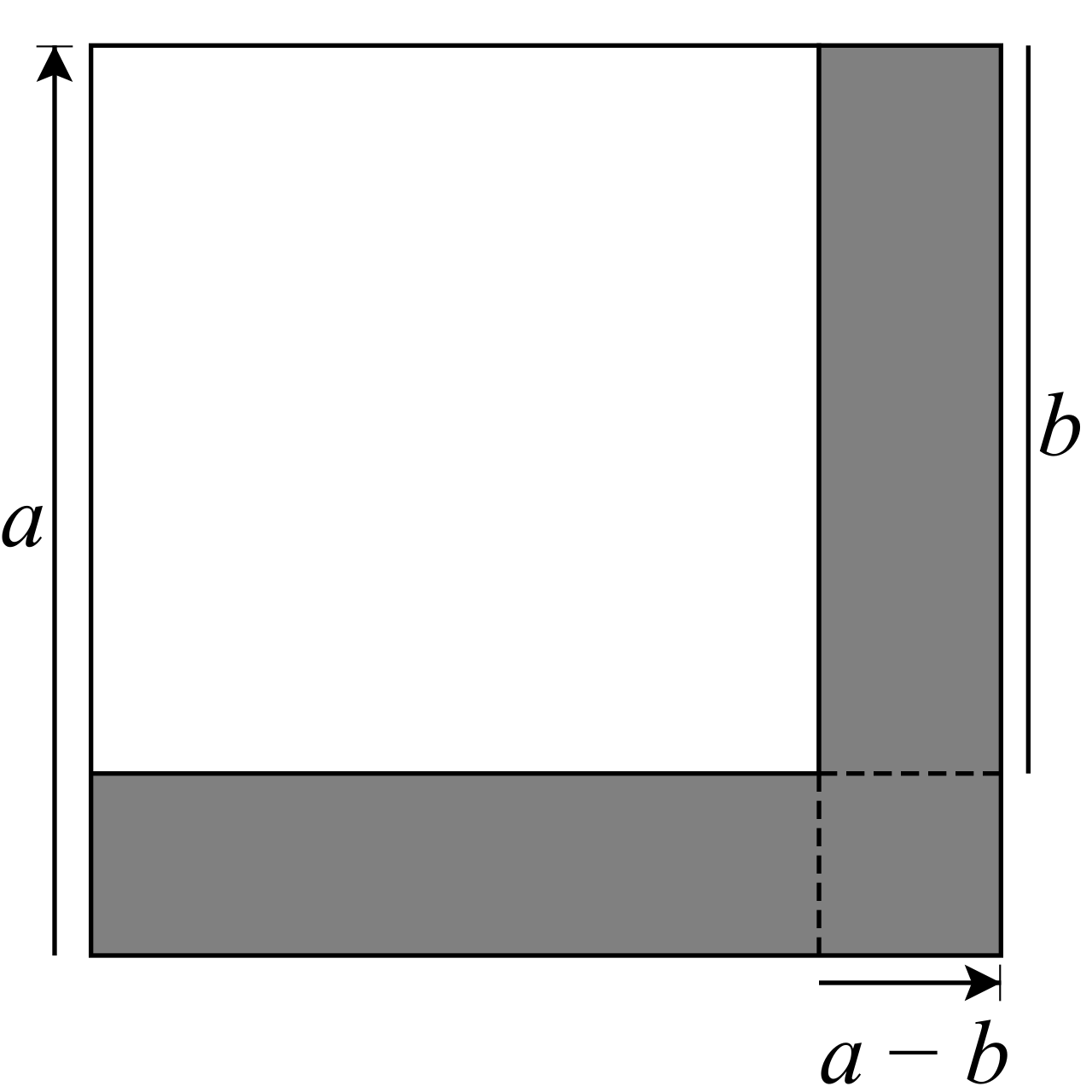
- Difference of Squares: This factorization rewrites a2−b2 as the product of (a−b) and (a+b). The middle terms perfectly cancel each other out during distribution. Example: x2−49=(x−7)(x+7).
- Perfect Square Trinomial: This factorization rewrites a2+2ab+b2 as the square of the binomial (a+b)2. Example: x2+10x+25=(x+5)2.
Vertex Form: Finding the Peak
What if we want to know the maximum height of the dolphin's leap? Factored form doesn't tell us this directly. Instead, we use a process called "completing the square."
Completing the square transforms a standard quadratic expression into vertex form. By taking a standard quadratic ax2+bx+c, halving the b-coefficient, squaring it, and balancing the equation, we force a perfect square trinomial to appear.
For instance, x2−6x+5:
- Isolate the variable terms: (x2−6x)+5
- Take half of −6 (which is −3), square it (which is 9). Add and subtract 9 to maintain balance: (x2−6x+9)−9+5
- Rewrite the perfect square: (x−3)2−4
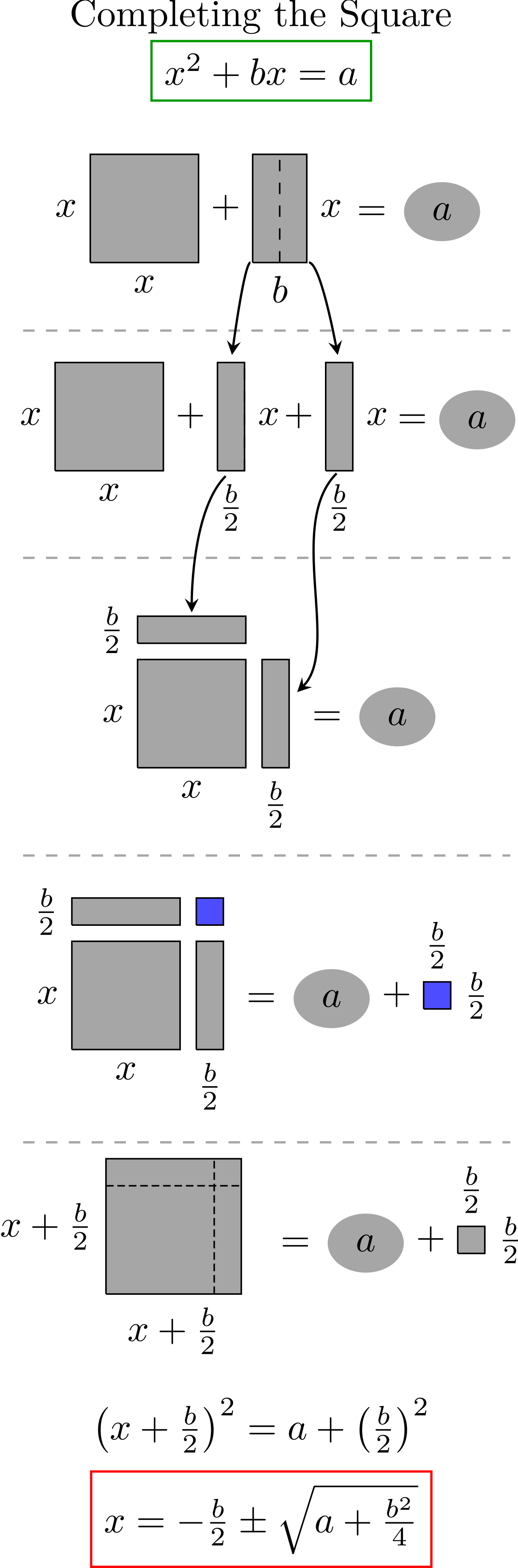
This final expression, (x−3)2−4, is the vertex form. The vertex form of a quadratic expression reveals the maximum or minimum value of the modeled quadratic function. Because any real number squared is at least zero, the lowest possible value of (x−3)2 is zero (occurring when x=3). Therefore, the minimum value of the entire expression is −4. We have located the precise vertex (3,−4) without needing to plot a single point on a graphing calculator.
In Summary
To your future middle school students, algebra may initially seem like an arbitrary set of rules dictating how to push letters around a page. Your task is to show them that it is actually a precise, highly intuitive language. A negative exponent is not a mystery; it is an instruction to take the reciprocal. A radical is not a wall; it is a fractional exponent waiting to be integrated into broader calculations. Rewriting an equation into vertex form or factored form is not a chore; it is an interrogation technique, forcing a parabola to confess its highest peaks and its zero-crossings. By understanding the profound equivalence behind these differing forms, you empower your students to stop memorizing disconnected rules, and start reading the structural poetry of the mathematical world.