A polynomial is an algebraic expression consisting of terms that have real numbercoefficients and variables raised to non-negative integerpowers. At its core, polynomial algebra is the syntax we use to describe quantities that scale at different, predictable rates. When you graph the trajectory of a thrown ball, model the area of an expanding garden, or calculate the trajectory of a vehicle, you are speaking the language of polynomials.
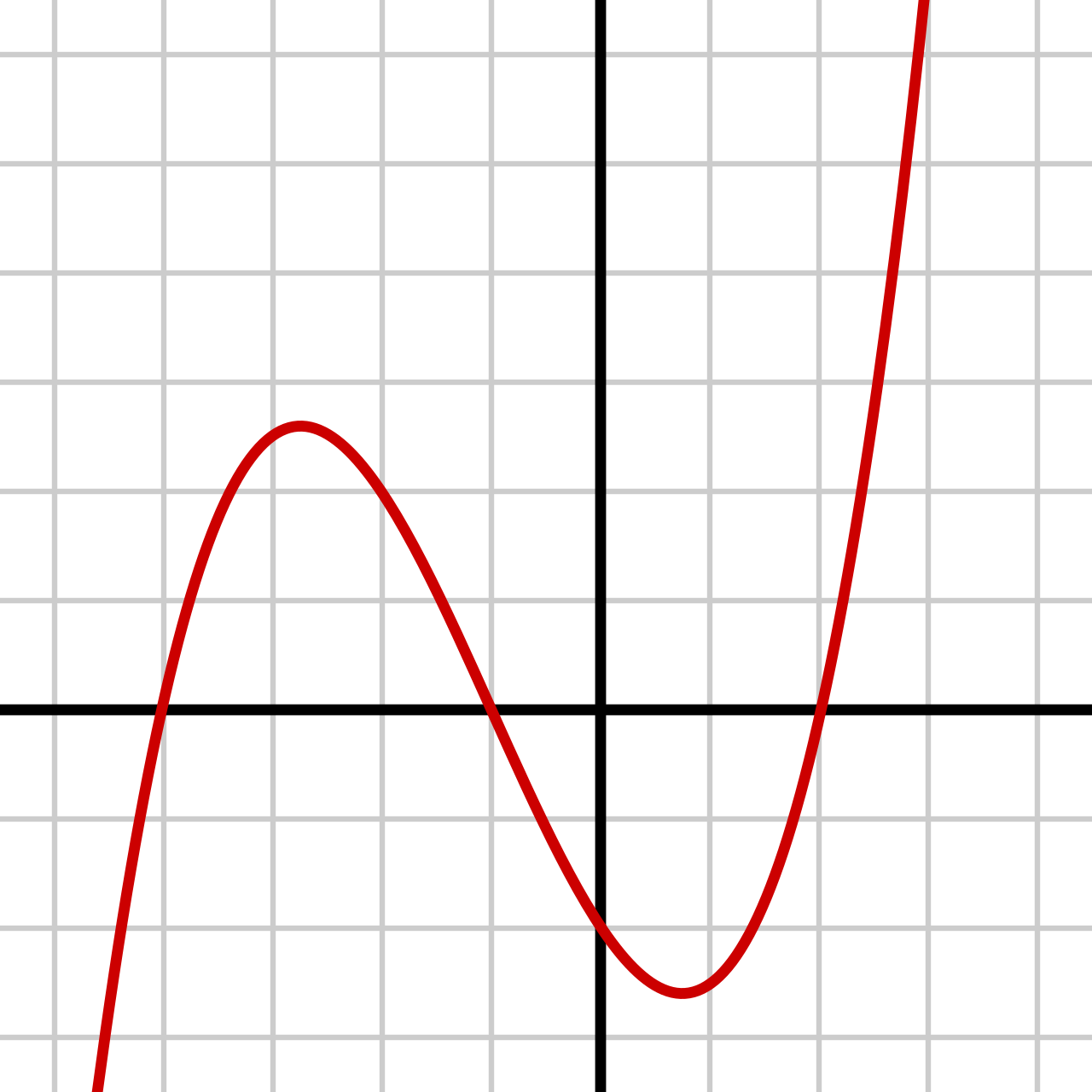
The graph of a third-degree polynomial, illustrating the continuous and predictable trajectory these algebraic models generate.
For the middle school mathematics teacher, mastering polynomial operations is not simply about learning rules for moving symbols around a page. It is about understanding the structural architecture of algebra so deeply that you can anticipate precisely where a student's intuition will fail, and how to rebuild it. When we manipulate these expressions, we rely on a profound mathematical truth: the mathematical set of polynomials is closed under the operations of addition, subtraction, and multiplication. This means that when you add, subtract, or multiply two polynomials, your result is guaranteed to be another polynomial. There are no sudden breaks in the machinery, no unexpected divisions by zero, and no asymptotes generated—just a beautifully predictable new expression.
Before we operate on polynomials, we must understand their constituent parts.
A term in a polynomial is a single mathematical expression consisting of a numerical coefficient multiplied by one or more variables. Think of terms as the individual building blocks of the expression. Depending on the highest exponent of the variable within these terms, we classify the polynomial's degree:
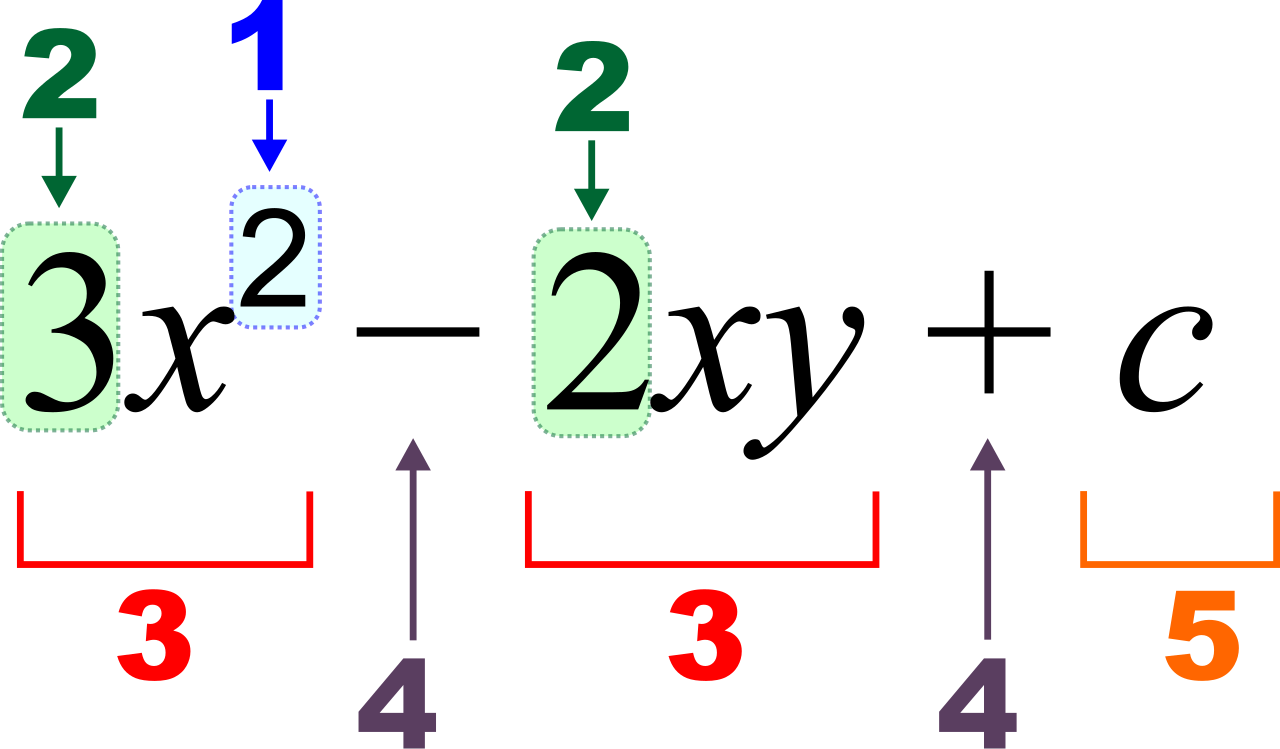
The anatomy of an algebraic expression, identifying the coefficient, variable, exponent, and constant terms that build up a polynomial expression.
A linear polynomial is a polynomial in which the highest exponent of the variable is exactly one (e.g., 3x−5).
A quadratic polynomial is a polynomial in which the highest exponent of the variable is exactly two (e.g., 4x2+2x−7).
To maintain clarity and uniformity, mathematicians write polynomials in standard form, meaning the terms of the polynomial are arranged in descending order of their degree. Think of standard form as packing a suitcase by placing the heaviest, most dominant items at the bottom. The term with the highest exponent controls the overall behavior of the graph as the variable grows, so it proudly leads the expression.
Adding two polynomials requires identifying and combining all like terms from both polynomial expressions.
Like terms are polynomial terms that contain the exact same variables raised to the exact same exponents. The variables and their exponents act as a unit of measurement. Just as you cannot meaningfully combine 3 meters of length with 2 square meters of area, you cannot combine 3x with 2x2.
The Rule of Addition
Like terms are combined by adding or subtracting the numerical coefficients of the terms. The variable parts of like terms remain unchanged when the terms are added or subtracted.
To facilitate this process, we rely on the commutative property of addition, which allows the terms of a polynomial to be rearranged in any order to group like terms together.
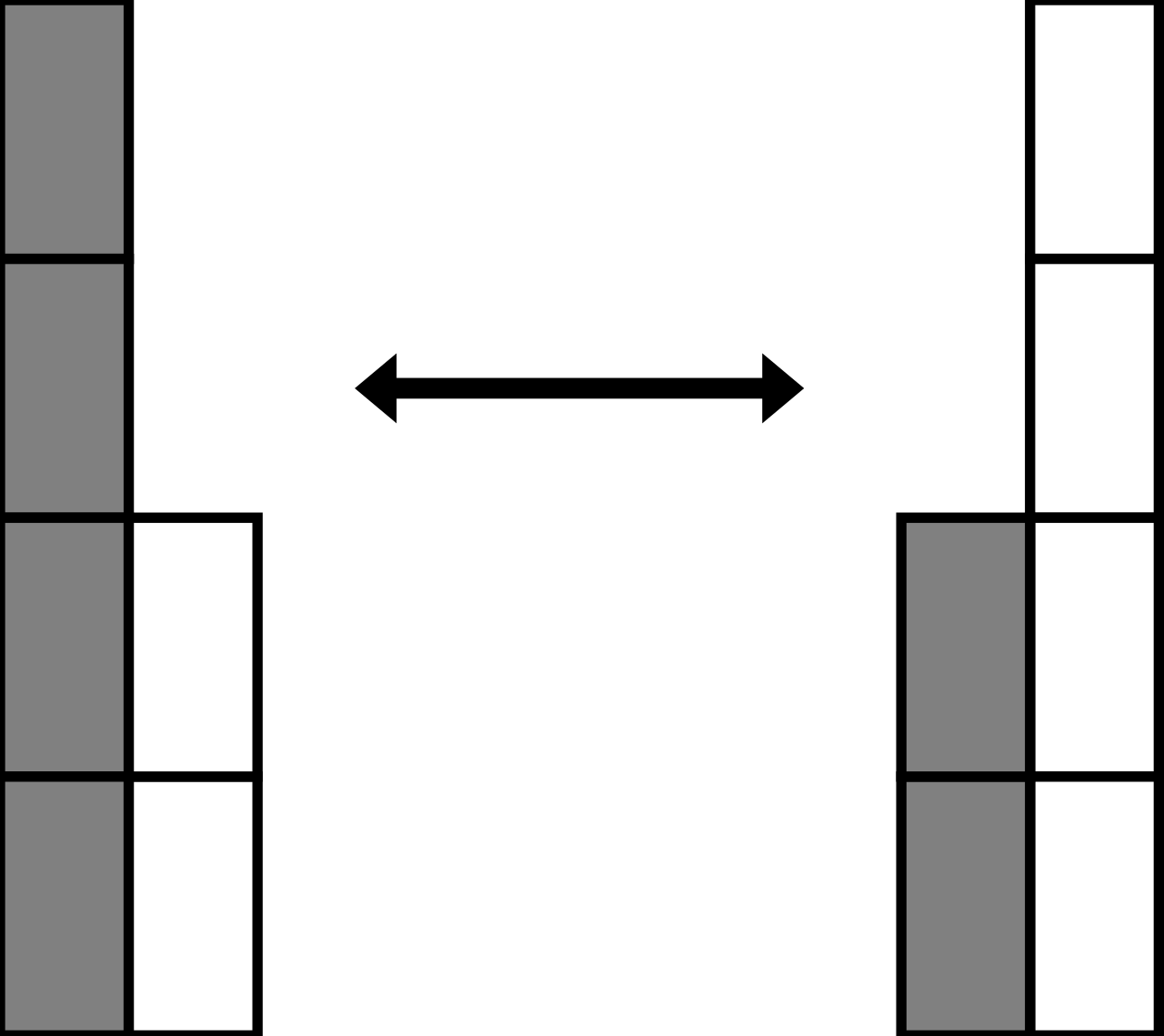
The commutative property of addition allows us to rearrange polynomial terms visually and algebraically, efficiently grouping like items together to simplify the total expression.
As a teacher, you must watch for a highly specific cognitive trap. A common student error when adding like terms is incorrectly adding the exponents of the variables. A student looking at 4x2+3x2 will often enthusiastically write 7x4.
They do this because they are conflating the rules of multiplication with the rules of addition. The remedy is to lean on concrete analogies: If x2 represents the area of a specific square, then four of those squares plus three of those squares yields seven squares of the exact same size. The size of the square (x2) does not miraculously expand into a hyper-dimensional cube (x4) simply because you gathered more of them into a pile.
Rational Coefficients in Addition
Often, coefficients are not whole numbers. Rational coefficients are numerical multipliers in a polynomial that can be expressed as a fraction of two integers, such as 32x2.
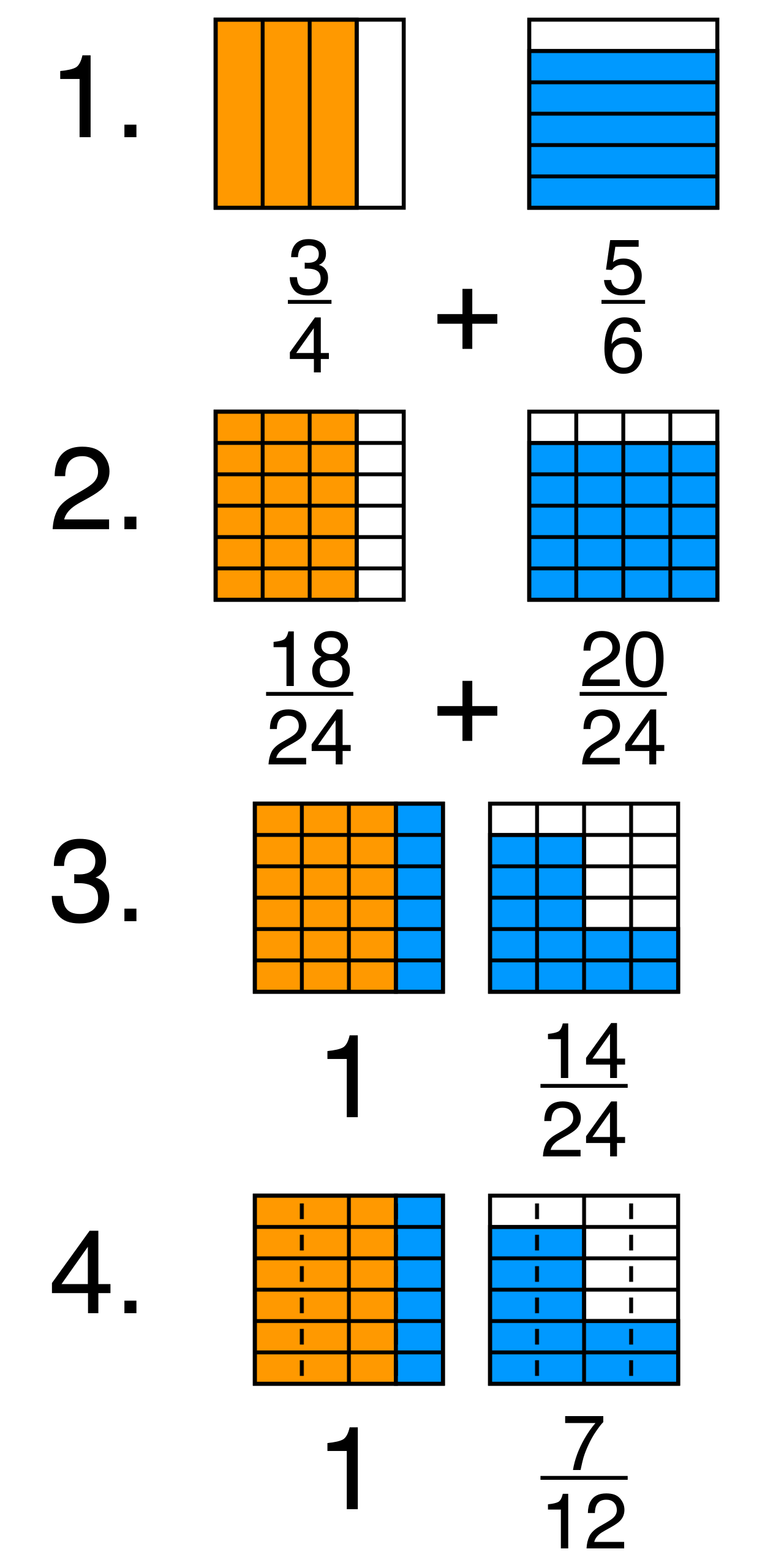
Combining like terms with rational fraction coefficients requires finding a common denominator for those numerical fractions. If you are adding 21x and 31x, the mathematics of the variables dictates they can be combined, but the arithmetic of the rational numbers demands a common denominator of 6, resulting in 65x.
Adding rational coefficients requires finding a common denominator, geometrically equivalent to subdividing regions into identically sized fractional units before they can be meaningfully combined.
Subtraction introduces a subtle but dangerous layer of complexity. Mathematically, subtracting a polynomial is mathematically equivalent to adding the additive inverse of that entire polynomial.
The additive inverse of a polynomial is created by changing the positive or negative sign of every numerical coefficient in the expression. Practically speaking, subtracting a polynomial requires distributing a negative one multiplier to every term inside the subtracted polynomial.
Consider the subtraction:
(5x2+3x)−(2x2−4x+1)
To process this, we rewrite it by distributing a −1 across the second polynomial, effectively finding its additive inverse:
(5x2+3x)+(−2x2+4x−1)
The Predictable Student Misconception
A frequent student misconception during polynomial subtraction is failing to distribute the negative sign to the second and subsequent terms of the subtracted polynomial.
A student will confidently write:
5x2+3x−2x2−4x+1
They have treated the negative sign as if it only applies to the front door of the house, ignoring the rooms inside. As a teacher, training students to physically draw the distribution arrows from the negative sign to every term in the parentheses is a tactical defense against this error.
While addition and subtraction are about grouping similar objects, polynomial multiplication is governed by the distributive property of multiplication over addition. Every piece of the first polynomial must interact with every piece of the second polynomial.
Monomials and the Product of Powers
Multiplying a monomial by a larger polynomial requires multiplying the monomial by every individual term inside the larger polynomial. When we multiply the variables themselves, we utilize the product of powers property, which states that multiplying two terms with identical variable bases requires adding the exponents of those bases.
For example, 2x(3x2+4x)=6x3+8x2. We multiply the coefficients, and we add the exponents.
When dealing with rational fraction coefficients, the arithmetic rules shift. Multiplying polynomial terms with rational fraction coefficients requires multiplying the numerators together and multiplying the denominators together. There is no need for a common denominator here; 21x⋅43x2 simply becomes 83x3.
Binomials and the FOIL Mnemonic
Multiplying a binomial by another binomial involves distributing each term of the first binomial to each term of the second binomial.
To help students track this exhaustive pairing, we use the FOIL method, which is a mnemonic device representing the multiplication of the First, Outer, Inner, and Last terms of two binomials.
If we multiply (x+3)(x+4):
First: x⋅x=x2
Outer: x⋅4=4x
Inner: 3⋅x=3x
Last: 3⋅4=12
Combining the like terms from the outer and inner products (4x+3x) yields x2+7x+12. Notice the pattern here: multiplying two linear binomials generally produces a quadratic trinomial after combining the resulting like terms.
Perfect Square Trinomials
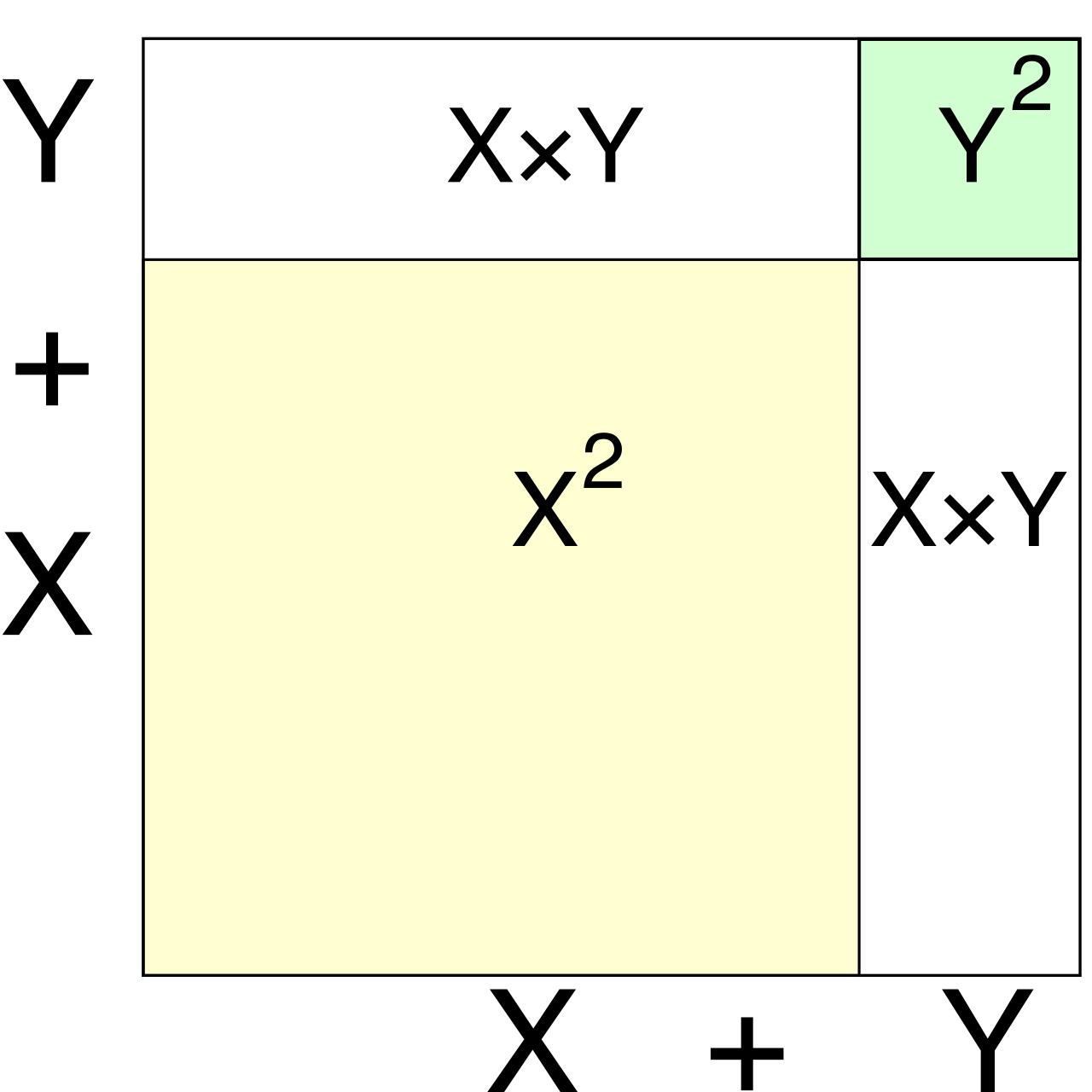
When the binomials are identical, fascinating geometries emerge. Squaring a binomial composed of two terms produces a perfect square trinomial equal to the square of the first term, plus twice the product of the terms, plus the square of the second term:
(a+b)2=a2+2ab+b2
The Predictable Student Misconception:
If there is one algebraic mistake that haunts middle and high school math classrooms, it is this: a common algebraic mistake when squaring a binomial is omitting the middle cross-product term entirely.
When faced with (x+5)2, students will almost instinctively write x2+25. They incorrectly distribute the exponent across addition—an illegal maneuver. By showing them a geometric area model—a large square divided into four smaller rectangles with areas x2, 5x, 5x, and 25—you can prove to them that the middle cross-product term (10x) physically occupies space. It cannot be ignored.
An area model geometrically visualizes that squaring a binomial generates middle cross-product regions, forcefully dismantling the common student misconception that a binomial square is simply the sum of its squared terms.
Scaling Up: Binomials times Quadratics
As polynomials grow in degree and term count, the FOIL mnemonic breaks down because it is explicitly designed for a 2×2 term multiplication.
However, the underlying mechanism—the distributive property—remains perfectly intact. Multiplying a linear binomial by a quadratic trinomial requires a minimum of six distinct term multiplications before combining like terms.
Consider (x+2)(x2+3x−4).
The x must multiply all three terms in the trinomial. Then, the 2 must multiply all three terms in the trinomial.
Finally, we comb through the expression, identifying and combining like terms (3x2 with 2x2, and −4x with 6x), re-establishing standard form:
x3+5x2+2x−8
When you step into your classroom or sit for the Praxis 5164 exam, remember that polynomial operations are deeply sequential. Multiplication builds on addition; polynomials build on rational number arithmetic; and quadratic behaviors emerge predictably from linear inputs. By mastering not just the procedural mechanics, but the reasons those mechanics work, you transform algebraic rules from arbitrary demands to logical necessities.