Fractions, Decimals, and Percents
Not sure you’re ready?
Take the ~3-minute readiness diagnostic and see where you stand.
Imagine a baker attempting to scale a recipe who receives ingredients measured in three different systems: one-third of a cup of sugar, 0.5 kilograms of flour, and a yeast packet labeled as 25% larger. To combine these elements into a single coherent dough, the baker must translate them into a common language. In mathematics, fractions, decimals, and percents function precisely like these different units of measurement. They are not distinct mathematical entities, but rather three distinct dialects used to articulate the exact same concept: parts of a whole. As a middle school mathematics teacher, your task is to reveal the underlying grammar that connects these dialects. When students grasp that dividing a pizza, calculating a tip, and analyzing statistical probabilities are identical operations masked by different notation, they transition from memorizing disjointed algorithms to fluent mathematical reasoning.
Before we can translate between these dialects, we must define the rules of the system. The English word percent derives directly from the Latin per centum, meaning "by the hundred." Consequently, the percent symbol indicates division by one hundred. It is a shorthand visual cue telling the reader that the number attached to it is the numerator of a fraction whose denominator is exactly 100.
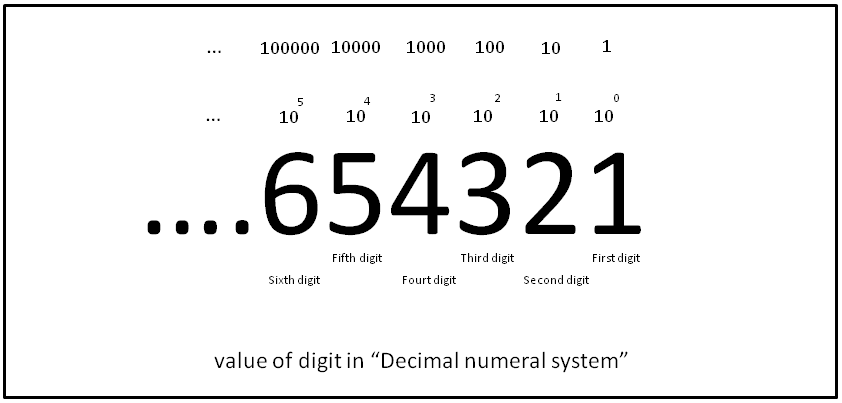
Because our entire place-value system is based on powers of ten, navigating between decimals and percents is remarkably fluid.
- To convert a percent to a decimal, divide the percent value by one hundred. Because of the base-10 structure, dividing a number by one hundred is mathematically equivalent to moving the number's decimal point two places to the left.
- Conversely, to convert a decimal to a percent, multiply the decimal value by one hundred. Physically on the page, multiplying a number by one hundred is mathematically equivalent to moving the number's decimal point two places to the right.
To tie this directly to fractional notation: to convert a percent to a fraction, write the percent value as the numerator over a denominator of one hundred.
Fractions are the most explicit way to write a division problem. To convert a fraction to a decimal, divide the fraction's numerator by the fraction's denominator. When your students do this, they will notice that some fractions divide cleanly to an end, while others generate digits that march on forever. This is not arbitrary; it is a structural artifact of our base-10 number system.
The number 10 is built from exactly two prime factors: 2 and 5. Therefore, any fraction that can be scaled into a perfect power of 10 (tenths, hundredths, thousandths) must be built strictly from those same prime building blocks.
- A fraction produces a terminating decimal if the prime factorization of the simplified fraction's denominator contains only twos and fives. For example, 403 terminates because 40=2×2×2×5.
- However, a fraction produces a repeating decimal if the prime factorization of the simplified fraction's denominator contains any prime factors other than two or five. If a 3, 7, or 11 sneaks into the denominator's prime factorization (such as in 61, where 6=2×3), the base-10 system cannot cleanly resolve it.
A repeating decimal features a sequence of one or more digits that repeats infinitely. To represent this on the page without writing infinitely many digits, mathematicians use the vinculum, which is a horizontal bar placed over the repeating digits of a decimal to indicate infinite repetition (e.g., 0.3).
Reversing the Translation: Decimals to Fractions
When working backward from a terminating decimal to a fraction, the place-value system does the heavy lifting. To convert a terminating decimal to a fraction, use the digits of the decimal as the numerator and the place value of the final digit as the denominator. For example, 0.48 becomes 10048. However, the translation is not considered complete until it is in its most elegant form. The fractional equivalent of a terminating decimal must often be simplified by dividing the numerator and denominator by their greatest common factor. In this case, dividing both 48 and 100 by their greatest common factor of 4 yields 2512.
Converting a repeating decimal back to a fraction requires one of the most satisfying sleights-of-hand in middle school algebra. We cannot simply place the digits over a base-10 denominator because the digits never end. Instead, we must use algebra to "chop off" the infinite tail.
Here is the precise mechanical process to teach your students:
- The first step in algebraically converting a repeating decimal to a fraction is to set a variable equal to the repeating decimal. Let x=0.454545...
- To shift the decimal point past one full repeating sequence, multiply the initial decimal equation by ten raised to the power of the repeating sequence length. Because "45" is a two-digit repeating sequence, we multiply by 102, or 100. 100x=45.454545...
- Subtracting the original repeating decimal equation from the shifted decimal equation cancels out the infinitely repeating fractional part.
100x=45.454545... −x=0.454545... -------------------- 99x=45
By solving for x, we reveal that x=9945. This elegant algebraic maneuver yields an incredibly useful shortcut that your students will rely on:
- A repeating decimal with exactly one repeating digit immediately following the decimal point equals a fraction with that repeating digit over nine (e.g., 0.7=97).
- A repeating decimal with exactly two repeating digits immediately following the decimal point equals a fraction with those two digits over ninety-nine (e.g., 0.45=9945, which simplifies to 115).
There are two primary cognitive bridges your students can use to traverse from fractions to percents.
- To convert a fraction to a percent, first convert the fraction to a decimal, then multiply the resulting decimal by one hundred. This is the brute-force, algorithmic path.
- Alternatively, a fraction can be converted to a percent by solving a proportion where the fraction equals an unknown value divided by one hundred (e.g., 53=100x). This path is profoundly important because it explicitly reinforces algebraic reasoning and the definition of a percent, laying the groundwork for complex scaling problems.
If arithmetic is the syntax of mathematics, geometry is the meaning. Students must see equivalence physically to believe it abstractly. The licensure exam will expect you to fluently interpret and design several core visual models:
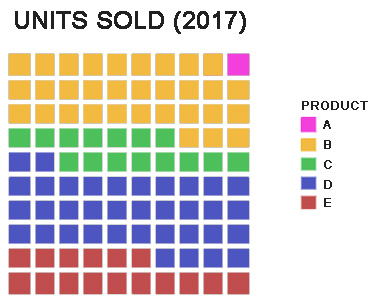
The Hundredths Grid A hundredths grid is a visual model consisting of a ten-by-ten square used to represent parts of a whole. It is the most direct physical translation of a percent.
- In a hundredths grid, shading exactly one square represents one percent of the whole. Because it is one out of one hundred, it mathematically represents the decimal value 0.01 and simultaneously represents the fraction 1/100.
- If we zoom out slightly, in a hundredths grid, shading an entire row of ten squares represents ten percent of the whole. Because ten out of one hundred simplifies to one out of ten, this row represents the decimal value 0.1 and exactly represents the fraction 1/10.
Linear and Proportional Models
-
A number line visually demonstrates the equivalence of fractions, decimals, and percents by plotting equivalent values at the exact same physical point. A number line proves to a student that 1/2, 0.5, and 50% are not three different numbers taking up space in the universe; they are coordinates mapping to the exact same location in space.
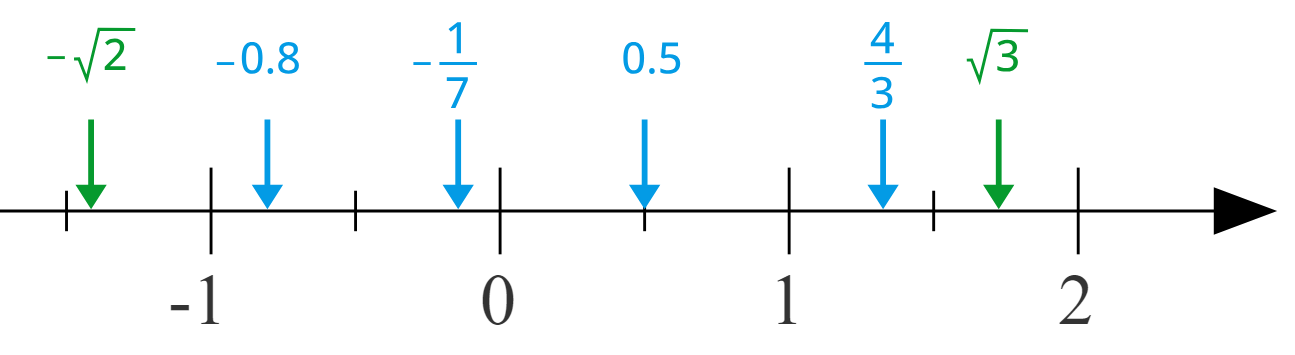
The number line proves equivalence geometrically by showing that equivalent fractions and decimals occupy the exact same physical coordinate in one-dimensional space. Source: Number line by Phlsph7, CC BY 4.0. -
A tape diagram is a rectangular visual model divided into equal-sized segments to represent proportional relationships between fractions and percents. If a tape diagram representing 100% is divided into 4 equal segments, each rectangular block visually represents 25%, allowing students to easily solve "part-to-whole" word problems.
-
A pie chart represents parts of a whole by dividing a circle into sectors whose central angles are proportional to given fractions or percents. Because a circle contains 360 degrees, a sector representing 25% must possess a central angle of exactly 90 degrees.
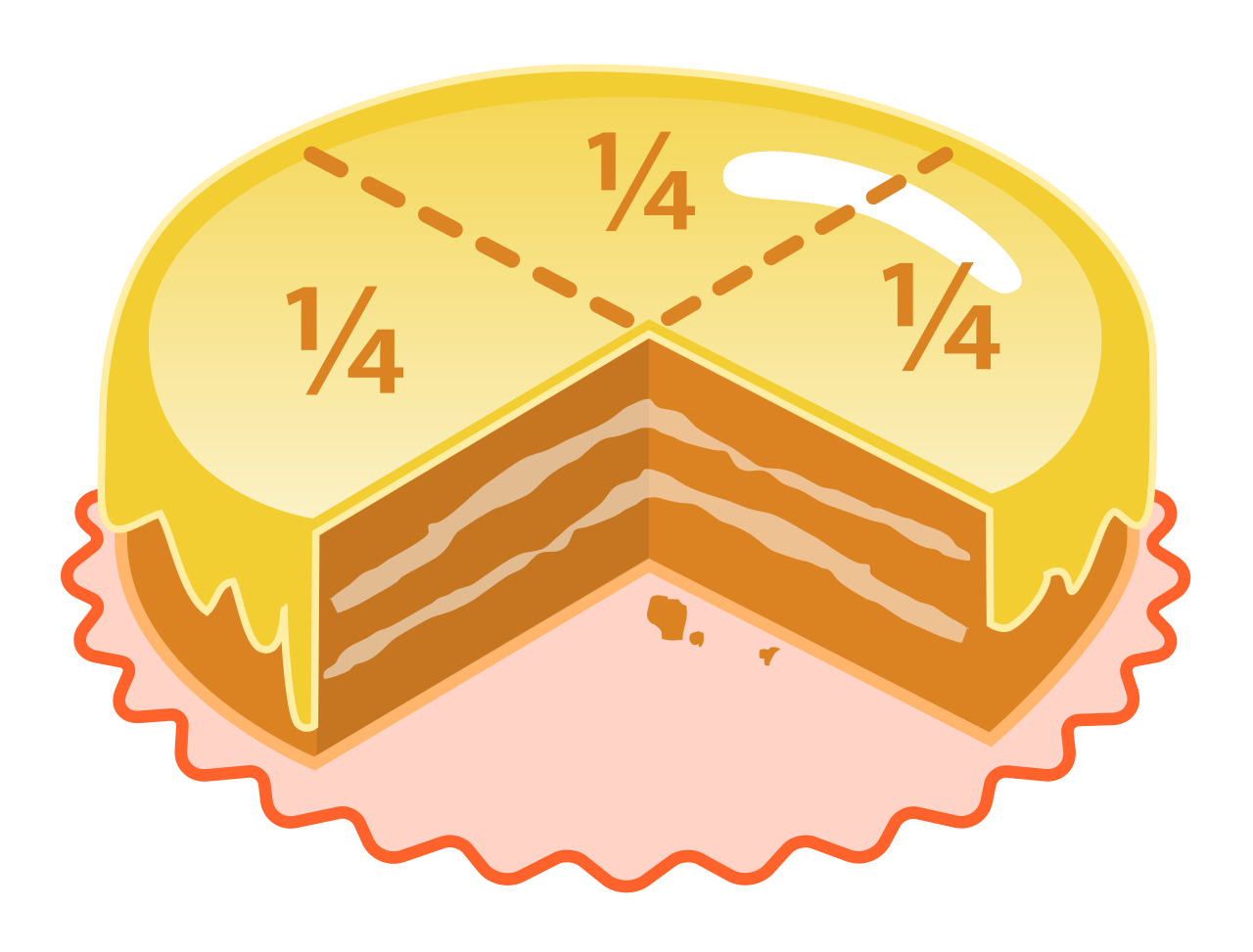
Circular models like pie charts rely on 360-degree proportionality, meaning a 25% sector naturally forms a 90-degree central angle corresponding exactly to one-fourth of the whole.
Just as language learners must memorize common vocabulary words to avoid constantly looking at a dictionary, middle school mathematics students must memorize canonical equivalencies. Fluency in these core translations reduces cognitive load, allowing students to focus on higher-level algebraic logic.
At the very foundation of this lexicon is unity: the integer one is mathematically equivalent to the percent 100%.
From unity, we break down the most common ratios:
| Fraction | Decimal | Percent |
|---|---|---|
| The fraction one-half | is mathematically equivalent to the decimal 0.5 | The decimal 0.5 is mathematically equivalent to the percent 50%. |
| The fraction one-fourth | is mathematically equivalent to the decimal 0.25 | The decimal 0.25 is mathematically equivalent to the percent 25%. |
| The fraction three-fourths | is mathematically equivalent to the decimal 0.75 | The decimal 0.75 is mathematically equivalent to the percent 75%. |
| The fraction one-fifth | is mathematically equivalent to the decimal 0.2 | The decimal 0.2 is mathematically equivalent to the percent 20%. |
| The fraction one-eighth | is mathematically equivalent to the decimal 0.125 | The decimal 0.125 is mathematically equivalent to the percent 12.5%. |
Furthermore, the foundational repeating fraction must be memorized: the fraction one-third is mathematically equivalent to the repeating decimal 0.333..., which means the repeating decimal 0.333... is mathematically equivalent to the repeating percent 33.333...%.
The greatest conceptual hurdles often arise when students are forced beyond the bounds of 0 to 1. The human brain instinctively wants a fraction or percent to mean a "part" of something smaller than the whole.
However, mathematical logic does not stop at 100%. A percent value strictly greater than one hundred represents a numerical value greater than one whole. If a business's revenue grows by 150%, they have not just kept their original revenue; they have added an additional one and a half times that amount. In exact parallel, a decimal value strictly greater than one translates to an improper fraction or a mixed number (e.g., 1.5=1015=121).
On the opposite end of the spectrum lies the microscopic. A percent value strictly less than one represents a numerical value less than 0.01. This is a notorious trap in real-world finance—a fee of 0.5% is half of a single percent, meaning its decimal equivalent is 0.005. Recognizing that 0.5% is drastically different from 50% (or 0.5) is not just a standard to be tested; it is an essential layer of financial literacy you are actively building in your students' minds.