Solving Nonlinear Equations
Not sure you’re ready?
Take the ~3-minute readiness diagnostic and see where you stand.
The leap from linear to nonlinear equations represents a fundamental shift in mathematical reasoning. In a linear world, every step is predictable and invertible: a single input yields a single output, and every equation maps to a straight line without a bend. But introduce an absolute value bar or square a variable, and the geometry of the situation warps. Lines fold into V-shapes and bend into sweeping curves. Suddenly, a single equation might yield two distinct solutions, one solution, or none at all. For a mathematics educator, mastering nonlinear equations—specifically absolute value and quadratic equations—is not merely about drilling algorithmic steps. It is about equipping students to connect abstract algebraic manipulation with spatial intuition, teaching them to see that setting an equation to zero is synonymous with finding where a mathematical curve touches the ground.
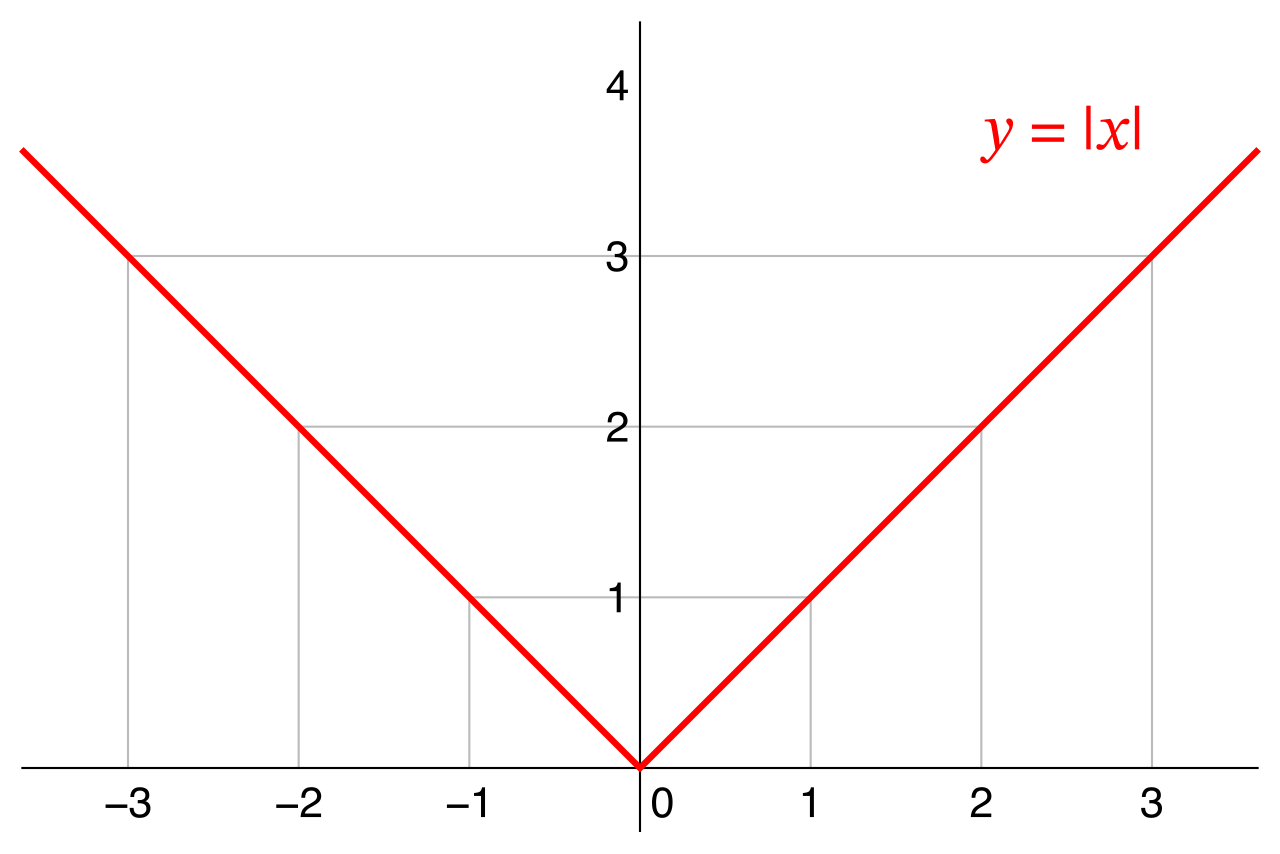
Before diving into complex algebra, we must define what absolute value actually is. To a middle schooler, it often looks like a magic machine that arbitrarily turns negative numbers positive. But physically, the absolute value of a number represents the distance of that number from zero on the real number line. Because distance is a physical measurement of length, it can never be negative.
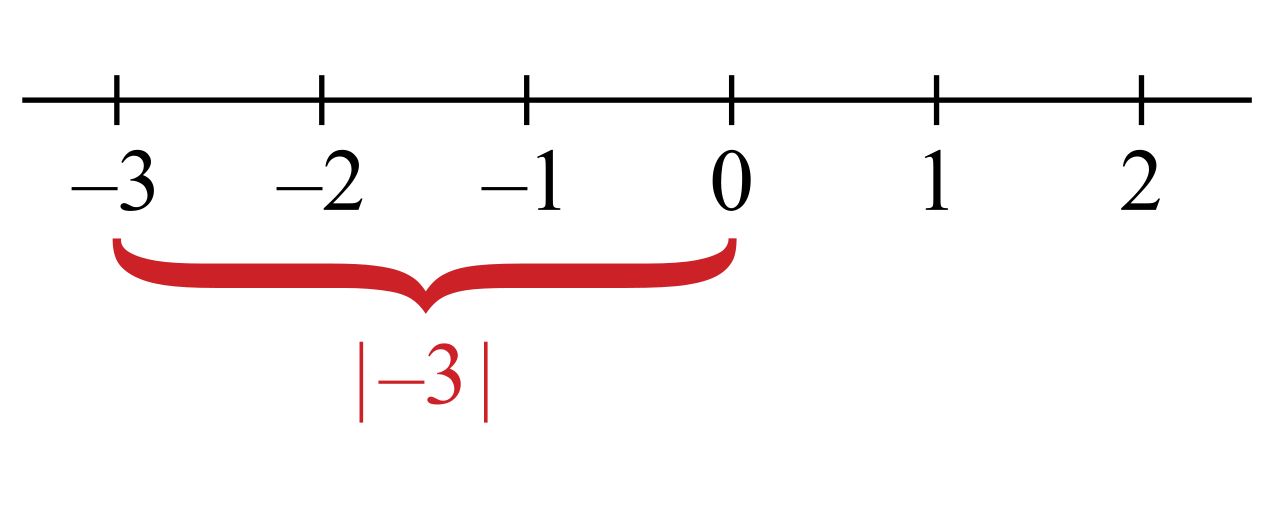
When we solve an absolute value equation, we are effectively asking, "What points are exactly this far away from a certain spot?" However, before we can decode this distance, an absolute value expression must be isolated on one side of an equation before splitting the equation into multiple cases. If you have 2∣x−3∣+4=10, you must peel away the 4 and the 2 before you deal with the absolute value bars.
Once isolated into the form ∣ax+b∣=c, the geometry dictates three possible realities depending entirely on the value of c:
- c>0: An absolute value equation of the form ∣ax+b∣=c has exactly two real solutions when the constant c is greater than zero. If a point is 5 units from zero, it could be at +5 or −5. Therefore, solving the equation ∣ax+b∣=c for a positive constant c requires solving the two distinct linear equations ax+b=c and ax+b=−c.
- c=0: An absolute value equation of the form ∣ax+b∣=c has exactly one real solution when the constant c is equal to zero. There is only one place that is exactly zero units away from zero: zero itself.
- c<0: An absolute value equation of the form ∣ax+b∣=c has no real solutions when the constant c is less than zero. If a student tries to solve ∣x∣=−4, remind them of the geometry. You cannot walk negative four steps.
Moving from absolute value to quadratic equations, the V-shape of distance smooths out into a sweeping curve. A one-variable quadratic equation can be written in the standard form ax2+bx+c=0 where a, b, and c are constants and a is not equal to zero.
When we graph the corresponding function y=ax2+bx+c, we leave the straight line behind. The graph of a quadratic function y=ax2+bx+c is a symmetric U-shaped curve known as a parabola.
This curve tells a physical story, highly relevant to students throwing a basketball or tracking a rocket. The direction the curve opens is entirely dictated by the leading coefficient, a:
- A parabola opens upward when the leading coefficient a in the quadratic function y=ax2+bx+c is a positive number. (Imagine a smile, or a bowl holding water).
- A parabola opens downward when the leading coefficient a in the quadratic function y=ax2+bx+c is a negative number. (Imagine a frown, or the trajectory of an object thrown under the force of gravity).
Crucially, the algebraic solutions to our equation are staring at us from the graph. The real solutions to a quadratic equation ax2+bx+c=0 correspond exactly to the x-intercepts of the graph of the function y=ax2+bx+c. When we set the equation to zero, we are asking: Where does the basketball hit the floor?
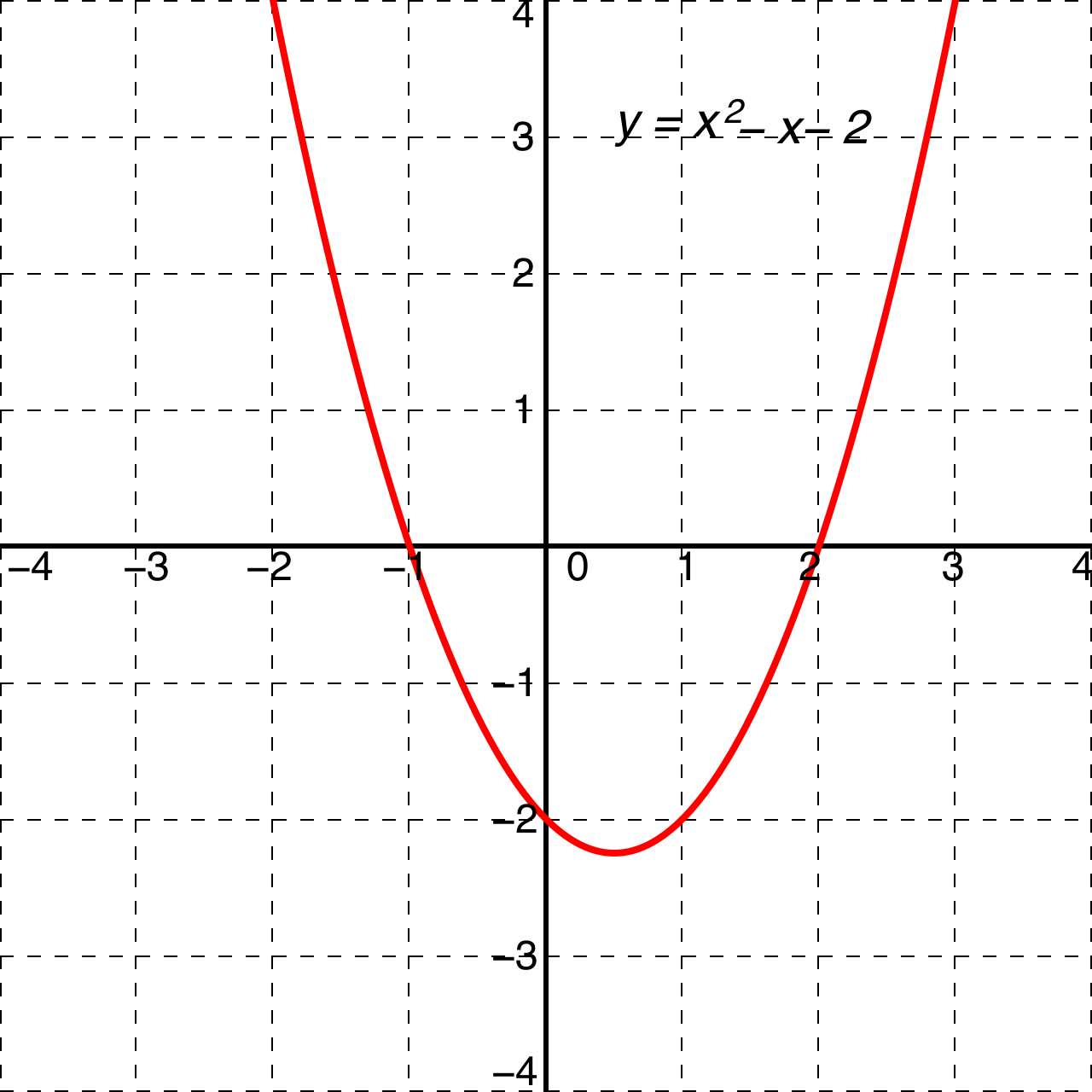
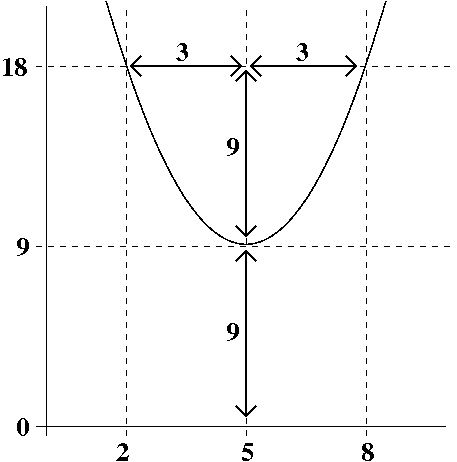
Because the parabola is perfectly symmetrical, its peak or valley—the vertex—is locked in the middle. The x-coordinate of the vertex of a parabola lies exactly halfway between the two x-intercepts of the parabola. By averaging the intercepts (when they exist), or by applying calculus to the standard form, we derive a beautifully simple tool: The x-coordinate of the vertex of the parabola defined by y=ax2+bx+c is calculated using the formula x=−b/(2a).
When an equation is set to zero, we can exploit one of the most powerful logical rules in arithmetic. The Zero Product Property states that if the product of two or more quantities is zero, then at least one of those quantities must be equal to zero. You cannot multiply two non-zero numbers and get zero.
This property is the exact reason we teach factoring. By breaking a complex quadratic down into multiplying pieces, we can solve them individually. A quadratic equation is written in factored form as a(x−r1)(x−r2)=0.
When we apply the Zero Product Property to this form, we see that the equation is true if x−r1=0 or if x−r2=0. Thus, the constants r1 and r2 in the factored quadratic equation a(x−r1)(x−r2)=0 represent the solutions to the equation.
Factoring is elegant, but it only works when the roots are friendly, rational numbers. For everything else, we must force the equation into a form we can solve directly.
Completing the square is an algebraic method used to convert a quadratic equation from standard form into vertex form. By deliberately building a perfect square trinomial, we gain the ability to isolate x using a square root.
The mechanics of this rely on a specific relationship between the x2 term and the x term. To complete the square for the expression x2+bx, a solver must add the square of half the linear coefficient b.
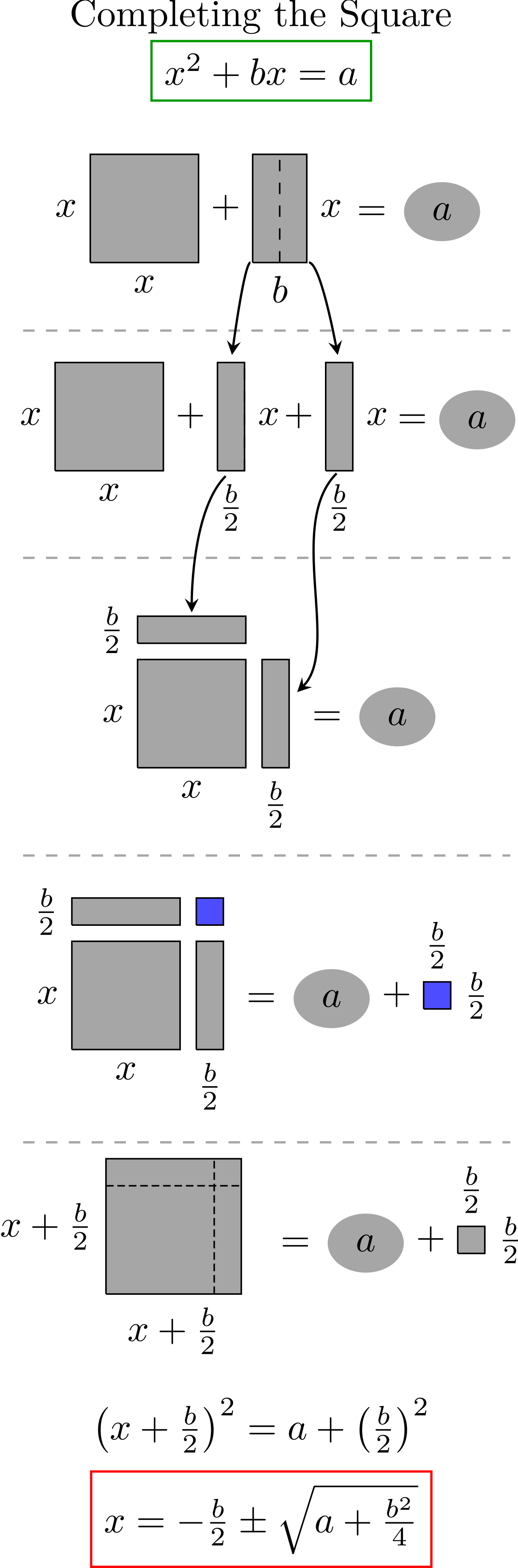
The Mechanics of Completing the Square: If you have x2+6x, the linear coefficient b is 6. Half of 6 is 3, and 32=9. By adding 9, we construct x2+6x+9, which magically collapses into the perfect square (x+3)2.
If you apply the process of completing the square to the abstract standard form ax2+bx+c=0, you generate the master key for all quadratics. The quadratic formula for solving ax2+bx+c=0 is x=(−b±b2−4ac)/(2a).
Look closely at that formula. Notice the −b/(2a) sitting at the front? That is our vertex! The formula essentially says: Start at the center of symmetry (the vertex), and walk outward to the right (+) and left (−) by the square root portion to find your x-intercepts.
The expression inside that square root is the most sensitive part of the equation. The discriminant of a quadratic equation ax2+bx+c=0 is the mathematical expression b2−4ac. Because it lives under a square root, the discriminant entirely dictates the nature and number of the solutions.
| Discriminant Value | Geometric Meaning | Algebraic Result |
|---|---|---|
| b2−4ac>0 | Parabola crosses the x-axis twice. | A quadratic equation has exactly two distinct real solutions when its discriminant is strictly greater than zero. |
| b2−4ac=0 | Parabola's vertex rests exactly on the x-axis. | A quadratic equation has exactly one real solution when its discriminant is exactly equal to zero. Because the ± part is zero, the roots merge. A single real solution to a quadratic equation with a discriminant of zero is formally called a double root. |
| b2−4ac<0 | Parabola floats above or below the x-axis, never touching it. | A quadratic equation has no real solutions when its discriminant is strictly less than zero. However, algebraically, we shift into the complex plane. A quadratic equation with a negative discriminant has exactly two complex conjugate solutions. |
As students tackle nonlinear equations, they will inevitably try to undo operations. If an equation has a square root, they will square both sides. If an equation features absolute value, they might square both sides to force the terms to be positive.
Herein lies a massive trap that every mathematics teacher must warn against: Applying non-invertible operations like squaring both sides of an equation can introduce extraneous solutions.
When you square a number, you destroy information. (−3)2 and (3)2 both equal 9. If you work backward from 9 by taking a square root, you cannot definitively know if the original input was positive or negative. Because of this loss of information during the squaring step, your final algebra might spit out a number that appears completely legitimate.
However, extraneous solutions are algebraically derived values that do not make the original equation true.
A classic example for your classroom: Solve x=x+2. Square both sides: x2=x+2. Rearrange: x2−x−2=0. Factor: (x−2)(x+1)=0. Solutions: x=2 and x=−1.
Check the work: If x=2, 2=4. True. If x=−1, −1=1. False. The principal square root of 1 is positive 1, not −1. The algebra generated x=−1 flawlessly, but it is an extraneous solution.
This is why, in the nonlinear world, checking one's work is not merely a good habit for earning a high grade. It is an absolute mathematical necessity to ensure that the answers derived align with the physical and geometric reality of the original equation.