Complex Number System
Not sure you’re ready?
Take the ~3-minute readiness diagnostic and see where you stand.
When we demand a solution to the equation x2+1=0, we are asking the one-dimensional real number line to produce something it does not possess. To square a real number is to stretch it and preserve its sign or make it positive, meaning no real number squared can ever yield −1. To solve this, we cannot merely squeeze a new value onto our existing number line; we must break off the line entirely and step into a second dimension. By defining a single new quantity—a unit moving at a strict right angle to everything we have ever known—we unlock a profound algebraic landscape that not only solves x2+1=0, but seamlessly completes the fundamental theorem of algebra.
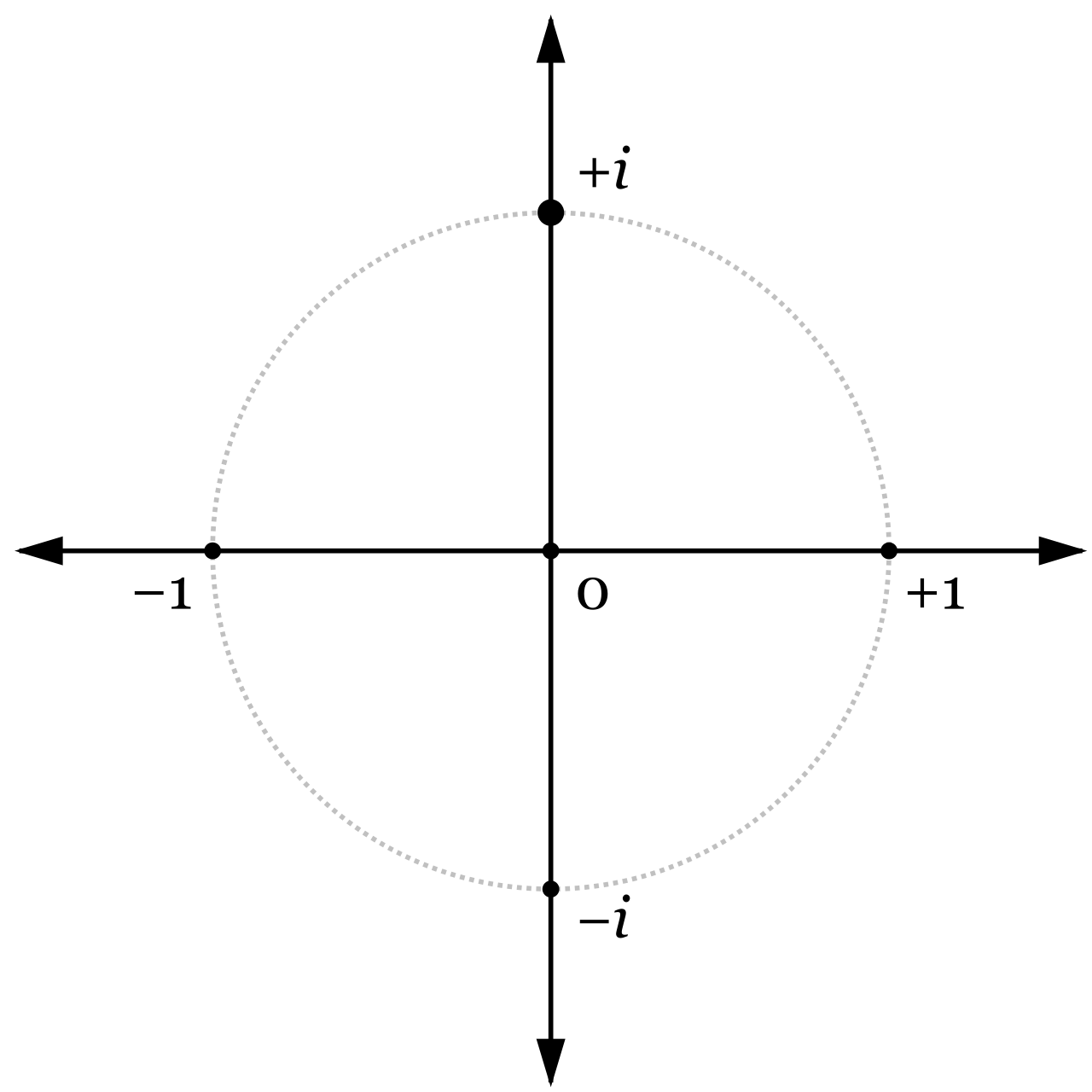
For the aspiring secondary mathematics teacher, the complex number system is not merely a collection of eccentric algebraic tricks to pass onto students; it is a masterclass in structural preservation. We invent a new number, yet remarkably, the familiar laws of arithmetic survive the transition intact. Let us tear down the machinery of the complex number system, examine its parts, and understand exactly why it operates as flawlessly as it does.
To construct this system, we begin with a single definition. The imaginary unit i is defined as the principal square root of -1. From this definition, a strict, uncompromising truth follows: the square of the imaginary unit i is exactly equal to -1.
Armed with this unit, we define the architecture of our new system. A complex number is any number that can be expressed in the standard form a+bi.
It is vital to draw your students' attention to a subtle point of nomenclature here: in the standard form of a complex number a+bi, the variables a and b represent real numbers. The i is the imaginary unit, but the coefficients themselves are pulled strictly from the real number line.
Structural Definitions:
- In the complex number a+bi, the real number a is called the real part.
- In the complex number a+bi, the real number b is called the imaginary part.
- A pure imaginary number is a complex number a+bi where the real part a is exactly zero and the imaginary part b is non-zero. (e.g., 0+3i, or simply 3i).
What happens when b is exactly zero? We are left with a+0i, which is simply the real number a. This reveals a beautiful nesting doll of mathematical sets: every real number is a complex number possessing an imaginary part of exactly zero. The real numbers are not separate from the complex numbers; they are merely the horizontal axis of the complex plane.
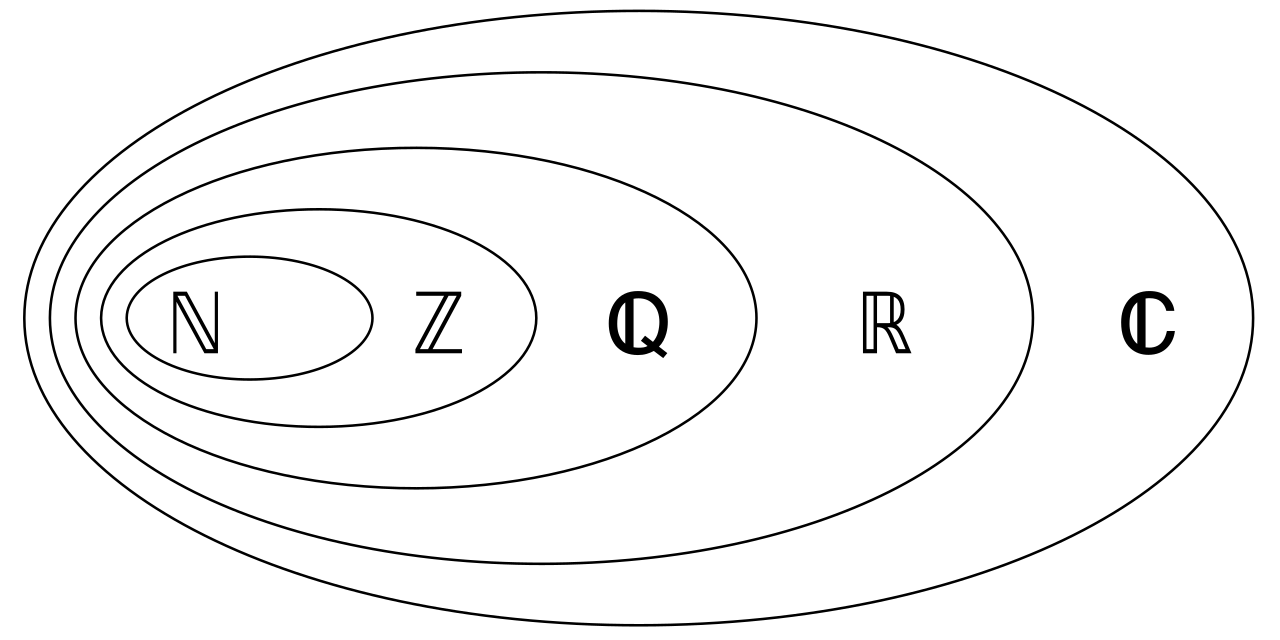
Because the real and imaginary parts exist on entirely separate axes—one horizontal, one vertical—they cannot intermingle. This gives rise to a strict condition for equality: two complex numbers are equal if and only if the respective real parts are equal and the respective imaginary parts are equal. You cannot compensate for a deficit in the real part by adding to the imaginary part. They are independent dimensions of the number.
Because a complex number has two independent components, we can visualize it on a Cartesian coordinate system known as the complex plane, plotting the real part a on the x-axis and the imaginary part b on the y-axis.
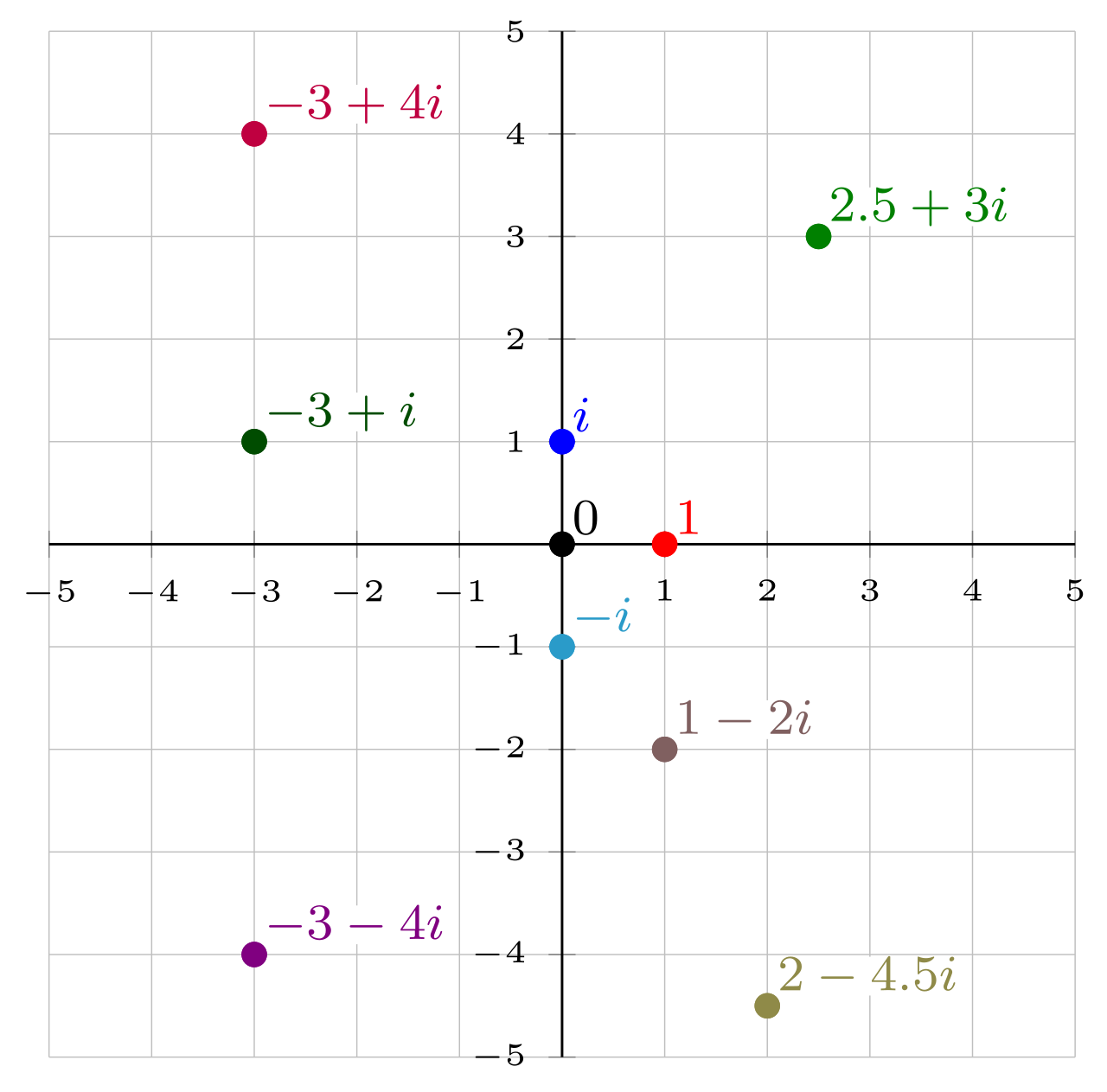
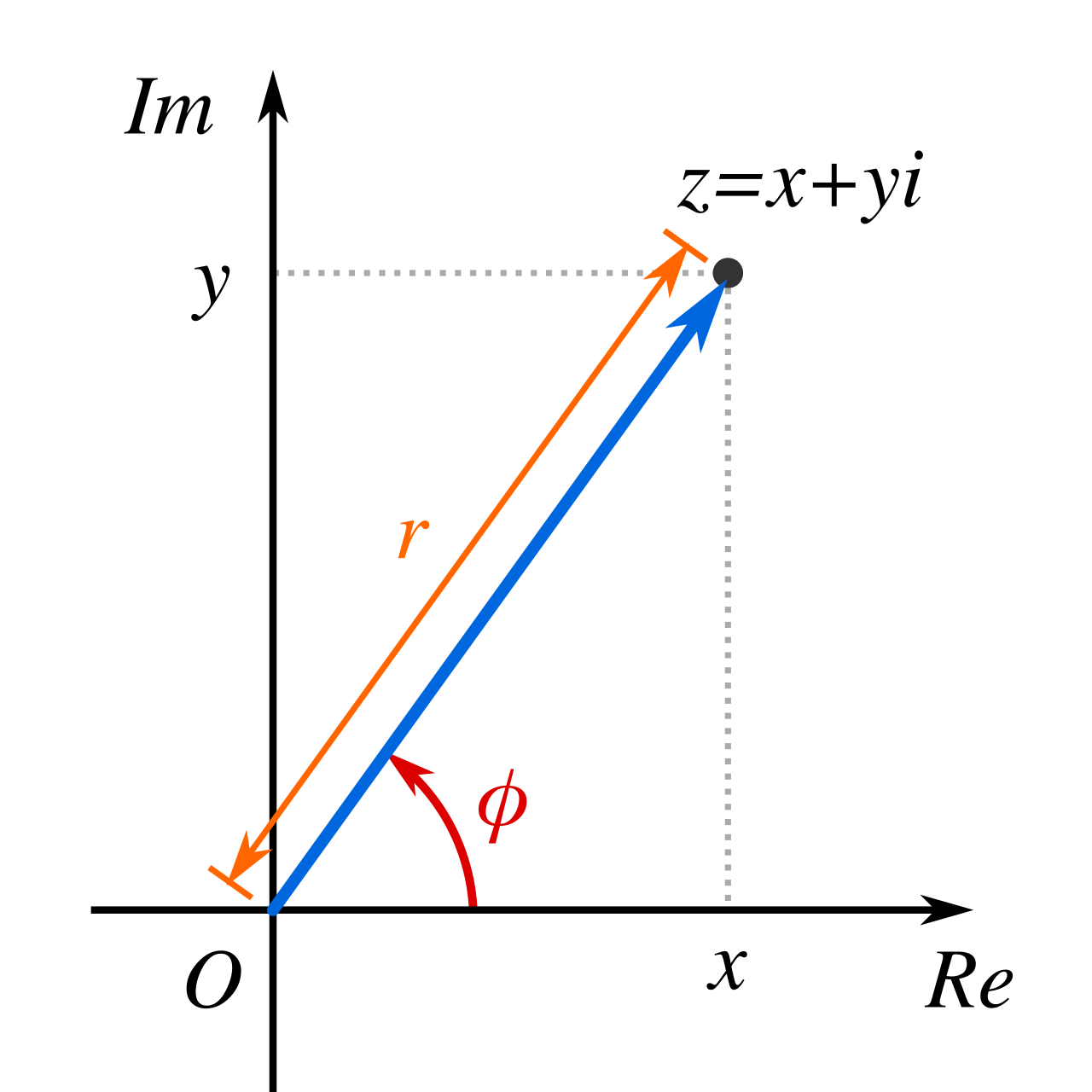
When we ask for the "size" of a real number, we take its absolute value—its one-dimensional distance from zero. In the complex plane, we apply the exact same logic in two dimensions. The absolute value of a complex number a+bi represents the distance from the origin to the point (a,b) in the complex coordinate plane.
Using the Pythagorean theorem, this distance is easily derived. The absolute value of a complex number a+bi is calculated by taking the principal square root of the sum a2+b2. Notation: ∣a+bi∣=a2+b2. Notice that we do not square the i; we are strictly using the real number b.
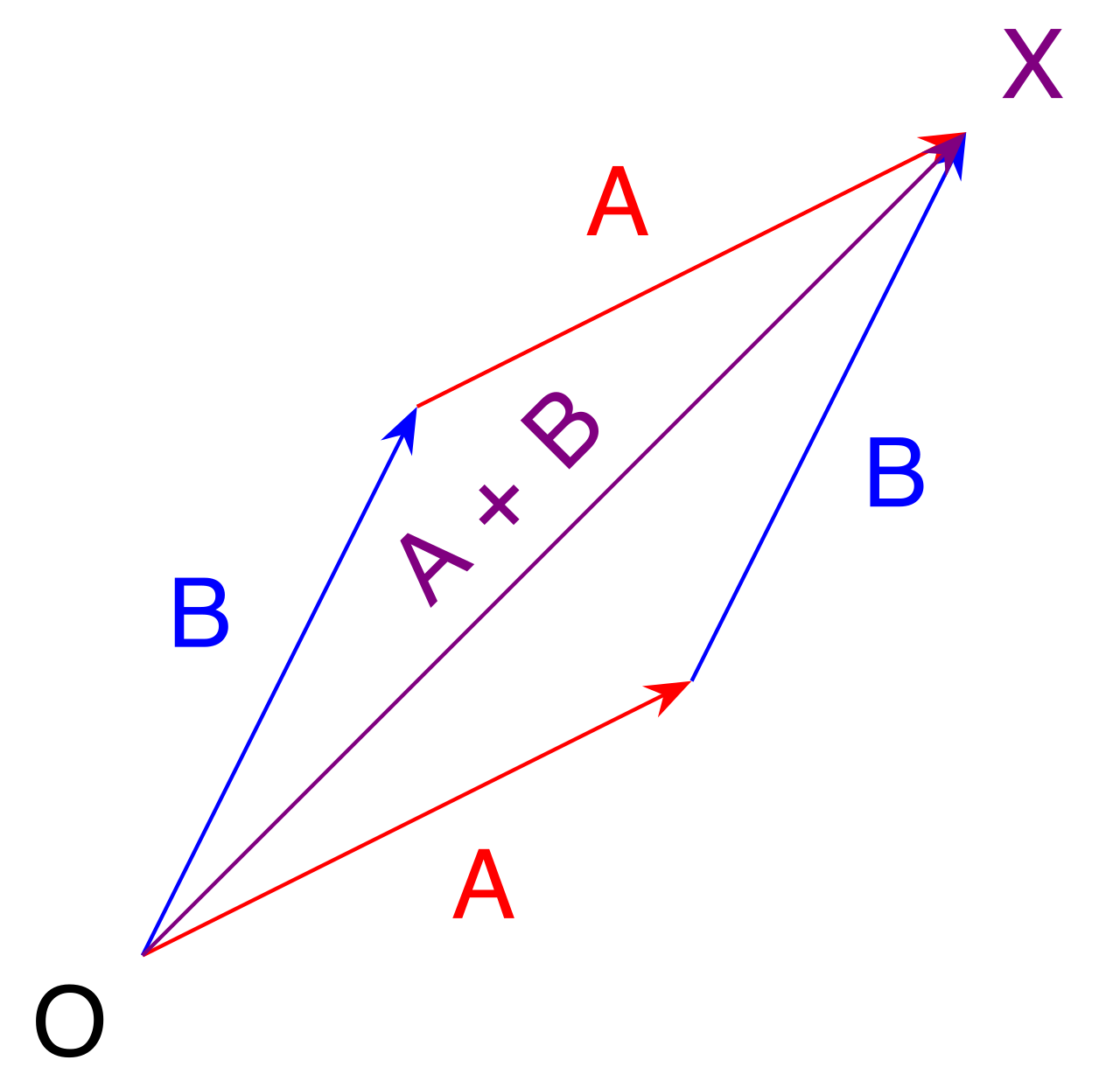
When you teach polynomial addition, you tell students to "combine like terms." Complex addition requires the exact same cognitive framework. To add two complex numbers, a person must add the corresponding real parts together and add the corresponding imaginary parts together.
Similarly, to subtract two complex numbers, a person must subtract the corresponding real parts and subtract the corresponding imaginary parts.
Structural Integrity: The Properties We Keep
The true miracle of the complex number system is that by introducing −1, we did not break the laws of arithmetic. The algebraic properties your students spend years mastering apply perfectly here:
- Closure: When you add or multiply two complex numbers, you are guaranteed to get another complex number. The set of complex numbers is closed under the operation of addition, and the set of complex numbers is closed under the operation of multiplication.
- Commutativity: Order does not matter. The commutative property of addition holds true for all complex numbers (z1+z2=z2+z1), and the commutative property of multiplication holds true for all complex numbers (z1z2=z2z1).
- Associativity: Grouping does not matter. The associative property of addition holds true for all complex numbers, and the associative property of multiplication holds true for all complex numbers.
- Distributivity: The bridge between addition and multiplication stands firm. The distributive property of multiplication over addition holds true for all complex numbers.
Because the structure matches the real numbers, the identity elements are direct parallels:
- The additive identity for the complex number system is 0+0i. Adding this changes nothing.
- The multiplicative identity for the complex number system is 1+0i. Multiplying by this changes nothing.
To reverse addition, we use inverses. The additive inverse of a complex number a+bi is the complex number −a−bi. Adding a complex number to its additive inverse will always return you to the additive identity, 0+0i.
Multiplying complex numbers relies heavily on the distributive property (often taught via the FOIL method). The product of two complex numbers is calculated by applying the distributive property to multiply each part of the first number by each part of the second number.
(a+bi)(c+di)=ac+adi+bci+bdi2
Here, the complex machinery engages. We have an i2 term. Remember our founding definition: i2=−1. When multiplying complex numbers, any resulting i-squared term must be replaced with -1 to simplify the expression into standard form.
Thus, bdi2 becomes −bd, which is a real number, and the result gathers cleanly into standard form: (ac−bd)+(ad+bc)i.
The Cyclical Sequence of i
One of the most highly tested concepts on the Praxis 5165 exam—and a favorite discovery for students—is what happens when we raise i to higher powers. If multiplying by a negative number is a 180-degree flip on the number line, multiplying by i is a 90-degree rotation in the complex plane. Four 90-degree rotations bring you right back to where you started.
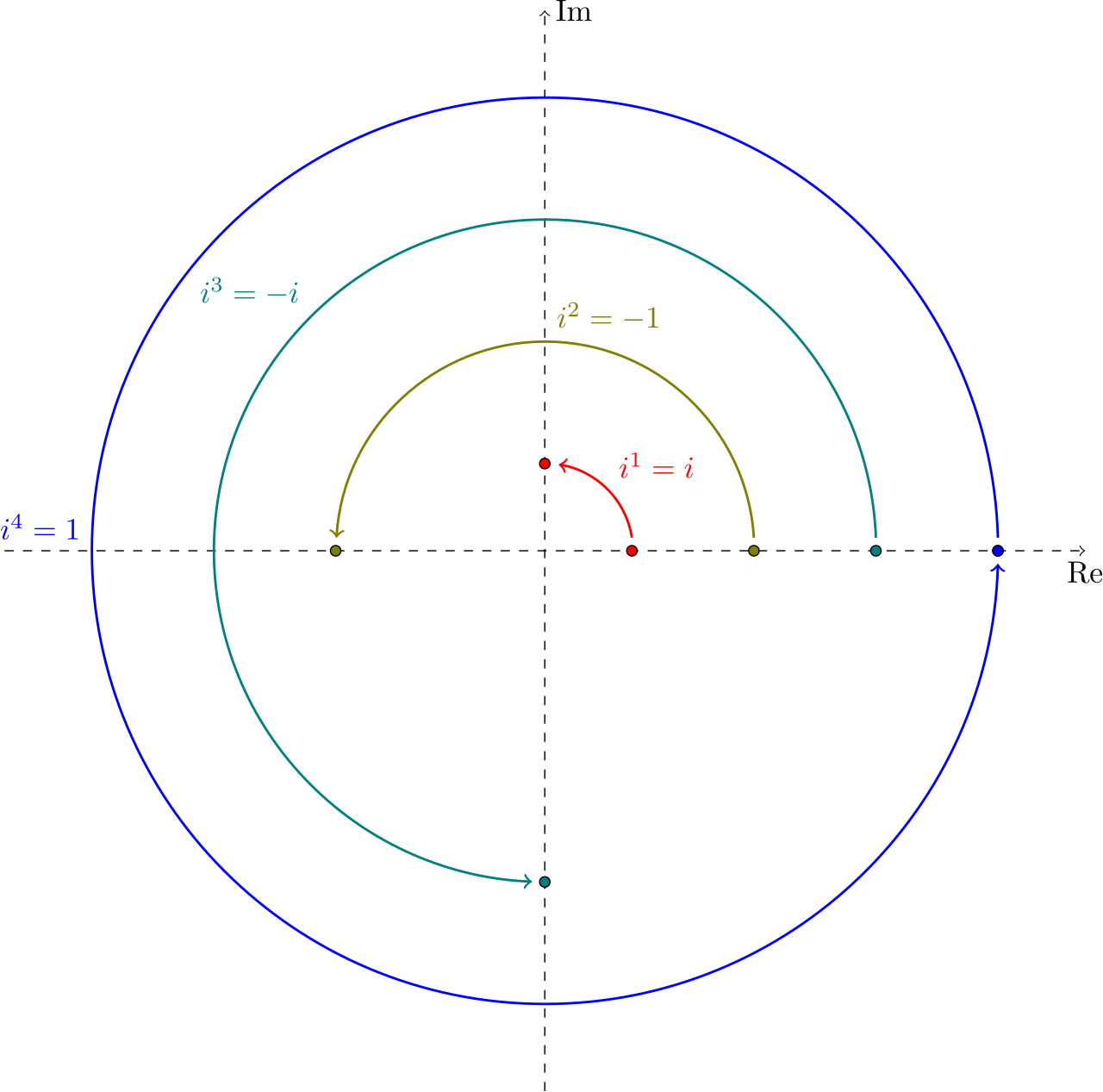
Because of this geometric reality, the powers of the imaginary unit i repeat in a cyclical sequence of four distinct values:
- The value of the imaginary unit i raised to the power of 1 is i. (i1=i)
- The value of the imaginary unit i raised to the power of 2 is -1. (i2=−1)
- The value of the imaginary unit i raised to the power of 3 is −i. (i3=i2⋅i=−1⋅i=−i)
- The value of the imaginary unit i raised to the power of 4 is 1. (i4=i2⋅i2=(−1)(−1)=1)
Because i4=1, the cycle resets perfectly at i5. This gives us a highly efficient algorithm for simplification. To evaluate any integer power of i, a person can divide the exponent by 4 and use the remainder to determine the value within the four-step cycle.
| Remainder when Exp is divided by 4 | Equivalent to | Result |
|---|---|---|
| Remainder 1 | i1 | i |
| Remainder 2 | i2 | −1 |
| Remainder 3 | i3 | −i |
| Remainder 0 (Divides evenly) | i4 | 1 |
Example for the classroom: To evaluate i2026, divide 2026 by 4. The quotient is 506 with a remainder of 2. Therefore, i2026 maps directly to i2, which is −1.
If multiplication is a matter of distribution, division introduces a distinct structural challenge. Consider the expression 1−4i3+2i.
To write this in the standard form a+bi, we cannot have an imaginary number in the denominator. We need a mathematical tool that can selectively annihilate the imaginary part of a complex number while leaving a rational, real number in its wake.
Enter the conjugate. The complex conjugate of a complex number a+bi is defined as a−bi.
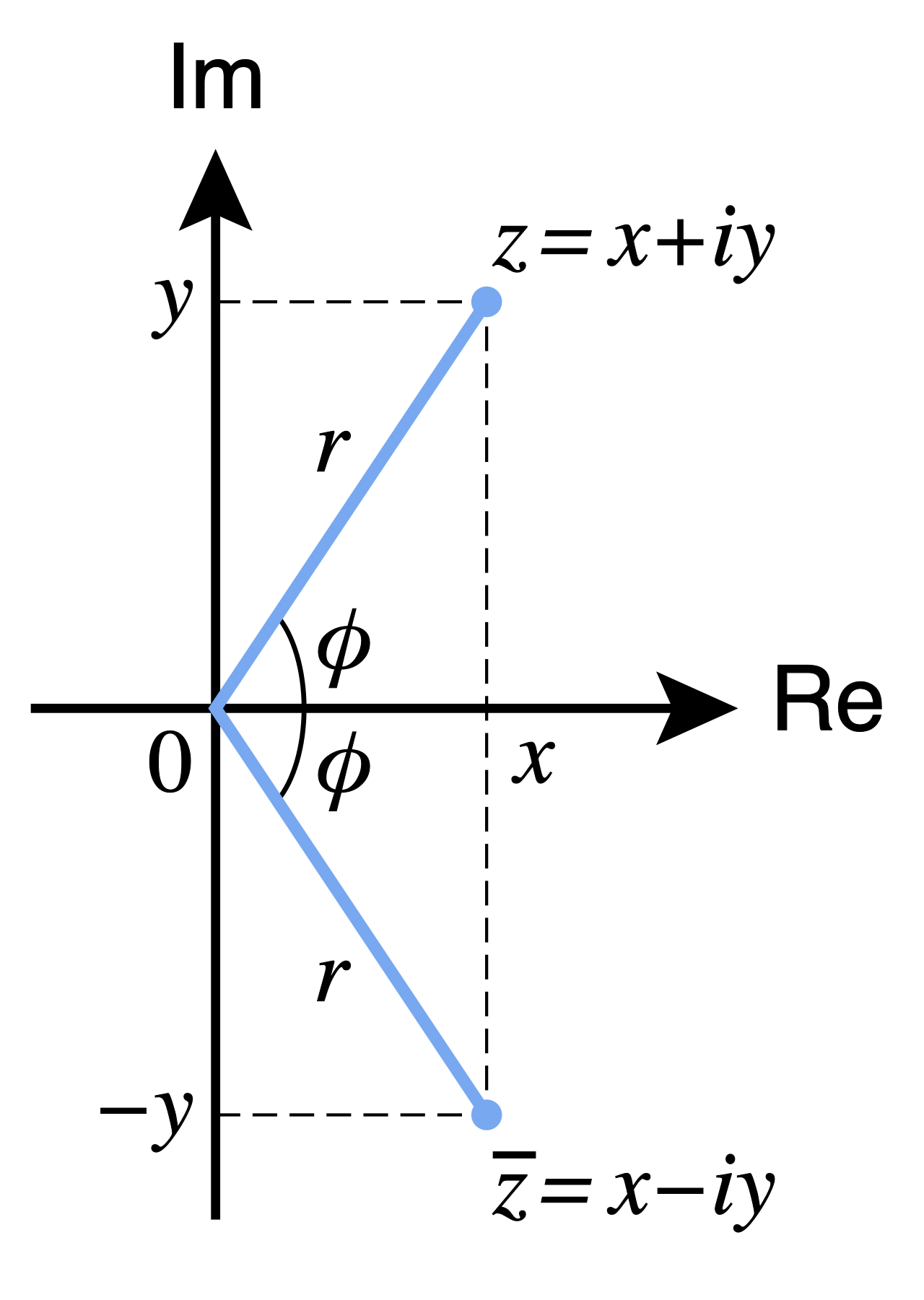
Watch what happens when we multiply them, recognizing this as a difference of squares expansion: (a+bi)(a−bi)=a2−abi+abi−b2i2 The middle terms cancel out. We are left with a2−b2(−1), which simplifies simply to a2+b2.
The Conjugate Rule: The product of a complex number a+bi and the complex conjugate a−bi is the real number a2+b2.
Notice what is missing from a2+b2? The imaginary unit. Multiplying a complex number by the corresponding complex conjugate eliminates the imaginary part completely.
We can weaponize this property to perform division. To divide two complex numbers, one must multiply both the numerator and the denominator by the complex conjugate of the denominator.
By doing this, you are effectively multiplying the fraction by 1 (e.g., 1+4i1+4i), which preserves the value of the expression, but "realizes" the denominator. Once the denominator is a single real number (a2+b2), you can simply split the fraction into the standard a+bi form.
Summary for the Mathematics Educator
When preparing for the 5165 exam, view the complex numbers not as a list of arbitrary rules, but as an elegant extension of the real numbers. The properties of associativity, commutativity, and distributivity still rule. Division is merely fraction simplification using a conjugate trick. Arithmetic is merely combining like terms and watching i2 eagerly snap into −1.
By internalizing why the machinery works—the strict independence of real and imaginary parts, the cyclic 90-degree rotations of i, and the real-number yielding power of the conjugate—you will navigate numeric-entry items swiftly and guide your future students with unparalleled clarity.